

PatSnap Files for IPO: Scaling from IP Intelligence to a Global Biopharma Data Powerhouse
For any innovative enterprise, technological innovation and intellectual property (IP) are key to building a competitive moat during its development. As exploration in various fields deepens, disputes arising from new technology patents are increasingly common, leading to a rapid growth in demand for innovative IP services and strategies to mitigate the risk of potential patent litigation.
According to relevant information, since 2018, people's courts have concluded an average of 440,000 intellectual property cases annually, representing a year-on-year growth rate of 21%. In recent years, China has continuously strengthened judicial protection for intellectual property rights, and this figure is expected to continue rising in the future.
Based on this, PatSnap, a SaaS provider for technological innovation intelligence, has built its product and service platform by leveraging global patent data as its entry point. It continues to invest in research and development to enhance the breadth and depth of its services in technological innovation and intellectual property. By integrating big data and artificial intelligence technologies, PatSnap has established a comprehensive product matrix that includes the PatSnap Global Patent Database, Innosnap Intellectual Property Management System, Insights Patent Analysis System, Discovery Innovation Intelligence System, and the Life Science series of databases.Providing technology innovation intelligence and intellectual property informatization services to innovative enterprises, research institutes, financial companies, and other institutions。
Currently, PatSnap’s services have gradually expanded to cover more than 50 high-tech industries, including biopharmaceuticals, chemicals, automotive, new energy, telecommunications, and electronics, serving over 10,000 clients worldwide. In March this year, PatSnap announced the completion of a $300 million Series E financing round, led by Tencent and SoftBank Vision Fund 2, with participation from CPE. Existing shareholders such as Sequoia China, Shunwei Capital, and Vertex Ventures continued to support the round. This marks the largest financing deal in China’s SaaS sector since 2020.
Cultivating High-Value Niche Segments to Build a Biopharmaceutical Intelligence Platform
After more than a decade of development, Patsnap has built mature global data systems for patents and literature based on its robust data resources, establishing an industry-leading patent search database. For industries with extremely high R&D investments, such as biopharmaceuticals and technology, Patsnap is continuously expanding and refining its corresponding services.
With the economic growth of countries worldwide and the improvement of people's living standards, global healthcare expenditure continues to rise. This has significantly boosted the development of the pharmaceutical industry, expanded the market size of the biopharmaceutical sector, and prompted pharmaceutical companies to intensify their efforts in new drug research and development (R&D). Currently, the drug discovery phase and preclinical research phase represent two critical challenges that pharmaceutical companies urgently need to address. The R&D of novel biologics faces significant hurdles, including long development cycles, low success rates, and high costs.
According to relevant data, the cost of drug development was $2.2 billion in 2018, compared with $1 billion in 2010, while the return on investment (ROI) for biopharmaceutical R&D declined from 10.1% in 2010 to 1.9% in 2018. In the overall process of new drug development, early-stage information gathering—such as disease selection and target discovery—is evidently a critical step that can significantly reduce the waste of resources and opportunities during R&D. However, in an era of information explosion, the sheer volume of data sources makes precise information mining extremely challenging.
Taking the number of patents as an example, there are over 1.069 million sequence-containing patents globally, with a rapid annual growth of 48,000 newly published patents. In contrast, traditional biomedical databases often suffer from incomplete information and fragmented content in free versions, while paid professional databases require advanced search skills and come with high costs, thereby failing to adequately support drug innovation.
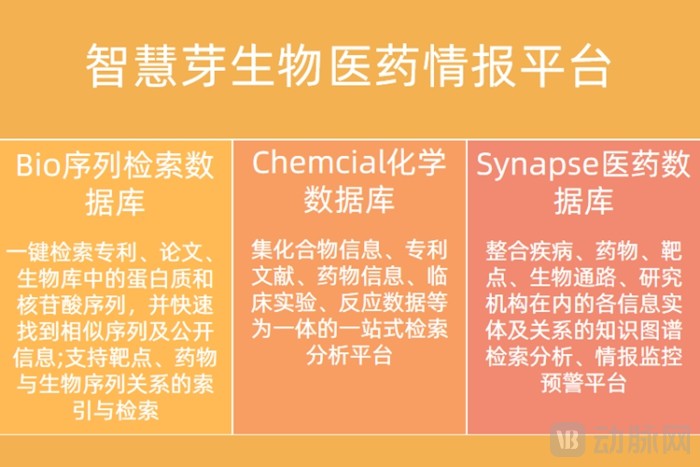
As early as 2015, PatSnap began to increase its investment in the biopharmaceutical product line,We have successively launched a chemical structure search database (Chemcial) primarily serving companies in the chemistry sector, and a sequence search database (Bio) for enterprises in the life sciences field. This year, we will roll out Synapse, a pharmaceutical intelligence data platform designed for the biopharmaceutical intelligence domain, with the ultimate goal of building an international public service platform dedicated to biomedicine.。
Due to the unique characteristics of the biopharmaceutical industry, the scope of data objects involved is extremely broad. In addition to small molecules and large molecules, it includes entity data such as targets, drugs, diseases, pathways, and biomarkers. This entails substantial efforts in data standardization, classification, alignment, and annotation. Furthermore, consideration must be given to corresponding public disclosures, as well as related patents, literature, clinical trials, drug approvals, news, and investment and financing information. This also implies that building such a platform demands highly comprehensive talent capabilities, requiring coverage of complex knowledge structures, including intellectual property, scientific and technical intelligence, big data processing, and artificial intelligence.
To ensure the smooth establishment of the platform, Patsnap has assembled a team of over 100 professionals while expanding its presence in the biopharmaceutical sector. The majority of these experts hail from leading enterprises in biopharmaceuticals, artificial intelligence, and intellectual property, both in China and abroad, with master’s and doctoral degree holders accounting for as high as 50% of the team.
By leveraging this platform, domestic enterprises, research institutes, investment firms, and consulting agencies can obtain the most comprehensive disclosure status of patents and publications based on chemical structures and biological sequences. Furthermore, they can access the most timely intelligence on new drug development processes centered around biological entities such as targets, diseases, and drugs. This enhances the accuracy, convenience, and timeliness of knowledge acquisition, thereby helping to accelerate the development of China’s biopharmaceutical industry—particularly among startups—and boosting innovation capabilities.
The service, built on core underlying data, has benefited over 1,000 biopharmaceutical companies.
Patsnap’s continued success in launching products and services in the biopharmaceutical sector is clearly attributable to its team’s longstanding accumulation of expertise. Given the variations in languages and levels of digitalization across national intellectual property datasets, it is often necessary to pioneer efforts in tracing data back to their sources, followed by a series of processing steps including translation, cleaning, mining, annotation, and intelligent analysis.After 14 years of accumulation, Patsnap has built an intellectual property database that ranks among the industry leaders, serving as a solid foundation for all its business operations.。
In the field of biomedicine, Patsnap has established a massive database comprising 170 million small-molecule structures and 610 million biological sequences. Additionally, it possesses extensive data covering 150 million patents across 116 countries, 140 million publications, 4.27 million companies, 16 million news articles, and 130,000 clinical trials.
In terms of data information processing,Leveraging technologies such as image processing, natural language processing, optical character recognition (OCR), and machine translation, PatSnap has established a robust “data processing factory” model., while establishing an integrated system for data standards engineering and data feature engineering, ensuring comprehensive data processing, achieving intelligent data annotation, and significantly improving data processing efficiency.
In the biopharmaceutical sector, PatSnap has innovatively applied advanced technologies such as deep learning models, natural language processing (NLP) for biological entities, and specialized retrieval algorithms for small and large molecules. These technologies are used to extract data on small and large molecules from scientific documents, including patents and academic papers, and to annotate corresponding relational data. By establishing standardized relational data for biological entities such as targets and drugs, and integrating specialized retrieval algorithms based on small-molecule chemical structures and large-molecule biological sequences, PatSnap has addressed the challenges of accuracy, comprehensiveness, and efficiency in information acquisition within the biopharmaceutical field.
From a structural perspective, the Patsnap Biopharma Intelligence Platform currently comprises three major databases: Bio, Chemical, and Synapse. While each database has its distinct focus, they collectively aim to lower the barrier to knowledge acquisition for users through common interactive features such as search, charts, and knowledge graphs.
It is reported that the Patsnap Biopharma Intelligence Platform has served over 1,000 biopharmaceutical companies worldwide. In China alone, nearly 300 enterprises have adopted Patsnap’s related products, including industry leaders such as Hengrui Medicine, Innovent Biologics, Borun Biopharmaceutical, PegBio, WuXi AppTec, and BGI.
Continuously Building Technological Advantages Through Industry Accumulation
Furthermore, in light of the current state of the biopharmaceutical industry, Patsnap will replicate its other mature products and services into this sector. Taking Patsnap’s Sci-Tech Innovation Evaluation System as an example, leveraging its robust database and product capabilities, the system provides enterprise clients with technology profiling assessments and evaluations of scientific and technological achievements. It has been widely applied across various sectors requiring sci-tech innovation assessment, including automotive, industrial manufacturing, communications and electronics, finance, and government park services.
Given the unique characteristics of sci-tech innovation assessment in the biopharmaceutical sector, Patsnap will continuously optimize and refine its indicator models for sci-tech innovation assessment, leveraging its leading data advantages and extensive experience in this field, so as to accelerate the application coverage in the biopharmaceutical industry.
In the future, Patsnap will continue to deepen its product layout in the biopharmaceutical sector, maintaining intellectual property data as its core while continuously expanding knowledge capabilities related to R&D and innovation. By providing industry-benchmark biopharmaceutical data and R&D innovation services to more clients both in China and abroad, Patsnap aims to drive the development of the industry.