

Eureka Health Files IPO Prospectus: Building the 'Architectural Spine' with a Dual-Engine Strategy to Drive Smart Hospitals Toward Intelligent Healthcare
“Smart Hospital,” though a long-standing concept that has waxed and waned for years in healthcare informatization, has now become the industry’s favored “darling” driven by policy advancements.
In China, the development of “Smart Hospitals” has followed a gradual diffusion pattern, extending from top-tier hospitals to primary care institutions and from coastal eastern regions to inland provinces. Meanwhile, the “Medical Community” model is emerging on the horizon. As coordination among healthcare services, health insurance, and pharmaceutical supply (“Three-Medical Linkage”) intensifies and public hospital reforms deepen, the themes and scope of “Smart Hospital” initiatives are continuously evolving and expanding. With the increasing penetration of advanced IT technologies into the healthcare sector—which has historically lagged behind in IT adoption—the industry now faces significant challenges.
Currently, there are nearly 12,000 public hospitals in China. A significant portion of their business systems have been in use for over 15 years. The traditional business-driven construction model, lacking “top-level design,” is almost unable to meet the requirements for building “Smart Hospitals” under the new situation and technological trends, particularly in terms of foundational data, basic services, business process control, interface standards, and data utilization.
In the past two years, the introduction of the “National Examination” has directly exposed the “weak points” of “data quality” and “data utilization” in hospital informatization. Many hospitals have opted for a “unified” hospital information system in an attempt to quickly overcome development challenges, but reality has fallen short of expectations.
Addressing industry pain points, Eureka Systems, a leading enterprise in the field of healthcare informatization, began exploring innovative service models in 2014. It pioneered the “Middle-Platform Solution,” represented by integration platforms and data centers designed to resolve hospital IT architecture challenges and data silos, establishing it as the “structural backbone” for building smart hospitals. By leveraging the “Dual-Wheel Strategy”—centered on achieving high ratings in the “Interconnectivity Assessment” and the “Electronic Medical Record (EMR) Grading Evaluation”—Eureka Systems has promoted the standardized development of smart hospitals. Using data as the connecting link, the company has developed a wide array of complex applications for healthcare institutions, including management tools for policy-based regulatory compliance, cost control, and connotation quality control; clinical decision support systems; and observational research data platforms based on medical big data.
To date, Eureka Systems has provided integration platform and data center solutions, as well as a comprehensive suite of smart hospital products centered on electronic medical records (EMR), to more than 200 Grade A tertiary hospitals across China. Its clientele includes three of the nation’s top 10 hospitals: The First Affiliated Hospital of Sun Yat-sen University, Ruijin Hospital affiliated with Shanghai Jiao Tong University, and Huashan Hospital affiliated with Fudan University. Its services cover over 17 provinces throughout China, spanning East China, Central China, South China, Southwest China, and the Shandong-Hebei region.
Professionalism and Long-Termism in Medical Big Data: A Clinician’s Perspective
After earning his Doctor of Medicine (M.D.) degree, founder Zhou Qi worked in surgical clinical practice for ten years before transitioning from clinician to medical IT professional. For Zhou Qi, this was a natural choice that enabled him to understand the medical profession from an entirely new perspective. “As I have grown older and accumulated more experience, I have increasingly felt a strong sense of mission associated with working in healthcare. This sense of purpose is the inner drive that motivates me to continuously explore the healthcare industry,” said Zhou Qi. “Through our team’s efforts, we aim to continually improve the work experience of frontline clinicians and researchers, with thorough understanding of usage scenarios being the most critical element.”
Currently, China’s medical IT industry faces multifaceted pain points, such as the prioritization of policies versus practical implementation, perceptions of return on investment, synergy between management and technology, integration of immediate needs with long-term infrastructure development, and issues concerning project boundaries and the sustainability of services. However, after nearly a decade of evolution, it is evident that smart hospital construction is shifting from a focus on basic functionality and external evaluation-driven initiatives toward a long-term orientation emphasizing foundational substance, architectural control, and value-oriented application services. “Users are increasingly recognizing and valuing the relationship between the richness of scenario-adapted applications and the robustness of underlying clinical data reserves.”
Dr. Zhou Qi shared a story with VCBeat.
Years ago, during a needs assessment at a well-known domestic pediatric medical center, the Eureka Systems team discovered that the cardiac surgery department sought to evaluate the performance of each surgical subgroup and individual surgeon using objective data on case volume, quality, and surgical difficulty coefficients, while also supporting clinical research initiatives. The Eureka Systems team initially proposed modeling and analysis based on data extracted from clinical and surgical systems. However, the results were highly disappointing: not only was the relevant data missing from the existing operational systems, but records maintained by nurses, anesthesiologists, perfusionists, and surgeons within the same medical team were often inconsistent with one another.
To address these issues, the team referenced 12 aspects—including ACC/AHA diagnostic terms, procedural and operative names, intraoperative findings, cardiac anatomical structures, names of gases and anesthetic agents used in cardiopulmonary bypass and anesthesia, dosages and administration methods, and disease complexity coefficients—to establish a specialized foundational dictionary for cardiac surgery comprising more than 1,500 data fields. To align with the prevailing work practices of the team’s international members, all medical terminologies and dictionary entries were provided in bilingual Chinese-English format. Building upon this foundation, a specialized structured electronic medical record (EMR) system was developed, enabling automatic validation of multi-role data entry for the same fields. Only after completing these steps did the team proceed with data analysis and modeling.
Following this implementation, individual surgical teams observed that although the number of interface clicks per person increased post-operatively, the time spent on documentation decreased by approximately 40%. This reduction was achieved because standardized medical records required by healthcare administration—such as operative reports, cardiopulmonary bypass records, and intraoperative nursing notes—could be automatically generated with a single click, thanks to the precise entry of clinical elements during the preoperative phase. Furthermore, in the cardiac surgery department, each physician can view both intra-team and inter-team “Aristotle” scores and construct observational cohorts for clinical research by filtering and combining hundreds of clinical elements based on specific criteria.
Similar processes and methods have been successfully replicated in cases involving hospital-wide vancomycin use with indication control for patients with hepatic and renal insufficiency, in cases where acid-base balance correction plans are automatically modeled and calculated based on water-electrolyte and blood gas analysis results, and in cases where the need for postoperative intensive care unit monitoring and the incidence of adverse events are predicted based on preoperative medical records.
The example cited by Dr. Zhou Qi illustrates that in the current era of medical big data, there is a need for a “remedial campaign” focused on foundational, bottom-layer basic data. Such a campaign requires not only a large number of technical personnel but also substantial participation from professionals with clinical knowledge backgrounds and expertise in human, financial, and material resource management. Sustained efforts in this direction are essential, embodying the “Professionalism” and “Long-termism” most highly valued in Eureka Systems’ corporate culture. Explaining the foundations of these two “isms,” Dr. Zhou believes they stem from the uniformity and stability of globalized modern medical education, as well as from the tradition of evidence-based medicine within modern science, which has evolved from empirical science since the time of Francis Bacon. The future of medical big data lies in the “chain reaction” built upon high-quality, rich data, a process that AI technology can empower and catalyze. For instance, Eureka Systems’ “digital therapeutics” products, such as the “Tinnitus Music Therapy” application and the “Individualized Dosing TDM” product, both demonstrate the empowering role of AI.
To provide high-level solutions to hospitals, Eureka Systems has established a dedicated R&D institution and multiple technical development teams specializing in the research, development, and design of new technologies and products. The company has set up offices and R&D centers in Guangzhou, Hefei, Beijing, and Jinan. Eureka Systems has accumulated more than 90 software copyrights. This year, the company has achieved new breakthroughs in several fields:
1. Based on the DARMA 2.0 framework, data governance services tailored to the hospital's actual data conditions provide hospitals with over 120 sets of data dictionaries, medical terminology dictionaries, and coding mapping tools;
2. Based on standards from ACC/AHA, IPSO, NANDA, NIC, NOC, and other professional societies, more than 30 specialty-specific electronic medical record (EMR) terminology sets have been developed;
3. The data lineage traceability management system of the platform data center enables front-end visualization of database data flow and closed-loop data management;
4. The platform leverages Hadoop big data technology to support hundreds of billions of data records and 20 TB of storage, enabling second-level application response times.
Currently, Eureka Systems offers comprehensive in-hospital medical services across all scenarios.In Smart Management, forming refined management and clinical empowerment for the management layer and functional departments, guided by DRG/DIP, leveraging comprehensive budgeting as an opportunity, and utilizing full-cost accounting and performance appraisal as key tools;On Smart Clinical Practice, an integrated electronic medical record system that achieves clinical care integration, closed-loop and streamlined physician order processes, standardized quality control procedures, and comprehensive clinical services;In Smart Scientific Research, it focuses on scientific research for core disease types, with patient profiling as the foundation, to support large-sample, multi-center clinical research on single diseases. Additionally, driven by market demands and policy incentives, Eureka Systems has strategically extended and decentralized its in-hospital smart healthcare solutions to out-of-hospital settings, thereby launching health management services.
Balancing a differentiated strategy for products and services with multi-line layout capabilities is the core advantage.
Eureka Systems’ Smart Hospital Solution centers on patient journey data, leverages operational data middle-platform technology, and features top-level design of clinical, management, and research models. It provides objective, actionable data sharing, interoperability services, and secondary data utilization for hospital clinical operations, management, scientific research, and patient services, thereby driving digital transformation and upgrading across these domains.
Its “backbone-level” products are the hospital-wide data center and integration platform.
Data Center:Extract, aggregate, clean, supplement, classify, and centrally store patient data from various hospital business systems; subsequently perform secondary processing to lay the foundation for smart hospital development, unlock and integrate data silos, establish a management mechanism based on an enterprise-wide clinical and operational data warehouse, and provide complete, accurate, and consistent analytical data and decision-support models.
Integrated Platform:Build an open integration platform to enable plug-and-play design for business systems, ensuring that each system remains concise and independent. Achieve data standardization through master data management, visualize interface and service management, and ultimately realize zero-cost interface maintenance and management.
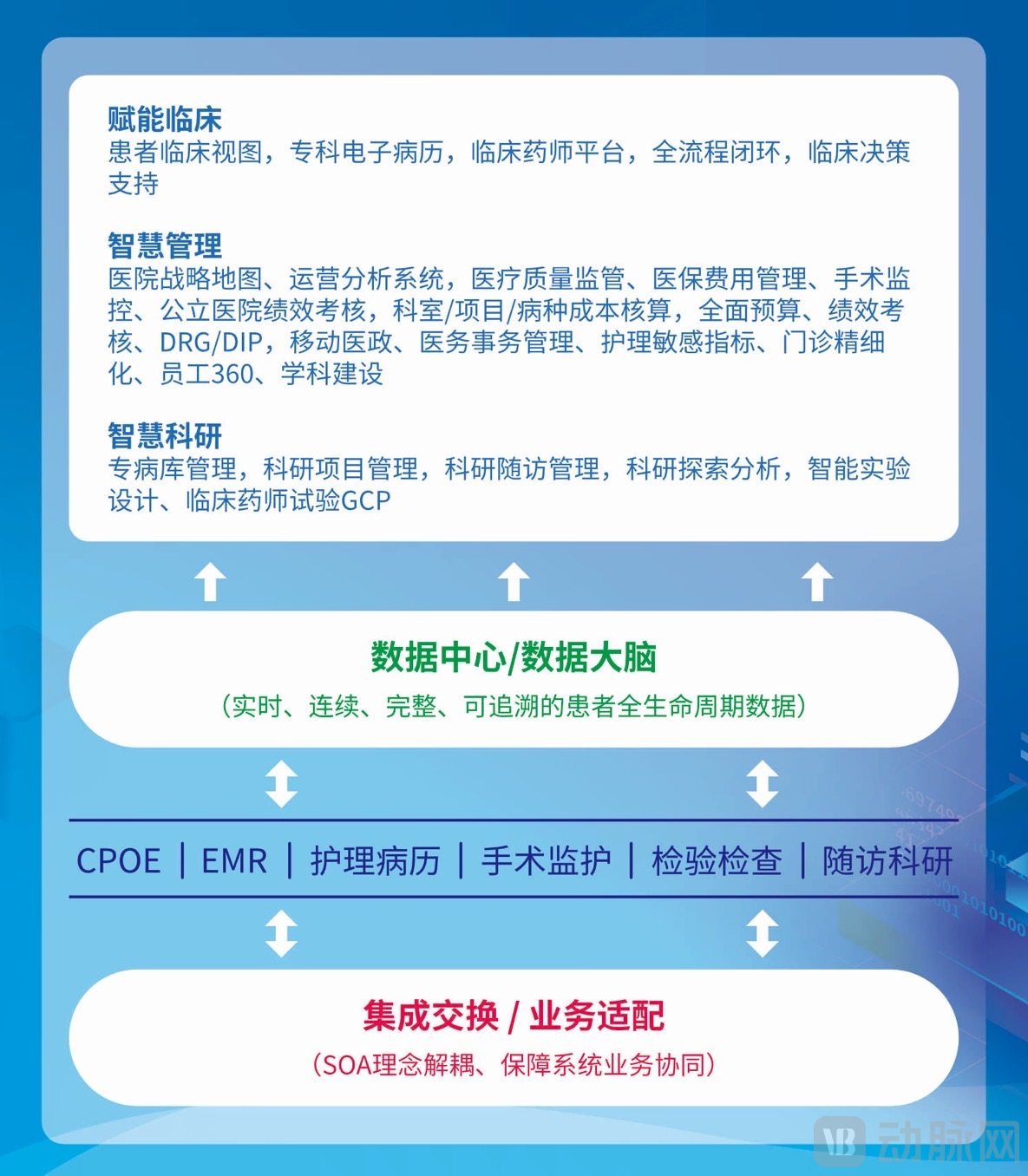
The platform meets the requirements for Level 4 Grade A or higher in the Standardization Maturity of Hospital Information Interconnectivity, as specified by the National Health Commission of China. This platform unifies information standards to enable data collection, information sharing, process interaction, and interoperability based on the hospital information platform. Leveraging the information platform and data center, it enhances the reuse of medical data and supports the interaction and collaboration of internal and external systems, such as “Internet+ Healthcare” and telemedicine, in the future planning of the healthcare industry.
Although the product appears to pursue multiple development tracks simultaneously, it is actually driven by a single underlying logic: data. Data serves as the core element and key “fuel” propelling the development of healthcare informatization. However, while other vendors in the industry have yet to recognize or produce the core components within this “fuel” or “element,” Eureka Systems has proactively begun constructing the most foundational, reusable clinical base data for various specialties through diverse specialized medical record formats. By leveraging data analytics capabilities and diverse tools, combined with a deep understanding of user needs, Eureka Systems fosters a highly scenario-specific and unified data usage experience.
From a technical perspective, Eureka Systems is not only engaged in the analysis and utilization of data but also delves into the initial standardization and normalization of underlying clinical data, as well as the standardized production processes for clinical data. It further extends to data integration and exchange along with the establishment of corresponding standards, culminating in subsequent data integration, modeling, and analytical application. Viewed in this light, the intrinsic logic connecting the company’s current four major product categories and over 140 applications is consistently underpinned by “data.” Through steadfast and in-depth investment in the traditional health informatics sector, Eureka Systems aims to ultimately deliver value to healthcare via explosive growth in data-driven applications.
Dr. Zhou Qi and his core founding team all have many years of work experience at Microsoft, giving them a clear understanding of the successes and failures encountered by foreign enterprises exploring China’s healthcare industry. At the outset of their venture, Dr. Zhou and his core team clearly defined their development strategy. “Healthcare IT companies can be broadly categorized into two types: those that are highly product-oriented and those that are highly service-oriented. Eureka Systems has pursued a differentiated path, aiming to rapidly and efficiently deliver value to customers by enhancing the productization of services and delivering services through a productized approach,” said Dr. Zhou. The technical team’s broad technological vision and deep business understanding have become the foundation of their R&D capabilities and ability to pursue multiple business lines simultaneously. Providing hospitals and patients with valuable, continuous improvement-oriented services is the surest way to earn industry reputation and realize value. After selecting their market niche, the team’s relentless pursuit of product transformation and upgrading has been the key to survival and growth in a fiercely competitive industry. There is strong consensus across the company on these two points.
As the construction of “Smart Hospitals” in public hospitals deepens, reforms to the national healthcare service system are influencing the future landscape of the industry on a broader scale and at a greater depth. Medical consortia, chronic disease management, and health management will become key challenges requiring collaborative efforts from multiple stakeholders. Eureka Systems is aligning its chronic disease and health management operations with the Wagner Model, while designing and developing a cloud service platform tailored for the medical consortium market, deployable across primary care hospitals. This platform features high availability and scalability, leveraging microservices architecture and service orchestration to enable rapid and flexible application development, facilitate multi-user service collaboration, maximize the sharing of medical resources, and enhance the precision of primary healthcare services.
Eureka Systems will remain committed to providing healthcare institutions with more efficient and secure next-generation smart hospital solutions and their extended applications. Looking ahead, Eureka Systems will leverage data-driven insights and AI empowerment to deliver more comprehensive tools and technical services for hospitals, patients, and the advancement of healthcare in China.
Dr. Zhou Qi concluded, “Smart hospitals are our starting point, and smart healthcare will be our goal.”