

Qitan Technology Secures Over RMB 400 Million Series B Funding Led by Hillhouse and CDH, Aims for Domestic Nanopore Sequencer Mass Production Within the Year

QitanTech
Gene Sequencing Technology R&D Provider
VCBeat has learned that on June 8, QitanTech officially announced the completion of its Series B financing round, exceeding RMB 400 million, led byHillhouse Ventures,CDH VGC (Venture & Growth Capital) co-led the round, with Boyuan Capital, Huagai Capital, and Sunshine Ronghui Capital participating as co-investors. Existing shareholders Gaorong Capital, Zhongguancun Collaborative Innovation Fund, Ginkgo Valley Capital, Yahui Investment, and BV Baidu Ventures continued to increase their stakes. QitanTech specializes in the independent R&D, manufacturing, and application development of nanopore single-molecule gene sequencers, along with supporting reagents and chips. It is reported that following the completion of this financing round, QitanTech will further ramp up its R&D investment and accelerate industrialization, aiming to achieve mass production and market launch of its finalized products within the year.
QitanTech, founded in 2016, is dedicated to the development and application of nanopore-based single-molecule continuous sequencing technology. In September 2020, it launched China’s first independently developed nanopore gene sequencer, the QNome-9604, along with its supporting reagents and consumables, and has continued to optimize the product’s accuracy and stability. Previously, QitanTech completed four rounds of financing, raising a total of nearly RMB 200 million.

Bai Jingwei, Co-founder and Chief Scientist of QitanTech, stated that this financing round marks another significant milestone in the company’s development history, serving as a testament to the substantial advancements made across multiple dimensions, including its technology, products, and team. QitanTech views the successful completion of this funding round as a demonstration of attention and support from China’s top-tier professional investment institutions. Leveraging the capital and resources provided by investors, QitanTech will further optimize and enhance the performance and capabilities of its domestically produced nanopore sequencers, accelerate their market launch, and collaborate with industry partners, clinical experts, and researchers to harness sequencing technology for the betterment of human health.
Yi Nuoqing, Co-Chief Investment Officer at Hillhouse and Head of Biopharma and Medical Devices at Hillhouse Ventures, stated, “QitanTech has developed China’s first nanopore gene sequencer, successfully breaking down the high barriers and overseas monopoly in the R&D of gene sequencing equipment, supporting chips, and reagents, thereby overcoming the critical technological bottlenecks that had long constrained China’s gene sequencing industry. In terms of market applications, niche sectors such as microbial pathogen detection and cancer testing are well-suited as the primary application areas for nanopore gene sequencers. We will continue to provide long-term support for scientific and technological R&D in key national priority areas, promoting high-level self-reliance and strength in science and technology.”
Wang Lin, Founding Partner of CDH Investments and Managing Partner of CDH VGC, stated, “The gene sequencing industry is experiencing rapid growth, yet traditional second-generation sequencing technologies have certain limitations in practical applications. As a high-barrier upstream player in the next-generation long-read sequencing sector, QitanTech boasts strong R&D capabilities, with rapid product iteration and performance enhancements. The company’s nanopore gene sequencer technology has already reached a globally leading level. We are delighted to partner with hard-tech innovators like QitanTech and look forward to the large-scale adoption of its products in both research and clinical settings in the near future.”
Since the outbreak of the COVID-19 pandemic, innovative technologies have been continuously employed to optimize clinical testing for infectious diseases, including single-molecule sequencing technology. The characteristics of long read lengths and real-time data output offered by this technology provide new solutions for the rapid diagnosis of pathogen infections. VCBeat has learned that as more clinical research teams in China utilize single-molecule sequencing to detect pathogen-infected samples, the application of single-molecule sequencing domestically is in a state of supply falling short of demand. This has once again sparked market enthusiasm and attention toward this technology.
Single-molecule continuous sequencing refers to the direct, continuous sequencing of individual DNA or RNA molecules without fragmentation during the gene sequencing process. Theoretically, this approach can capture the full spectrum of genomic features and data, making it a more ideal method for gene sequencing; however, its implementation presents significant technical challenges.
In 1989, Professor David Deamer of the University of California proposed threading a single-stranded DNA molecule through a nanoscale pore via electrophoresis and recording the resulting translocation current signals to infer sequence information, thereby initiating the exploration of nanopore sequencing. In nanopore gene sequencing, an electric field drives single-stranded nucleic acid molecules to pass sequentially through a nanoscale protein pore. As different bases traverse the nanopore, they cause varying degrees of obstruction to the ionic current within the pore, making the distinct current signals characteristic markers for distinguishing base types. Algorithms then convert these current signals into base sequences, yielding the final gene sequencing results.
For a long period following the emergence of nanopore gene sequencing technology, its widespread adoption was hindered by lagging development in interdisciplinary supporting technologies, including relevant proteins, microcircuits, biochips, algorithms, and bioinformatics. Consequently, core performance metrics of nanopore sequencing devices, such as stability and accuracy, remained in need of improvement. It is only in recent years, with the vigorous advancement and deep integration of cutting-edge technologies like structural biology and deep learning algorithms into nanopore sequencing, that this technology has achieved leapfrog development.
In Bai Jingwei’s view, nanopore gene sequencing technology is a wave driven by the all-encompassing tide of technological progress. “Only with the improvement of overall societal technical capabilities and a reduction in costs can the optimization, practical implementation, and widespread application of nanopore sequencing technology be truly propelled. This is also why it has taken nearly 30 years of development for nanopore gene sequencing to emerge prominently in more application scenarios.” It is understood that, under certain specific library preparation conditions, the accuracy of nanopore gene sequencing can already rival that of next-generation sequencing (NGS).
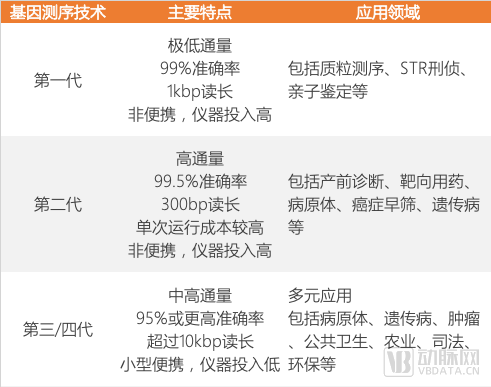
With continuous improvements in accuracy and stability, nanopore sequencers are enabling diverse applications in the evolution of gene sequencing technologies, leveraging their flexible throughput, long read lengths, and compact, portable design.
In fact, first-generation sequencing offers high accuracy and long read lengths but suffers from extremely low throughput. It is now primarily used in scenarios such as research-grade plasmid sequencing, forensic science, paternity testing, and the detection of certain genetic disorders. In the field of high-throughput sequencing, it has been replaced by second-generation sequencing (NGS) technology, which is adopted by current mainstream gene sequencing platforms.
Next-generation sequencing (NGS) technology offers exceptionally high throughput and accuracy, and has been widely adopted in both scientific research and clinical practice. For instance, NGS applications in prenatal diagnosis and tumor companion diagnostics are relatively mature, with highly penetrated products available in both domestic and international markets. Meanwhile, emerging NGS application scenarios, such as pathogen detection and early cancer screening, are gaining significant momentum. It is estimated that the current global market size for NGS applications exceeds USD 20 billion, growing rapidly at a compound annual growth rate (CAGR) of over 20%.
However, next-generation sequencing (NGS) technology is limited to fragmented, short-read gene sequencing. The large-scale instruments employed typically require centralized sample processing to reduce per-test costs, creating bottlenecks when expanding into certain application scenarios, such as point-of-care pathogen detection. In contrast, nanopore gene sequencing enables rapid data output, significantly improving the timeliness of infectious pathogen detection. Its miniaturized devices facilitate direct point-of-care testing within hospitals. Furthermore, nanopore sequencing provides ultra-long reads for individual genes, preventing critical genetic information from being overlooked during data averaging, thereby enhancing patient detection efficiency. This explains why an increasing number of studies on infectious pathogen detection are adopting nanopore gene sequencing.
Bai Jingwei told VCBeat that, in addition to pathogen detection for infections, nanopore gene sequencing is also worthy of significant attention in research areas such as genetic disease studies, forensic science, environmental protection, and even tumor diagnosis and treatment. For instance, the ultra-long read lengths of nanopore gene sequencing are better suited for detecting structural genetic variations and precisely identifying disease-causing genes, thereby providing more comprehensive biological data to explore new therapeutic approaches for major diseases, including cancer. Alternatively, leveraging the compact and portable nature of the equipment, it can be used to rapidly identify the source of problems at the scene of major sudden public health emergencies.
Nevertheless, Bai Jingwei also acknowledged that controlling single-stranded nucleic acid molecules within nanoscale pores is a highly complex systemic task. “At the single-molecule scale, the thermal motion of nucleic acid molecules is extremely active, and their trajectories are highly irregular. It remains quite challenging to control their orderly passage through nanopores and to continuously extract and analyze base information during this process, requiring ongoing optimization.” Even so, the accuracy of nanopore gene sequencing has improved rapidly over the past two years. Taking QitanTech as an example, the sequencing accuracy of its first-generation product has quickly risen from 83%–85% last year to a peak of approximately 92%. Bai Jingwei stated that with continuous improvements in upstream bioengineering and electronic engineering capabilities for nanopore gene sequencing technology, coupled with ongoing refinements in downstream bioinformatics analysis and algorithmic models, sequencing precision will continue to increase rapidly.
QitanTech is a team founded by interdisciplinary top-tier technical experts. Jingwei Bai holds a Bachelor’s degree in Chemistry from Peking University, a Ph.D. in Materials Science from the University of California, Los Angeles (UCLA), and completed his postdoctoral research at IBM Watson Research Center. He previously worked in R&D at Illumina, possessing extensive experience in the development of micro/nano devices and nucleic acid molecular biology. The other two co-founders, Geng Hu and Dan Xie, hold Ph.D.s from the Department of Automation at Tsinghua University and the University of Illinois at Urbana-Champaign, respectively, with Dr. Xie also completing a postdoctoral fellowship at Stanford University School of Medicine. Geng Hu is an expert in electronic instrumentation and was selected as one of Siemens China’s “Young Talents” in 2015, while Dan Xie has extensive expertise in sequencing technologies and bioinformatics.

Founding Team of QitanTech (From left to right: Xie Dan, Hu Geng, and Bai Jingwei. Image source: Provided by the interviewee)
In the nearly five years since its founding, QitanTech has gone from zero to one, achieving the first fully domestic production of nanopore gene sequencers in China.
According to Bai Jingwei, since its inception, QitanTech has been committed to enhancing technology and optimizing processes. This strategy aims to achieve superior biological data output, analytical capabilities, and performance scalability compared to similar products on the market, while simultaneously reducing the costs associated with the technical platform and supporting reagents and consumables. It is understood that QitanTech’s nanopore gene sequencer, which is about to enter mass production, has largely achieved these two objectives. “Currently, we are continuously improving product sequencing stability and chip accessibility, striving for further excellence,” stated Bai Jingwei.
In September 2020, QitanTech publicly released the QNome-9604 nanopore gene sequencer and launched a recruitment campaign for its ALPHA TEST application ecosystem. VCBeat has learned that QitanTech has leveraged nanopore sequencing technology to generate extensive biological data from samples across various industries, supporting a series of innovative research initiatives. During this period, QitanTech expanded its team, optimized its operational management, and commenced construction of a production base compliant with medical device manufacturing requirements.
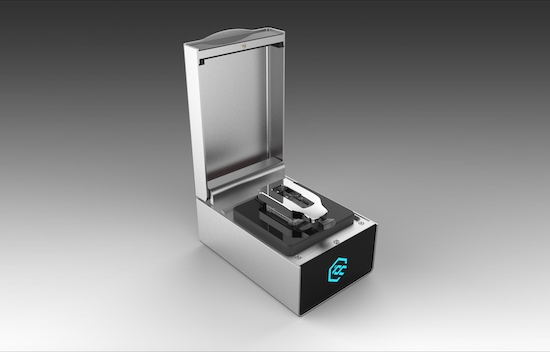
QitanTech’s QNome-9604 Nanopore Gene Sequencer (Image source: Provided by the interviewee)
Looking ahead, QitanTech will continue to increase its R&D investment to optimize product performance and diversify its product portfolio. Meanwhile, the company will focus on uncovering user needs, making timely product adjustments based on customer feedback, and exploring the establishment of a more robust ecosystem for nanopore gene sequencing applications.