

Tumor NGS Industry Embarks on Its Second Growth Curve: MRD-Based Recurrence Monitoring Drives Sector Transformation
Over the past six months, early screening has emerged as one of the core topics in the tumor NGS industry. Early screening undoubtedly presents a compelling narrative, aligning with the concept of “early detection, early treatment” while offering substantial room for growth. However, based on current industry developments, early screening still has a long way to go before it can become a second growth curve for tumor NGS companies. Significant technical challenges must be overcome, and market education efforts are required. At this stage, as the companion diagnostics market gradually matures, early screening is not yet poised to shoulder the responsibility of driving a second growth curve.
If we shift our focus further downstream, beyond companion diagnostics, there remains a vast market yet to be tapped—recurrence monitoring.
As we write this article, oncology NGS companies have already made significant moves in the field of recurrence monitoring. Since the second half of 2020, tumor recurrence monitoring based on MRD (minimal residual disease) has become an “invisible” hotspot in the industry. News from within the sector has blossomed everywhere: clinical results have been published, products launched, and corporate collaborations formed. Industrial developments across multiple dimensions have successively emerged, making it only a matter of time before MRD-based tumor recurrence monitoring gains widespread mainstream attention.
Therefore, today we aim to focus on this highly specific scenario. Amid the industry’s rising momentum, we seek to establish an early benchmark for this impending major hotspot by analyzing market development trends, synthesizing industry insights, and interpreting several core case studies.
Tumor recurrence is fundamentally caused by minimal residual disease (MRD) remaining at the lesion site after patients receive standard treatment. The reactivation of MRD ultimately leads to tumor recurrence in patients.Since MRD cannot be directly observed, its presence can only be detected through the signals it releases. Currently, the most effective detection method is ctDNA liquid biopsy based on NGS technology.ctDNA released by MRD inevitably carries tumor-specific low-frequency mutations. Through NGS sequencing, it is possible to accurately identify which fragments of cfDNA in plasma are derived from MRD-associated ctDNA, thereby determining the presence of MRD based on the abundance of ctDNA.
MRD is not a new concept that has only emerged in the past two years. However, due to the immaturity of ctDNA-based MRD detection methodologies, incomplete clinical research data, and the lack of relatively unified industry standards, it has not previously become a hot topic in industry development. Starting from the second half of 2020, with the gradual disclosure of clinical data related to MRD monitoring, this not-so-new direction has begun to demonstrate its unique appeal.
As an application scenario on par with early screening and companion diagnostics, recurrence monitoring has not received sufficient attention within the oncology NGS industry.
From a procedural standpoint, the application of recurrence monitoring is similar to early screening, as both aim to detect tumor onset and progression before patients become aware of symptoms. However, due to patients’ prior diagnostic and treatment records, recurrence monitoring has more specific objectives and can leverage postoperative data for reference. From a market perspective, although the target population for recurrence monitoring is smaller than that for early screening, this group demonstrates a stronger willingness to pay. Consequently, extensive market education is largely unnecessary, making rapid growth more achievable.
The market potential for recurrence monitoring is more comparable to that of companion diagnostics. The patient populations for both are largely identical. In terms of per-patient costs, companion diagnostics have a higher unit price but are performed only once, whereas recurrence monitoring involves a longer duration with lower per-test costs, resulting in a total cost that can be on par with companion diagnostics.
For recurrence monitoring, the market size corresponds to postoperative surviving cancer patients. Data for the domestic market is not easily measured directly, but we can roughly draw an analogy based on the U.S. market situation. According to data from a study published in the New England Journal of Medicine (NEJM),By 2020, the number of cancer survivors in the United States reached 16.9 million. Excluding a small subset of patients who live with cancer long-term, the addressable population for recurrence monitoring in the U.S. is approximately 15 million.
A key factor enabling the United States to accumulate such a large prevalent patient pool is its high survival rates, driven by substantial healthcare spending. The overall five-year survival rate for cancer patients in the U.S. has reached 70%, whereas in China it is slightly above 40%. Accordingly, China’s “Opinions on Implementing the Healthy China Action,” issued in 2019, set a target of achieving an overall five-year cancer survival rate of no less than 46.6% by 2030. From this perspective, the adoption of recurrence monitoring tools is particularly critical for China to meet its 2030 target.
According to the latest 2020 statistical data released by the International Agency for Research on Cancer (IARC) of the World Health Organization, there were 4.57 million new cancer cases in China in 2020, compared with 2.28 million new cancer cases in the United States in the same year.The annual number of new cancer cases in China is approximately twice that of the United States; however, given the lower five-year survival rate, the estimated prevalent population of cancer patients in China is around 20 million. Assuming each patient undergoes recurrence monitoring screening once every six months at a cost of RMB 2,000 per visit, the domestic market for recurrence monitoring is estimated to reach RMB 80 billion.
The clinical significance of recurrence monitoring is beyond doubt; another issue lies in which indicators can signify signs of tumor recurrence. Commonly used methods in clinical practice include CEA (carcinoembryonic antigen) and imaging examinations. However, the former has very limited utility in monitoring recurrence, while the latter cannot provide advance warning and can only detect tumors after recurrence has occurred.
In terms of insights into new directions, overseas markets seem to always be one step ahead of China. The European Union and the U.S. FDA have already approved certain MRD relapse monitoring products for market launch, including products from Chinese companies.
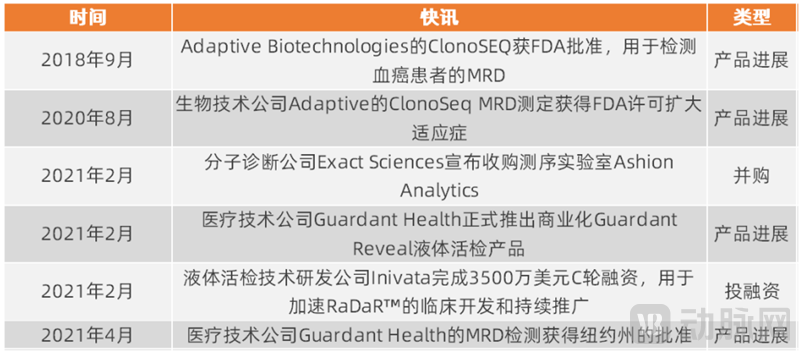
Overseas Developments in MRD Companies
International industry developments have primarily focused on two companies: Adaptive Biotechnologies and Guardant Health.
Adaptive Biotechnologies is fundamentally an immunotherapy research company, with business lines encompassing drug discovery, life sciences research based on TCR antigens, and clinical diagnostics based on MRD testing.
Adaptive’s ClonoSEQ is, to date, the only liquid biopsy product approved by the FDA for MRD detection, initially approved in 2018 and subsequently granted an expanded indication in 2020.Because early screening via imaging methods is not feasible, minimal residual disease (MRD) testing holds particular significance in hematologic malignancies. Consequently, clinical guidelines for hematologic cancers, especially those concerning acute lymphoblastic leukemia (ALL) and multiple myeloma (MM), recognize MRD status as a reliable indicator of clinical outcomes and treatment response. This underscores the market value of ClonoSEQ.
To date, the scope of ClonoSEQ has been confined to hematologic malignancies and has not expanded to encompass solid tumors.However, given the relatively small patient population for hematologic malignancies compared to solid tumors, there is a substantial gap between the two. From a long-term perspective, the market potential for solid tumors remains significantly larger.
When it comes to breakthroughs in solid tumors, mention must be made of Guardant Health, whose newly launched product recently received limited approval in New York.
In February 2021, Guardant Health launched its MRD testing product, Guardant Reveal, which obtained approval from the New York State Department of Health’s Clinical Laboratory Evaluation Program (CLEP) just two months later. The test enables long-term recurrence monitoring in postoperative colorectal cancer patients by analyzing minimal residual disease (MRD).
Compared to Grail, which was acquired by Illumina for $8 billion, or Foundation Medicine, which was acquired by Roche for $2.4 billion in 2018, Guardant Health may have slightly lower brand recognition in China. In reality, however, this star enterprise has maintained a high stock price since its IPO in 2018, with its current market capitalization exceeding $10 billion, making it one of the most valuable oncology NGS companies globally.
Guardant Reveal is an NGS-based liquid biopsy test. When Guardant Health went public in 2018, Guardant Reveal (then codenamed LUNAR-1) had already demonstrated its clinical value. In a collaboration with the MD Anderson Cancer Center, Guardant Health evaluated specimens from colorectal cancer patients who had undergone curative surgery and had up to five years of follow-up data.Guardant Reveal detected signs of residual tumor in 48% of patients, all of whom, according to their clinical records, experienced tumor recurrence within 18 months after surgery.
Subsequently, Guardant Health conducted a prospective clinical study. The 84 patients included in the primary milestone analysis all had blood samples collected approximately one month after completing their final treatment.During the subsequent follow-up period of more than one year, all patients who showed signs of recurrence at the initial detection experienced tumor recurrence.Based solely on the analytical conclusions derived from samples collected one month postoperatively, Guardant Reveal achieved a sensitivity of 55.6% and a specificity of 100%, indicating no false positives but a relatively high rate of false negatives. However, with the introduction of periodic monitoring, sensitivity increased significantly by 36 percentage points, ultimately exceeding 90%.
Given this series of strong clinical results, it was only natural for Guardant Health to launch its own product and gain favor with certain regulatory authorities.
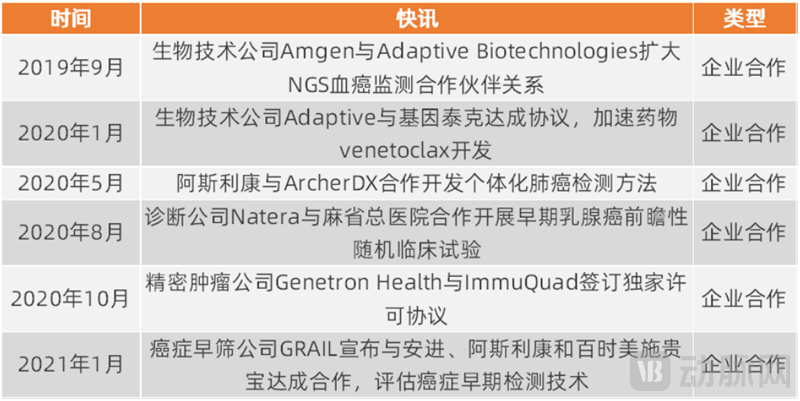
International Collaborative Progress on MRD
With products already in the approval process as a foundation, overseas companies providing MRD testing have maintained close collaborations with pharmaceutical firms. Adaptive Biotechnologies, which secured the first approved product, began advancing collaborations in hematologic malignancies with companies such as Amgen and Genentech at an early stage. Other companies entering this field, including ArcherDX, Natera, and Genetron Health, have also partnered with pharmaceutical companies to share their R&D costs and gain access to richer clinical research datasets.
In January 2021, GRAIL, the “cash magnet” of the primary market in the early screening sector, also announced its entry into the MRD early screening arena through collaboration with pharmaceutical companies.This company, renowned worldwide for conducting mega-scale prospective early screening cohorts, has finally stepped out of its comfort zone to venture into new territories. Its inaugural move features simultaneous collaborations with Amgen, AstraZeneca, and Bristol Myers Squibb (BMS). The entry of this early-screening giant further underscores the high value of the MRD (Minimal Residual Disease) detection sector. It remains to be seen whether Grail can continue to dominate in this new arena.
From a global perspective, MRD-based recurrence monitoring appears poised to break through the bottlenecks it has faced for many years. Leading companies’ products are beginning to pursue regulatory approval for market launch, and collaborations with pharmaceutical firms are becoming increasingly close. This imminent breakthrough has attracted more enterprises to concentrate their strategic investments in this field, resulting in a clearly upward trend across the entire industry.
At this point, let us turn our attention back to China. The domestic genetic testing industry is one of the few biotech sectors in China that keeps pace with global advancements. In the specific context of MRD (Minimal Residual Disease) detection, Chinese companies are equally competitive.
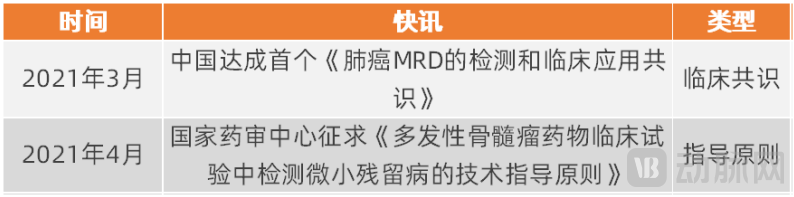
Progress in Guidelines and Consensus on MRD in China
As the industry develops, domestic guidelines and clinical consensus are rapidly catching up. In the field of scientific research, clinical consensus on solid tumors has achieved a breakthrough first in the area of lung cancer. At the regulatory level, the Center for Drug Evaluation (CDE) has begun drafting guidelines for relevant applications in hematologic malignancies.
Domestic industry development has largely kept pace with international trends over time, with many companies beginning to make strategic moves early on.However, starting from the second half of 2020, there has been a concentrated wave of information disclosures, with new products, new collaborations, and new scientific research advances emerging in rapid succession.
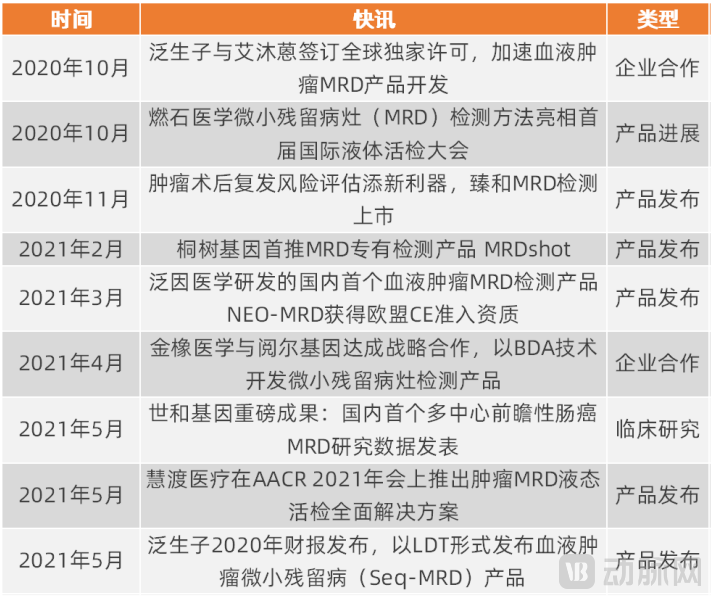
Recent MRD-Related Disclosures in China
The surge in MRD testing in China can be traced back to October 2020, when two domestic listed tumor NGS companies successively announced new developments related to MRD.Genetron HealthReached an exclusive licensing agreement with Hangzhou-based startup Amune Biotech, securing global exclusive rights to its blood cancer minimal residual disease (Seq-MRD) product, and will accelerate product development and commercialization;Burning Rock Biotechpresented its multi-omics MRD detection findings at the inaugural International Liquid Biopsy Conference, providing significant reference value for further precision in the diagnosis and treatment of lung cancer.
In November 2020,Genetron Healthalso announced the launch of its MRD detection product. In May 2021,Genetron HealthUpon the release of its Q1 2021 financial report, CEO Wang Sizhen announced the official launch of Seq-MRD, a previously collaborated hematologic malignancy testing product, in the form of a Laboratory Developed Test (LDT). In the field of solid tumors, the company stated that “thanks to the Mutation Capsule technology, the MRD testing projects for hepatocellular carcinoma and colorectal cancer have yielded excellent preliminary results, and plans are underway to transition to larger multicenter studies.” At nearly the same time,GeneseeqThe results of China’s first multicenter, prospective study on minimal residual disease (MRD) in colorectal cancer, conducted jointly with research institutions such as Sun Yat-sen University and Fudan University, have been officially published in the Journal of Hematology & Oncology.
Oncology NGS Companies Are Successively Announcing Their Entry Into MRD Testing, a Scenario That Is Likely to Become an Industry Hotspot.
At the beginning of 2021,Tongshu Gene, Huidu Medicalhave successively launched their own MRD detection products;Fanin MedicineThe company’s MRD testing product for hematologic malignancies has obtained CE marking in the European Union, gaining entry into overseas markets.
As companies race to position themselves, MRD testing has quickly gained traction within the industry.
The surge in early screening and the explosive popularity of MRD testing both point to the same conclusion—The Maturation of Companion Diagnostic Technology Is Driving the Expansion of the Genetic Testing Industry.
Companion diagnostic technologies have largely matured, allowing patients to flexibly choose among single-cancer small panels, pan-cancer large panels, and whole-exome sequencing based on individual needs. Market education is well-established in most regions of China; physicians clearly recognize the clinical value of companion diagnostics, and patients understand their importance in guiding treatment decisions.Currently, tumor NGS companies in China have basically completed market exploration. It will become increasingly difficult to maintain high revenue growth rates by relying solely on companion diagnostic services.
Therefore, tumor NGS companies began to drive their second-curve growth at this stage. Many companies foresaw this trend and made early strategic deployments before the companion diagnostics market became saturated.Starting from companion diagnostics, the company’s business extends along the oncology diagnosis and treatment pathway in both directions. Moving forward entails cancer early screening, enabling more healthy individuals to avoid the burden of cancer; moving backward involves recurrence monitoring, allowing more postoperative cancer patients to avoid the distress of recurrence. This explains why early screening and minimal residual disease (MRD) monitoring have recently become industry hotspots.
So, what will the endgame look like for the tumor NGS industry? Currently, services offered by companies are still fragmented: early screening remains separate from companion diagnostics, which in turn is distinct from recurrence monitoring. In the future, as technologies for early screening and recurrence monitoring mature, tumor NGS will inevitably evolve toward a one-stop service model better aligned with consumer usage habits. This model will provide comprehensive, full-lifecycle oncology solutions—ranging from tumor detection via early screening, through treatment planning assisted by companion diagnostics, to post-treatment recurrence monitoring.
However, based on the current situation, it seems premature to incorporate early screening into this system. The current application scenarios for early screening are still concentrated on a few major cancer types, particularly colorectal cancer. Market education efforts are ongoing, and there is still a considerable way to go before comprehensive rollout can be achieved.Recurrence monitoring, as a relatively essential application scenario, engenders stronger willingness to pay among patients. Companies can also adopt the Laboratory Developed Test (LDT) model to provide services initially, without needing to emphasize regulatory approval as critically as they do for early screening.
Therefore, it may still be premature to discuss “full lifecycle” solutions.But we may soon see this unfold. The emergence of this new model could become the core driver of growth in the next phase of the tumor NGS industry, freeing more cancer patients from the shadow of recurrence.