

Olymvax Lists on STAR Market with 300% Surge, 3 Vaccines Commercialized and 10 in Pipeline
olymvax
Human Vaccine Research and Development Manufacturer
On June 8, 2021, Chengdu Olymvax Biopharmaceuticals Inc. (hereinafter referred to as “Olymvax”) was officially listed on the STAR Market through its initial public offering (IPO). The company issued a total of 40.53 million shares, accounting for more than 10% of its total share capital after the issuance. It aimed to raise RMB 763 million, with the proceeds primarily intended to fund research on its clinical vaccine projects and to support the industrialization of its recombinant Staphylococcus aureus vaccine, AC-Hib combination vaccine, and pneumococcal vaccine projects.
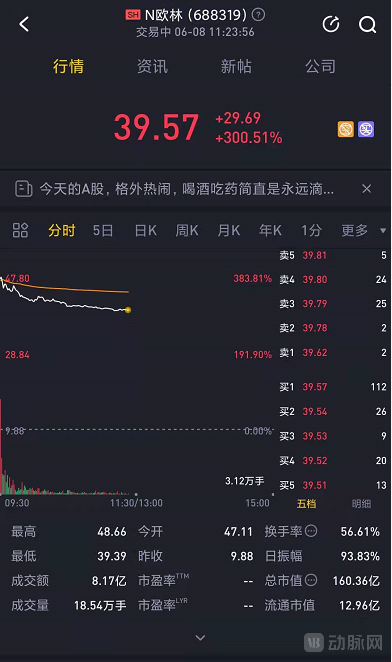
This morning, Olymvax opened at 47.11 yuan, reaching a high of 48.66 yuan; as of press time, its current share price stood at 39.57 yuan, representing a gain of 300.51%, with a total market capitalization of 16.036 billion yuan.
Olymvax, established in 2009, is a biopharmaceutical company specializing in the research and development, manufacturing, and sales of human vaccines. Founded under the leadership of Mr. Fan Shaowen, who brings over 40 years of experience in the biopharmaceutical industry, the company is committed to providing safe, effective, and high-quality human vaccine products to consumers both domestically and internationally. Its portfolio includes upgraded versions of traditional vaccines with broad current market demand, developed to enhance people’s quality of life, as well as innovative vaccine products with significant future market potential, addressing unmet or urgent needs in disease control and prevention.
Notably, Olymvax applied for its listing under the fifth set of listing criteria on the STAR Market, making it the first among the seven biopharmaceutical companies currently using this listing rule to achieve profitability. The prospectus shows that Olymvax’s compound annual growth rate (CAGR) in operating revenue from 2017 to 2020 reached 180%. In 2020, the company reported operating revenue of RMB 320.1092 million and net profit of RMB 36.1302 million. In the first quarter of this year, the company recorded operating revenue of RMB 52.4479 million to RMB 63.1958 million, with a net profit ranging from RMB 4.3091 million to RMB 9.5446 million.
10 vaccine pipelines, 3 products launched; adsorbed tetanus vaccine sales have become the primary revenue source
Since its inception, Olymvax has adopted a dual-drive product R&D strategy of “upgrading traditional vaccines + developing innovative vaccines,” combining independent R&D with collaborative R&D.
On one hand, Mr. Fan Shaowen and his team have leveraged their extensive experience in R&D and industrialized production within the biopharmaceutical industry to establish a product pipeline for traditional vaccines, implementing necessary improvements and innovations based on already marketed traditional vaccines. The company has improved multiple traditional vaccines, accumulating rich experience in large-scale bacterial fermentation culture, separation and purification of target products, polysaccharide-protein conjugation, and formulation development, while obtaining multiple invention patents. This has laid a solid foundation for the subsequent development of combination vaccines, multivalent vaccines, and innovative vaccines with broad market prospects;
On the other hand, given the long development cycles and high capital requirements for vaccines, the company entered the vaccine industry relatively late. To rapidly catch up with industry leaders, it has adopted a collaborative R&D model with domestic and international universities and research institutes to develop innovative vaccines. This approach effectively combines the company’s extensive experience in pilot-scale scale-up, clinical studies, and industrial production development with the advanced fundamental theoretical and laboratory research capabilities of academic and scientific institutions. By leveraging these complementary strengths, the model significantly shortens the R&D timeline for innovative vaccines, thereby enhancing the company’s R&D capabilities and competitiveness, while also accelerating the industrialization of innovative biotechnologies from universities.
Olymvax improves and technologically innovates traditional vaccines with broad market demand in China through independent R&D, and collaborates with domestic and international universities and research institutes to develop innovative vaccines. After years of technological accumulation, the company has mastered six core technologies: polysaccharide-protein conjugation technology, genetic engineering technology, peptide vaccine technology, separation and purification technology, high-density bacterial culture technology, and detoxification control technology. Leveraging these core technologies, the company has obtained multiple invention patents and applied them to the R&D and industrialization of combination and multivalent vaccines as well as innovative vaccines.
After more than a decade of continuous research and development, the company has established a product R&D framework characterized by “structured progression, focused breakthroughs, and a diversified product pipeline.” It has a total portfolio of 13 products either on the market or under development, including the marketed adsorbed tetanus vaccine, Hib conjugate vaccine, and AC conjugate vaccine, as well as five Class 1 innovative vaccines and five broad-market combination multivalent vaccines currently in development.
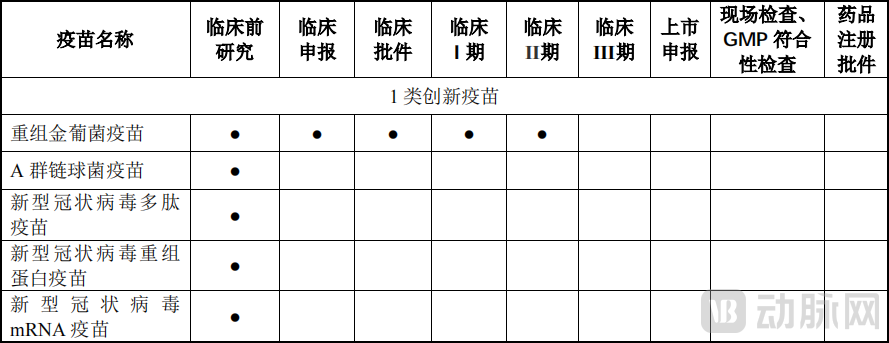
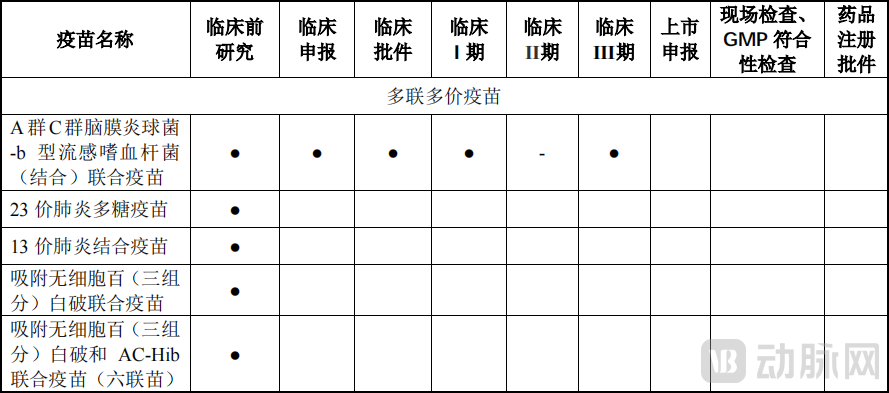
Olymvax's Clinical Pipeline
Currently, Olymvax’s primary revenue streams are derived from the sales of its three marketed vaccines, with adsorbed tetanus vaccine accounting for over 70% of total sales. In the CDC procurement market, Wuhan Institute of Biological Products’ vaccines have winning bid prices ranging from RMB 158 to RMB 193, while Olymvax’s tetanus vaccine in vials has winning bid prices ranging from RMB 157 to RMB 198.
Tetanus toxoid adsorbed vaccine is manufactured from tetanus toxoid and is used to prevent tetanus. In addition to the tetanus toxoid adsorbed vaccine, other tetanus toxoid-containing vaccines (TTCVs) are available in China. For example, the diphtheria-tetanus-pertussis (DTP) combination vaccine can also be used for tetanus prevention. However, the DTP combination vaccines marketed in China are part of the National Immunization Program, provided free of charge by the government, and are primarily administered to infants and young children.
Olymvax has introduced technological innovations to the detoxification control process for its adsorbed tetanus vaccine, employing a proprietary automated control system during detoxification to ensure greater batch-to-batch consistency. Furthermore, the formulation process for the company’s adsorbed tetanus vaccine does not include preservatives, resulting in fewer side effects and an improved safety profile.
Meanwhile, this adsorbed tetanus vaccine is classified as a non-EPI (Expanded Program on Immunization) vaccine, with target populations including individuals of all age groups who have sustained injuries, pregnant women, and others. However, due to China’s National Immunization Program, nearly all newborns in the country receive the diphtheria-tetanus-pertussis (DTP) combination vaccine. Consequently, the actual recipients of the company’s adsorbed tetanus vaccine are primarily adolescents and adults. The company obtained the drug registration approval for its adsorbed tetanus vaccine in 2016 and received the first batch release certification from the National Institutes for Food and Drug Control (NIFDC) in June 2017, marking the commencement of its commercial sales.
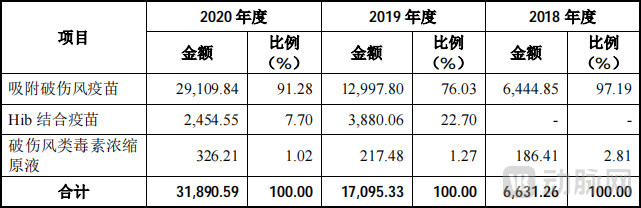
Revenue from Olymvax's Three Marketed Vaccines
Among the two other vaccines already launched by the company, the Hib conjugate vaccine primarily prevents invasive infections caused by Haemophilus influenzae type b. Haemophilus influenzae (Hi) is a pathogen responsible for various severe diseases in infants and young children, including pneumonia, meningitis, and sepsis. It is mainly transmitted through respiratory droplets from saliva. The susceptible population consists of children under five years of age, particularly infants and toddlers aged 2 months to 2 years. Of the severe diseases caused by Haemophilus influenzae, 95% are attributable to Haemophilus influenzae type b.
Hib conjugate vaccines are prepared by covalently linking the bacterial capsular polysaccharide, a polyribosyl ribitol phosphate (PRP), to a carrier protein. This conjugation induces a T-cell-dependent B-cell immune response against the polysaccharide antigen.
The Hib conjugate vaccine produced by Olymvax is a non-immunization program vaccine. It received drug registration approval in 2017 and obtained its first batch release from the National Institutes for Food and Drug Control (NIFDC) for the Hib conjugate vaccine in December 2018.
Olymvax’s most recently launched vaccine is the AC conjugate vaccine, a group A and group C meningococcal polysaccharide conjugate vaccine used to prevent epidemic cerebrospinal meningitis caused by group A and group C Neisseria meningitidis.
Epidemic cerebrospinal meningitis is caused by infection with *Neisseria meningitidis*. Based on differences in their surface-specific polysaccharide antigens, *N. meningitidis* strains are classified into serogroups A, B, C, H, I, K, L, W135, X, and Y. Among these, serogroups A, B, C, W135, and Y are currently the predominant pathogenic strains circulating globally. In China, serogroups A, B, and C are predominant, while the incidence of serogroup W135 is gradually increasing. The pathogen primarily invades the bloodstream from the nasopharynx, causing septicemia, and ultimately localizes to the meninges and spinal meninges, resulting in purulent meningoencephalitis.
Currently, none of the commercially available AC conjugate vaccines include a booster immunization schedule for infants and young children aged 6–24 months. However, domestic and international literature reports that one year after completing the primary immunization series with AC conjugate vaccines, the geometric mean titers (GMTs) of antibodies in this age group decline to pre-vaccination levels or lower, indicating the need for booster immunization one year after primary immunization.
Considering the need for booster immunization, Olymvax conducted a study combining primary and booster immunization schedules during the clinical trials of its AC conjugate vaccine. A single booster dose is administered at 18 months of age to provide children with more durable protection.
Global Vaccine Market: The Big Four Hold 80% of the Global Vaccine Share
Vaccines are currently the most effective weapon for humans to prevent diseases and are essential public health products. Vaccines have made tremendous contributions to the health of all humanity and the course of historical development. As a primary form of preventive medicine, vaccination is more cost-effective from the perspective of public health expenditure compared to treating diseases after infection.
In terms of vaccine products, by the end of 2019, the total sales revenue of the top ten best-selling products in the global vaccine market, calculated at ex-factory prices, amounted to USD 22.14 billion. The sales performance of the top ten vaccines globally in 2019 (at ex-factory prices) is shown in the figure below:
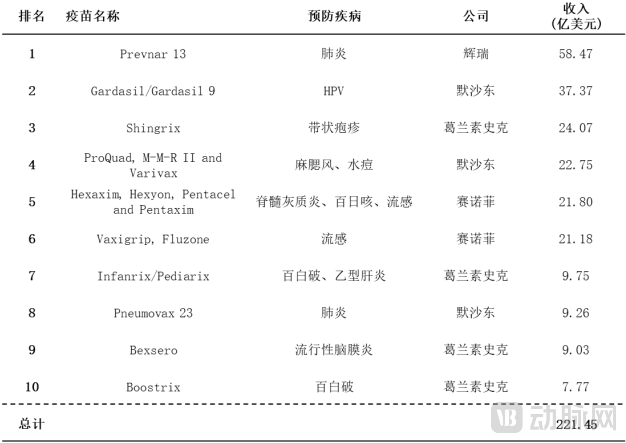
The top ten best-selling vaccines globally in 2019 were produced by four multinational vaccine companies—Pfizer, Merck & Co., Sanofi, and GlaxoSmithKline—which together accounted for nearly 80% of the global vaccine market.
In terms of sales revenue, the global vaccine market size increased from USD 34.1 billion in 2014 to USD 52.9 billion in 2019, representing a compound annual growth rate (CAGR) of 9.1%. It is projected to reach USD 101.0 billion by 2030, with a CAGR of 6.1%. This trend is primarily driven by the growing global demand for vaccination, support from governments and international organizations, and the research and development of new vaccines.
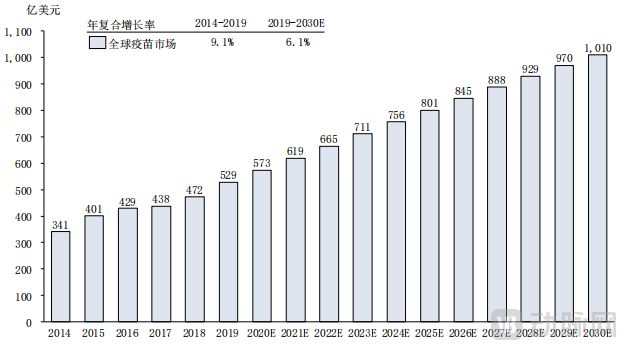
Global Vaccine Market Size (by End-User Sales/2014-2030E)
The market size of vaccines is closely related to a country's economic level. In Europe and the United States, where healthcare systems are well-developed and vaccination programs are comprehensive, many innovative vaccines have been included in national immunization plans, resulting in high market shares. At present, China's vaccination program still needs further improvement, leaving significant room for market growth.
In China, vaccines are primarily categorized into National Immunization Program (NIP) vaccines and non-NIP vaccines. NIP vaccines are purchased by provincial Centers for Disease Control and Prevention (CDCs) from manufacturers at relatively low prices and provided to the public free of charge, mainly for neonatal immunization. Suppliers of NIP vaccines are predominantly state-owned vaccine enterprises, which provide the government with a stable annual supply. Non-NIP vaccines are purchased out-of-pocket by the public at higher prices, and the market is mainly dominated by foreign-invested and private vaccine companies.
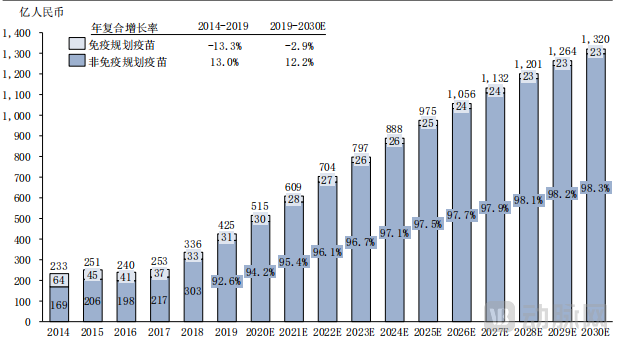
China’s Vaccine Market Size (by Terminal Sales/2014–2030E)
The market size of non-National Immunization Program (NIP) vaccines in China increased from RMB 39.4 billion in 2019 to RMB 129.8 billion in 2030, representing a compound annual growth rate (CAGR) of 12.2%. The share of the non-NIP vaccine market, measured by sales revenue, in China’s total vaccine market is projected to rise from 92.6% in 2019 to 98.3% in 2030. Meanwhile, the NIP vaccine market declined at a CAGR of 2.9% between 2019 and 2030, accounting for a gradually diminishing proportion of the overall Chinese vaccine market.
China’s vaccine market holds broad future demand, with particularly promising growth expected for high-quality National Immunization Program (NIP) vaccines and non-NIP vaccines. Although China has a large population, its vaccine landscape is dominated by NIP vaccines, most of which are older-generation products. The penetration rate of non-NIP vaccines and the adult vaccination rate remain low. However, driven by heightened public awareness of vaccine safety, advancements in domestic vaccine R&D and manufacturing capabilities, and supportive policies, there is a growing demand for high-quality, novel vaccines that offer greater safety, better immunogenicity, and broader disease prevention. Consequently, China’s vaccine industry still possesses significant growth potential. Factors such as increasing government expenditure on preventive healthcare and strengthened policy support will further drive the demand for high-quality, innovative vaccine products.