

Digital Therapeutics Paves the Way in Chronic Pain Management: How China’s PAINCARE Emerges Amid Global Disparities
Wan Qing is all too familiar with the condition he faces. Whenever zigzag flashes appear before his eyes, he finds a place to lie down. He knows that scintillating scotomas will follow, accompanied by throbbing headaches, fatigue, and nausea with vomiting. During a migraine attack, his photophobia and phonophobia render him nearly incapable of doing anything. Sometimes, the pain subsides "rapidly," ending within a few hours; at other times, it is "prolonged," lasting for one or two days or even longer.
Even so, Wan Qing is fortunate; he only needs to cope with one or two such acute episodes every few months. Most patients experience multiple attacks per month, with each episode lasting for several days. In severe cases, attacks can occur as frequently as every one to two days.
It is not an incurable disease. The prognosis for the vast majority of migraine patients is relatively favorable if they receive timely and accurate diagnosis and treatment. However, if left untreated or improperly managed, migraines may progress to chronic migraine, becoming a lifelong condition characterized by headache frequency increasing to 15 or more days per month, accompanied by insomnia, memory decline, cognitive impairment, and comorbid psychiatric and psychological disorders such as anxiety and depression.
Pain, in most cases, is regarded as a symptom; for instance, common acute pain often serves as a signal that the body is facing injury or disease. However, chronic pain conditions such as migraine, back pain, and neuropathic pain, once persisting for more than three months, are not merely symptoms but independent, long-term chronic clinical diseases.
Currently, pain has become one of the chronic diseases that seriously affect human life and quality of life, following cardiovascular and cerebrovascular diseases, tumors, etc. Chronic pain not only brings problems such as limited physical function, anxiety, insomnia, and depression to patients themselves, but also imposes a huge medical burden on society.
However, public awareness of pain remains inadequate. Developed countries and regions, such as those in Europe and the United States, have been engaged in pain treatment and research for over 40 years, whereas the development of pain management departments in China has spanned only a little more than a decade.
What problems and challenges do we face in the field of pain management? What lessons can we draw from Europe and the United States, where pain management is relatively more mature? What further steps are needed to promote the development of this field? In the current climate of surging interest in digital therapeutics, how should companies strategize their market positioning? VCBeat provides a brief overview of these issues.
Up to 300 Million Patients with Chronic Pain: The Dawn of Pain Management in China
The “Blue Book on China’s Strategy for Pain Prevention, Control, and Health Promotion: Report on the Development of Pain Medicine in China (2020)” points out that “there are over 300 million patients with chronic pain in China, with an annual rapid increase of 10 to 20 million, and the patient population is trending toward younger ages.”
On one hand, the population of patients suffering from pain is substantial. Among the 300 million individuals with chronic pain, approximately 80 to 100 million suffer from headaches, including migraines and cluster headaches. Women are affected three times more often than men, and patients are typically concentrated in the under-55 age group. The number of patients with cervical spondylosis and lumbar disc disease exceeds 200 million, with a trend toward younger onset. Other types of chronic pain, such as neuropathic pain, affect tens of millions, while cancer-related pain also impacts a significant number of patients.
On the other hand, pain imposes a substantial burden. In terms of disease burden, low back pain is the leading cause of disability among the Chinese population. At the individual level, 65% of patients with chronic pain suffer from severe depression, and 32% exhibit suicidal tendencies. When one spouse experiences chronic pain, the divorce rate reaches 75%. These factors collectively impose a significant societal burden.
Although the number of patients with chronic pain far exceeds that of patients with diabetes (the IDF reported 116 million diabetic patients in China in 2019) and is comparable to the number of patients with cardiovascular diseases (330 million prevalent cases in 2019), resulting in a significant social impact, there are still various issues in the current pain management market, including limitations in supply-side hospital and physician resources, as well as insufficient patient awareness on the demand side.
China began developing its pain medicine discipline in 2007, when there were fewer than 50 independent departments and fewer than 1,000 pain physicians. Since then, the field has maintained rapid growth. By 2020, more than 2,000 independently established pain departments had been set up, with over 20,000 specialized pain physicians. However, these professionals are responsible for managing nearly 300 million patients with chronic pain. In contrast, the United States has only 15,000 pain specialists managing approximately 100 million chronic pain patients. Currently, China faces a severe shortage of physicians in the field of pain management, and the development of pain specialty care must continue to advance rapidly over the next decade.
According to a 2020 survey, 40% of patients with chronic pain incurred treatment-related costs of RMB 1,000–5,000 within six months, while approximately 20% spent more than RMB 5,000. Based on an estimated 300 million chronic pain patients in China and a healthcare utilization rate of 60%, the total expenditure on treatment could exceed RMB 500 billion.
Reality, however, presents a different picture. Data from 2018 show that the number of patients visiting pain clinics across China rose from 800,000 in 2007 to 7.04 million, while hospitalizations increased from 61,000 to 482,000. Although patients’ awareness of seeking medical care for pain has improved, the current consultation rate still requires further penetration relative to the 300 million individuals suffering from chronic pain. With public healthcare systems reaching saturation in treating chronic pain patients, how to better assume responsibility for their management represents a significant market opportunity and substantial growth potential for enterprises.
How do developed countries in Europe and America manage pain for their vast patient populations? And does their approach offer valuable lessons for China?
Rich International Experience in Pain Management: How Can China Learn From It?
It should be noted that China and the United States face different social realities, which have determined their distinct developmental pathways in the field of pain management.
In the United States, the early phase of pain management (the 1990s) was characterized by the FDA’s approval of a large number of opioid analgesics for market entry, which significantly aided in patient pain treatment with notable efficacy. However, their overuse ultimately led to widespread opioid abuse. Over the past decade, U.S. pain management has increasingly focused on developing treatments aimed at combating opioid abuse.
In 2015, in response to the rising number of disabled veterans and the continuing increase in deaths due to opioid overdose, the U.S. government designated pain as a public health issue, employing various strategies to reduce the progression from acute to high-impact chronic pain and its associated morbidity and disability, thereby alleviating the burden of pain on individuals, families, and society as a whole.
In the first two decades of the 21st century, the U.S. pain management community focused on innovative non-opioid analgesics and various minimally invasive surgical procedures, combined with physical therapy and psychological counseling, achieving significant results. However, due to regulatory restrictions and the high economic costs associated with innovative drugs and medical devices, the pace of development has remained unsatisfactory.
This challenge has driven them to focus on the translation of innovative technologies and scientific achievements in the medical field over the past five to ten years, aiming to treat and manage the vast population of chronic pain patients by developing new pain management products (not necessarily hardware), thereby spurring the growth of digital health enterprises in the pain management sector.
In China, there is a shortage of medical personnel, and therapeutic drugs, surgical procedures, and technical approaches are still in their nascent stages. Although we can now effectively treat seven major categories of chronic pain conditions—including spine- and joint-originated pain, migraine, neuropathic pain, and cancer-related pain—using dozens of minimally invasive techniques, we continue to face challenges such as imprecise diagnoses, incomplete treatment protocols, and inadequate implementation of management and follow-up care.
We have conducted a partial review of pain management companies:
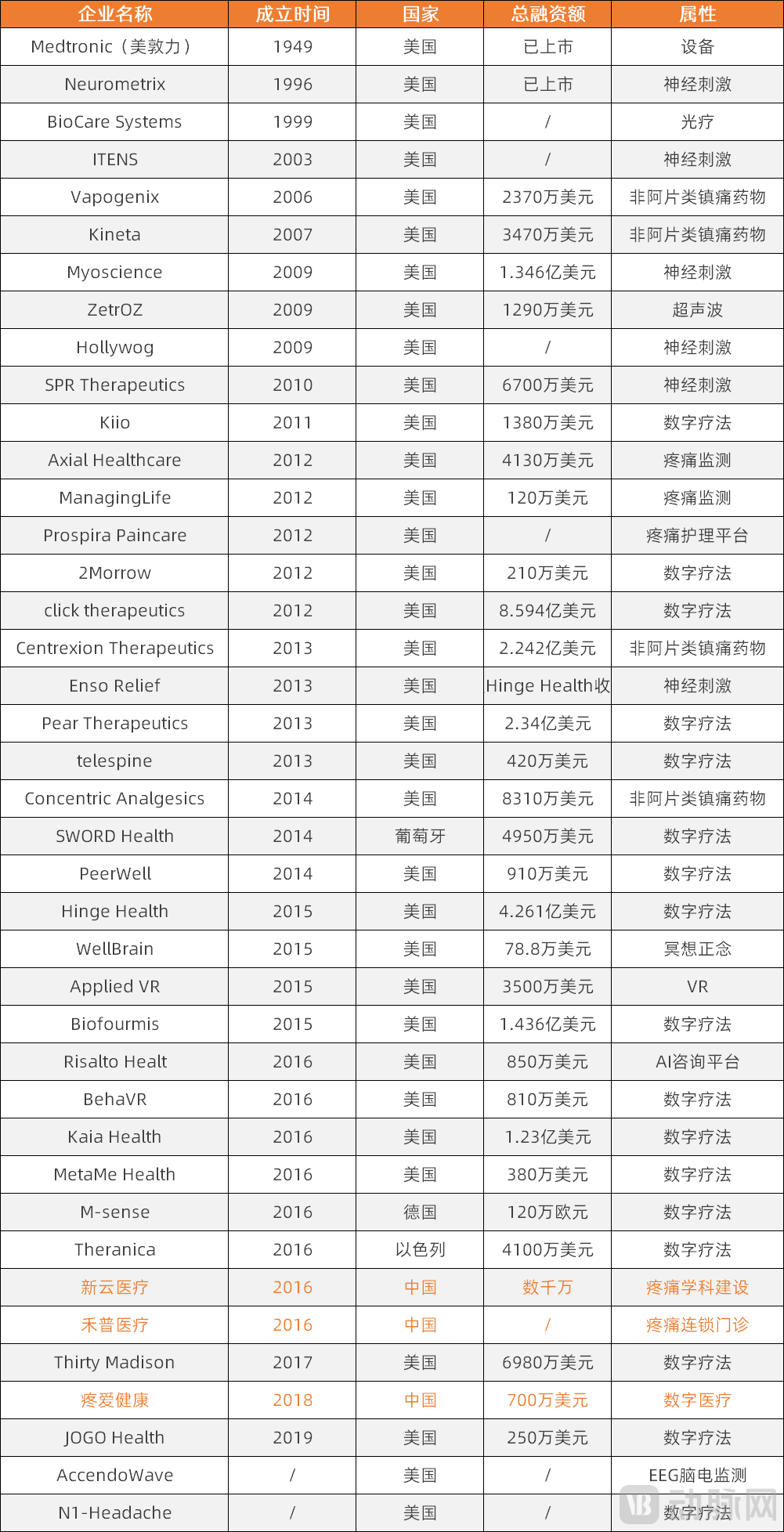 Data compiled from VCBeat, Crunchbase, FDA, etc.
The current pain management landscape in the United States is characterized by intense competition, with a surge of diverse enterprises entering the market. From an investment perspective, digital therapeutics companies have garnered greater favor from capital investors, with standout representatives including Hinge Health, Kaia Health, and N1-Headache. Hinge Health and Kaia Health primarily target musculoskeletal (MSK) pain, such as lower back pain and knee pain, while N1-Headache focuses mainly on migraine. Most digital therapeutics companies in pain management tend to concentrate more narrowly on specific chronic pain conditions.
Digital therapeutics are gaining momentum. Adopting digital therapeutics that focus on single-disease areas, are supported by evidence-based medicine, offer higher levels of intelligence, and incur lower costs can help China overcome its weaknesses in pain management and achieve leapfrog development. However, no companies specializing in digital therapeutics for pain management have yet emerged. We have also conducted a preliminary review of companies operating in China’s pain management sector:
Xinyun Medical primarily targets county-level hospitals and pain management departments as its clients, providing them with system infrastructure or medical devices and consumables. Hepu Medical focuses on patients with chronic pain, delivering offline medical services through a chain of clinics. Tengai Health, which has rapidly established professional influence in the pain management sector, leverages data and artificial intelligence technologies to cover the entire pain care cycle, including prevention, diagnosis, treatment, and follow-up. Its model, centered on online internet hospitals and supplemented by offline international pain clinics, has further broken down geographical barriers to diagnosis and treatment.
HePu Medical and Tengai Health specialize in the field of chronic pain management. However, as a digital health and internet healthcare company within the pain management sector, Tengai Health possesses inherent advantages. The company is currently planning to conduct clinical trials to accelerate its acquisition of digital therapeutic certifications for pain management. It aims to develop targeted digital therapeutics for specific subtypes of chronic pain diseases, accelerating breakthroughs in digital therapeutics through the integration of foundational technical architecture, data intelligence engines, and theoretical frameworks in pain medicine.
For instance, for migraine patients, the planned digital therapeutics offering includes AI-powered self-diagnosis based on clinical protocols from Stanford University’s Pain Center, integrated with treatments primarily involving medication or wearable devices, as well as lifestyle management to deliver meditation-based rehabilitation training. This approach aims to alleviate headache severity, reduce the frequency of migraine attacks, and ultimately lower the rate of progression from episodic to chronic migraine. As a next step, the company plans to draw on the models of Hinge Health and Kaia Health to develop new digital therapeutics targeting the over 100 million people in China suffering from lower back pain.
How Does Tengai Health Support Patients in Pain Management?
As a pioneering digital health and internet healthcare brand in the field of pain management, the Teng’ai Health platform boasts over 10,000 registered pain specialists and covers more than 1,600 hospitals across China. By establishing a presence in the Boao Lecheng International Medical Tourism Pilot Zone in Hainan and preparing to build an International Pain Medicine Center, the company has leveraged these resources to create an internet hospital dedicated exclusively to pain care. What aspects of its strategic layout in pain management are worthy of emulation?
From the perspective of Tengai Health, the core of next-generation chronic pain management lies in data-driven, real-time, continuous, and automated monitoring and intervention.
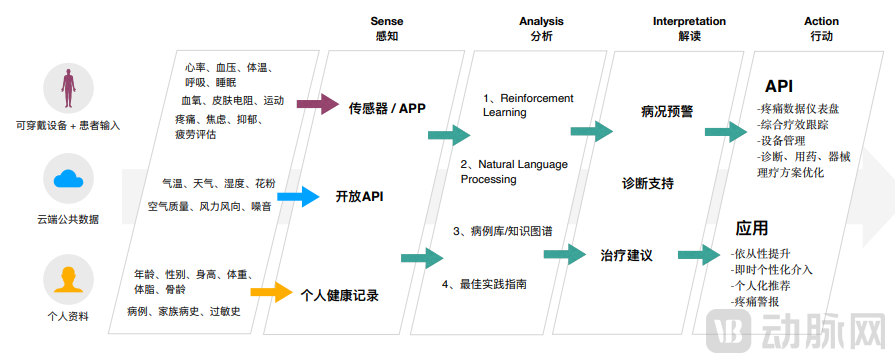
Leveraging IoT and AI technologies, the Tengai Health SAIA (Sense, Analysis, Interpretation, Action) data intelligence engine can collect various data metrics in real time, including patients’ daily physical activity, frequency and intensity of pain episodes, as well as local weather and air quality information. By analyzing and integrating these data, the engine enables continuous assessment and early warning of disease conditions anytime and anywhere. Through this intelligent engine, Tengai Health provides a comprehensive personalized solution for both patients and physicians. Featuring machine learning capabilities, the system continuously adjusts and optimizes the solutions by tracking outcomes and incorporating feedback.
"Your pain is unique, and so should be your treatment."
To address the challenges of difficult diagnoses, Tengai Health matches patients with the nearest pain specialists based on their reported pain locations and assessment results. By leveraging AI-assisted intelligent pain diagnosis, it helps physicians and patients identify more precise headache subtypes and underlying causes. In the future, its AI-driven diagnostic capabilities will be extended to other pain domains, such as lower back pain.
To address the challenges in treatment, Tengai Health has achieved precise guidance for patients based on their pain conditions by accurately categorizing pain departments and physicians, thereby facilitating both online consultations and offline medical visits. In this process, it also provides patients with pain self-management tools, including physical therapy and cognitive behavioral therapies such as meditation and mindfulness, to complement pharmacological treatments and minimally invasive surgical procedures.

Rendering of the Teng'ai Health Lecheng Clinic, Currently Under Construction
To address patient management challenges, Tengai Health has launched a Pain Studio on its "Doctors Without Borders" app. This initiative empowers physicians to tailor treatment plans in real time based on disease progression, accounting for the complex and diverse pathogenic mechanisms of patients, while also accumulating data for future real-world clinical research.
Patients can continuously record their treatment progress, lifestyle habits, and pain logs during both online and offline medical consultations, enabling them to share their personal health records. During follow-up care, Tengai Health provides personalized solutions by developing practical and efficient follow-up management plans tailored to specific pain conditions and patient data, incorporating elements such as cognitive behavioral therapy and adherence to medical advice.
To address the shortage in the supply of pain specialists, Tengai Health continues to strengthen professional development and knowledge training for pain physicians. Through the Online International Pain Academy on the “Yizhe Wujie” app, the company focuses on global clinical practices and cutting-edge research in pain medicine. Under the guidance of the Pain Physicians Branch of the Chinese Medical Doctor Association, the Pain Committee of the Chinese Medical Association, the Society of Chinese American Physician Executives (SCAPE), the American Academy of Pain Medicine (AAPM), and the World Association of Pain Medicine Union (WAPMU), Tengai Health provides high-quality, professional learning resources for pain physicians, including an up-to-date pain medication database, surgical training, bilingual literature, and expert lecture series.
Amid the Digital Therapeutics Boom, How Should Enterprises Develop?
As traditional public hospitals undergo reform, what steps should enterprises take to address the current dilemmas in pain management and drive industry development? The following perspectives may warrant consideration:
1. Further integrate resources across the upstream, midstream, and downstream segments of the industry chain by organizing verticals within the pain management sector—such as exploring new drugs under development, minimally invasive surgical procedures, and medical devices—to help patients access premier healthcare resources and alleviate their suffering.
2. Emphasize the critical role of digital therapeutics. Digital therapeutics, supported by evidence-based medicine, will significantly reduce reliance on physicians, enhance their service capabilities, and further optimize the allocation of medical resources. Meanwhile, improved patient adherence can help lower healthcare expenditures.
This is also what “Tengai Health,” a digital health and internet healthcare brand in the field of pain management, is currently doing.
It is important to note that the U.S. experience should not be blindly replicated in the development of digital therapeutics (DTx) in China. In the Chinese context, the integration of software and hardware is, to some extent, necessary. Given the current development of health insurance, whether patient pain management can be integrated with health insurance coverage in the future is a topic worthy of in-depth exploration.
Note: To protect privacy, the names used in this article are pseudonyms.