

Breaking the 30-Year Duopoly: How Chinese Firms Are Reclaiming the $100B Medical Imaging Market

United Imaging
High-end Medical Device Developer
Since the advent of the first EMI head CT scanner in 1972, CT technology has undergone five generations of development. However, nearly 50 years later, this equipment, long considered a standard fixture in medical institutions, has still failed to achieve fully independent domestic production in China. The root cause lies in core CT components such as X-ray tubes and detectors, which remain formidable barriers for Chinese medical device manufacturers.
For a long period, Zhuhai Ruineng was the only domestic manufacturer with the capability to produce CT X-ray tubes. However, the performance of its RX series tubes, approved by the NMPA in 2012, was relatively limited. At that time, the average lifespan of Ruineng’s X-ray tubes was only 50,000 scan seconds, significantly lower than the international industry standard of over 200,000 scan seconds.
In stark contrast to the domestic market, which sees sparse participation and little discussion, the overseas market has generated significant buzz. In 2001, Philips acquired Dunlee, a pioneer in the X-ray tube replacement market. After establishing its Imaging Components Business (ICB)—the predecessor of Varex—in 2012, Varian spun off this division as a publicly listed company in 2017. In 2015, Richardson Electronics, a global manufacturing and distribution company, entered the replacement X-ray tube market by acquiring the renowned IMES, thereby initiating replacement services for mainstream CT systems from Philips, Siemens, Toshiba, and others. Behind these frequent mergers and acquisitions lie the continuous technological advancements and highly competitive landscape of the overseas market.
The turning point came roughly in 2018. In June of that year, United Imaging’s UHCT0550 CT tube, developed discreetly, received approval from the National Medical Products Administration (NMPA), making United Imaging the second company in China with the capability to develop and sell CT systems. Over the following year, CT tubes from Kunshan Yiyuan and Raymemo sequentially gained approval. In December 2019, Ruineng Medical launched its new product, the RH406, a CT tube capable of replacing those from major domestic manufacturers such as Philips and Neusoft Medical.
The localization of the CT X-ray tube market is reshaping both the domestic CT system market and the domestic CT replacement market,Among them, market changes in the replacement market are particularly evident.。
In the past, China’s third-party CT maintenance market was constrained by a lack of in-house X-ray tube development capabilities, forcing service providers to procure original equipment manufacturer (OEM) tubes and bundle them with their repair services. This model, akin to mobile phone repair vendors being required to purchase OEM components for repairs, resulted in persistently high maintenance costs. Today, the rise of domestically produced replacement X-ray tubes is subjecting OEM tubes to a new round of competitive challenges.
The entire market is gradually accumulating vitality, which is becoming increasingly evident. At the CMEF in spring 2021, we were surprised to see many X-ray tube manufacturers entering the imaging section, signaling the rise of domestic CT X-ray tube makers.
So, what is the current state of the market for domestically produced CT X-ray tubes? Where lie the barriers to entry? Who are the key players? What development trends will emerge in the future? This article will address each of these questions in turn.
As one of the core components of CT scanners, the X-ray tube insert is inherently a high-value consumable. Therefore, the market size for X-ray tubes depends on the prevalence and utilization rate of CT scanners.
In May 2015, the State Council released Made in China 2025, the first ten-year action plan for implementing the strategy of building a manufacturing powerhouse. This policy has provided strong support for the high-end development and industrialization of domestic medical imaging equipment manufacturers, setting a positive precedent for the research, development, and sales of large-scale medical devices.
More specific policies emerged in 2018. The “Catalogue for the Administration of Licensing for the Allocation of Large Medical Equipment (2018)” redefined the allocation methods for large imaging equipment:CT scanners with 16 slices or fewer do not require administrative approval; the authority for configuration management of large medical devices with a unit price of RMB 10–30 million for initial procurement, as well as CT scanners with 64 slices or more, has been transferred from the National Health Commission to provincial-level health commissions.
The primary healthcare market, supported by government public spending, has been greatly encouraged. As the tiered diagnosis and treatment system requires continuous improvement in its capabilities,The State provides direct financial support to primary healthcare institutions, thereby facilitating improvements in their hardware infrastructure. In the wake of these policies, primary healthcare institutions began to widely procure 16-slice CT scanners, leading to substantial growth in both the original equipment market and the replacement market for X-ray tubes.
Demand for high-end CT scanners is exhibiting a diversified trend. On one hand, as the annual revenue of tertiary hospitals across various regions has increased significantly, the financial burden of purchasing CT systems has been markedly reduced, making it common for a single hospital to operate multiple CT units. Following the decentralization of configuration licensing authority, top-tier tertiary (Grade 3A) hospitals have begun extensively procuring high-end CT scanners to enhance their disciplinary capabilities and, consequently, their overall competitiveness. On the other hand, the rise of independent imaging centers has also sparked a wave of high-end CT acquisitions, with these institutions focusing their capital investment on high-end imaging equipment as a critical strategic asset.By the end of 2019, the total number of installed CT scanners with 64 slices or more in China had nearly doubled.
In addition to changes on the demand side, the supply side is also undergoing a major reshuffle due to the entry of new players. Economical CT systems developed by domestic whole-unit manufacturers such as United Imaging, Neusoft Medical, and Anke have rapidly captured market share, prompting international medical imaging equipment manufacturers to advance their localization strategies by establishing factories in China to localize the R&D and production of CT systems and components.
The importance of cost control through supply chain optimization has become comparable to that of technological innovation. In the wake of this competition, the cost and price of CT scanners have declined year after year, ushering in unprecedented prosperity for the entire market—a boom that also extends to X-ray tubes.
Transitioning from CT market analysis to X-ray tube market analysis yields somewhat optimistic conclusions; however, entering this field is fraught with challenges. After all, the technological vacuum of nearly half a century cannot be bridged overnight.
When discussing the manufacturing challenges behind X-ray tubes, Ye Huawei, founder of Raymemo, a developer and manufacturer of CT X-ray tubes, summarized them into three aspects:Complex technology, high process requirements, and customized equipment.
“Taking common spiral CT scanners as an example, the X-ray tube remains in constant motion during operation. Achieving such high power output is no simple feat, presenting an inherent technical barrier.”
Secondly, the X-ray tube operates under vacuum, high-temperature, and high-speed rotation conditions during use. Ensuring its stability and precision amidst these complex operational states is highly challenging, making the overall manufacturing process quite intricate.
Revisiting the Design and Manufacture of Equipment for X-ray Tubes. Manufacturers must not only understand how to produce X-ray tubes and design manufacturing processes, but also clearly comprehend how to design the equipment used in their production. Since all such equipment is custom-built, ensuring that the designed equipment meets manufacturing requirements demands significant effort from enterprises and entails considerable risk.
Overcoming the technical challenges in manufacturing merely marks the entry point for X-ray tube manufacturers. As a core component of CT scanners, the production and development of X-ray tubes cannot be divorced from the constraints of the overall CT system. Companies cannot operate in isolation or arbitrarily choose their direction of advancement. This means that,Prior to X-ray tube design, manufacturers must select the CT equipment from the target OEM, and the entire design philosophy must align with the overall system.
With the design and manufacturing work completed, the next challenge lies in mass production. “‘Making it’ and ‘making it well’ are two entirely different things,” Yu Shan, General Manager of Skyray, told VCBeat. “CT X-ray tubes demand high reliability, which originates from the design and hinges on strict process control and high-precision production equipment. Only by addressing the five interconnected elements—personnel, machinery, materials, methods, and environment—can we achieve mass production of highly reliable products. If the X-ray tubes in complete CT systems frequently fail, which CT manufacturer would dare to use our tubes?”
To date, few companies have overcome the aforementioned challenges and are capable of providing comprehensive solutions. VCBeat has compiled and categorized domestic CT tube manufacturers in China, primarily including the following eight companies.
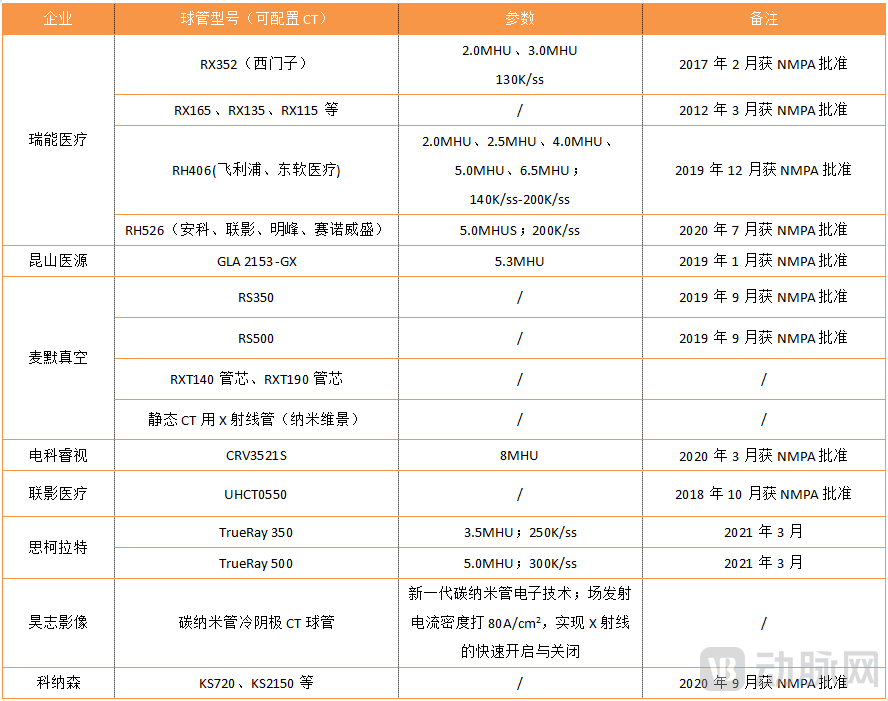
Overview of Domestic CT X-ray Tube Manufacturers
Overall, the market is dominated by third-party CT tube manufacturers. Ruineng Medical has leveraged its production line advantages to develop replacement tubes compatible with nearly all mainstream CT vendors, thereby capturing a significant market share. Skylight has adopted a high cost-performance strategy, mass-producing and selling its TureRay350 and TrueRay500 models at prices 30% or more below those of industry leaders, thus entering both the Chinese and international markets. Raymemo has pursued a diversified product strategy: on one hand, its RS350 and RS500 models, approved by the NMPA, can replace CT tubes from most manufacturers; on the other hand, the company is customizing static CT X-ray tubes for Nanovision Imaging, a developer of static CT systems, seeking breakthroughs while maintaining stability.
Furthermore, the entry of domestic original equipment manufacturers (OEMs) into the market also warrants attention. In November 2019, Mingfeng Medical acquired a stake in Kunshan Yiyuan. Kunshan Yiyuan had previously signed an agreement with the Ministry of Industry and Information Technology (MIIT) in June 2016 for the “Industrial Foundation Strengthening Project on High-Energy X-Ray Tubes with Ratings Above 5 MHU for Medical Use,” and obtained registration certification from the National Medical Products Administration (NMPA) in January 2019. Neusoft Medical has made fewer public moves; in July 2019, it established a “Key Components Exhibition Zone” at the China Medical Equipment Conference and 2019 Medical Equipment Exhibition, showcasing several critical imaging equipment components independently developed by the company, including CT detectors, CT X-ray tubes, and CT high-voltage generators. However, it did not disclose the progress of its X-ray tube research and development.
It is evident from the approval status of domestic X-ray tubes that approved products are all targeted at mid-to-low-end CT systems, with plans to capture this incremental market by aligning with the national “Strengthening Primary Care” strategy.
For primary care institutions, technological superiority is not their primary consideration; more important are price, ease of use, after-sales support, and the controllability of total lifecycle costs. Taking Skyrate as an example, this X-ray tube manufacturer has struck a balance among these four factors, packaging, and performance to secure pricing advantages and service guarantees.
The vast majority of X-ray tube manufacturers have adopted strategies similar to that of Skytech. However, with the continuous advancement of X-ray tube technology, companies must also achieve distinctive breakthroughs in the low-to-mid-end segment.
The strategy of domestic CT manufacturer MinFound Medical is to achieve targeted breakthroughs based on conventional X-ray tubes. The company chose to develop a 5.3 MHU X-ray tube, as 5.3 MHU tubes are primarily used in 16-slice CT scanners, which are widely prevalent in China.
Dr. Jiang Haochuan, President of Minfound Medical, stated, “The domestic manufacturing of X-ray tubes was previously almost nonexistent. Few companies were capable of producing 4 MHU tubes, and even those that achieved this capability struggled to realize mass production. Therefore, we targeted this specification as a breakthrough point for our R&D efforts. Currently, the stability of our self-developed X-ray tubes has gained recognition from physicians. As the R&D of our 5.3 MHU X-ray tube nears completion, we will embark on other more valuable X-ray tube development projects.”
So, when will domestically produced X-ray tubes be able to enter the high-end market? Judging from the current situation, it may still take a considerable amount of time. After all, the average lifecycle of high-end CT scanners is very long; for instance, the average lifespan of Philips’ liquid metal bearing X-ray tubes typically exceeds 2 million seconds.
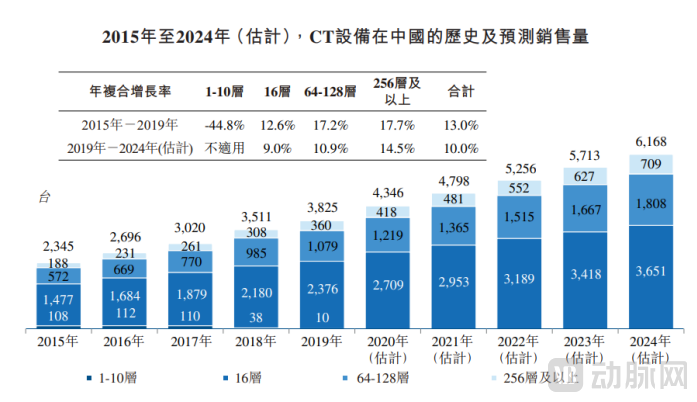
CT Equipment: Historical and Forecasted Sales Volume in China (Image Source: Neusoft Medical Prospectus)
According to Frost & Sullivan data, CT scanners with more than 16 slices accounted for 37.6% of total sales volume in 2019. This suggests that the replacement market for high-end X-ray tubes—characterized by low frequency, low volume, and high R&D costs—is not substantial. Therefore, future breakthroughs in the high-end X-ray tube market may rely more on CT manufacturers engaging in independent research and development.
NanoVision once commissioned Raymemo to manufacture miniaturized X-ray tubes specifically for its static CT systems. Static CT employs instantaneous pulsed X-ray emission, requiring R&D personnel to precisely control the flash duration and maximize the flash frequency through narrow-pulse rapid switching technology. The technical challenge lies in the fact that X-ray generation requires a high-voltage power supply of 140 kV, with rapid switching achieved at the microsecond level. Raymemo spent several months resolving this issue.
As demonstrated by the case of Raymemo, market demand serves as the primary driver for R&D in X-ray tube technology. As X-ray tube manufacturers continue to refine their technical capabilities, they will receive an increasing number of customized orders from clients, which in turn will further propel the technological upgrading and iteration of these manufacturers.
Looking back on the past three years, the domestic X-ray tube market has achieved a breakthrough from “0” to “1,” but this “1” is merely a starting point. There remains a substantial gap to catch up with leading X-ray tube manufacturers.
Medical imaging equipment requires innovation; however, for CT X-ray tubes, the potential for breakthrough innovations is limited, as their fundamental principle of generation has remained unchanged since the discovery of X-rays in 1895. Consequently, innovations in manufacturing processes, materials, and business models have become the development goals of major X-ray tube manufacturers in recent years.
Technological innovation is the essence of CT X-ray tubes. In recent years, the rapid development of liquid metal bearings and direct anode cooling technologies has revolutionized the service life of these tubes.
Heat management is the most critical aspect of an X-ray tube, as 99% of the energy generated by the tube is converted into heat, with only 1% used for X-ray production. Liquid metal bearings are designed to address the increasingly severe heat dissipation challenges in X-ray tubes.
Liquid bearings based on gallium-indium-tin alloys fill the gap between the rotor and the bearing with liquid metal, replacing mechanical bearings centered on steel balls. This design enables high heat dissipation rates while achieving zero wear and zero vibration. In practice, the service life of liquid metal bearings can be several times that of ball bearings.
Siemens and Philips were the earliest adopters of this technology, followed by Dunlee, GE, and domestic manufacturers such as United Imaging Ruineng and Zhuhai. Taking Dunlee’s CoolGlide™ liquid metal bearing as an example, this technology minimizes pressure on the CT tube envelope by preventing direct metal-to-metal contact, thereby reducing operational noise and temperature of CT scanners, extending the service life of CT X-ray tubes, and ultimately enhancing tube performance.
From a materials perspective, metal envelopes made of cermet tubes are gradually replacing traditional glass envelopes. This change not only enhances the strength of the envelope but also improves vacuum sealing. Furthermore, grounding the metal shell can capture stray electrons, effectively preventing arcing and crack formation. Meanwhile, using ceramic as the electrode support improves insulation performance. Therefore, metal tubes not only have a longer service life but also allow the filament to be heated to higher temperatures, thereby increasing the tube’s load capacity.
Currently, overseas manufacturers have almost universally replaced glass envelopes with metal envelopes. Domestic companies such as Kunshan Yiyuan and Skylight have also achieved the substitution of glass walls with metal-ceramic structures. However, some emerging technologies remain unexplored by domestic manufacturers. Given China’s current R&D capabilities, it is still challenging to implement technologies such as direct anode cooling and flying focal spot.
Revisiting Business Model Transformation. Taking Dunlee as an example, this upstream supplier of medical imaging equipment is no longer limited to providing individual components for imaging devices. Instead, it leverages its comprehensive capabilities across the imaging chain to deliver personalized CT, MR, and X-ray imaging solutions tailored to customers’ specific needs and the characteristics of their imaging equipment. Through this model, Dunlee will further expand its OEM market in China.
Overall, overseas enterprises have provided ample case studies for domestic companies across three dimensions: technology, materials, and business models. However, catching up with established players that have accumulated decades of experience will still require tens of years of sustained effort. Therefore, rather than competing head-on in cutting-edge technologies, it is more prudent to capture market share step by step at one’s own pace. In a saturated “red ocean” market, pursuing growth amidst stability is the key to corporate survival.