

Stringent Regulations and Supply-Demand Imbalance: How Far Is China from Domestic Substitution of High-End Medical Polymers?
With the aging of China’s population, rising health awareness among residents, and the continuous deepening of government support policies, medical demand will be increasingly unleashed, driving sustained expansion of the medical device market. Data from iiMedia Research shows that since 2013, the market size of China’s medical device industry has been growing steadily, reaching RMB 628.5 billion in 2019 and is projected to reach RMB 765.5 billion in 2020, a year-on-year increase of 17.9%. Among these, medical consumables, as a segment of the medical device industry, have already achieved a market size of RMB 320 billion.
Medical-grade polymers are critical raw materials in the medical device market, particularly within the segment of disposable medical supplies. They are utilized in a wide range of products, from simple items such as IV infusion sets, syringes, gloves, and protective gowns, to more complex devices including cardiovascular stents, orthopedic implants, and 3D-printed medical products. As the markets for medical devices and disposable medical supplies continue to expand, demand for medical-grade polymers continues to grow.Data shows that the global medical polymer market is projected to exceed $24 billion by 2024.
The upstream and downstream industrial chain of medical-grade polymers includes chemical companies, as well as manufacturers of medical devices and pharmaceuticals. Taking medical-grade plastics as an example, after general plastic synthesis, the material emerging from the polymerization reactors at large petrochemical plants is in the form of flour-like powder, referred to as resin or powder feedstock. This raw material exhibits poor flowability, low thermal stability, susceptibility to aging and degradation, and inadequate resistance to environmental aging, making it unsuitable for direct product manufacturing. By incorporating heat stabilizers, anti-aging agents, UV stabilizers, plasticizers, and other additives into the resin, and undergoing pelletization and modification, its flowability is enhanced. This process yields various grades of plastic with specialized properties tailored to different processing techniques. Medical device manufacturers procure these modified plastic pellets.
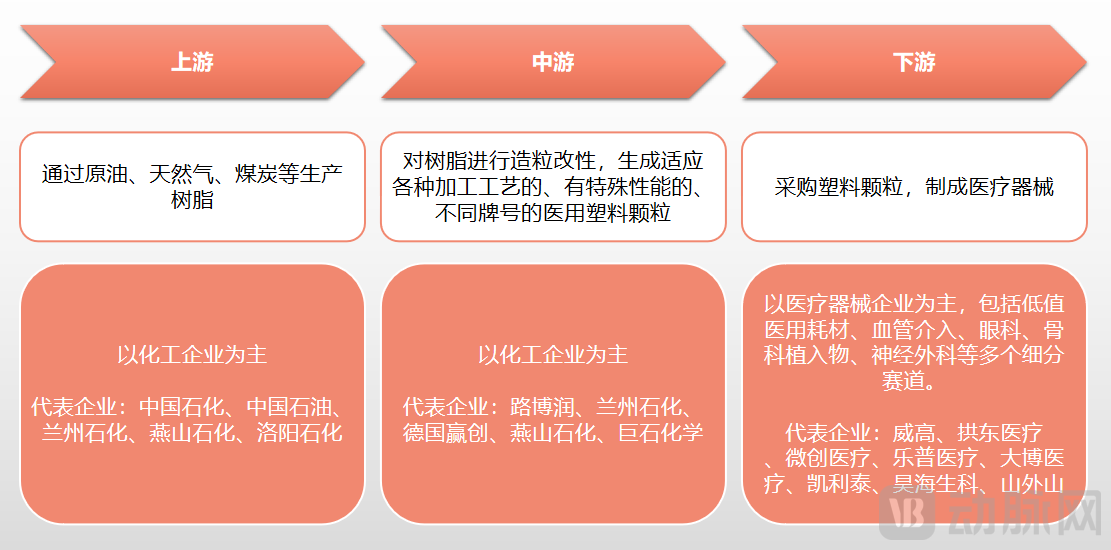
Upstream and Downstream Industrial Chain of Medical Polymers
Compared with conventional polymers, medical-grade polymers come into direct contact with pharmaceutical solutions and the human body; therefore, they must exhibit higher chemical stability and biosafety. Regulatory authorities impose stricter risk control measures on medical-grade polymers, requiring short-term biological testing reports. Implantable-grade medical polymers further require comprehensive biological testing, chemical characterization, and product traceability. Typically, medical-grade polymers available on the market have been certified and tested by authoritative medical regulatory bodies, with clear identification of which grades are designated as medical-grade.
Currently, common medical-grade polymers include polyethylene (PE), polyvinyl chloride (PVC), polystyrene (PS), polypropylene (PP), polycarbonate (PC), polyurethane (PU), polyamide, polyether ether ketone (PEEK), polysulfone, ABS, and thermoplastic polyurethane (TPU). According to market statistics, PVC and PE have the highest consumption, accounting for 28% and 24% of the medical polymer market, respectively. Additionally, PS accounts for 18%, and PP accounts for 16%.
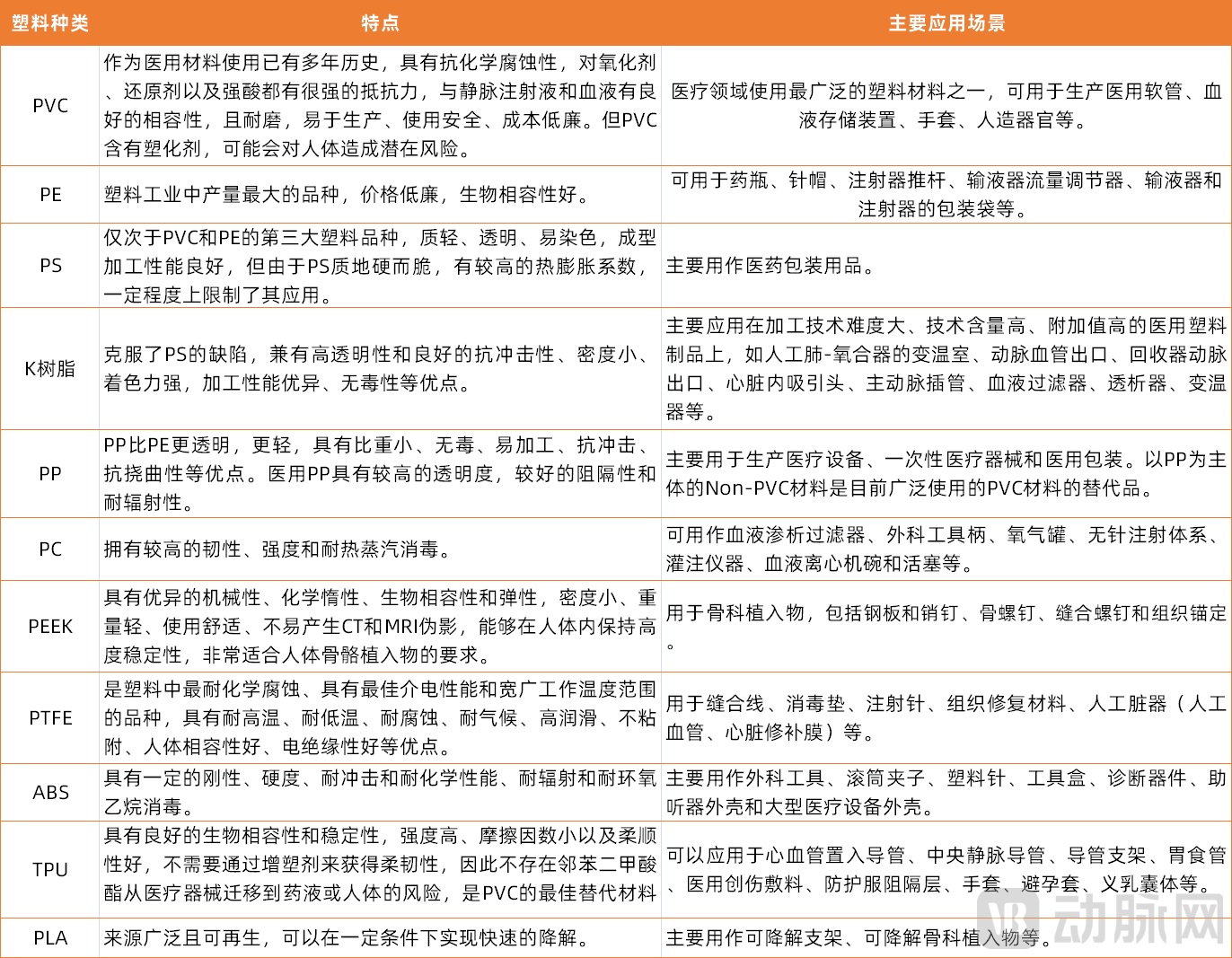
Common Types and Characteristics of Medical-Grade Polymers
In summary, there is a wide variety of medical-grade polymers, which are extensively applied in the healthcare sector.Previously, the polymer raw materials used in most domestic medical devices were predominantly PVC, PP, and PE.Used for the production of disposable medical devices.As China’s healthcare system continues to improve and medical standards rise, coupled with the accelerating pace of domestic substitution for high-end medical devices such as orthopedic implants and cardiovascular interventional products, the application of new high-performance polymer materials—including PEEK, PTFE, and TPU—in the medical field is expected to expand gradually.
In 2020, amid the COVID-19 pandemic, demand for epidemic prevention-related products such as face masks, protective suits, goggles, ventilators, and respirators surged in the short term, driving a spike in upstream demand for medical-grade polymers like polypropylene (PP) and polycarbonate (PC). Relevant companies delivered outstanding performance. For instance, during the pandemic, Dawn Polymer customized and produced a cumulative total of 25,000 metric tons of polypropylene spunbond material to ensure the supply of raw materials for nonwoven fabrics. Huitong Shares developed high-flow melt-blown PP materials for nonwoven fabrics and anti-fog transparent PC materials, among other products, for the production of epidemic prevention supplies. In the first half of 2020, Huitong Shares generated RMB 2.8 billion in revenue from its epidemic prevention products, accounting for approximately 14.86% of its total revenue, and achieved a gross profit of RMB 1.2 billion, representing about 34.94% of its total gross profit.
Therefore, against the backdrop of rapid growth in the medical device industry and the COVID-19 pandemic, attention to and the importance of the medical polymer industry have surged once again. Medical polymers are shedding the label of “low-end manufacturing,” with the pace of innovation and upgrading gradually accelerating. Recently, VCBeat conducted a comprehensive review of the medical polymer industry.
Compared with medical materials such as metals, ceramics, and glass, medical polymers offer multiple advantages.
I. Promote the rapid development of the disposable medical device market and ensure medical safety.Medical-grade polymers are lightweight, offer design flexibility, and are cost-effective, making them highly suitable for the manufacture of disposable medical devices such as infusion sets, syringes, and blood transfusion sets. The use of disposable medical devices reduces the risk of cross-infection and ensures greater safety in medical procedures.
II. Medical-grade polymers exhibit superior biocompatibility when used as implants.Medical-grade polymers are innovative materials used in cardiovascular stents and orthopedic implants. Traditionally, these devices are made from metals, which have several drawbacks: they are non-biodegradable, require surgical removal, are prone to causing immune rejection reactions, generate artifacts during imaging examinations, and exhibit suboptimal biomechanical properties. In contrast, polymer materials are less likely to trigger adverse immune responses. Cardiovascular stents and orthopedic implants fabricated from medical-grade polymers offer superior biocompatibility and do not produce artifacts during imaging studies.
For instance, PEEK exhibits excellent biocompatibility, biological stability, and radiolucency, drawing significant attention to its promising applications in artificial spinal devices, orthopedics, sports medicine, and cardiovascular care. Furthermore, implants fabricated from biodegradable polymers, represented by polylactic acid (PLA), can degrade autonomously, thereby avoiding the physical trauma associated with secondary surgical procedures. In 2016, Abbott’s globally first biodegradable polymer stent, developed based on PLA, received FDA approval. Huamu Medical has also leveraged PLA to develop a novel, self-degrading cervical interbody fusion cage.
III. Medical-grade polymers exhibit superior environmental adaptability.Polymers exhibit lower thermal conductivity than metals, resulting in reduced impact on patient implants under high- or low-temperature conditions.
IV. Medical polymers exhibit superior mechanical properties and enhanced wear resistance.Products such as tubing require frequent bending and twisting. Tubing made of metal materials has high rigidity and is prone to wear. By incorporating different additives into polymers according to their specific applications, polymers can exhibit varied physical and mechanical properties. Studies have shown that in simulated walking experiments, implants made from reinforced PEEK material exhibited 50% less wear compared to traditional metal implants.
For a long time, low-value medical consumables have been the largest application scenario for medical polymers. The market demand for low-value medical consumables is substantial and the scale is large, but they involve low technological content and offer low added value.Exploring the Application Potential of Medical-Grade Polymers in High-Value Medical Devices Such as Orthopedic Implants and Cardiovascular Interventions Has Become a New Trend.
China's orthopedic implant consumables market is driven by strong momentum and is developing rapidly. From 2010 to 2019, the market size of orthopedic implant consumables in China grew from RMB 7.2 billion to RMB 27 billion, with a compound annual growth rate (CAGR) of 15.8%. Orthopedic implants include trauma implant consumables, spinal implant consumables, and joint implant consumables.PE, PEEK, and PMMA are currently widely used medical polymers for orthopedic implants.
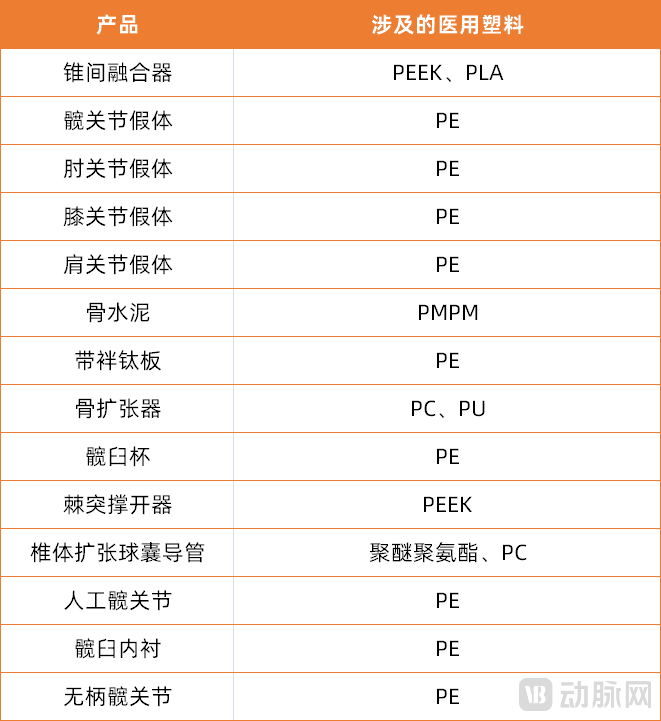
Medical Polymer Materials Involved in Certain Orthopedic Implants; Data Sourced from the Internet
In recent years, domestic medical device companies have increasingly entered the cardiovascular interventional device sector, driving rapid growth in China’s domestically produced cardiovascular interventional device industry. According to data from the National Health Commission, the market size of cardiovascular interventional devices in China grew from RMB 14.2 billion in 2015 to RMB 31.9 billion in 2019, representing a compound annual growth rate (CAGR) of 22.4%.PE, PTFE, PA, and other polymers are commonly used raw materials for cardiovascular interventional consumables.Due to the characteristics of cardiovascular interventional devices, such as small size, complex shapes, high geometric precision requirements, stringent hygiene standards, and high biochemical stability, large and medium-sized manufacturers of cardiovascular interventional devices generally purchase medical-grade polymers from foreign suppliers with mature production processes.
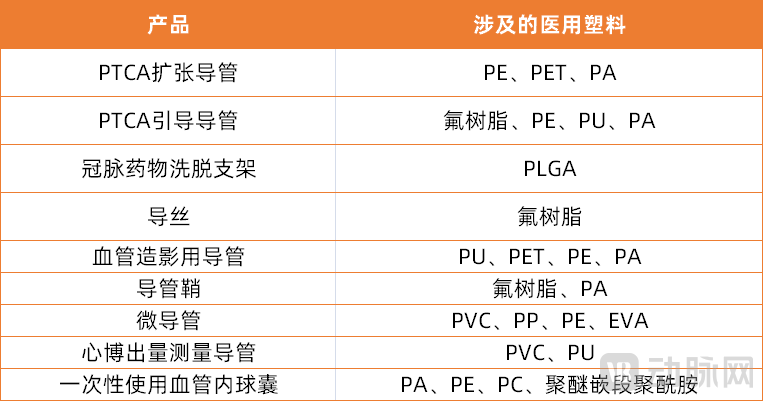
Medical Polymers Involved in Certain Cardiovascular Interventional Devices
Furthermore, emerging high-growth sectors such as ophthalmic consumables, blood purification devices, and controlled/sustained drug release systems also represent innovative application scenarios for medical-grade polymers. In the future, the application of medical-grade polymers in the high-end medical device market is expected to expand gradually.
Based on the registration status of medical polymer devices, currently registered medical polymer products in China are mainly concentrated in low-value medical consumables with low added value and low technological content, such as infusion sets, syringes, and laboratory testing supplies. There are relatively few high-value medical devices, such as ECMO systems, cardiovascular interventional devices, and orthopedic implants. This phenomenon is partly due to the late start of the high-value medical device sector, the significant challenges in research and development, and the domestic shortage of relevant professional talent.On the other hand, the high-end medical-grade polymers required for manufacturing high-value medical devices, such as PEEK and PC, are heavily reliant on imports, which constrains downstream development.
Medical polymers are closely linked to human health and are critical to ensuring the performance of medical devices. Therefore, stringent requirements are imposed on both the raw materials and manufacturing processes for medical polymers, necessitating safe and reliable materials, clean production workshops, precision manufacturing equipment, as well as low-cost and high-efficiency operations.
Currently, foreign enterprises such as Lubrizol, Evonik, BASF, DuPont, Avient, Membrana, Eastman Chemical Company, Victrex, Kolon Industries, Dow Chemical, Solvay, Covestro, and DSM are the main suppliers of high-end medical polymers in China.
China has gradually surpassed Europe and the United States to become the world's largest producer and consumer of TPU, but medical-grade TPU still relies mainly on imports.Lubrizol is a major domestic supplier of medical-grade TPU. Its developed ellethane® TPU is a safe, stable, and high-quality alternative to PVC, which has been recognized by numerous intravenous infusion set manufacturers worldwide. Tecobax™ is a patented TPU product developed by Lubrizol that withstands steam sterilization, making it an ideal material for short- to medium-term interventional devices.
PMP membranes are the core material for manufacturing ECMO devices. Currently, Mitsui Chemicals, Inc. of Japan is the world’s sole manufacturer of PMP resin, and Membrana, a subsidiary of 3M Company, is the global exclusive supplier of PMP membranes. PMP membranes exhibit high permeability coefficients for oxygen and nitrogen, with an oxygen flux approximately ten times that of polyethylene (PE). They also possess characteristics such as low extractables and biosafety, which enhance the separation between the blood and gas phases, overcome the issue of plasma leakage, and effectively extend the clinical usage duration of ECMO. Due to the difficulties in controlling process parameters, membrane formation, and stretching-induced pore formation during PMP membrane production, Membrana remains the exclusive supplier. Tight production capacity has constrained the output of downstream ECMO manufacturers, leading to supply shortages during the pandemic. Moreover,Due to supply and price monopolies, the high cost of PMP membranes has constrained domestic independent production of ECMO.
Domestic medical implants rely primarily on imported PEEK materials.Victrex (USA), Solvay (Belgium), and Evonik (Germany) are the primary suppliers of medical-grade PEEK materials. As the world’s largest supplier of PEEK materials, Victrex produces PEEK resins that represent the highest international standards. Its PEEK-OPTIMA series was the first dedicated implant-grade PEEK resin developed and has been successfully used in the manufacture of artificial spinal implants, artificial joints, bone repair devices, and other applications. Solvay, the second-largest global producer of PEEK, has developed Zeniva® PEEK, a long-term implantable material favored by numerous medical companies. Evonik, the third-largest global PEEK producer, launched the world’s first 3D-printable PEEK material for use in fabricating implants.In China, Jilin Zhongyan Polymer Materials Co., Ltd. has achieved industrialized production of PEEK, but domestically produced medical-grade PEEK remains unavailable.
Regarding the issue of reliance on imports for high-end medical-grade polymers, an industry insider in the field of medical consumables stated, “The import monopoly on high-end medical-grade polymers is primarily due to the late start of basic materials research in China, which lags behind developed countries by several decades.” Taking medical plastic products as an example, the United States surpassed one million tons in medical plastic product output in 1986, and Japan’s domestically produced medical plastic products reached 2 billion units in 1992, with sales amounting to RMB 190 billion. In China, plastic infusion bags began to be used only in the 1970s. It was not until 1987, when the Ministry of Health issued the Notice on Promoting the Use of Disposable Plastic Infusion Sets, Blood Transfusion Sets, and Syringes, that the domestic medical polymer industry experienced rapid development. He believes that with the booming development of China’s healthcare sector, intensified efforts in basic materials research and development, and a growing pool of specialized talent, the localization of high-end medical-grade polymers holds promising prospects.
Yan Ge, Senior Business Manager for Greater China at Lubrizol Life Science Health, has over 20 years of experience in the medical polymer industry. He stated that the reliance on imports for high-end medical polymers is not solely due to technological limitations but rather stems from multiple factors.
First, the demand for polymers in the medical market is relatively small.Currently, the vast majority of polymers are utilized in industrial and consumer sectors, with only a small fraction employed in medical devices. It is understood that globally, no more than 3% of polymer materials are used in the medical field. Consequently, many polymer manufacturers devote minimal attention and investment to the healthcare sector.
Second, China's medical polymer market is subject to stringent regulatory oversight, necessitating sustained investment and entailing prolonged project development cycles.The complex documentation required for innovative product registration, including raw material certificates, safety certifications, and clinical data. Stringent regulatory requirements have resulted in a slower development pace for innovative medical polymers in China compared to foreign countries.
Third, following the implementation of centralized procurement policies, prices for many medical devices plummeted sharply. Device manufacturers were forced to cut procurement costs for polymer materials and slow down new product development, leading to a further decline in profits for polymer manufacturers.
It is precisely because the medical market’s demand for polymers is relatively small, faces pressure from centralized procurement, and is subject to strict regulations that require substantial and long-term investment, leading domestic manufacturers to adopt a conservative approach toward the development of innovative medical-grade polymers, which has, to some extent, dampened enterprises’ enthusiasm for developing new materials.
However, stringent regulation does not necessarily equate to negative outcomes. Many industries grapple with the dilemma of “stagnation under strict control and chaos upon deregulation.” The key lies in finding an appropriate balance. In recent years, Chinese regulatory authorities have been continuously revising and improving relevant regulations and oversight mechanisms, aiming to promote the healthy and sustainable development of the industry while ensuring the safety of medical-grade polymers. Meanwhile, Yan Ge also expressed hope that downstream manufacturers would demonstrate greater flexibility and tolerance regarding pricing from polymer producers.
VCBeat has noted that the pace of innovation in medical-grade polymers is accelerating in China, with many domestic companies launching innovative products focused on high-end and differentiated solutions.
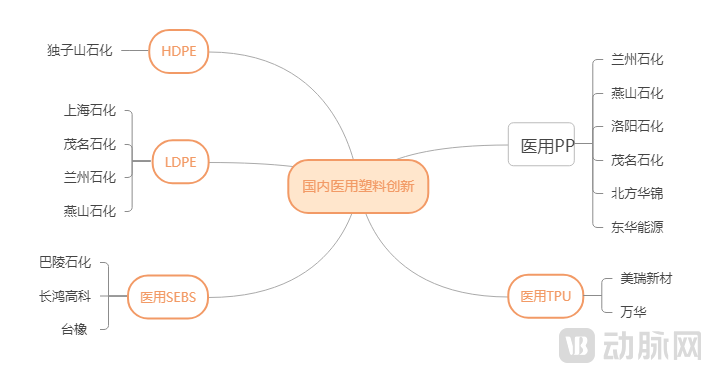
We look forward to the continuous improvement of relevant domestic regulations in the future, increased investment by related enterprises in the medical market, enhanced innovation capabilities, and accelerated localization of high-end medical polymers such as medical-grade PEEK.