

LifeStance Health Goes Public on Nasdaq Amid Surging Demand for Digital Mental Health Solutions

Silversmith Capital Partners
Private Equity Firms

TPG
Global Private Equity Investment Firms

LifeStance Health
Behavioral Healthcare Service Provider

Summit Partners
Global Alternative Investment Firm
On June 10 local time, U.S. mental health services provider LifeStance Health Group, Inc. (stock ticker: LFST; hereinafter referred to as “LifeStance”) listed on the Nasdaq, with Morgan Stanley, Goldman Sachs, JPMorgan Chase, and Jefferies serving as the lead bookrunners for the offering.
LifeStance priced its offering at $18.00 per share, issuing a total of 32.8 million shares. The stock opened at $20.00 and closed at $21.90, representing a 21.67% increase over the IPO price, with a total market capitalization of $8.183 billion.
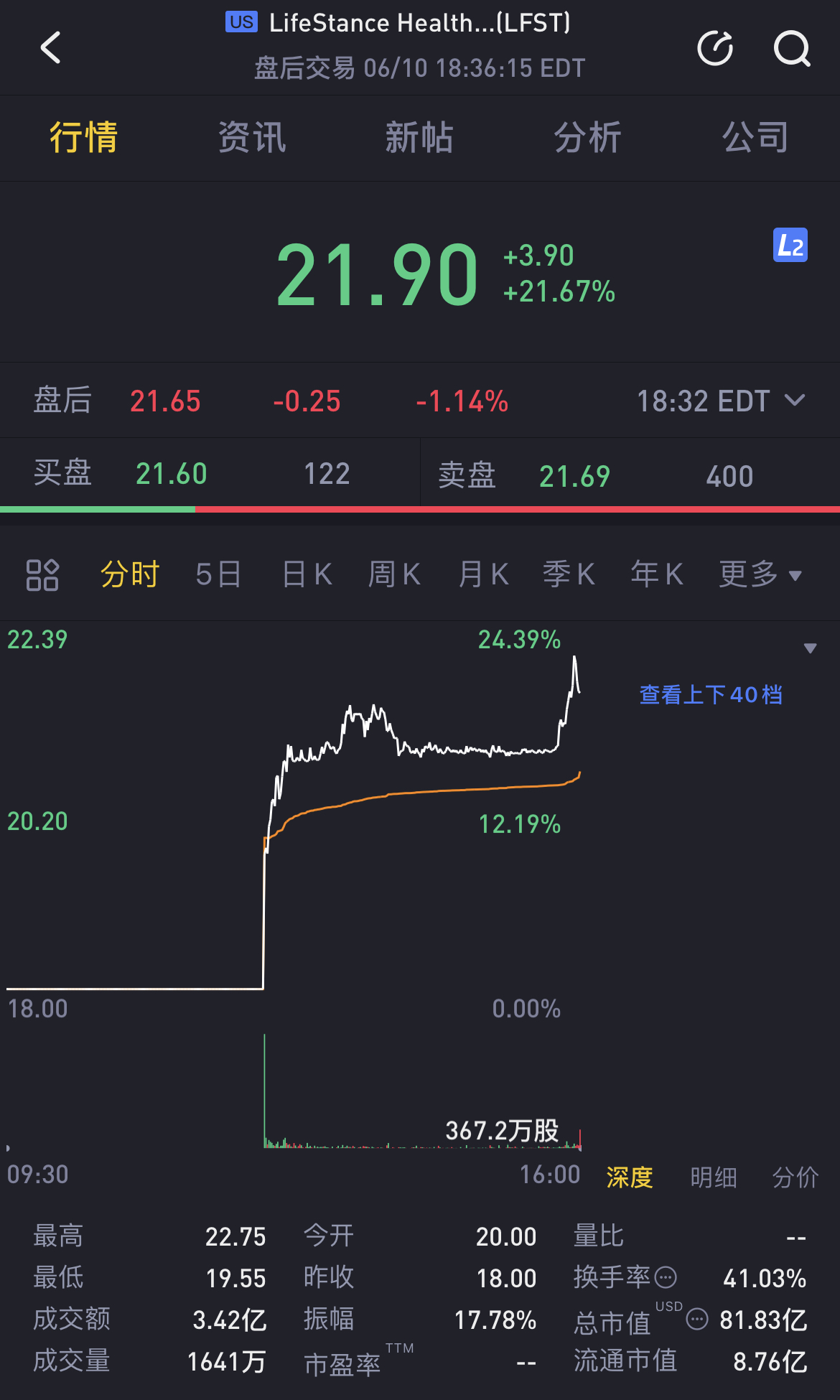
LFST Trading Activity | Source: Tiger Brokers
Previously, LifeStance secured over $1 billion in equity investments from institutional investors such as TPG Capital, Summit Partners, and Silversmith Capital Partners. The prospectus indicates that LifeStance plans to allocate $302.7 million from the net proceeds of this offering to repay outstanding amounts under its existing credit agreement and for general corporate purposes, including operating expenses and potential acquisitions or strategic investments.
LifeStance is a behavioral healthcare company dedicated to providing evidence-based, integrated online and offline treatment services for patients with mental health conditions. Founded in 2017 and headquartered in Scottsdale, Arizona, the company was co-founded by Michael Lester, who serves as its Chairman and CEO. Mr. Lester previously served as the Founder and CEO of Accelecare Wound Centers.
The $10 Billion Mental Health Market: LifeStance’s Business Is Flourishing
In 2019, more than 51 million people in the United States suffered from mental illness. Each year, one in five American adults and one in six young people experience mental illness. Over 45% of adults will encounter at least one mental health issue during their lifetime, and more than one-third of individuals with chronic diseases also suffer from mental health disorders. In recent decades, the incidence of psychological and psychiatric disorders has been on the rise.
Since the outbreak of the COVID-19 pandemic, adverse psychological and mental health conditions (including depression and anxiety) have become widespread among large populations. The crisis in mental health has become increasingly prominent, even surpassing cancer and heart disease to constitute a greater disease burden.
LifeStance’s prospectus states that individuals with mental health conditions increase overall healthcare costs by 50% to 100%. However, addressing this crisis faces numerous barriers, including poor patient accessibility and affordability, as well as insufficient clinical scale, organizational capacity, and resources.
LifeStance’s estimates indicate that the U.S. outpatient mental and behavioral health market was valued at approximately $116 billion in 2020. Driven by rising disease prevalence, greater awareness and acceptance, and increased support from federal and state regulations, this market is projected to grow at a compound annual growth rate (CAGR) of 14% over the next five years, reaching $215 billion.
LifeStance was founded in response to these urgent market needs and the vast potential of the market space. The company combines personalized, digital patient experiences with differentiated clinical capabilities and in-network insurance relationships to build a technology-enabled, integrated online and offline care delivery platform. This approach transforms how patients access mental health treatment, thereby expanding accessibility and affordability, improving outcomes, and reducing overall healthcare costs.
LifeStance brings together psychiatrists, psychologists, nurse practitioners, and licensed therapists to provide comprehensive mental health treatment services for individuals, families, and groups.Its care delivery platform is equipped with an online mental health assessment system, a seamlessly integrated internal referral and follow-up system, and a doctor-patient communication system, enabling full-cycle care management for patients.Patients can receive appropriate treatment through online platforms or in-person clinic visits.
LifeStance has established “LifeStance Health” mental health outpatient centers across the United States, based on clinician headcount and regional coverage, to treat conditions including but not limited to anxiety, depression, bipolar disorder, schizophrenia, and post-traumatic stress disorder.

As of March 31, 2021, LifeStance operated more than 300 outpatient care centers across 73 Metropolitan Statistical Areas (MSAs) in 27 states nationwide through its subsidiaries and affiliates. The company employed over 3,300 licensed mental health clinicians, recorded more than 2.3 million visits to its online platform, and provided treatment services to nearly 360,000 patients.
Survey data from LifeStance patients shows that the company’s digital health platform has a Net Promoter Score (“NPS”) of 8. Furthermore, LifeStance has demonstrated notable clinical effectiveness: after two treatment sessions, 81% of patients reported reduced suicidal ideation, 53% reported improved depressive symptoms, and 54% indicated alleviation of anxiety symptoms.
Payment Model: Compatible with virtually all commercial insurance plans
LifeStance supports multiple payment methods, but its primary source of revenue remains commercial insurance. According to LifeStance’s prospectus,89% of the company's 2020 revenue came from commercial insurance., with only 5% from government medical insurance, 4% from out-of-pocket payments by patients, and 2% from non-patient services.
By tracking clinical outcomes, quality of care, and insurance utilization rates, LifeStance not only follows up on patient treatment progress but also provides insurers with quantifiable key metrics. This facilitates the design of insurance products and enhances the accessibility and affordability of disease treatment.
LifeStance Health’s contracts with insurance providers typically adopt a fee-for-service model, with reimbursement rates negotiated based on clinical services.In 2020, 93% of LifeStance patients utilized commercial insurance. Currently, LifeStance is in-network with over 200 commercial insurance plans, actively collaborating with multiple Medicare Advantage plans, and continuously expanding its commercial insurance coverage.
According to the prospectus, LifeStance’s total revenue increased from $100 million in 2018 to $377 million in 2020. Revenue for the first quarter of 2021 was $143 million, nearly double the $73.11 million reported in the same period of the previous year.
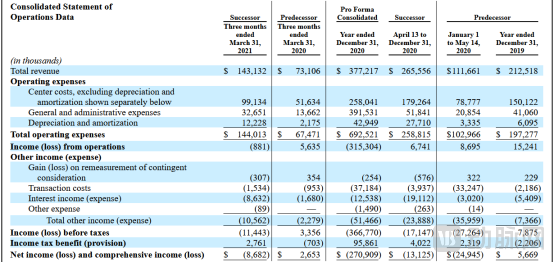
LifeStance Financial Overview | Source: LifeStance Prospectus
Fierce Competition, Operating Losses: Is an IPO Merely a Stopgap Measure?
The mental health care market is highly fragmented and intensely competitive. LifeStance faces varying degrees of competition from traditional healthcare providers, medical technology platforms, care coordination and management platforms, digital health solutions, telehealth services, and health information exchange platforms.
LifeStance operates in regions with distinct competitive landscapes. It not only competes with local outpatient mental health service providers for patients and commercial insurance contracts, but also faces intense competition from other clinical practices, hospitals, health systems, and outpatient mental health providers in recruiting psychiatrists, advanced practice nurses, psychologists, therapists, and other healthcare professionals.
In addition to direct competitors, LifeStance’s indirect competitors also include consumer-driven point solutions, such as in-person and virtual life coaching, digital therapeutics and support tools, and technology platform providers related to mental health care services.
Facing fierce external competition and internal challenges, LifeStance reported total revenue of $377 million in 2020, but its operating loss reached as high as $315 million. In the first quarter of 2021, the company incurred an operating loss of $880,000, compared to a net operating profit of $5.635 million in the same period of the previous year.
Furthermore, LifeStance is heavily indebted. As of March 31, 2021, LifeStance had $39.5 million in cash and total liabilities of $580.5 million. In the previous fiscal year, the company’s free cash flow was negative ($41.5 million). The most explicit use of the proceeds from this IPO is to repay debt.
Overall, LifeStance achieved impressive revenue growth during the global pandemic. With increased government funding for mental health, rising public awareness of mental health needs in the United States, and a payment model fully integrated with commercial insurance, LifeStance is well-positioned for business expansion.
This IPO has directly propelled LifeStance to launch new expansion plans. The company has identified 28 additional Metropolitan Statistical Areas (MSAs) for expansion, aims to acquire more existing high-quality service centers, and seeks to extend its market coverage to 57% of the U.S. population. In the short term following the listing, LifeStance’s performance is expected to improve and achieve anticipated returns.