

MicroPort MedBot Files for Hong Kong IPO with RMB 22.5 Billion Valuation Backed by Hillhouse

MedBot
Surgical Robot Developer
On June 10, 2021, MicroPort spun off MedBot for its listing in Hong Kong, a move that greatly energized China’s surgical robotics industry. Although MedBot was not the earliest entrant in the surgical robotics sector, it has demonstrated aggressive growth momentum.
In 2014, MicroPort began developing laparoscopic surgical robots and incubated the initiative as an internal project. In 2015, MedBot was officially registered and established in China. In September 2020, it completed a RMB 3 billion financing round, the largest in China’s surgical robot sector, attracting multiple prominent strategic investors including Hillhouse Capital, CPE, Bailin Capital, Yuanyi Investment, and E Fund Capital. Following the financing, MedBot’s post-money valuation was approximately RMB 22.5 billion.
On December 31, 2020, MedBot signed a listing advisory agreement with CICC, planning to list on the STAR Market; on the same day, MedBot completed its joint-stock reform. In June 2021, MedBot began its push for an IPO on the Hong Kong Stock Exchange, with JPMorgan and CICC serving as joint sponsors. Based on the shareholding structure, MicroPort Medical holds approximately 52.76% equity interest in the spun-off company.As of December 31, 2020, Hillhouse held more than 8% of the shares in MedBot, making it the largest institutional investor.
MedBot operates in the surgical robotics sector, a high-growth market with significant entry barriers.
Surgical robots are advanced medical devices invented through the development of minimally invasive surgery and related underlying technologies. Surgical robots are used to achieve precision control of surgical instruments beyond human capabilities in the field of minimally invasive surgery, which exceeds human abilities. A surgical robot typically consists of a surgeon console, a patient-side cart equipped with robotic arms, and a vision system. The surgeon sits at the console, viewing three-dimensional images of the surgical site transmitted by an endoscope placed inside the patient’s body, while controlling the movement of the robotic arms as well as the surgical instruments and endoscope attached to them. The robotic arms mimic human arms, providing surgeons with a range of motions that simulate those of the human wrist, while simultaneously filtering out hand tremors.
From the perspective of its product pipeline, MedBot has five major product lines: laparoscopic surgical robots, orthopedic surgical robots, vascular interventional surgical robots, natural orifice surgical robots, and percutaneous puncture surgical robots.
Among them, MicroPort'sToumai Four-Arm Laparoscopic Surgical RobotBenchmarking against Intuitive Surgical’s da Vinci surgical robot series, Toumai is primarily used in a wide range of surgical procedures, including urological, gynecological, thoracic, and general surgeries. Toumai is currently in the clinical trial phase. Other domestic laparoscopic surgical robots also entering the clinical trial phase include Weigao’s Microhand-S system and the Kangduo surgical robot.
In the field of orthopedic surgical robots, MicroPort'sHonghu Series of Joint Replacement Surgical RobotsThe system is benchmarked against Stryker’s MAKO RIO surgical robot (approved for market launch by the National Medical Products Administration in 2014), which is primarily used for total knee arthroplasty (TKA). Honghu has completed patient enrollment for its clinical trials. In China, Jianjia Surgical Robot and Yuanhua Intelligent Total Knee Arthroplasty Surgical Robot have also completed clinical enrollment. In addition, Hua Ruibo’s total knee arthroplasty surgical robot has advanced to the clinical trial stage.
InVascular Interventional RobotIn the field of vascular interventional surgical robots, MicroPort’s product originates from Robocath, a French company specializing in vascular interventional surgical robotics. The two companies have established a strategic partnership to jointly develop the R-One system. Vascular interventional surgical robots are used to treat diseases affecting blood vessels or related organs within the cardiac, cerebral, or peripheral vascular systems. Other major players in China’s vascular interventional robot market include Siemens Healthineers, Allpen Medical, Weimai Medical, and Aibo Medical.
Like vascular interventional robots, MedBot'sPercutaneous Puncture Surgical RobotThe products are also introduced through partnerships. Percutaneous puncture surgical robots are primarily used to collect tissue samples for disease diagnosis, such as detecting early-stage lung cancer, breast cancer, and prostate cancer. In this field, MicroPort Medbot has expanded its product portfolio through commercial collaborations with Singapore-based NDR Medical Technology to include its Automatic Needle Targeting (ANT) robotic system, and with Biobot to incorporate its Mona Lisa prostate biopsy robot.
Furthermore, MedBot has proactively laid out its strategic presence inNatural Orifice Surgical Robot, natural orifice surgical robots are applied in natural orifice endoscopic surgeries, such as bronchoscopy (lung examination), colonoscopy (intestinal examination), and gastroscopy (stomach examination). Globally, only three natural orifice surgical robots have received FDA approval, including the Ion bronchial robot developed by Intuitive Surgical, the Monarch bronchial robot developed by Johnson & Johnson, and the Flex gastrointestinal robot developed by MedRobotics. In this field, MedBot has chosen to directly compete with Intuitive Surgical and Johnson & Johnson by developing a transbronchial surgical robot, which is currently in the design phase.
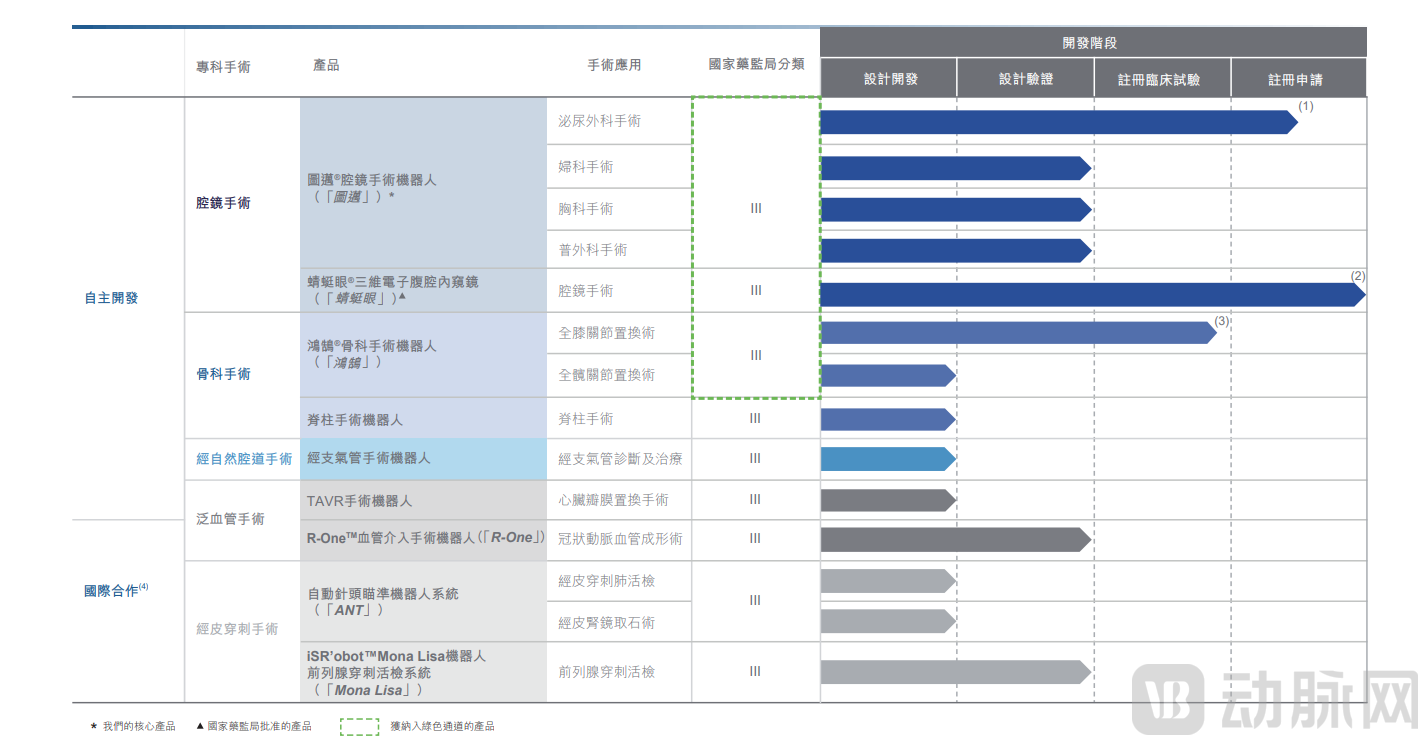
MedBot Product Portfolio
From the perspective of MedBot’s product portfolio, apart from its 3D electronic laparoscope (approved for market launch in June 2021), MedBot does not yet have any surgical robot products that have obtained commercialization licenses in China.
With no mature commercialized products, MedBot has yet to generate any revenue or incur cost of sales, remaining in a loss-making stage. The company recorded losses of RMB 69.8 million and RMB 209 million in 2019 and 2020, respectively. In the first quarter of this year, the loss amounted to approximately RMB 115 million, representing a 3.9-fold increase from RMB 23.62 million in the same period last year. The losses were primarily driven by R&D expenses and administrative expenditures.
In terms of R&D investment, MedBot’s research and development costs amounted to RMB 60 million, RMB 135.4 million, and RMB 90.1 million in 2019, 2020, and the first quarter of 2021, respectively. MedBot projects that future R&D expenditure will continue to rise in tandem with the expansion of its research and development activities.
Surgical robots are scarce assets in the secondary market. Currently, the only listed domestic surgical robot company is Tinavi Medical Technologies, which went public on the STAR Market in July 2020. However, within less than a year of its listing, Tinavi’s market capitalization halved. How MedBot will perform on the Hong Kong Stock Exchange remains to be seen.