

China's Largest Hair Restoration Provider Yonghe Medical Files for Hong Kong IPO, Backed by a 250-Million-Person Market
China’s RMB 10-billion hair transplant industry is about to welcome its first publicly listed company.
On June 17, Yonghe Medical Group Co., Ltd. (hereinafter referred to as “Yonghe Hair Transplant”) filed an application for listing on the Main Board of the Hong Kong Stock Exchange, with Morgan Stanley and CICC serving as joint sponsors.
As a leading enterprise in China’s hair health sector, Yonghe Hair Transplant was established in 2005 and has since developed into a comprehensive hair care medical conglomerate encompassing alopecia outpatient services, pharmacological treatments, the Savena Hair Care Center, and the Hadafa Wig R&D and Production Center. According to data from Frost & Sullivan,Among hair restoration medical service providers in China, Yonghe Hair Transplant ranks first based on various key financial and operational metrics, including total operating revenue, number of registered physicians, and number of patients undergoing hair transplant procedures in 2020.
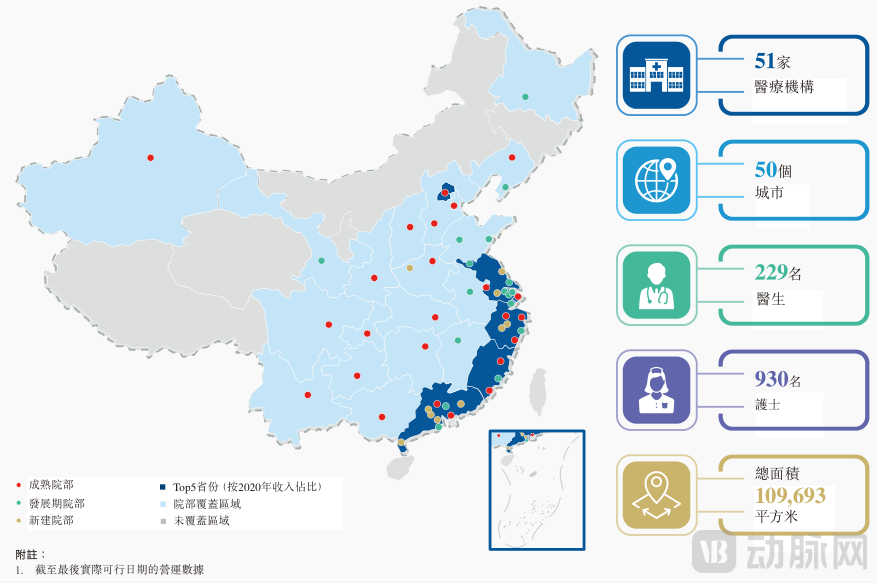
According to the prospectus, Yonghe Hair Transplant operates 51 medical institutions across 50 cities in China, making it the largest and most widely distributed chain of hair transplant medical institutions in the country. It also leads the industry in terms of the growth rate of new store openings. Notably, Yonghe Hair Transplant has assembled the largest medical team in the industry, comprising approximately 1,200 members, including 229 registered physicians and 930 nurses, a figure that exceeds the combined total of the second- and third-largest players in the sector.
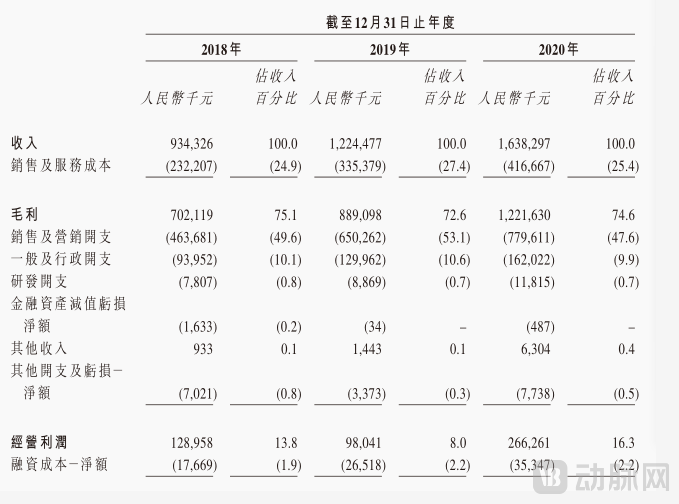
Revenue figures also stood out as a major highlight. The prospectus revealed that Yonghe Medical’s total revenue grew from RMB 934 million in 2018 to RMB 1.22 billion in 2019, representing a 31.1% increase. In 2020, total revenue continued to climb, reaching RMB 1.64 billion, a year-on-year increase of 33.8%.As for gross profit margin, it remained at a high level of over 70% from 2018 to 2020.
(Image source: Yonghe Hair Transplant prospectus)
After 16 years in operation and on the verge of an IPO, how has Yonghe Hair Transplant managed to break out ahead of its competitors? What is the composition of its business? For a hair transplant procedure that often costs tens of thousands of yuan, where do the costs actually lie? What are the company’s core competitive barriers? What new trends are emerging in the hair care sector? To address these questions, VCBeat (WeChat ID: vcbeat) will now dissect and conduct an in-depth analysis of Yonghe Hair Transplant’s prospectus.
The Development History of Yonghe Hair Transplant: An Evolution from the Chaotic, Small-Scale, and Fragmented Phase to Standardized Chain Operations, and Further Toward Diversified Business Development in China’s Hair Restoration Medical Service Industry
According to the prospectus, it took Yonghe Hair Transplant five years, from its establishment in Beijing in 2005 to the creation of the “Yonghe” brand. It was also in 2010 that Yonghe Hair Transplant formulated China’s first hair transplant industry standard reported by China Central Television (CCTV) and became the country’s first hair transplant medical service provider to obtain ISO certification.
By 2013, Yonghe Hair Transplant began to lay out its business across China and operated entirely through directly-owned stores; in 2014, Yonghe Hair Transplant introduced five guarantee service agreements to assume risks for patients before and after surgery, and publicly disclosed the entire hair transplant procedure in the same year to enhance industry transparency; in 2017, it introduced the “Yongting” brand and entered the high-end personalized hair transplant market; in 2020, Yonghe Hair Transplant reached a strategic cooperation with Ping An and launched the industry’s first hair transplant insurance...
(Image source: Yonghe Hair Transplant's prospectus)
As of now, with RMB 1.4 billion in hair transplant revenue, 229 registered physicians, 51 hair transplant medical institutions, and over 50,000 patients served, Yonghe Hair Transplant has become China’s largest hair transplant medical service provider.
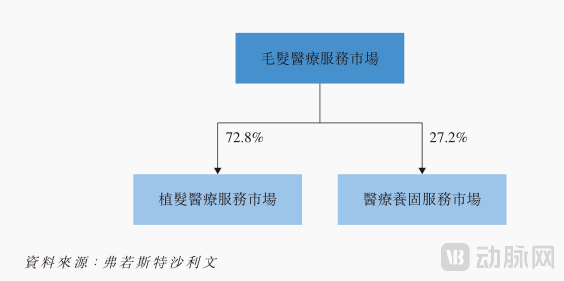
The prospectus shows,Yonghe Hair Transplant’s core business currently consists of two segments: hair transplant medical services and medical hair care and maintenance services.These two business segments correspond precisely to the two major subsectors of the hair restoration medical services industry.
(Image source: Yonghe Hair Transplant prospectus)
First, hair transplant medical services primarily address the need of patients with hair loss to regain their hair.
From the perspective of Yonghe Hair Transplant's strategic layout,The core of this business segment lies in the supply of professional hair transplant medical personnel and reliable hair transplant technology.AtPhysician Level, since hair transplantation requires operation through tiny incisions, the process demands higher precision than traditional surgery, thus placing greater demands on the professional competence and experience of medical service personnel; inTechnical LevelMinimal scalp trauma, rapid recovery, favorable outcomes, high postoperative hair density, and natural hair growth direction are key indicators for evaluating technical proficiency. Driven by these criteria, hair transplantation technology has gradually evolved from Follicular Unit Extraction (FUE) to the current micro-needle hair transplantation technique.
Of course, China's hair transplant medical service market is subject to strict regulation, thereforeAll hair transplant medical service providers must obtain a valid medical license.Furthermore, regarding diagnostic and therapeutic capabilities, the etiologies of hair disorders involve a wide range of potential causes, thereby imposing high demands on the comprehensive medical service capabilities of hair transplant institutions.
To enhance its medical service capabilities, Yonghe Hair Transplant has established a set of recruitment standards and training systems for physicians; on the patient side, it has built a customer service system and provides 24-hour consultation services; in terms of technological application, Yonghe Hair Transplant has obtained six invention patents for medical technologies.
It is precisely in the continuous enhancement of healthcare service capabilities thatYonghe Hair Transplant has gradually expanded its market presence, capturing an 11% share of China’s hair transplant medical services market in 2020.
Furthermore, medical hair care and maintenance services primarily provide long-term conditioning regimens for patients with hair concerns (excluding hair loss).
More specifically, this segment of the business can serve as a supplement to pre- and post-operative care for hair transplant medical services, helping individuals with folliculitis or those in the early stages of hair loss receive treatments that include pharmaceuticals or medical devices.The core lies in the development of related products and service solutions, thus requiring a multidisciplinary approach (e.g., endocrinology, dermatology).
Therefore, in terms of research and development, Yonghe Hair Transplant has collaborated with several key universities in China. For instance, it has partnered with Sun Yat-sen University to work on solutions for immune rejection in hair follicle transplantation, develop novel small-molecule drugs for preventing anxiety-induced hair loss, and create multifunctional hair transplant surgical beds and gentle foam shampoos, achieving preliminary results to date.
As of now, Yonghe Hair Transplant holds a 5% market share in China’s medical hair care and maintenance services sector.
In summary, Yonghe Hair Transplant’s development has primarily gone through three key milestones: brand establishment, chain-based expansion, and the adoption of a diversified strategy that extends from hair transplant medical services to include medical hair care and maintenance services. The company has achieved commendable results in both of its core business segments—hair transplant medical services and medical hair care and maintenance services.
Having clarified its development trajectory and business operations, what is the logic behind Yonghe Hair Transplant’s strategic layout? A key analysis will follow.
The prospectus shows that Yonghe Hair Transplant's annual total revenue from 2018 to 2020 was RMB 934 million, RMB 1.22 billion, and RMB 1.64 billion, respectively, with a year-on-year growth rate of over 30%.
Behind the rapid revenue growth, we believeYonghe Hair Transplant has benefited from its strategic positioning in four key areas: rapid industry growth, the advancement of chain operations, the application of new technologies, and the establishment of a closed-loop business model.
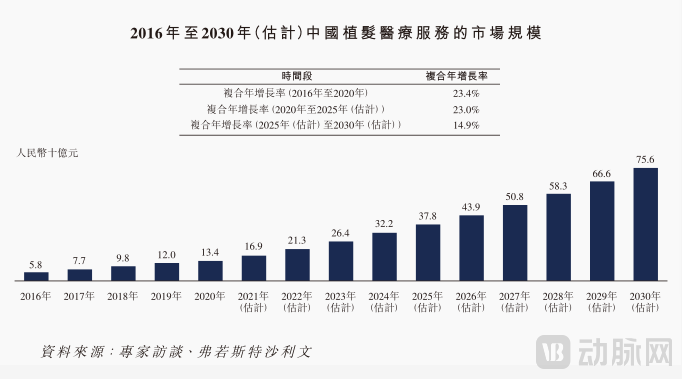
First, let's look at the industry's rapid growth.In recent years, the booming “appearance economy” has significantly raised people’s expectations and demands for their outward appearance. Coupled with mounting work- and life-related stress among contemporary individuals, hair loss has become increasingly severe, driving rapid growth in demand for hair transplantation and a rising penetration rate. According to Frost & Sullivan’s assessment,China's hair transplant medical services market is projected to grow from RMB 13.4 billion in 2020 to RMB 37.8 billion in 2025, representing a compound annual growth rate (CAGR) of 23%.A vast market offers significant growth potential, with institutions like Yonghe Hair Transplant holding considerable room for expansion.
(Image source: Yonghe Hair Transplant prospectus)
Next, let us examine the advancement of chain operations.Yonghe Hair Transplant has established a presence in 50 cities across China and is expanding into new markets, thereby achieving economies of scale in both the standardization of hair transplant medical services and the procurement of related medical devices. As is well known, since hair transplant treatment is primarily a one-time service, customers place significant emphasis on safety and efficacy. Therefore, the standardized capabilities built through its chain operations help ensure a relatively consistent experience for hair transplant patients across various clinics, thereby enhancing brand reputation.
Next, let’s look at the application of new technologies.Once chain institutions reach a certain scale, they need to reduce costs and increase efficiency through appropriate informatization construction, thereby strengthening their competitive moat. The prospectus reveals that, in addition to traditional SaaS software systems, Yonghe Hair Transplant is also actively introducing new technologies, such as automated follicle detectors and robotic arms for hair follicle transplantation, to improve standardization and service efficiency.
Finally, in terms of building a closed-loop business model.In the field of hair transplantation, despite the high average transaction value per customer, user stickiness remains low due to the infrequent nature of the procedure. This has historically resulted in a one-off transaction model for hair transplant clinics, where nearly all customers are lost after treatment, necessitating continuous acquisition of new clients. Starting in 2019, Yonghe Hair Transplant expanded into the medical hair care and maintenance sector, thereby unlocking a new avenue for growth. This is becauseMedical wellness and maintenance services are more frequently utilized than medical hair transplant services, resulting in higher user stickiness. Leveraging high-frequency services to drive low-frequency ones will help Yonghe Hair Transplant achieve stable and sustained revenue.
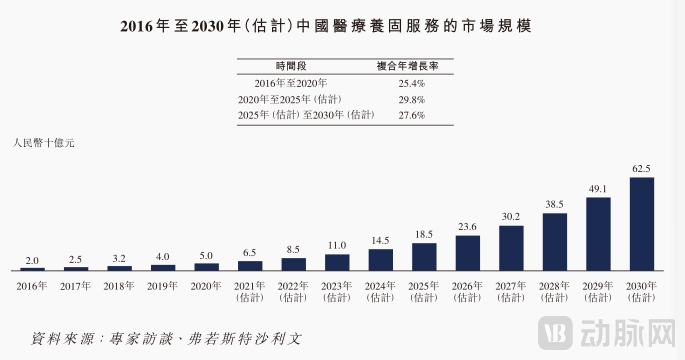
More notably, the continued expansion of the medical hair care and maintenance services market may also become Yonghe Hair Transplant’s second growth curve. According to Frost & Sullivan’s projections, in 2025 and 2030, the medical hair care and maintenance services market will account for 32.9% and 45.3%, respectively, of the total hair-related medical services market in China; that is to say,The future market for medical healthcare and wellness services will become the primary driver of growth in the hair care medical services market.
(Image source: Yonghe Hair Transplant prospectus)
In summary, operating within the rapidly growing consumer healthcare sector of hair medical services, Yonghe Hair Transplant has achieved economies of scale through its chain-based model. By leveraging new technologies to reduce costs and enhance efficiency, and by using high-frequency hair care and maintenance services to drive low-frequency hair transplant procedures, the company has established a closed-loop business model.
However, there are hidden concerns behind the rapid growth. After all, with a gross profit margin exceeding 70%, Yonghe Hair Transplant’s net profit margin in 2020 was only 10% after deducting other costs (5.7% in 2018 and 2.9% in 2019). Why is this the case?
A claim circulating on the internet asks: What is a programmer’s most expensive body part? The answer is hair. This is because once hair loss occurs, the average cost per patient for hair transplantation often exceeds RMB 10,000; if the latest microneedle hair transplantation technology is used, the cost can even surpass RMB 50,000.
Why Is Hair Transplantation So Expensive? To begin with, it is essential to understand the underlying principle. Since each hair follicle on the human scalp is independent and capable of normal growth, healthy follicles can be harvested from other areas of the body and transplanted to balding regions to address hair loss. Consequently,Hair transplant procedures on the market are mostly priced based on the number of hair follicle units implanted.
Public data shows that the current price for hair transplantation starts at RMB 10 per follicular unit, which may not seem high. However, since most hair transplant procedures require the extraction of thousands of follicular units, the total cost of a single surgery can easily reach tens of thousands of yuan.
With such a high average transaction value, where do the costs lie? The prospectus shows that,"Besides labor costs and store rent, the majority of funds are primarily allocated to customer acquisition marketing."How high is it?Yonghe Hair Transplant accounted for 47.6% of total revenue in 2020, nearly half.. Specifically, according to previous research by VCBeat, the average comprehensive customer acquisition cost in the hair transplant industry is over RMB 2,000 per person.
From the perspective of industry competition, due to current overreliance on marketing, coupled with the high labor costs of doctors—a scarce resource—and persistently high rental expenses, the hair transplant industry is prone to engaging in intense price wars under survival pressure. This erodes corporate profits, may even trigger vicious competition, leads to a decline in medical quality, and causes a crisis of patient trust, ultimately forming a vicious cycle that hinders industry development.
It is not difficult to observe that hair restoration medical service providers, represented by Yonghe Hair Transplant, remain heavily reliant on marketing.From this perspective, Yonghe Hair Transplant still faces severe challenges in its future development; therefore, it needs to find more diversified ways to reduce costs and gradually wean itself off its reliance on marketing.
In China's hair transplant industry, four main types of players have currently emerged.
First, hair transplant departments in public hospitals such as Shanghai Changzheng Hospital and Southwest Hospital; second, hair transplant departments in private medical aesthetic and plastic surgery institutions represented by Yimeier and Xiduo; third, private non-chain hair transplant institutions represented by Hengbo; and fourth, national private chain hair transplant institutions represented by Yonghe Hair Transplant, Biliansheng, Xinsheng Hair Transplant, and Damai.
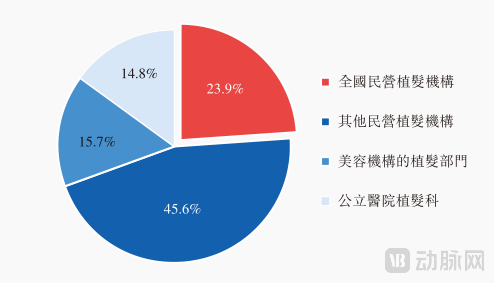
According to the prospectus, large chain hair transplant institutions, including Yonghe Medical, Biliansheng, Damai, and Xinsheng Hair Transplant, collectively account for approximately 23.9% of China’s hair transplant market share. Local non-chain specialized hair transplant clinics, due to their vast numbers, hold approximately 45.6% of the market share. The hair transplant departments of comprehensive medical aesthetic institutions account for approximately 15.7% of the market share, while public hospitals’ hair transplant departments hold the remaining 14.8%.
(Image source: Yonghe Hair Transplant prospectus)
In fact, the hair transplant industry has been developing in China for over 20 years, but it only gained widespread public attention and discussion in 2017, when “China surpassed Brazil to become the world’s second-largest medical aesthetics market.” Public records show that Yonghe Hair Transplant and Biliansheng both secured large financing rounds exceeding RMB 100 million starting from that year.
It was also from that year onward that the hair transplant industry, buoyed by capital infusion, launched a fierce marketing war, with advertisements saturating streets and alleys, leading to a major reshuffling of the hair transplant market. Among them, small and medium-sized hair transplant clinics found themselves in a precarious position. AndFor large hair transplant institutions, the focus is shifting continuously toward technology adoption, strategic upgrades, and marketing iteration.
From the perspective of recent developments, large chain hair transplant institutions have undoubtedly achieved significant results and gradually grown stronger and larger, which has undoubtedly promoted the entire industry. Among them,Four Key Considerations for the Industry: First, strengthen brand building; second, continuously innovate products and services; third, extend business models toward industrial diversification; and fourth, gradually reduce reliance on marketing.
We believe that with Yonghe Hair Transplant’s IPO push, increasing attention from both the public and investors will be drawn to this industry, which serves 250 million people suffering from hair loss. As more resources and capital enter the market, the hair transplant industry is poised for greater development and improvement.