

Youxin Pharma Files IPO Prospectus: A Decade of Personalized Rare Disease Care Through a Bio-Psycho-Social Approach
In recent years, although China has successively introduced a series of policies—including reducing tariffs on orphan drugs, encouraging the research and development of rare disease medications, granting priority review for orphan drugs, establishing a national collaborative system for the diagnosis and treatment of rare diseases, and including certain rare disease drugs in the national medical insurance reimbursement list—to continuously address the challenges of drug accessibility and high treatment costs for patients with rare diseases, issues such as “lack of available treatments” and “unaffordable care” remain prominent among this patient population in China.
Moreover, in addition to challenges such as limited drug accessibility and high treatment costs, patients with rare diseases often encounter difficulties in accessing medication information, as well as a lack of psychological counseling and specialized pharmaceutical care during their treatment journey. For physicians and pharmaceutical companies, key issues warranting in-depth consideration include how to optimize patient disease management, enhance medication adherence, and strengthen brand loyalty among patients.
iBless Speciality Pharmacy’s APIE patient self-management system and its social CRM-enabled pharmaceutical e-commerce platform can effectively address the aforementioned challenges. The solution not only delivers precise pharmaceutical care and psychological counseling services to patients with rare diseases, but also supports physicians and pharmaceutical companies in optimizing patient management by establishing comprehensive databases—including medication records, personalized tags, and communication logs—thereby enhancing patient brand loyalty.
According to Li Rong, founder of iBless Speciality Pharmacy, with the development and implementation of the APIE system, the company’s sales are projected to grow at a rate of 50% per period. As the system becomes more widely adopted and matures, the customer base is expected to expand exponentially. Sales from high-margin projects are anticipated to drive gross profit margins to increase year over year to 25%, 30%, and 35%, respectively.
What advantages does the APIE patient self-management system offer to drive rapid sales growth for iBless Speciality Pharmacy? Why did the two founders, despite having no pharmaceutical background, choose to launch a startup in the rare disease field? VCBeat interviewed Li Rong and Huang Huan, founders of iBless Speciality Pharmacy, to uncover the answers.
Based solely on the academic backgrounds of iBless Speciality Pharmacy’s two founders, Li Rong and Huang Huan, it is hard to believe that they would choose to enter the pharmaceutical industry.
Founder Li Rong graduated successively from the PLA Academy of Art, the School of Journalism and Communication at Wuhan University, the Beijing Film Academy, and IPAG Business School in France. In 1997, he was among the first batch of defense personnel deployed to Hong Kong.
In 2002, Li Rong was transferred from military service to the government of Futian District in Shenzhen. However, he resigned in 2009 and moved north to Beijing to study film directing.
As can be seen, Li Rong’s academic background and early career experience were unrelated to the pharmaceutical industry—indeed, they had virtually no connection to it. The shift in his career trajectory stemmed from a memorial event for patients with rare diseases held at the 798 Art Zone in Beijing in 2010.
At the time, Li Rong was filming a documentary on pulmonary arterial hypertension and met Huang Huan at this commemorative event; Huang was advocating for the inclusion of medications for rare disease patients in medical insurance reimbursement coverage.
At this point, Huang Huan had already been diagnosed with pulmonary arterial hypertension for five years. Due to the prohibitive cost of medication, she discontinued bosentan and instead opted for the risky use of vardenafil (a vasodilator similar to Viagra) for treatment.

Pictured are the two founders of iBless Speciality Pharmacy (Li Rong on the left, Huang Huan on the right)
After meeting Huang Huan, Li Rong began to engage with and learn about the community of patients with rare diseases, while also conducting preliminary filming and interviews with Huang Huan as the central figure of the documentary.
“Before meeting Huang Huan, I had no idea that there was such a patient population who not only faced lack of treatment due to unavailability of medications, but also died because they could not afford or access the drugs,” Li Rong remarked with emotion. “Moreover, the rare disease patient community is relatively unique—mostly comprising children or young adults, with very few elderly cases. Their lives are cut short or their quality of life severely diminished due to lack of medication or financial barriers to accessing treatments. This has left me feeling both regretful and shocked. Therefore, I hope to raise greater societal awareness of this group through the medium of documentary filmmaking.”
Throughout her illness, Huang Huan also dedicated her spare time to providing the latest medical information and psychological counseling services free of charge to patient communities across China, while simultaneously assisting pharmaceutical companies in launching a charitable drug donation program under the auspices of the China Charity Federation.
In early 2011, Li Rong received a letter from the Jury President of the Sundance Film Festival Documentary Program. After viewing the trailer of the aforementioned documentary filmed by Li Rong, the Jury President considered it a compelling subject and advised Li Rong to apply for funding from the festival to complete the production. When Li Rong submitted the English production proposal to the festival, Huang Huan provided substantial assistance, ranging from project planning to textual refinement. Through this process of mutual support, the two developed the idea of starting a business together.
“At that time, when we reported to government agencies and the general public about the difficulties rare disease patients faced in obtaining diagnoses and affording medications, we found that few people understood what rare diseases were, and traditional fundraising methods had minimal impact,” said Huang Huan. “We decided to leverage our respective expertise to establish a professional institution or non-profit organization capable of delivering specialized services to patients from a professional perspective.”
Therefore, in June 2011, Ai Xi Ke, China’s first patient consultation and service platform for pulmonary hypertension, was established in a 15-square-meter office in Beijing.
Since its inception, iBless has provided charitable services to nearly 10,000 patients with pulmonary arterial hypertension across China, including pharmaceutical assistance programs, free expert consultations, educational lectures on disease and medication management, and psychosocial support within patient communities. Additionally, iBless has collaborated with experts who demonstrate both scientific innovation and a commitment to public welfare to conduct extensive patient education initiatives.
In 2019, leveraging years of experience and resources in the field of rare diseases, Li Rong and Huang Huan founded iBless Speciality Pharmacy (Guangzhou) Co., Ltd., China’s first pharmaceutical big data company specializing in Direct-to-Patient (DTP) pharmacies for rare diseases, to continue providing services to patients with rare diseases, physicians, and pharmaceutical companies through more professional technologies and approaches.
According to Li Rong, founder of iBless Speciality Pharmacy, over the next three years, sales revenue is projected to grow at a rate of 50% per period with the development and implementation of the APIE system. As the system becomes more widely adopted and matures, the customer base is expected to expand exponentially, while the gross profit margins for high-margin projects are anticipated to rise annually to 25%, 30%, and 35%, respectively.
From the perspective of revenue sources, iBless Speciality Pharmacy’s income is primarily derived from four areas: patient recruitment for clinical drug trials; social work, rehabilitation, nursing, psychological, and legal consulting services; insurance for individuals with pre-existing conditions; and sales of pharmaceuticals and medical devices. Among these, pharmaceutical sales are projected to account for the largest share in 2021 at 93%, while clinical trial-related revenue and other income are expected to constitute 6% and 1%, respectively.
The relatively high proportion of drug revenue may be attributed to iBless Speciality Pharmacy’s newly launched APIE patient self-management system and its social pharmaceutical e-commerce platform.
According to iBless Speciality Pharmacy’s analysis of its member data, as well as data from rare disease research institutions and patient organizations both domestically and internationally, factors influencing patients’ medication purchasing behaviors have become increasingly diverse in the post-national-reimbursement era. Among these, psychological and social factors account for 67%.
In response, Li Rong, founder of iBless Speciality Pharmacy, believes that relying solely on traditional approaches such as physician recommendations or price wars for pharmaceutical sales makes it increasingly difficult to achieve a sustainable profit model.
“I often wonder why, despite the rapid development of internet healthcare over the past decade, a 90% reduction in drug prices, and a tenfold increase in the number of specialized treating physicians, patients still fail to adhere to standardized medication regimens. What have we overlooked?” said Huang Huan, who has been living with the disease for ten years.
Through exchanges with rare disease patient organizations in the United States, Europe, Japan, and other regions, Huang Huan has noted that an increasing number of rare disease guidelines are beginning to advocate for the “biopsychosocial” treatment model.
According to Li Rong, founder of iBless Speciality Pharmacy, the company’s APIE system will integrate extensive local patient experiences with advanced overseas concepts of holistic care across the “biological–psychological–social” dimensions. By providing multidimensional, personalized services, the system aims to enhance patients’ willingness to voluntarily adhere to standardized treatment protocols.
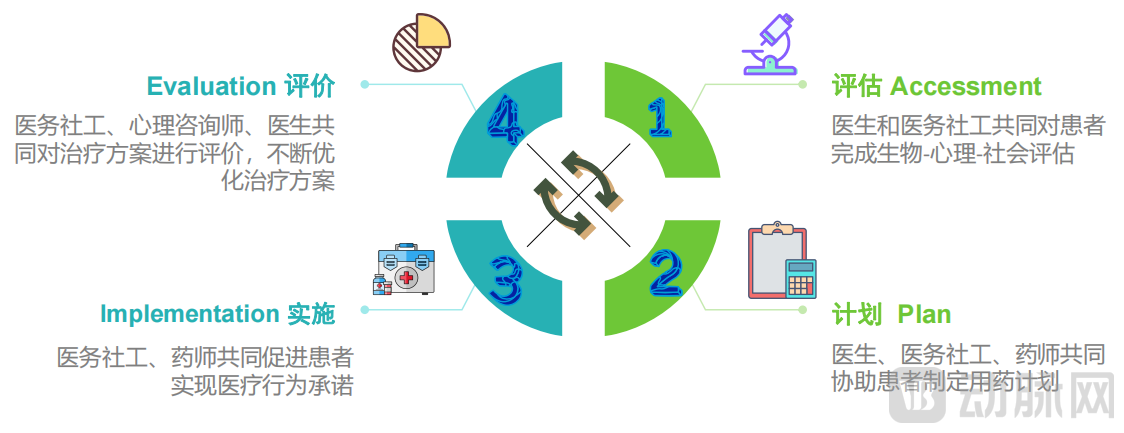
iBless Speciality Pharmacy APIE Patient Self-Management System
In the APIE patient self-management system, patients become active participants, collaborating with physicians, nurses, pharmacists, social workers, rehabilitation therapists, and psychological counselors to develop their individualized medication plans. Meanwhile, iBless Speciality Pharmacy’s newly launched social pharmaceutical e-commerce platform enables pharmaceutical companies and physicians to effectively manage patients with chronic diseases by providing professional pharmaceutical care, disease guidance, medication recommendations, follow-up visits, and early warning alerts, thereby improving patient medication adherence and enhancing brand loyalty.
Furthermore, leveraging the rare disease patient resources accumulated by AiXiKe over the past decade, iBless Speciality Pharmacy not only possesses a profound understanding of patients’ needs and psychological well-being but also maintains strong relationships with leading rare disease patient organizations both domestically and internationally. This enables seamless access to patients with pulmonary arterial hypertension (PAH). Additionally, initiatives launched by AiXiKe, such as the “Blue Lips Classroom” and “Blue Lips Rebirth Program,” along with the iBless Specialty trademark, have achieved high recognition and strong patient loyalty within the patient community.
Furthermore, iBless Speciality Pharmacy has established collaborative partnerships with leading expert teams in respiratory and cardiovascular medicine, headed by Academicians Wang Chen, Zhong Nanshan, and Ge Junbo, as well as with more than 100 experts from over 30 Grade A tertiary hospitals across China, including Peking Union Medical College Hospital, China-Japan Friendship Hospital, Shanghai Zhongshan Hospital, Guangzhou Institute of Respiratory Health, and West China Hospital of Sichuan University. The company boasts a robust foundation of expert resources.
“Although our current scale is small and our scope of business is narrow, we have already established a closed-loop ecosystem integrating pharmaceuticals and healthcare. In addition to medication procurement and pharmaceutical care consultation, iBless Speciality Pharmacy also provides extended services for chronic disease patients, such as long-term follow-up and non-pharmacological interventions. During the service delivery process, we assist experts in conducting real-world data studies on patients, and may even deeply participate in the early-stage design and clinical trials of innovative drugs for rare diseases in the future,” said Li Rong.
In the view of Li Rong, founder of iBless Speciality Pharmacy, “profitability is merely a byproduct generated in the process of addressing social issues.”
“Whether it was the former Ai Xi Ke or the current iBless Speciality Pharmacy, our mission has remained consistent: to address the societal challenges of difficult diagnosis and limited access to medications for patients with rare diseases,” stated Li Rong. “We are not disregarding profitability; rather, we aim to generate both social and economic value through this platform, with economic value following the creation of social value.”
To uphold the public-welfare nature of Ai Xi Ke, iBless Speciality Pharmacy places great emphasis on its service capabilities. This commitment is evident even from the company’s name.
Youxin, a homophone for “right heart,” references the gold standard for diagnosing the rare disease pulmonary arterial hypertension—right heart catheterization. This name embodies the company’s founding commitment to serving patients with rare diseases and helping them regain new life. The vision and mission of Youxin Pharmaceuticals are firmly centered on serving this patient population—creating value in the treatment of rare diseases and ensuring that every patient achieves favorable survival outcomes and quality of care.
Looking back on the development journey of iBless Speciality Pharmacy, the word “service” stands out particularly.
In July 2015, Bayer Healthcare’s sudden announcement of its decision to withdraw Ventavis from the Chinese market sent shockwaves through the domestic community of patients with pulmonary arterial hypertension (PAH), as well as patient advocacy groups and physicians, placing more than 1,000 PAH patients in China at risk of treatment interruption.
“Without this medication, patients could face treatment interruptions, and some might even be at risk of losing their lives. At that time, many patients reached out to us for help,” recalled Li Rong. “Therefore, we exhausted every possible means to contact Bayer’s headquarters, hoping they would reverse this decision.”
“We explored numerous avenues at the time, including sending emails, writing letters, and initiating a joint letter of appeal, which was signed by 1,400 patients, family members, and physicians,” said Li Rong. “To ensure that Bayer’s headquarters received it, we simultaneously dispatched hard-copy letters and reached out to patient advocacy groups in the United States and Japan to seek their support.”
On January 5, 2016, thanks to concerted efforts from multiple parties, iBless Speciality Pharmacy received a positive response from Bayer confirming that Ventavis would not be withdrawn from the Chinese market. Although Ventavis has gradually been replaced by Remodulin due to subsequent advances in drug development, this outcome holds significant meaning for iBless Speciality Pharmacy and the domestic community of patients with pulmonary arterial hypertension.
“We have done extensive coordination during the launch and withdrawal of new drugs to ensure patients can safely transition to alternative therapies, thereby maximizing life-saving outcomes,” Li Rong remarked with emotion. “This endeavor holds significant personal meaning for me.”
In 2020, the outbreak of the COVID-19 pandemic disrupted the work and daily routines of many people, with patients suffering from rare diseases being among the groups most significantly affected.
“During the pandemic, many patients found it inconvenient to purchase medications at hospitals and were unable to buy them elsewhere. Patients in Hubei Province, in particular, faced difficulties in accessing necessary medications,” shared Huang Huan. “We devised various strategies to help them locate and purchase medicines. For instance, we assisted more than 10 patients in Hubei in obtaining their medications during the outbreak. In areas where JD.com and SF Express did not deliver, we shipped the medications via EMS. In villages under lockdown, we explained to village officials that these medications were life-saving, enabling them to assist patients in collecting packages from town post offices. As a result, we maintained very close contact with our patients.”
In addition, Huang Huan believes that in addition to medication and diagnosis issues, the psychological and family relationship problems of patients with rare diseases should also be paid attention to.
“Medication management for patients with rare diseases is a long-term process, which may involve issues such as drug side effects and treatment efficacy. During this period, patients may experience emotions like unease and tension,” stated Huang Huan. “iBless Speciality Pharmacy provides patient follow-up services and professional psychological counseling. Additionally, by encouraging patients to share their personal experiences, we facilitate peer-to-peer communication, thereby alleviating patients’ tension and anxiety during the course of treatment.”
Huang Huan further added, “At the same time, we have also found that for some patients, treatment decisions are made by their family members. The influence of the pure biomedical model on patient treatment is limited. Therefore, we need to introduce other professional roles besides doctors into the APIE system to serve patients from non-medical dimensions.”
“In recent years, driven by policy support, the rare disease sector has become a hotbed of investment and innovation,” said Li Rong. “However, in the process of entrepreneurship, we should not focus solely on profitability; rather, we ought to prioritize addressing social issues. Profitability is merely a byproduct generated in the course of solving these problems.”