

At Age 93, Academician Han Jisheng Breaks New Ground: Integrating Acupuncture into Autism Spectrum Disorder Therapy
Academician Han Jisheng, 93, still walks with steady gait, only occasionally accepting assistance when ascending or descending the stage. In front of the exhibition booth at Peking University’s Boya International Hotel, attendees eagerly sought photos with him, and Academician Han graciously obliged with a warm smile.
From the audience’s perspective, his physical condition appeared to be quite good. At the Peking University Health Science Center Forum on Integrated Traditional Chinese and Western Medicine Innovation and Development held on June 12, Academician Han Jisheng clearly articulated and logically presented the latest research progress made by his team in using acupuncture-related techniques to treat autism spectrum disorder.
Following the sharing session, Academician Han Jisheng proceeded to the reception room for a 40-minute group media interview. Leaning half his body against the sofa on the left with his hands clasped, he spoke in a calm tone that prompted the interviewing journalists to slow their pace.
Academician Han Jisheng was originally trained exclusively in Western medicine, but upon accepting a national mandate, he established a research team on the principles of acupuncture anesthesia at Beijing Medical College (the predecessor of Peking University Health Science Center), thereby embarking on a scientific career in the field of integrated traditional Chinese and Western medicine.
As research progressed, Academician Han Jisheng evolved from initial skepticism about traditional Chinese medicine (TCM) acupuncture to validating its efficacy through clinical trials, and ultimately elucidating the scientific mechanisms underlying acupuncture-induced analgesia and other effects. Through more than five decades of dedicated work, he transformed traditional manual acupuncture into digital, non-invasive neuromodulation therapeutic devices, making substantial contributions that have filled numerous gaps in modern medicine. Having published over a thousand articles in domestic and international medical journals, he has ultimately become a global leader in the study of the principles of TCM acupuncture.
Academician Han Jisheng also places particular emphasis on academic exchange. In his view, for traditional Chinese medicine (TCM) to go global, it must actively participate in international activities. Regarding talent development and discipline construction, Academician Han believes that universities should embrace an open-minded approach akin to “the ocean accepting all rivers.” Only by “going out” and “inviting in,” fostering mutual exchange and communication, can the collision of ideas spark theoretical insights.
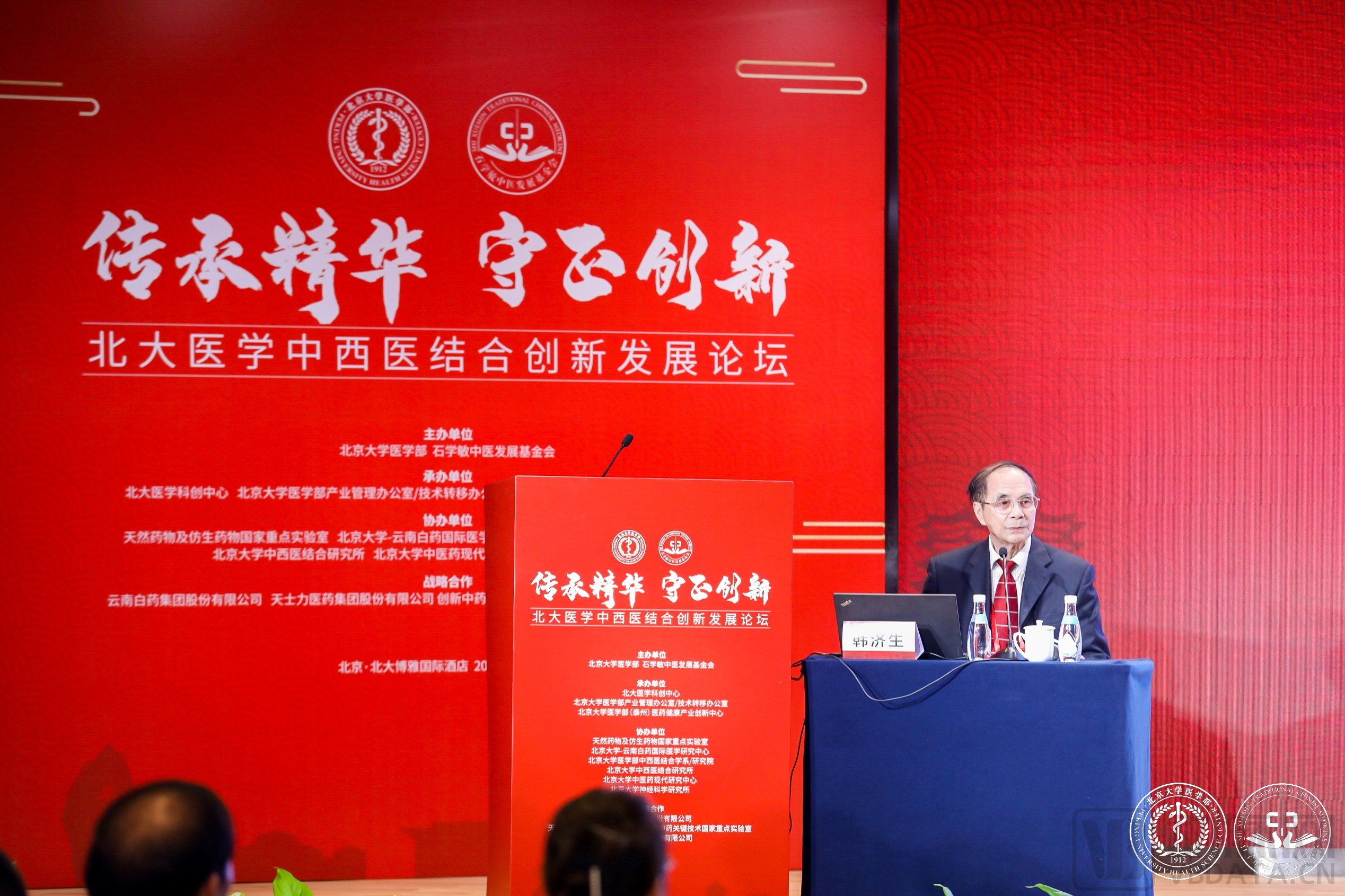
Academician Han Jisheng began his teaching and research career in 1952 and initiated research on the principles of acupuncture anesthesia in 1965. He devoted nearly 60 years of his life to studying the mechanisms of acupuncture analgesia.
He was the first to elucidate the spatiotemporal distribution patterns of analgesia induced by acupuncture at a single acupoint, further demonstrating that acupuncture promotes the secretion of analgesic substances, such as serotonin and endorphins, within the nervous system. He discovered that altering the frequency of electrical stimulation at acupoints could trigger the release of specific neurochemicals, including certain neuropeptides, in the brain, thereby establishing the neurochemical theory of acupuncture analgesia.
“The efficacy of acupuncture analgesia in each individual depends on the levels and relative balance of two types of substances: analgesic and anti-analgesic agents.” Based on this principle, Academician Han Jisheng designed and developed the “Han’s Acupoint Nerve Stimulator” for analgesia and spasmolysis. In 1980, this technology was applied to the treatment of heroin addiction.
In 2004, Academician Han Jisheng was awarded a key research grant from the U.S. National Institutes of Health (NIH) and traveled to the United States to collaborate with Harvard University on researching the mechanisms underlying acupuncture-assisted detoxification from drug addiction, during which time he also served as an Adjunct Professor in the Department of Psychiatry at Harvard University.
In 2008, at the age of 80, Academician Han Jisheng, who had just returned to China after concluding an international scientific research collaboration, set a new goal for himself: to expand the range of diseases treatable with acupuncture and to identify new indications. “At that time, I was thinking, ‘After practicing acupuncture for so many years, what other conditions besides pain management and drug addiction could I address with acupuncture?’”
With a clear direction in mind, Academician Han Jisheng launched the “Spring Light Initiative” to explore additional indications for acupuncture, focusing on diseases that pose significant threats to public health, respond poorly to conventional Western medicine, and may potentially benefit from acupuncture. Ultimately, Academician Han set his sights on autism and infertility—two conditions often described as “hope-destroying.”
Academician Han Jisheng mentioned that the film *Ocean Heaven* was a significant catalyst in his resolve to apply acupuncture techniques to autism. “The world of families with autistic members is often bleak; we aim to bring them hope, like a ray of sunshine.”
Autism Spectrum Disorder (ASD) is a pervasive neurodevelopmental disorder, also known as autism. Its core features include impairments in social interaction and stereotyped, repetitive behaviors, while the majority of individuals also present with language impairments and delayed intellectual development. Over the past decade, the incidence of neurodevelopmental disorders, such as ASD and developmental delays, has been steadily rising.
On March 26, 2020, the U.S. Centers for Disease Control and Prevention (CDC) reported the latest prevalence of autism spectrum disorder (ASD) as 1 in 54. This figure represents an increase of nearly 10% compared to the 1 in 59 reported in 2018. The conservative estimate of ASD prevalence in China is 0.7%, while the global average prevalence is 1.8%, with a male-to-female ratio of 5:1.
In recent years, numerous studies published in top international journals have found that, in addition to susceptibility genes and environmental factors, the etiology of autism is closely associated with various biological factors, including immune dysfunction, nutritional imbalances, oxidative stress, mitochondrial dysfunction, and gut microbiota dysbiosis.
The FDA has also approved certain medications for the treatment of autism, such as risperidone and aripiprazole. Pharmacological therapy can alleviate symptoms including agitation, hyperactivity, irritability, attention deficits, self-injurious behavior, and repetitive stereotyped behaviors; however, it may also cause side effects such as sedation, weight gain, acute dystonia, and tardive dyskinesia.
Chinese Scientists Are Also Exploring Innovative Approaches to Treating Autism
As is well known, the function of acupuncture is to “strengthen the body’s vital energy and consolidate its foundational resilience, supporting your original Zheng Qi (vital energy), reinforcing intrinsic capabilities, and mobilizing the body’s own resources to overcome disease.” Drawing on Academician Han Jisheng’s research on acupuncture analgesia conducted over more than half a century, electroacupuncture has been found to accelerate the release of various analgesic substances, including endorphins, thereby alleviating pain.
Research by Academician Han Jisheng’s team has revealed that a key reason for the low social competence in individuals with autism spectrum disorder is the deficiency of certain social factors in the brain, most notably oxytocin (OXT) and arginine vasopressin (AVP). These two substances are neuropeptides produced by the hypothalamus.
Actual measurements confirm that oxytocin (OXT) and arginine vasopressin (AVP) levels in the blood of patients with autism spectrum disorder (ASD) are indeed lower than those in healthy individuals. Furthermore, these two biomarkers are lower in patients with severe ASD compared to those with mild ASD. Reduced hypothalamic gray matter volume has also been observed in ASD patients, which is positively correlated with decreased plasma OXT and AVP levels.
Furthermore, Academician Han Jisheng’s team compared the plasma of mothers of children with autism to that of mothers of neurotypical children and found that oxytocin (OXT) and arginine vasopressin (AVP) levels were significantly lower in the former. Having identified a potential etiological factor for autism, the team initiated research into the application of acupuncture techniques for its treatment.
After thousands of years of inheritance and development, acupuncture techniques have evolved from stone pressing and manual needle manipulation to modern electroacupuncture. Considering that manual needle manipulation and electroacupuncture are less suitable for children, the team led by Academician Han Jisheng developed a more convenient, stamp-sized acupoint patch for "transcutaneous electrical acupoint stimulation," also known as TEAS therapy.
Drawing on over five decades of experience, Academician Han Jisheng’s team is well aware that acupuncture-related techniques exhibit clear “frequency specificity” in therapeutic applications. For analgesia, a stimulation frequency of 2 Hz selectively triggers the release of monoamine neurotransmitters and enkephalins in the human body, whereas a frequency of 100 Hz prompts the selective secretion of dynorphin in the brain. However, it remains unclear which frequency should be used to robustly activate and induce the hypothalamus to release oxytocin (OXT) and arginine vasopressin (AVP), which are needed for children with autism spectrum disorder. As no answer could be found in the literature, independent exploration was required.
In initial animal experiments, after repeated trials, Academician Han Jisheng’s team discovered that five sessions of electroacupuncture treatment administered to rats over a nine-day period led to increased levels of oxytocin (OXT) and arginine vasopressin (AVP) in the brain, as well as enhanced exploratory behavior in novel environments. Following treatment with transcutaneous electrical acupoint stimulation (TEAS) using alternating frequencies of 2 Hz and 15 Hz, children with autism spectrum disorder (ASD) showed elevated levels of OXT and AVP in their blood, along with significant improvement in symptoms. Clinical trials also revealed that children with ASD exhibited varying responses to this neuromodulation therapy depending on their specific symptom profiles. Academician Han Jisheng’s team conducted in-depth research into an ASD classification method based on questionnaires completed by patients and their parents, adapting it to align with national conditions and ultimately naming it the Beijing Autism Subtyping Questionnaire. Classifying patients based on their symptoms and severity, and then determining tailored treatment plans, can significantly improve therapeutic efficacy.
Academician Han Jisheng concluded, “The above represents the current state of scientific knowledge, derived from over a decade of day-and-night repeated observation, practice, and verification by our team members and numerous collaborators.” The adoption of Transcutaneous Electrical Acupoint Stimulation (TEAS), integrating Traditional Chinese Medicine with Western medicine and supplemented by modern experience and methodologies, helps alleviate symptoms in children with autism spectrum disorder and facilitates their early integration into society.