

Honglin Pharmaceutical: Empowering the Medical Distribution Industry through 'Internet Plus' Innovation
With the rapid development of the national economy, compounded by the impact of the COVID-19 pandemic in 2020, Chinese citizens have placed increasing emphasis on their personal health, leading to a gradual expansion in demand for pharmaceutical products. As an important component of the national economy, the pharmaceutical industry has received extensive attention from all sectors of society in recent years.
From the perspective of the pharmaceutical industry's supply chain, the pharmaceutical industry mainly includesPharmaceutical Manufacturing, Pharmaceutical Distribution, and Medical ServicesThree Major Subsectors. The upstream segment of the industry chain comprises the pharmaceutical industry, primarily encompassing R&D of pharmaceutical products, production of active pharmaceutical ingredients (APIs) and bulk materials, as well as manufacturing of drugs and medical devices. The mid- and downstream segments mainly consist of pharmaceutical distribution and healthcare service providers, including hospitals, pharmacies, retail drugstores, and centers for disease control and prevention (CDCs).
Across the entire industry chain, pharmaceutical distribution serves as the “courier,” playing a pivotal role in connecting upstream and downstream segments. It is responsible for the circulation of pharmaceuticals, medical devices, and related products, with the aim of ensuring that drugs and devices flow smoothly from manufacturers to healthcare institutions and ultimately to consumers.
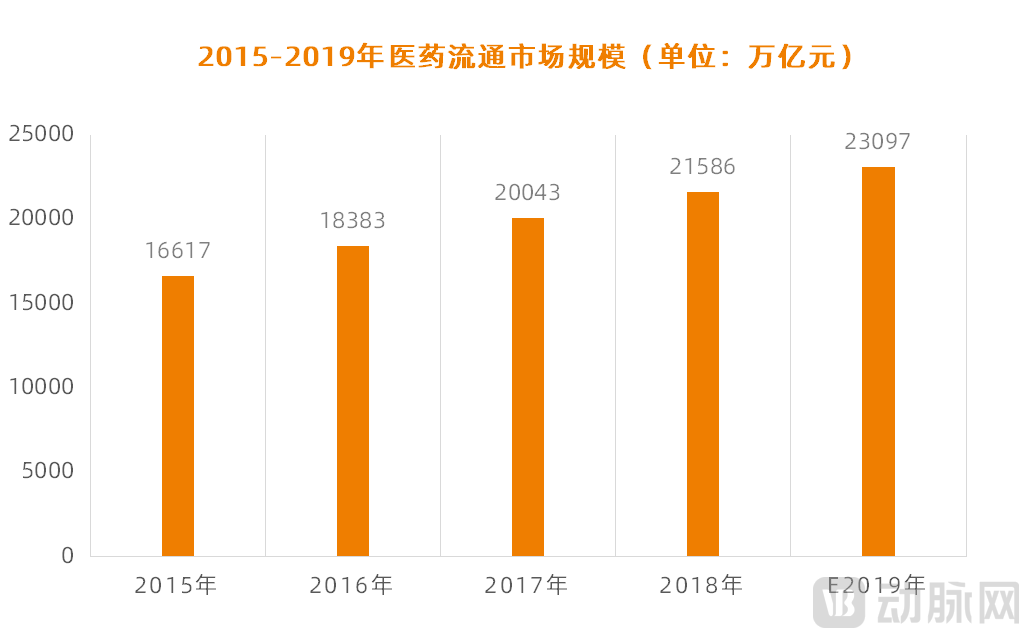
Data source: Bureau of Commerce; graphic by VCBeat
Currently, driven by China’s healthcare policies, pharmaceutical distribution enterprises are continuously expanding in scale, market concentration is steadily rising, and the rectification of the pharmaceutical distribution industry is showing a trend of rapid growth.According to the "2018 Statistical Analysis Report on the Operation of the Pharmaceutical Distribution Industry" released by the Ministry of Commerce, the total sales volume of seven major categories of pharmaceutical products in China reached RMB 2.1586 trillion in 2018, a year-on-year increase of 7.7%. It is preliminarily estimated that the market size of the pharmaceutical distribution industry will grow to RMB 2.3097 trillion in 2019.
The trillion-yuan blue-ocean market will naturally attract numerous “dream chasers” to enter the fray, and among them, Honglin Pharmaceutical is undoubtedly a force to be reckoned with.
Honglin Pharmaceutical was established in 2009 and has been committed to operating as a modern pharmaceutical service provider, with core businesses focusing on the promotion and distribution of pharmaceuticals and medical devices, pharmaceutical care services, pharmacy trusteeship, and SPD (Smart Logistics within Hospitals). Despite its relatively short history, the company has surpassed many industry veterans through its excellent leadership philosophy and development strategy, earning a strong reputation and achieving remarkable performance in the healthcare and pharmaceutical sector.
I. Leveraging the listed company Realcan Medicine as an “endorsement” to fully integrate the industrial resource chain
Like the vast majority of innovative enterprises, the founding of Honglin Pharma is accompanied by a little-known backstory.
Before 2000, company foundersWang HongliangServing in the key role of a pharmacist at a hospital, he gained extensive familiarity with pharmaceuticals and the entire drug industry chain. It was during this period that the event of 999 Group taking over the pharmacy operations of seven hospitals, including the Liuzhou Hospital of Traditional Chinese Medicine in Guangxi, began to generate widespread discussion within the pharmaceutical sector. The novel model of “pharmacy trusteeship” was subsequently implemented intermittently across various regions. Leveraging this favorable momentum and his profound understanding of the pharmaceutical industry, Wang Hongliang officially founded Honglin Pharmaceutical in March 2009.
After nearly eight years of quiet dedication and relentless effort, Honglin Pharma has begun to emerge as a notable player in the industry, successfully attracting significant attention from leading enterprises.In November 2017, Honglin Pharmaceutical was successfully acquired by Realcan Pharmaceutical Group (Stock Code: 002589), officially becoming its controlling subsidiary in Jiangsu Province.
As the second industry pioneer in China’s pharmaceutical distribution sector to achieve a successful public listing, Realcan Pharmaceutical Group has maintained a leading position in the pharmaceutical and medical device distribution industry, leveraging its advantages of a comprehensive product portfolio, reliable quality, timely delivery, and attentive service.As of now, the Group has established 186 subsidiaries across 31 provinces, municipalities, and autonomous regions, serving over 8,000 medical institutions at Level II and above. In 2018, it achieved sales revenue of RMB 33.9 billion and a net profit of RMB 778 million, ranking among the top ten pharmaceutical commercial enterprises in China.
Leveraging the strong entry of this “industry giant,” Honglin Pharmaceutical has entered a new stage of development, receiving robust support across all key operational areas.
Su Tao, Deputy General Manager of Honglin Pharmaceutical, told VCBeat, “For our company, Ruikang Pharmaceutical Group is like a seasoned ‘elder,’ steadily guiding Honglin Pharmaceutical toward becoming a leading enterprise. Specifically, Ruikang Pharmaceutical Group has first and foremost provided us with significant brand advantages. Our competitors are either state-owned enterprises or backed by regional industry leaders, which often placed Honglin Pharmaceutical at a competitive disadvantage. However, with the ‘joining’ of Ruikang Pharmaceutical Group, an industry giant, we now also benefit from strong backing.”
On the other hand, it has enabled the company to integrate industry resource chains. “In the pharmaceutical distribution sector, Realcan Pharmaceutical Group’s established resource advantages far exceed ours. Whether in upstream industrial resources or regional channel resources, Realcan Pharmaceutical Group has provided strong support to Honglin Pharmaceutical. This has, to a certain extent, deepened and broadened the company’s resource base, providing a continuous driving force for its ongoing growth and expansion.”
II. Leveraging the “SPD” Operational System as the Core Driver to Strategically Focus on Four Key Service Segments
Honglin Pharmaceutical’s business operations primarily revolve around two core segments. The first is the promotion and sales of pharmaceuticals and medical devices, which has been the company’s foundational business since its inception. After years of development, it has established a certain level of influence within the industry and captured a significant share of the market.
On the other hand, there is the innovative business model known as “SPD.” The SPD model refers to a framework in which a company signs medium- to long-term contracts with healthcare institutions. Within the agreed contract period, the company establishes an intelligent supply chain management platform for medical consumables, centered on “smart supply chain services,” to provide diversified services that help healthcare institutions achieve refined operational management. Driven by both policy support and market demand, the SPD model has emerged as a dark horse in the pharmaceutical distribution sector, experiencing rapid growth and boasting considerable market prospects.
Specifically, how has Honglin Pharmaceutical structured its business operations?
First, the pharmaceutical and medical device distribution segment.In terms of pharmaceuticals, the company’s core management team possesses many years of experience in hospital pharmacy services and extensive expertise in pharmacy trusteeship, yielding significant competitive advantages in the pharmaceutical sector. The company has established strong collaborative relationships with over 100 pharmaceutical manufacturers, including China Otsuka Pharmaceutical, Shijiazhuang No.4 Pharmaceutical, and Beijing Sihuan Pharmaceutical. It offers a portfolio of more than 4,000 product varieties, with pharmaceutical distribution covering 58 secondary-and-above hospitals, 125 primary community health centers, and 2 hospitals receiving pharmacy management services in Nanjing. Annual sales revenue has achieved rapid growth exceeding 30%.
Next is the field of medical devices. Honglin Pharmaceutical focuses on departments, with a particular emphasis on hemodialysis and clinical laboratory departments. For hemodialysis, this includes dialysis tubing as well as maintenance and after-sales services for related equipment, while the clinical laboratory segment primarily concentrates on immunology automation lines. To date,
Medical device distribution services have achieved full coverage of all Tier II and above hospitals in Nanjing, and the company has secured exclusive distribution rights from multiple medical device manufacturers in Nanjing’s centralized volume-based procurement program for medical consumables.
Second is the academic promotion sector.The company’s academic promotion team is led by professional managers from central state-owned enterprises and listed companies, covering 22 hospitals at Level II and above, with full coverage of grassroots community medical institutions. Adhering to the marketing philosophy of “promotion plus academia,” the company has built a highly executable marketing force and is committed to providing value-added services in market development and academic promotion for upstream manufacturers. The company currently holds provincial and municipal agency rights for 32 product varieties, with several essential drug products ranking first or second nationwide in grassroots sales, establishing multiple “benchmark hospitals” for product sales.
Third is the sector of traditional Chinese medicine and physical pharmacies.The company offers over 400 types of Traditional Chinese Medicine (TCM) decoction pieces, including traditional TCM decoction pieces, refined TCM decoction pieces, and TCM formula granules. It employs two licensed TCM pharmacists and four TCM specialists, and operates a specialized TCM warehouse with an area of 600 square meters. For many years, Honglin Pharmaceutical has adhered to the use of authentic medicinal materials, strictly controlling their quality, and has established strong collaborative relationships with multiple TCM manufacturing enterprises. Currently, it provides services such as TCM distribution, decoction on behalf of patients, and preparation of herbal pastes for seven community hospitals, one secondary Grade-A hospital, and one tertiary Grade-A hospital. Meanwhile, the company collaborates with Nanjing University of Chinese Medicine to actively explore new processing methods and quality standards for TCM decoction pieces.
Fourth is the “SPD” innovative services segment.Distinct from the traditional “SPD” model, Honglin Pharmaceutical focuses primarily on extended hospital services, encompassing six core functional modules: comprehensive barcode management, traceability management for high-value consumables, intelligent replenishment models, construction of intelligent supply chain systems, optimization of settlement models, and basic management design. By innovating the hospital medical material supply chain model within the context of healthcare reform, it streamlines and optimizes hospital management processes, provides advanced logistics management systems, and achieves end-to-end transformation of in-hospital consumable workflows, thereby enhancing hospital management standards and strengthening close collaboration between hospitals and suppliers.
To better collaborate with enterprises in delivering precise services and enhancing supply chain efficiency, Honglin Pharmaceutical established a wholly-owned innovative medical device supply chain management company in August 2019. The company specializes in refined hospital logistics management and operations (SPD), developing and implementing software systems tailored to hospitals’ internal supply chain management needs. It has successfully launched the SPD project at Gaochun People’s Hospital, with its operational model gaining recognition from visiting hospitals. Currently, it has also secured contracts for the SPD projects at Jiangsu Province Hospital of Integrated Traditional Chinese and Western Medicine and Qixia District Hospital.
III. Surviving Amidst Turmoil, Striving to Become a Modern Pharmaceutical Service Institution
Data released by the Ministry of Commerce indicates that China’s pharmaceutical distribution industry has maintained an overall trend of continuous growth; however, in terms of growth rate, influenced by national macroeconomic policies, the general operational trend is showing a gradual slowdown.
Su Tao, Deputy General Manager of Honglin Pharmaceutical, told VCBeat, “Currently, China’s pharmaceutical distribution sector is in a ‘period of turbulence,’ primarily because policies such as volume-based procurement and the two-invoice system are still in the stage of full implementation. As a result, the overall pharmaceutical distribution market faces dual pressures of challenges and innovation. Taking the price of a specific drug as an example, its original price while stored in the warehouse was RMB 100, but due to the impact of medical insurance or other relevant policies, the price suddenly plummeted to RMB 1. This resulting price disparity and instability are extremely ‘fatal’ for pharmaceutical distribution enterprises. Therefore, our short-term goal is to maintain profitability and weather this turbulent phase, so that we can regain momentum when the timing is right.”
Challenges and opportunities always coexist.Although China’s pharmaceutical distribution sector is currently enduring a “period of growing pains” due to policy impacts, it will inevitably usher in a new competitive landscape once this transitional phase passes. Those who can seize the opportunity early and explore a development path that better integrates with their business operations will gain the first-mover advantage and emerge as unicorn enterprises in this field.
Mr. Su Tao stated that three distinct business models will emerge in the pharmaceutical distribution sector: first, large-scale platformization focused on last-mile delivery, characterized by comprehensive service offerings and a full range of pharmaceutical products; second, specialization and modularization, centered on precise strategic layout within specific niche areas; and third, third-party extended services oriented around end-users, aimed at assisting hospitals in establishing and refining their supporting service infrastructure.
For Honglin Pharmaceutical, the primary focus is on extensive layout around the latter two models.On one hand, the focus is on core pharmaceuticals and medical devices, leveraging the “SP” operational system to deliver innovative services and continuously enhance overall operational efficiency. On the other hand, the “SPD” model is introduced to provide end-to-end logistics services for hospital consumables—including supply, processing, and distribution—driven by both external and internal hospital demands.
The goals are clearly defined, but their realization will require reinforcement and supplementation across multiple areas. Mr. Su Tao told VCBeat, “For Honglin Pharmaceutical, the most pressing need at present is talent in relevant fields. Secondly, capital injection is also a critical requirement for the company at this stage. On one hand, it will better support the rapid advancement of various business segments; on the other hand, it will facilitate collaborative partnerships with investment institutions to jointly drive the company’s continuous growth.”
“The phoenix fledglings on the Dan Mountain sing clearer than their elders,” a verse quoted by Honglin Pharma in its corporate introduction, essentially conveys the idea that “the student surpasses the master.” Currently, while Honglin Pharma still lags behind many industry veterans in various aspects, there is good reason to believe that, driven by innovative service models and the deepening integration of information technology, the company will achieve leapfrog development in the future.