

Can Seres Therapeutics Sustain Its Momentum in the Microbiome Therapeutics Field After the Commercialization of Its First-in-Class Biologic?
Seres Therapeutics
Novel Drug Developer
Cambridge, Massachusetts, USA, home to Harvard University and the Massachusetts Institute of Technology.
Cambridge, adjacent to Boston and part of the Greater Boston metropolitan area, is not only rich in academic atmosphere but also one of the world’s renowned biopharmaceutical hubs.
According to MassBio’s 2020 Biopharma Funding Report, Massachusetts’ biopharmaceutical industry experienced its best funding year on record. In 2020, venture capital investment in Massachusetts-based companies reached $5.8 billion, surpassing the previous record of $4.8 billion. That year, 41% of all U.S. biopharmaceutical venture capital flowed into Massachusetts.
It is reported that more than 100 biopharmaceutical companies are located in the Cambridge area, and Seres Therapeutics (hereinafter referred to as “Seres”), introduced in this article, is one of them.
Seres Therapeutics, founded in 2010, is a late-stage clinical biotechnology company dedicated to transforming the treatment of various diseases by modulating the function of the human microbiome, thereby improving the lives of patients worldwide.
Seres experienced rapid growth; just five years after its founding in 2015, it became the first microbiome pharmaceutical company to list on the Nasdaq, with a market capitalization that once exceeded $1.5 billion.Its rapid growth is attributable not only to the biopharmaceutical geographic advantages of its location but also, notably, to Flagship Pioneering (hereinafter referred to as “Flagship”).
Flagship is a venture capital firm founded in 2000 that focuses on the life sciences and healthcare sectors. To date, it has co-founded and incubated more than 100 companies, with a combined valuation exceeding $30 billion.Flagship employs an internal incubation model known as “Venture Labs,” which provides funding and support to promising projects based on specific concepts or cutting-edge, disruptive technologies, enabling them to rapidly mature into viable ventures.
At its inception, Seres attracted the attention of Flagship Pioneering, also based in Cambridge. David Berry from Flagship is one of the co-founders of Seres. Furthermore, Flagship played a significant role in Seres’ Series A, B, and C financing rounds, leading the Series A and Series C investments.
So, what exactly is the “dark technology” of Seres that Flagship has its eye on?
This "dark technology," after a decade of development, has gradually entered the public spotlight—the human microbiome. Over the past decade, research on initiatives such as the Human Microbiome Project and the human gut microbiota has shown that within the vast human microbiome, the functional characteristics of certain microorganisms can influence people's health status and disease conditions, holding immense potential for the development of new therapeutics.
Seres Therapeutics pioneered the use of microbiome-based therapies for serious diseases and has remained at the forefront of microbiome therapeutics for over a decade, focusing on the development of novel biologic drugs. According to its official website, three drug candidates are currently in clinical trials, while two others are in preclinical development. In addition, other candidate products from Seres are still in the early discovery stage.
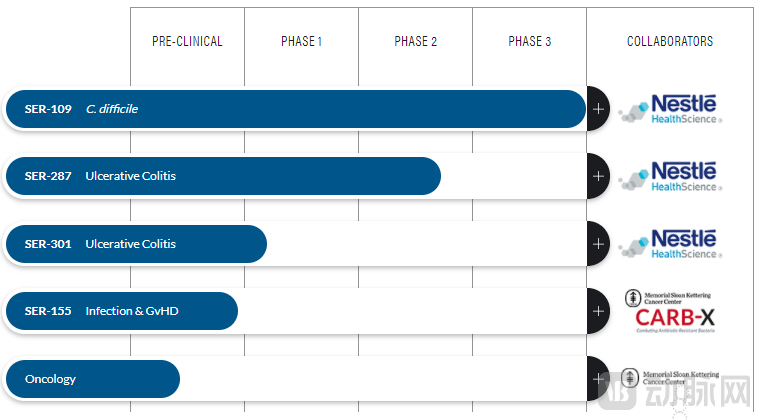
Drug Development Progress Source: Seres Therapeutics Official Website
The core of Seres Therapeutics’ drug development lies in multifunctional bacterial consortia, which functionally interact with host cells and tissues to modulate the gut microbiome.Compared with traditional treatments that target only a single disease, they can exert multiple pharmacological effects and modulate multiple functional pathways in the human body.
Seres has established a microbiome therapeutics platform to design, test, and manufacture multi-functional drugs.This process primarily consists of five stages: microbiome biomarker discovery, bacterial consortium design, pharmacological validation, oral formulation manufacturing, and quality control and product safety, as shown in the figure.
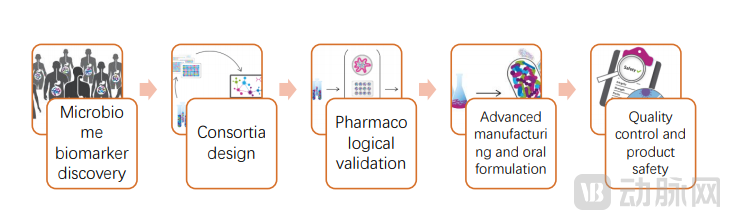
Drug Development Process Source: Seres Official Website
According to the drug development progress published on the Seres Therapeutics website, the pipeline includes SER-109, SER-287, SER-301, SER-155, and an oncology-focused drug.During the development of these drugs, Seres Therapeutics has established strong partnerships with several companies, jointly elucidating the role of gut microbiota in maintaining human health.
Specifically, Seres Therapeutics and Nestlé Health Science entered into a license agreement in 2016 and an amendment thereto in 2018, whereby the parties agreed on their respective rights and obligations regarding the development, commercialization, regulatory affairs, manufacturing, and supply of products including SER-109, SER-287, and SER-301. Seres Therapeutics received corresponding payments from Nestlé.
SER-109 is a blockbuster drug for the treatment of recurrent Clostridioides difficile infection (CDI) and has completed Phase III clinical trials. SER-287 and SER-301 are drugs for the treatment of ulcerative colitis (UC).SER-287 is undergoing a Phase 2b clinical trial in patients with mild-to-moderate ulcerative colitis (UC), has been granted FDA Fast Track designation, and has been designated as an orphan drug for pediatric UC, with results expected by mid-2021. SER-301 is also undergoing initial clinical studies.
SER-155 is indicated for severe bacterial infections and graft-versus-host disease (GvHD) in patients with solid organ and allogeneic stem cell transplants. On June 1 this year, the FDA approved the investigational new drug application for SER-155.This project initiated a collaboration with Memorial Sloan Kettering Cancer Center in 2016 and received research funding from CARB-X in both 2017 and 2019.
According to Seres' annual report, SER-401 is a drug targeting melanoma.In 2019, Seres Therapeutics collaborated with The University of Texas MD Anderson Cancer Center and the Parker Institute for Cancer Immunotherapy to conduct a Phase 1b clinical study of the drug. However, the clinical development of SER-401 was significantly impacted by the COVID-19 pandemic. In March this year, Seres announced that it would discontinue its research on SER-401 for the treatment of metastatic melanoma.
In addition, in 2019, Seres entered into a research collaboration and option agreement with MedImmune, LLC, a wholly-owned subsidiary of AstraZeneca; however, this agreement was terminated on April 2, 2021. In the same year, Seres entered into a loan and security agreement with Hercules, under which it could receive term loans in three tranches, with an aggregate principal amount not exceeding $50 million.
Although multiple drugs are under development, Seres’ progress has not been as smooth as anticipated.Drug development, from inception to Phase III clinical trials, involves close multidisciplinary and multi-specialty collaboration and is a protracted and capital-intensive process.Seres Therapeutics’ drug development has also been fraught with twists and turns, particularly in the case of SER-109.
SER-109 has been designated by the FDA as a breakthrough therapy and an orphan drug for CDI. Regarding CDI, it was listed by the U.S. Centers for Disease Control and Prevention (CDC) as one of the greatest microbial threats to human health in 2019 and is also one of the most common hospital-acquired infections.
The current standard of care for Clostridioides difficile infection (CDI) is antibiotic therapy; however, antibiotics alone are ineffective against the dormant spore form of C. difficile, and repeated exposure depletes beneficial bacteria that suppress CDI, thereby increasing the risk of recurrence. Consequently, treatment options for recurrent CDI are limited and demonstrate modest efficacy, whereas SER-109 is an agent capable of effectively preventing recurrent CDI.
Among Seres Therapeutics’ drug development programs, SER-109 is the most advanced; however, its development has been far from smooth, marked instead by a tortuous and turbulent path., vividly demonstrating the enormous risks inherent in biopharmaceutical development.
In August 2016, the Phase II clinical trial of SER-109 failed. Upon the news, its stock price plummeted instantly, directly causing a two-thirds erosion of the company’s market capitalization, and the stock price remained sluggish.
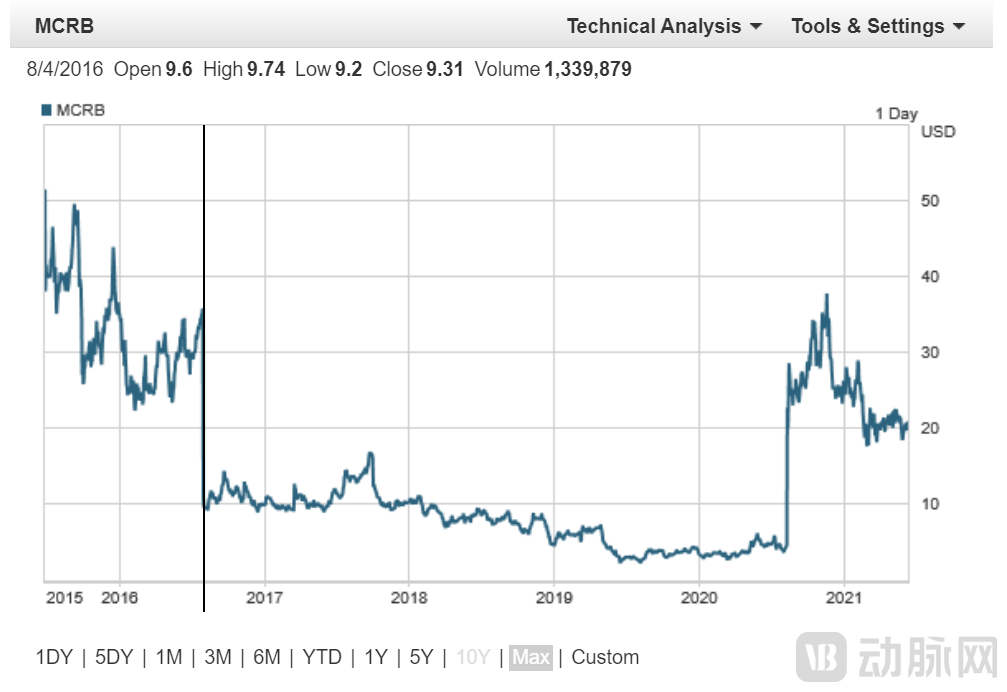
Seres Stock Price Chart, August 2016 Source: Seres Official Website
However, Seres Therapeutics did not abandon the development of SER-109. On one hand, analyses indicated that although SER-109 failed to meet the primary endpoint of the trial, it was able to colonize patients and exhibit biological activity. On the other hand, Seres believed that the accuracy of PCR testing and the dosage of SER-109 may have contributed to the failure of the Phase II clinical trial. Consequently, Seres decided to relaunch the clinical trials.
Four years later, in early August 2020, Phase III clinical trial results for this drug demonstrated that it could significantly reduce the risk of recurrent Clostridioides difficile infection (CDI). Among patients receiving SER-109, only 11.1% experienced recurrence, compared with 41.3% in the placebo group. The SER-109 arm not only achieved a higher rate of sustained clinical response but also exhibited a safety profile comparable to that of placebo. Following this announcement, Seres Therapeutics’ stock price surged by nearly fourfold.
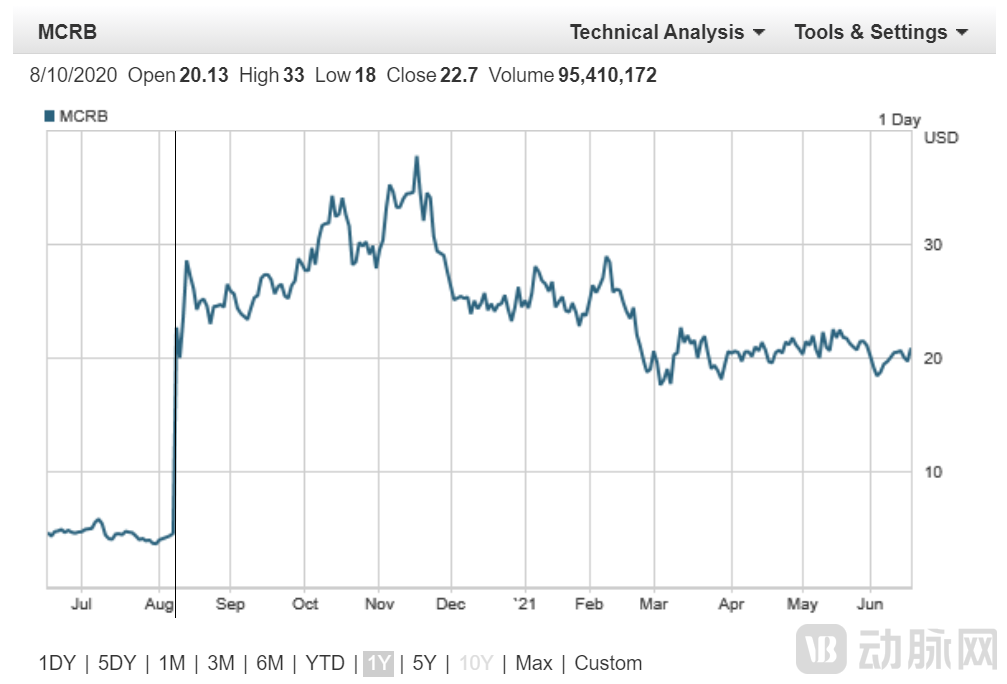
Seres Stock Price Chart, August 2020 Source: Seres Official Website
Although SER-109 has experienced such ups and downs, it is fortunately on the verge of success. In the field of live biotherapeutic product development, perhaps more drugs do not have such good luck to come back from the dead.
Seres successfully went public within just five years of its founding, but a decade has now passed without any revenue from product sales; even SER-109 is still being prepared for Biologics License Application (BLA) submission.
and Seres Therapeutics is operating at a loss, according to its annual report released in March 2021, as of December 31, 2020, its annual net loss was $89.1 million, with accumulated deficit reaching $548.8 million.
Seres states that R&D activities are central to its business model, with its primary expenditures indeed being R&D costs.Moreover, in the foreseeable future, it will continue to bear substantial drug development costs and operational risks. According to Seres Therapeutics’ projections, as of the end of last year, its cash reserves would be sufficient to sustain operations for the next twelve months; however, this estimate is subject to potential inaccuracies due to unforeseen changes during that period.
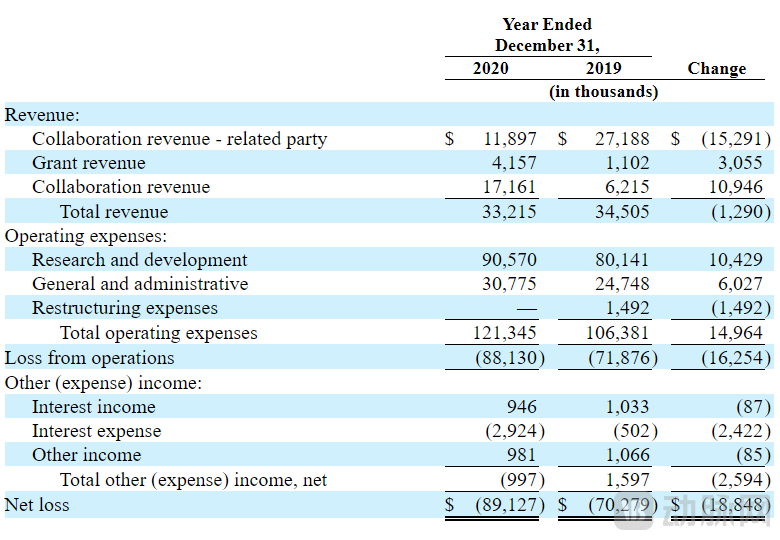
Source: Seres Official Website
So, where is Seres Therapeutics headed in 2021?The 2020 annual report outlined 12 planned initiatives for its future operational activities, primarily including completing the clinical development of SER-109 and preparing for its commercialization; continuing the clinical development of other products; and making further investments in its manufacturing capabilities and research platforms.
Seres stated that, despite facing intense competition from biotechnology companies, large pharmaceutical firms, and academic institutions, as well as the operational impact of COVID-19, it would continue to advance its product pipeline, committed to treating various diseases by modulating the function of the human microbiome.