

Zenflow Files IPO Prospectus Following Five Funding Rounds for Its Innovative BPH Treatment Device

Zenflow
Prostate Hyperplasia Treatment Device Developer
Among global investors, companies operating in saturated “red ocean” markets rarely attract attention, as market share has been largely monopolized by industry leaders, prompting many entrepreneurs to pursue emerging industries. However, Zenflow has taken a contrarian approach by targeting the patient population with benign prostatic hyperplasia (BPH), addressing current technological gaps and unmet patient needs through the development of novel medical devices, thereby successfully unlocking incremental market growth.
Zenflow was founded in 2014 through a collaboration between a team of Stanford University Biodesign fellows and leading urologists worldwide. Following its successful Series B financing round in 2018, the company has recently secured additional capital support. Is its growth driven by the “prestige advantage” of its elite academic origins, or are there other factors at play?
Nick Damiano graduated from Stanford University with a Master’s degree in Management Science and Engineering. Unlike many of his peers from prestigious universities, he did not choose to join tech giants such as Google, Apple, or Facebook to easily become a “winner in life.” Instead, he focused on the independent research and development of medical devices for benign prostatic hyperplasia (BPH).

Source: Zenflow Official Website
It is reported that in 2020, global therapeutic device companies secured only 77 rounds of financing in total, while biopharmaceutical companies completed 638 rounds. In addition, manufacturers are subject to a 2.3% medical device tax, and products must undergo FDA approval before market launch, a process with a lengthy cycle. Challenges such as time-consuming procedures and high costs seem to suggest that his entrepreneurial journey involves far more than just “countless trials and tribulations.” Yet, since the company’s inception, its repeated success in securing financing appears to send a clear message: “You were wrong.”
From 2002 to 2004, he served as an MRI Analyst in the Division of Cardiothoracic Surgery at the University of Washington, where he improved graph analysis algorithms for the cardiac surgery laboratory. He subsequently worked as a Biodesign Engineer at Kensey Nash, Webgen, and EBR Systems, accumulating extensive experience in observing the needs of patients with prostate diseases and conducting in-depth analyses of the related market size.
In 2013, Nick Damiano reached a turning point in his career when he was recruited by Stanford University to join its Biodesign team for innovative research. The seed of an idea in Nick Damiano’s mind—using medical devices to treat benign prostatic hyperplasia (BPH)—began to take root and sprout, as partners for the development of the Spring® System gradually came together.
Benign Prostatic Hyperplasia (BPH) is a common benign condition causing urinary dysfunction in middle-aged and elderly men. It is the primary cause of Lower Urinary Tract Symptoms (LUTS) in this demographic, with moderate-to-severe LUTS significantly impairing quality of life. Meanwhile, population aging—a persistent headline topic in media worldwide—is intensifying at an accelerating pace, inevitably leading to a rise in the number of BPH patients.
Last year, the “Multidisciplinary Team (MDT) Discussion on Management of Benign Prostatic Hyperplasia in the Elderly,” part of the “Elderly Comorbidity Management Project” initiated by China Medical Tribune, reported that the prevalence of benign prostatic hyperplasia (BPH) was 70% among men aged 61–70 years and 90% among those aged 81–90 years. Elderly patients with BPH often have concurrent chronic diseases, and a greater number of comorbidities is associated with more severe lower urinary tract symptoms (LUTS) and poorer quality of life. Current common treatments, including medication and surgery, do not provide a satisfactory cure for BPH.
Setting aside medication adherence, statistics indicate that among the nearly 40 million BPH patients in the United States, the vast majority perceive pharmacological therapy as having a slow onset of action and insufficient efficacy. Furthermore, BPH patients with comorbidities such as hypertension, hyperglycemia, or hyperlipidemia (“three highs”), or those with a family medical history, may experience complications including dizziness, somnolence, and sexual dysfunction, while also bearing high medication costs.
If surgical treatment is performed, there is a high risk of tissue damage within the prostate gland, which can easily disrupt normal physiological functions and lead to urinary incontinence. For minimally invasive procedures such as transurethral resection of the prostate (TURP), although the cure rate can reach 85%–90%, complications are frequent, including perforation, bleeding, urethral stricture, erectile dysfunction, and retrograde ejaculation.
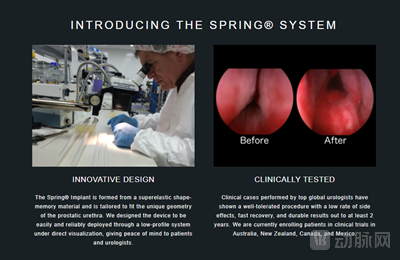
Source: Zenflow Official Website
When neither pharmacotherapy nor surgery could improve patient recovery outcomes, a new clinical need emerged. Drawing on his prior experience, Nick Damiano recognized the potential of medical device-based therapy and boldly decided to develop devices utilizing shape-memory and superelastic materials, aiming to address the treatment of benign prostatic hyperplasia (BPH) through interventional devices.
The minimally invasive Spring® Treatment System was also developed, utilizing a shape-memory material implanted in the prostate urethra that conforms to its unique anatomy, enabling rapid and visualized deployment.
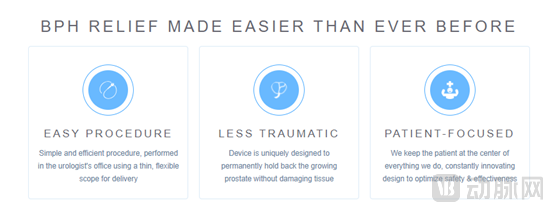
Compared with traditional open surgery, it causes less trauma, less pain, and faster recovery. Due to the superelasticity and shape memory of the material, there are almost no postoperative complications related to the lesion, ensuring normal organ function. The operability and effectiveness are very significant.
Source: Zenflow Official Website
In the year following Zenflow’s establishment, the U.S. research and consulting firm GlobalData analyzed that the global treatment market for benign prostatic hyperplasia (BPH) would grow from $2 billion in 2014 to approximately $4.9 billion in 2024, representing a compound annual growth rate (CAGR) of 8.23%.
This indirectly proves that Zenflow has successfully tapped into the incremental market for benign prostatic hyperplasia (BPH), serving as a “catalyst” for the company’s development and, to some extent, facilitating its successful fundraising. In May of that year, it secured its initial funding of $120,000 from Y Combinator and Wei Guo, marking the first time in its 10-year history that Y Combinator (a U.S. venture capital firm) had invested in a medical device company.
Opportunity Favors the Prepared—Innovation Is the Key to Success
Unlike other industries, the medical device industry takes medical advancement as its starting point and ultimate goal; that is, the design and development of medical equipment must closely revolve around diseases.
For startups, the key lies in delivering high-quality products that effectively address patient needs, making innovation critically important. Take internet healthcare as an example: during the pandemic, timely access to medical care became challenging, which spurred the emergence of a fully online healthcare service ecosystem integrating “medical care, pharmaceuticals, and insurance.”
Following this line of reasoning, it is easy to see that the Zenflow team’s extensive industry experience has enabled them to identify existing problems in the current treatment of benign prostatic hyperplasia (BPH) and market gaps—namely, the lack of a curative option via medical devices.

Source: Zenflow Official Website
Drawing on extensive practical experience, they firmly believe that closely addressing clinical needs and challenging long-standing industry assumptions will drive continuous optimization of the safety and efficacy of treatment regimens. This pattern holds true for nearly all successful startups in the healthcare sector. Examples include Pack4U, which focuses on medication adherence, and EvoEndo, which specializes in pediatric endoscopy and surgical procedures.
From a technical perspective, the Zenflow Spring system is advancing the diagnosis and treatment of benign prostatic hyperplasia (BPH), significantly alleviating patients’ financial, physical, and lifestyle burdens. From a market standpoint, its launch fills the gap between surgical interventions and pharmacological therapies. Although still in the FDA approval process, Zenflow has already secured support from several prominent venture capital firms, including Invus, F-Prime Capital, Medical Technology Venture Partners, and StarX.
Implications for Domestic Entrepreneurs
From a market perspective, the Seventh National Population Census indicates that the proportion of China’s population aged 65 and above reached 18.7%, an increase of 5.44 percentage points. With aging intensifying day by day, demand for therapeutic treatments and healthcare services is growing substantially. According to incomplete statistics, approximately half of men aged 51–60 suffer from benign prostatic hyperplasia (BPH), while among those over 80, the prevalence rises to 90%. The Statistical Yearbook 2020 shows that in 2019, the national mortality rate due to urogenital diseases was 6.6 per 100,000 people, with the rate for men reaching as high as 7.49 per 100,000. Currently, BPH treatment relies almost exclusively on medication, and the incremental market for device-based therapies remains largely untapped.
From a technical product perspective, the market sales of medical devices in China are less than one-fifth of those for pharmaceuticals. Large and medium-sized enterprises are the mainstay of the industry, while there are numerous small enterprises facing a serious problem—severe product homogenization. For instance, there are 47 products from 44 manufacturers for just a single type of compliance filter. Mid-to-low-end products account for 75% of the market share, whereas high-end products account for only 25%. In contrast, the composition of medical device products in the international market is basically 55% high-end and 45% mid-to-low-end, highlighting an urgent need to implement technological innovation. In the absence of high-quality products, it is easy to reap market dividends; however, entrepreneurs must carefully consider how to drive innovation closely aligned with local needs.