

OneHealthPro Files IPO Prospectus: Delivering Integrated Cross-border Healthcare Solutions for Chinese Enterprises Going Global
Perhaps five years ago, it was hard to imagine that telemedicine would enter the public eye with such explosive growth. Even in the United States, which has a mature business model for telemedicine, telemedicine services have not progressed as rapidly as one might have expected.
It was not until the outbreak of the COVID-19 pandemic in early 2020 that numerous diagnostic and therapeutic activities shifted from offline to online settings, ushering in rapid development for telemedicine. Meanwhile, many healthcare institutions expanded their online operations, providing services such as remote outpatient consultations, psychological counseling, and epidemic prevention training to individuals at home. A thematic report published by Ascension, a private healthcare system in the United States, revealed that telemedicine utilization surged 40-fold between January and April 2020. Furthermore, it remained highly active even after the pandemic entered a phase of normalized control, with service volumes reaching nearly 20 times the pre-pandemic levels.
Amid the rampant spread of the COVID-19 pandemic at that time, employees of Chinese enterprises working on overseas projects faced challenges in receiving timely and effective healthcare due to language barriers, limited communication network connectivity, and scarce local medical resources. In fact, the medical needs of Chinese expatriate staff had long existed, and the onset of the COVID-19 pandemic further exacerbated this demand.
How to provide Chinese enterprises’ overseas employees with higher-quality, comprehensive cross-border medical service solutions in locations with weak healthcare systems and poor communication networks is a challenge that requires proactive responses from overseas employees, enterprises, and even government authorities.
Based on this, Wanhaishi (Shenzhen Wanhaishi Digital Medical Co., Ltd.) took telemedicine as its entry point and was officially established in 2020.As domestic telemedicine and internet healthcare platforms engage in fierce competition, Vancision has chosen a different angle—cross-border telemedicine.。
Strengthening Health Protection for Overseas Employees to Safeguard the Belt and Road Initiative
Before delving into the details of Vanhius, let us first consider the following background.
In recent years, with the continuous advancement of the Belt and Road Initiative, Chinese enterprises, particularly state-owned enterprises (SOEs), have deepened their overseas investment and operations, expanding their presence across an increasingly wide range of countries and regions. Statistics show that there are approximately 1 million Chinese enterprise employees stationed abroad, including about 400,000 from state-owned enterprises, distributed in more than 180 countries and regions. However, it is worth noting that in some countries and regions, the prevalence of epidemics and outbreaks, coupled with scarce local health resources and poor medical conditions, poses a significant threat to the health and safety of expatriate personnel from Chinese-funded enterprises.
To safeguard the health and safety of Chinese enterprises’ overseas employees, the State-owned Assets Supervision and Administration Commission (SASAC) of the State Council conducted two special research projects on “Medical Security for Overseas Employees of Central State-Owned Enterprises” during 2018–2019, proposing the establishment of telemedicine platforms to address the healthcare challenges faced by Chinese companies’ expatriate staff.
Due to the impact of the COVID-19 pandemic in 2020, health coverage challenges for overseas employees have become more severe, further accelerating the platform’s development process.June 29, 2020,Under the promotion of the State-owned Assets Supervision and Administration Commission (SASAC), six central state-owned enterprises, including China Merchants Group and China General Technology Group, together with Hongyun Rongtong, jointly established the cross-border digital healthcare platform “Central Enterprise Telemedicine Platform.”Meanwhile, seven entities jointly established Wanhaishi as the implementing body of the platform to actively integrate high-quality domestic resources. By focusing on the construction and operation of medical clinics for overseas projects and specialized training for medical personnel, it effectively addresses the health protection needs of overseas projects and employees, thereby achieving the goal of “reassuring the nation, easing concerns for enterprises, and providing peace of mind to employees and their families.”

Dynamically optimize international video dedicated line networks to deliver premium-quality video cloud services.
Wanheisi, leveraging its partners, has established a global video communications virtual private network comprising one central hub, four domestic backbone nodes, and 20 international communication nodes.By integrating technologies such as cascaded networking, intelligent distributed routing, multi-network aggregation transmission, network adaptation, and encrypted data transmission, it achieves low-cost, high-quality, wide-coverage, and highly scalable audio-video communication capabilities across multi-network platforms and multi-path routes.。
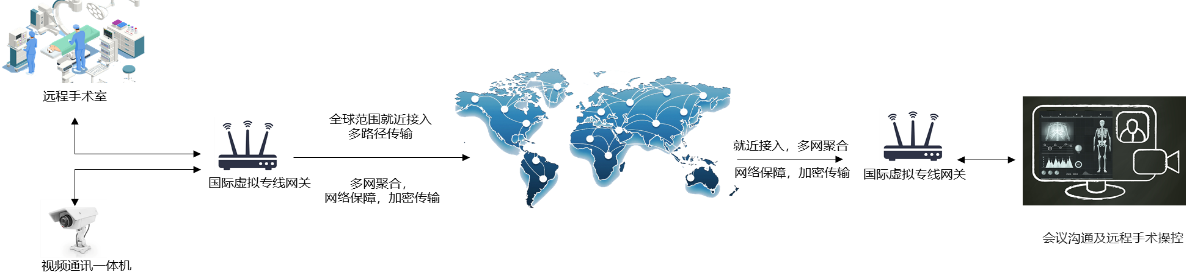
Currently, the Wanhaishi Video Communication Virtual Private Network (VPN) covers projects in over 130 countries. With acceleration implemented in certain regions, the cross-border packet loss rate has been stabilized at below 2%, down from more than 15%; cross-border network access latency has improved from 3 seconds to under 300 milliseconds; and the number of simultaneous participants in video interactions exceeds 500.Built on a global video communications virtual private network, Wanhai Si enables access to telemedicine services in most Belt and Road Initiative countries.。
Integrating the Concept of Tiered Diagnosis and Treatment to Achieve Efficient Resource Coordination
For telemedicine platforms, possessing a systematic array of medical resources is clearly the top priority for robust development and the key to establishing a competitive moat.
In alignment with the tiered diagnosis and treatment model advocated both domestically and internationally, WanHaisi has leveraged its strengths in resource integration to establish a three-tier healthcare delivery system in collaboration with dozens of hospitals across China.Among them,Infrastructure LayerIt is a telemedicine service center built upon the medical resources of its shareholder entities, primarily providing overseas employees with consultations for common illnesses and health management services.Middle LayerIt is composed of high-quality Grade 3A hospitals under central state-owned enterprises and selected local Grade 3A hospitals, leveraging the strengths of their key specialized departments to primarily provide consultation services for specialized diseases.Top LevelIt is composed of select multidisciplinary, nationally leading hospitals in Beijing, Shanghai, and Guangzhou, primarily responsible for providing expert consultations for critical, emergency, complex, and rare diseases, as well as professional medical training, popular science lectures, and green-channel referral services.
Moreover, when collaborating and integrating with domestic hospitals, the platform’s service center can be directly deployed within the hospitals’ own telemedicine centers. After overseas employees initiate diagnostic and treatment requests through the project, the platform assists hospitals in coordinating and assigning appropriate specialists based on actual conditions. Services are delivered via the “Kangqiao Hulian” system deployed at the patient, project, and hospital ends, thereby ensuring the quality of medical care throughout the entire process.
By leveraging a planned three-tier diagnosis and treatment system and a physician matching model, Wanhaisi can achieve more optimal planning and coordination of existing medical resources., efficiently connecting domestic experts with overseas project sites, and fully leveraging the platform's characteristics of timely, high-quality, and precise response., providing strong support for the advancement of the company's overseas projects.
In some underdeveloped regions of China, there are also issues such as insufficient high-quality medical resources and the inability to effectively integrate medical resources across different areas. Drawing on existing overseas service practices, the platform plans to replicate and expand its overseas medical service model domestically in the future, thereby supporting the development of China’s tiered diagnosis and treatment system.
Furthermore, although the platform’s current business focus is on safeguarding the health of overseas employees of central state-owned enterprises (SOEs) along the “Belt and Road” routes, leveraging the network of overseas medical clinics established by these SOEs and the platform’s telemedicine capabilities, Wanhai Si will alsoThe scope of services is gradually expanding to cover local state-owned enterprises and private enterprises with overseas operations, while also providing comprehensive health protection services for overseas Chinese citizens and international students.。
Starting from the B2B sector to provide comprehensive medical security solutions for Chinese enterprises operating overseas
Compared to the consumer (B2C) market, the business-to-business (B2B) market offers the advantage of a more stable user base. Moreover, acquiring B2C customers individually tends to incur higher costs. Therefore, targeting B2B clients is an effective strategy for reducing customer acquisition costs. As a result, Wanhaisi’s current business focus is primarily on the B2B sector.
Currently, Wanhaisi is capable of providing B-side clients with comprehensive overseas medical security support services, including monitoring and early warning services (data aggregation, health monitoring, medical risk alerts, etc.), COVID-19 public health services (prevention and control plans and manuals, emergency response guidance), telemedicine services, health management, tool support, training services, and infirmary construction and operation.
It is reported that during the platform's operation, a cumulative total ofProvided over 5,000 remote epidemic prevention and consultation services for more than 2,000 overseas projects across 130+ countries and regions, serving over 180,000 expatriate employees., and established a high-level expert team composed of senior specialists at the associate chief physician level or above from departments including Infectious Diseases, Respiratory Medicine, Emergency Medicine, and Psychiatry.
While the significant growth of telemedicine today has been largely driven by the COVID-19 pandemic, the fundamental foundations for cross-border telemedicine remain high-quality, professional network support and robust backend medical resources. Wanhaisi possesses unique advantages in cross-border network communications, resource background, and distribution channels. Its business model, which focuses on serving large enterprise clients (B2B) and enters the market from overseas to bypass the fiercely competitive domestic telemedicine landscape, grants Wanhaisi substantial potential for future growth.