2021 Smart Hospital Innovation White Paper: Exploring Innovation Pathways Through Insights from Nearly 10,000 Survey Respondents
The digital wave is sweeping across all industries, and the healthcare sector is no exception.
Amid the digitalization trend, the deep integration of information technology with the healthcare sector has made digital and smart transformation an imperative for hospitals’ long-term development. Smart hospitals serve both the demand side (i.e., patients) and the supply side (i.e., healthcare professionals and hospital administrators). Compared with traditional hospitals, smart hospitals are still in their early stages of development; the needs, perspectives, decisions, and actions of both patients and healthcare providers will influence the construction and evolution of smart hospitals.
To gain a clearer understanding of patient needs, key construction elements, and development trends in smart hospitals, BOE Technology Group Co., Ltd. and VCBeat Research Institute jointly released the “2021 White Paper on Smart Hospital Innovation.” The white paper includes interviews with more than 20 hospital administrators and industry experts, as well as a survey of 7,803 patients across seven cities. It examines smart hospital development from multiple perspectives, outlines typical scenarios and case studies, and highlights industry innovation achievements and development trends, with the aim of providing reference insights for the sector.
Currently, the development of smart hospitals is driven by multiple factors, including policy, demand, and technology.
In terms of policy, top-level design is aligned with implementation.The nation is vigorously advancing a new round of healthcare and pharmaceutical system reforms to address, at their source, challenges such as difficult and costly access to medical care. The Healthy China Strategy has been launched to facilitate a shift from a disease-treatment-centered model to a health-centered approach. Traditional hospital operational systems struggle to meet the policy requirements of this new phase, making intelligent solutions a critical means of optimizing resource allocation and extending the hospital service value chain.
Meanwhile, the wave of digitalization has swept across all industries. The healthcare system has seized this opportunity to foster synergy with smart cities and innovative artificial intelligence applications, initiating large-scale intelligent transformation. Guided by top-level design, departments such as the National Health Commission and the National Healthcare Security Administration have formulated requirements and standards for corresponding modules of smart hospitals, providing a more definite regulatory framework for their construction.
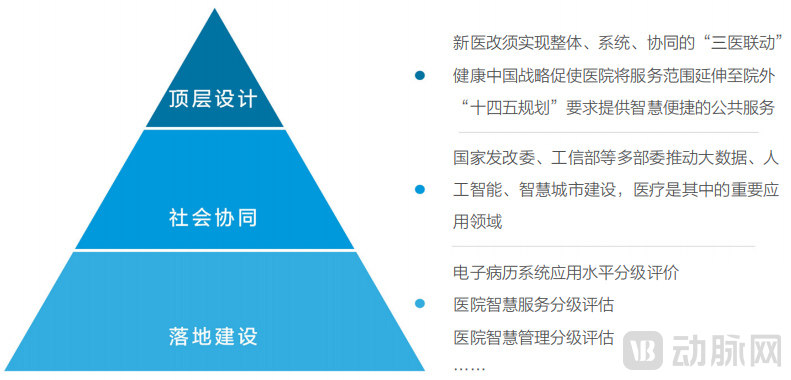
Policy-Driven Development of Smart Hospitals
On the demand side, changes in disease patterns, consumer purchasing power, and consumption habits are generating new demands.According to the “Opinions of the State Council on Implementing the Healthy China Action,” deaths from chronic non-communicable diseases (NCDs) such as cardiovascular and cerebrovascular diseases, cancer, chronic respiratory diseases, and diabetes account for 88% of all deaths in China, and the economic burden of these diseases accounts for more than 70% of the total disease-related economic burden. In the future, hospitals will be able to provide full-cycle management for patients with chronic diseases through wearable devices, remote monitoring, and other methods, thereby reducing the incidence of complications.
In recent years, with the rapid development of the socio-economic landscape, Chinese residents’ purchasing power and health-conscious consumption awareness have significantly improved compared to the past. Patients now have higher expectations for medical services, seeking not only effective clinical outcomes (“quality care”) but also a positive service experience (“comfortable care”). The traditional healthcare delivery model, characterized by “three long waits and one short consultation,” no longer meets patient needs. Consequently, hospitals must leverage smart healthcare services to enhance the patient experience.
Meanwhile, the mobile internet has profoundly transformed residents’ lifestyles and habits. Mobile-based social networking, shopping, and payment services have long become deeply embedded in daily life. As people enjoy the convenience brought by mobility in other domains and develop corresponding usage habits, they have generated parallel demands for healthcare services, thereby driving the construction and upgrading of online medical platforms and even smart hospitals.
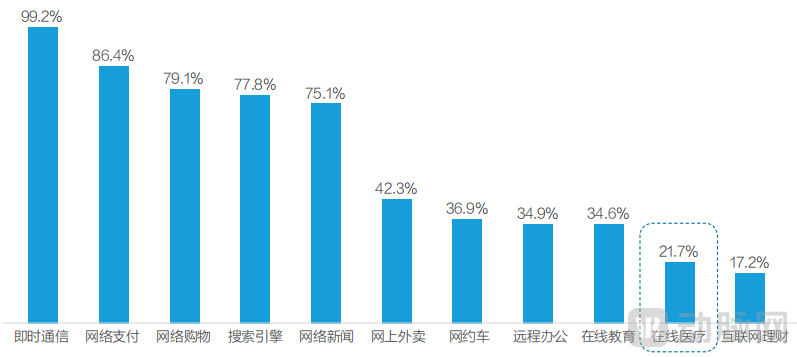
User Penetration Rates of Common Functional Internet Applications, Data Source: China Internet Network Information Center
Technologically, new infrastructure brings new opportunities.In the context of limited medical resources, the application of next-generation information technologies—such as cloud computing, big data, artificial intelligence, the Internet of Things (IoT), and 5G—in the healthcare sector continues to deepen. These advancements enhance connectivity efficiency among people, between people and devices, and among devices themselves. The vast amounts of data accumulated during the traditional era of informatization will help unlock the significant potential of limited medical resources. Currently, the internet has already achieved remarkable results in optimizing healthcare service processes. In the future, next-generation information technologies will penetrate the core of healthcare, playing a pivotal role in hospital management, clinical practice, and scientific research.
Furthermore, as a black swan event, the pandemic has accelerated the development of smart hospitals.As a critical component of smart hospitals, internet hospitals have transcended spatial limitations, with their advantages of high efficiency and low risk becoming more pronounced than ever. A significant number of physical hospitals have launched online diagnosis and treatment services. Meanwhile, the intelligent transformation of processes such as infectious disease early warning and healthcare-associated infection prevention and control has provided strong support for the precision and efficiency of epidemic prevention and control. The pandemic has further heightened hospital administrators’ awareness of the necessity of building smart hospitals, prompting them to take concrete actions and thereby accelerating the overall development of smart hospitals.
Of course, smart hospitals also face constraints during their development, such as uneven foundations in medical informatization, information silos, and a shortage of interdisciplinary talent, which require continuous breakthroughs throughout the construction and development process.
In this white paper, VCBeat Research Institute summarizes six key construction points, three optimization points, and a set of innovation points for smart hospitals, based on user questionnaire surveys and in-depth expert interviews.
Key Construction Points: Addressing Pain Points Across the Entire Patient Journey While Accommodating the Differentiated Healthcare Needs of Specific Population Segments
First, patients face difficulties in selecting appropriate care before consultation, necessitating the efficient matching of medical resources through a combination of AI and human expertise.Patients experience a range of distress even before seeking medical care. The most common concern, reported by 55.7% of patients, is the excessive number of people registering for appointments on-site, which necessitates multi-channel appointment scheduling solutions. Additionally, nearly one-third of patients are uncertain about which doctor to choose or which department to visit. Smart hospitals can address standardized issues through AI-powered triage tools, such as recommending appropriate departments based on patient symptoms and affected body areas. Meanwhile, human customer service agents can handle more flexible inquiries, addressing patients’ questions about other hospital-related information. Combining these two approaches enables efficient and precise matching of patients with appropriate medical resources.
Second, multiple ineffective back-and-forth movements during consultations waste time and effort, necessitating optimization of the patient journey and spatial layout.The inconvenience caused by repeated back-and-forth trips was fully reflected in this survey, with 47.1% of respondents considering the medical consultation process complicated and requiring them to run between different floors or buildings within the hospital. This necessitates that hospitals optimize their spatial layout during construction—for instance, processes that can be completed within a single building should not be spread across multiple buildings, and those that can be handled on one floor should not span multiple floors. While this poses significant challenges for hospitals that have been built and operational for many years, spatial layout should be a key consideration for newly constructed hospitals.
Third, there are limited channels for doctor-patient communication outside the hospital; it is necessary to establish unimpeded channels to facilitate doctor-patient interaction.43.5% of users still have questions for their doctors after consultations; 40.2% are unsure how to respond to sudden changes in their condition. Communication barriers are particularly evident among specific populations: pregnant women are most concerned about whether minor ailments require medical attention, while elderly patients often forget medical advice after consultations. These pain points can be addressed through online consultations, online pharmaceutical services, internet-based diagnosis and treatment, and health education, enabling rapid responses to patient inquiries and supporting patients in making informed healthcare decisions.
Fourth, the elderly face a "digital divide," necessitating age-friendly adaptations of smart services.Up to 62.9% of users have encountered issues where elderly family members are unable to use mobile phones for services such as appointment registration. While hospitals maintaining traditional offline service windows is indeed one approach to addressing the “digital divide,” it is also advisable to design applications or products better aligned with older adults’ usage habits. Examples include incorporating intelligent voice interaction features to minimize manual input, designing user interfaces tailored to the visual characteristics of older adults, and reducing the number of operational steps as much as possible.
Fifth, the experience for special groups is suboptimal; hospital design must balance professionalism with human-centered considerations.Regarding pediatric healthcare, as many as 63.7% of parents believe that hospitals are overly crowded, leading to a high risk of cross-infection among children. Some parents also report that medical examination equipment frightens children, resulting in non-cooperation. Pregnant women and the elderly similarly face challenges due to poorly designed restrooms and waiting areas, which contribute to an unfriendly patient experience. When discussing the “smart transformation” of hospitals, the focus should not be limited to the application of cutting-edge technologies; equal attention must be paid to infrastructure, equipment, and the overall environment. For instance, to mitigate the risk of cross-infection, child health care zones (primarily serving healthy children) should be physically separated from clinical diagnosis and treatment zones (primarily serving sick children).
6. Working professionals find it difficult to coordinate medical appointments, and internet hospitals play a crucial complementary role.57.2% of working professionals consider multiple hospital visits and repeated leave requests for a single illness to be the greatest challenge. The diagnostic and treatment process facilitated by internet hospitals can improve the healthcare experience for this demographic. Although online consultations are currently limited to follow-up visits and cannot serve as initial diagnoses, the integration of internet hospitals with physical medical institutions creates a closed-loop care system across online and offline channels, thereby minimizing the number of in-person hospital visits required by working professionals.
Optimization Highlights: Smart services must be patient-centric, with comprehensive, distributed enhancements across the entire care journey
In recent years, the smart healthcare services successively launched by hospitals have become increasingly perceptible to patients. This white paper outlines common smart service initiatives across the pre-consultation, during-consultation, and post-consultation stages, and examines their user penetration rates and satisfaction levels.
Intelligent Risk Assessment in the Pre-Consultation Phase Shows “Dual Low” Results; Addressing Patients’ Substantive Issues Is the True Measure of Value.Survey data indicate that in pre-consultation smart services, mobile appointment registration and intelligent triage or registration have achieved high penetration rates of 76.7% and 60.7%, respectively, with these two services also recording the highest average satisfaction levels. This fully demonstrates the critical importance of establishing convenient registration channels for patients and providing timely responses to their registration-related inquiries.
In contrast, both the penetration rate and user satisfaction of intelligent disease risk assessment are relatively low. Such systems fail to provide substantive results and cannot replace physician diagnosis. Moreover, disease risk assessment is not a high-frequency need, unlike appointment registration, which is utilized with every visit. Therefore, hospitals must carefully consider patients’ core needs when developing similar systems.
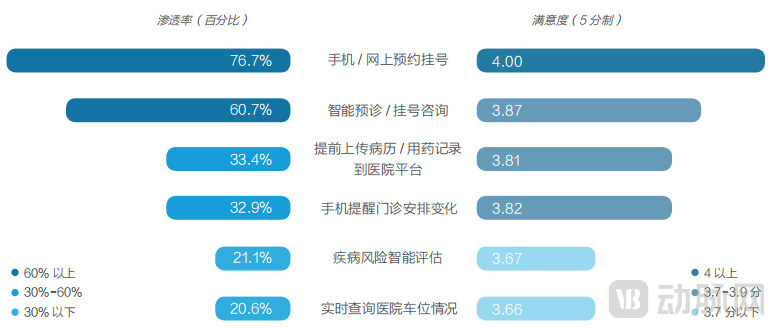
User Penetration Rate and Satisfaction with Pre-Consultation Smart Services, Data Source: User Survey
Overall satisfaction during consultations is relatively high, and improving convenient services helps enhance the medical experience.In this survey, the overall penetration rate and patient satisfaction with smart in-consultation services were relatively high. Services such as self-service payment, medical record inquiry or printing, and report retrieval have become standard features of smart hospitals, playing a significant role in addressing the pain point of "three longs and one short" (long registration queues, long consultation wait times, long medication dispensing queues, and short consultation durations). However, both the penetration rate and patient satisfaction for convenience services and indoor hospital mapping and navigation remain low, indicating a need for improvement. Although convenience services are often perceived as peripheral and easily overlooked within hospital operations, patients’ convenience experience throughout their hospital visit should be comprehensive, warranting greater attention to these services.
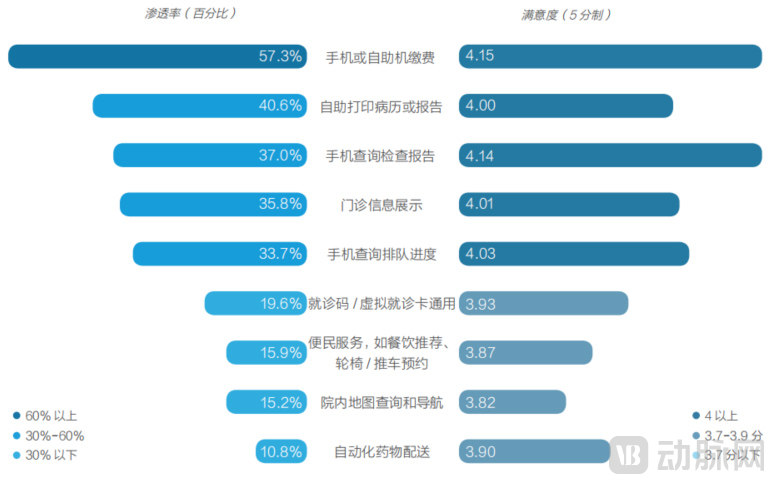 User Penetration Rate and Satisfaction with Smart In-Consultation Services; Data Source: User Survey
Low penetration rate of post-diagnosis services; internet hospitals and out-of-hospital care require focused strengthening.This survey indicates that mobile reminders for post-consultation follow-up visits, medication adherence, and other precautions achieve the highest penetration and satisfaction rates. In these services, hospitals have assumed a more proactive role, reversing the previous perception of passive healthcare delivery. However, compared with the overall performance of smart initiatives in pre-consultation and intra-consultation phases, the penetration and satisfaction rates in the post-consultation phase remain relatively lower. Smart healthcare services focusing on internet hospitals and out-of-hospital nursing care require further strengthening.
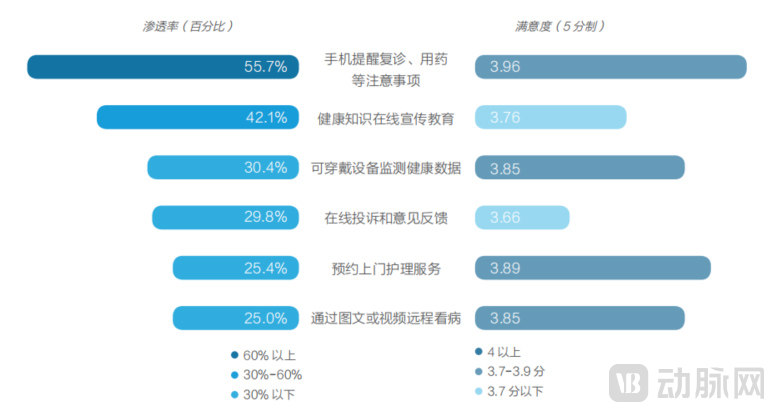
User Penetration and Satisfaction with Post-Consultation Smart Services, Source: User Survey
Innovation Highlights: Characterized by high quality, efficiency, health orientation, technological advancement, and humanistic care
Building on users’ existing awareness, we surveyed their perceived value of smart hospitals. The results show that nearly half of the respondents believe that smart hospitals can make medical visits more time- and effort-efficient, deliver a more patient-centered healthcare experience, reflect technological advancement, and represent an inevitable trend. The remaining respondents largely offered various other positive assessments of the value of smart hospitals.
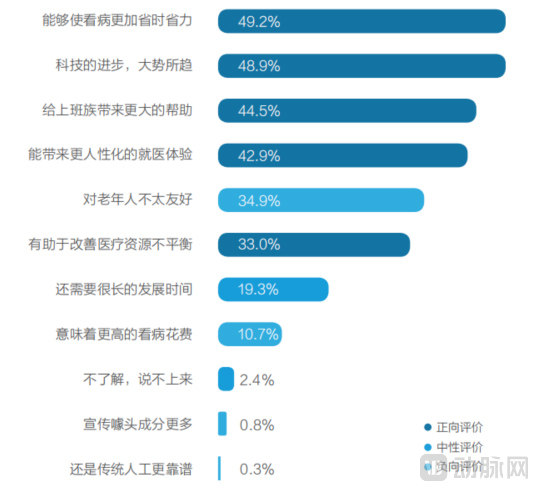
Users’ Attitudes Toward Smart Hospitals, Data Source: User Survey
Furthermore, users have expressed expectations for further improvements in their medical care experience. The largest proportion of patients, 59.1%, hoped to optimize the consultation process and reduce the need for excessive movement within the hospital. More than one-third of patients desired increased appointment availability on weekends and holidays, as well as enhanced services such as post-consultation Q&A, medication guidance, and navigation and support for the consultation process. Building upon the previously mentioned construction and optimization priorities, we further summarize the key innovation pillars for smart hospitals as follows: high quality, efficiency, technology-driven, health-focused, and humanistic care.
Currently, China has basically established a “trinity” system for the development of smart hospitals. Domestic hospitals are gradually aligning with a framework that encompasses smart medical care for healthcare professionals, smart services for patients, and smart management for hospital administration during their development processes. Additionally, some technology companies, such as BOE, have entered the healthcare sector, leveraging their intelligent technologies and scenario-based empowerment capabilities to conduct in-depth explorations of application scenarios in smart hospitals.
In the realm of smart healthcare, comprehensive integration and interoperability are currently the focal points of development. On one hand, enhancing the patient experience through synchronized medical and medication records, universal access via a single patient ID code, and self-service inquiry and download of medical reports relies on the interoperability and sharing of data across various systems within individual hospitals and even between different institutions. On the other hand, the current reality is that achieving interoperability within and between hospitals remains challenging, compounded by low data quality, which has resulted in numerous "information silos." In 2019, the average level of electronic medical record (EMR) application among tertiary hospitals across China exceeded Level 3 for the first time; however, only four hospitals achieved Level 7, indicating substantial room for improvement.
Consequently, hospitals are placing greater emphasis than ever on smart healthcare initiatives grounded in electronic medical record (EMR) applications, thereby creating more favorable conditions for advancing the overall informatization level of the industry in the next phase. Most newly built hospitals have established a goal of “comprehensive integration” from the outset, building a unified cloud architecture. They construct hospital-wide information systems with EMRs at the core to achieve interconnectivity among various clinical information systems. Meanwhile, significant innovative explorations have been made in application scenarios such as smart emergency care solutions, integrated operating rooms, mobile nursing management solutions, infusion monitoring and management solutions, and mobile workstations for physicians.
Among these solutions, physician mobile workstations have garnered significant attention from hospitals in recent years due to their convenience and efficiency. According to the CHIMA survey on hospital informatization in China for 2019–2020, 36% of respondent hospitals had achieved comprehensive deployment of physician mobile workstations, while 13% had implemented them partially. Furthermore, 31% of respondent hospitals planned to implement physician mobile workstations, representing the highest proportion among all planned information system projects. The physician mobile workstation at BOE Hospital is a major innovative application that deeply integrates and enables interoperability between the enterprise’s in-house development capabilities and electronic medical records (EMR). Leveraging mobile clients, physicians can overcome spatial constraints and conveniently complete the signing and issuance of various reports, including imaging reports.
In terms of smart services, “people-centric, reshaping service processes” is regarded as the core principle for the current construction of smart hospitals. In addition to the lack of an effective tiered diagnosis and treatment system, poorly designed medical care processes that operate inefficiently are also a significant cause of “difficulty in accessing medical care.” This is particularly evident in challenges such as difficult appointment scheduling, cumbersome consultation procedures, long waiting times, disordered patient flow, and insufficient communication time with physicians.
Currently, an increasing number of hospitals are rethinking healthcare delivery processes, striving to shift from a hospital-centric to a patient-centric model in process design, and flexibly integrating smart services to enhance patient experience. In recent years, newly built hospitals have placed particular emphasis on optimizing care pathways, introducing advanced concepts such as “integrated clinical zones” and “center-based hospital models,” while driving numerous innovations in smart services. Taking BOE Hospital as an example, each floor of its outpatient department features integrated clinical zones designed to provide one-stop healthcare services. These zones incorporate consultation rooms, pharmacies, and blood collection stations, among other units. Patients can complete the entire care journey within these integrated zones—from registration and payment, vital signs measurement, waiting and consultation, to electrocardiogram (ECG) testing, laboratory blood sampling, report retrieval, and medication pickup—significantly reducing unnecessary movement and travel distances.
Furthermore, various smart services—such as intelligent triage and guidance, electronic map navigation, smart queuing, smart waiting, and end-to-end QR code “one-code access”—have significantly enhanced patients’ healthcare experience.
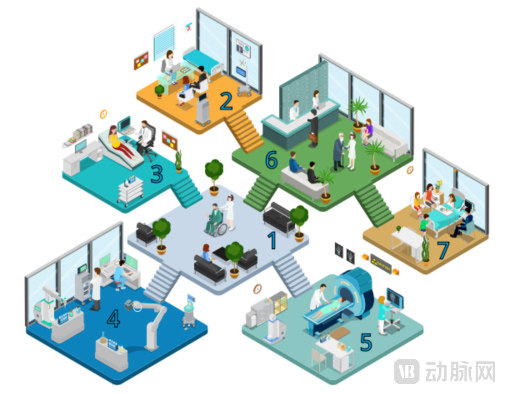
Inefficiencies in the Traditional Healthcare Process Lead to Congestion
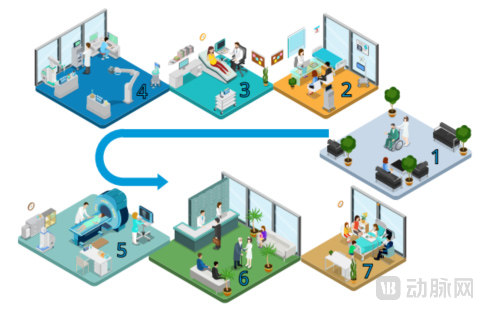
Integrated Consultation Areas Redesign the Patient Journey, Significantly Enhancing the Patient Experience
In terms of smart management, an increasing number of hospitals are leveraging intelligent tools to achieve lean management. There is a significant gap between the management standards of public hospitals in China and those of industries with fully competitive markets. To address this, the government has successively introduced policies aimed at enhancing hospital management capabilities. The "Graded Evaluation Standards for Smart Management," implemented in March 2021, incorporated smart management into the performance assessment system for hospitals. Achieving smart hospital management requires not only the adoption of advanced management concepts and methods but also the development of internal digital and informational capabilities. Currently, some hospitals are actively exploring various innovative applications, including mobile material management, central pharmacy systems, equipment lifecycle management, executive dashboards, and CRM (Customer Relationship Management).
Taking the mobile material management application independently developed by BOE Hospital as an example, scanning the asset QR code with a mobile phone enables operations such as equipment traceability, mutual borrowing, and warehouse transfer. Since the system went live, hospital-wide asset management has been well-organized, strengthening medical staff’s awareness of asset management and embedding the philosophy of lean management into daily practice.
In the realm of out-of-hospital health management, creating full-lifecycle health management services has become a focal point of societal attention. As health awareness among Chinese residents continues to rise, there is an increasingly strong demand for out-of-hospital medical services, including disease prevention and rehabilitation. In response, the newly released 14th Five-Year Plan and the Outline of Long-Range Objectives Through the Year 2035 propose comprehensively advancing the construction of a Healthy China, adhering to the principle of prioritizing prevention, and providing people with comprehensive, full-cycle health services. Some hospitals have proactively introduced a “one body, two wings” model of full-lifecycle health management, integrating in-hospital medical care with upstream disease prevention and intervention, as well as downstream chronic disease management and smart elderly care. These institutions have also made innovative explorations in application scenarios such as community health management, home-based health management, internet hospitals, and “Internet + Nursing” services.
China offers fertile ground for the demand and implementation of smart hospitals. The development of smart hospitals is driven by multiple factors, including policy, demand, and technology. Meanwhile, as China’s healthcare market gradually opens up, cross-industry players entering the healthcare sector have brought new development perspectives. Synthesizing various viewpoints, VCBeat believes that smart hospitals will continue to develop in three major areas: smart healthcare centered on electronic medical records, smart management aimed at standardization and efficiency, and patient-centric smart services. Furthermore, six trends are expected to emerge:
1. Interoperability applications for electronic medical records will become more widely adopted
2. Data-Driven Models Will Drive the Rise of More Personalized and Precise Treatment Approaches
3. The online and mobile transformation of smart hospitals will usher in a new model of medical services
4. Patient-centered flattening and centralization of processes will significantly enhance healthcare efficiency
5. The outward expansion trend of smart hospitals will become more pronounced
6. Intelligent Technology Empowerment Will Become the Driving Force for Hospitals to Comprehensively Enhance Services in the Future
Scan the QR code below to get the white paper for free (including detailed user research data)