

HeyGene's cfDNA Whole Genome Sequencing Recognized in World’s First Expert Consensus on Liver Cancer Early Screening
On June 22, the first “Expert Consensus on Early Screening Strategies for Liver Cancer in China” was officially published in the Chinese Journal of Hepatology. Led by the PreCar project expert group under the guidance of Academician Wang Hongyang from the Eastern Hepatobiliary Surgery Hospital affiliated with Naval Medical University and the National Center for Liver Cancer, and Professor Hou Jinlin from Nanfang Hospital of Southern Medical University and Shenzhen Hospital of Southern Medical University, the Consensus proposes a “pyramid-style stratified screening model” for the first time. It breakthroughly incorporates whole-genome sequencing of cell-free DNA (cfDNA) into the entire process of early liver cancer screening, enabling precise stratification of the target population in China through initial screening, refined screening, and early diagnosis. This approach effectively improves the detection rate of early-stage liver cancer and lays the foundation for establishing a “Chinese solution for early cancer screening.”
In the “Expert Consensus on Early Screening Strategies for Liver Cancer in China,” a “pyramid-style stratified screening model” was proposed for the first time, which employs a precision-based, pyramid-like stratified screening strategy to progressively enrich and concentrate the at-risk population.
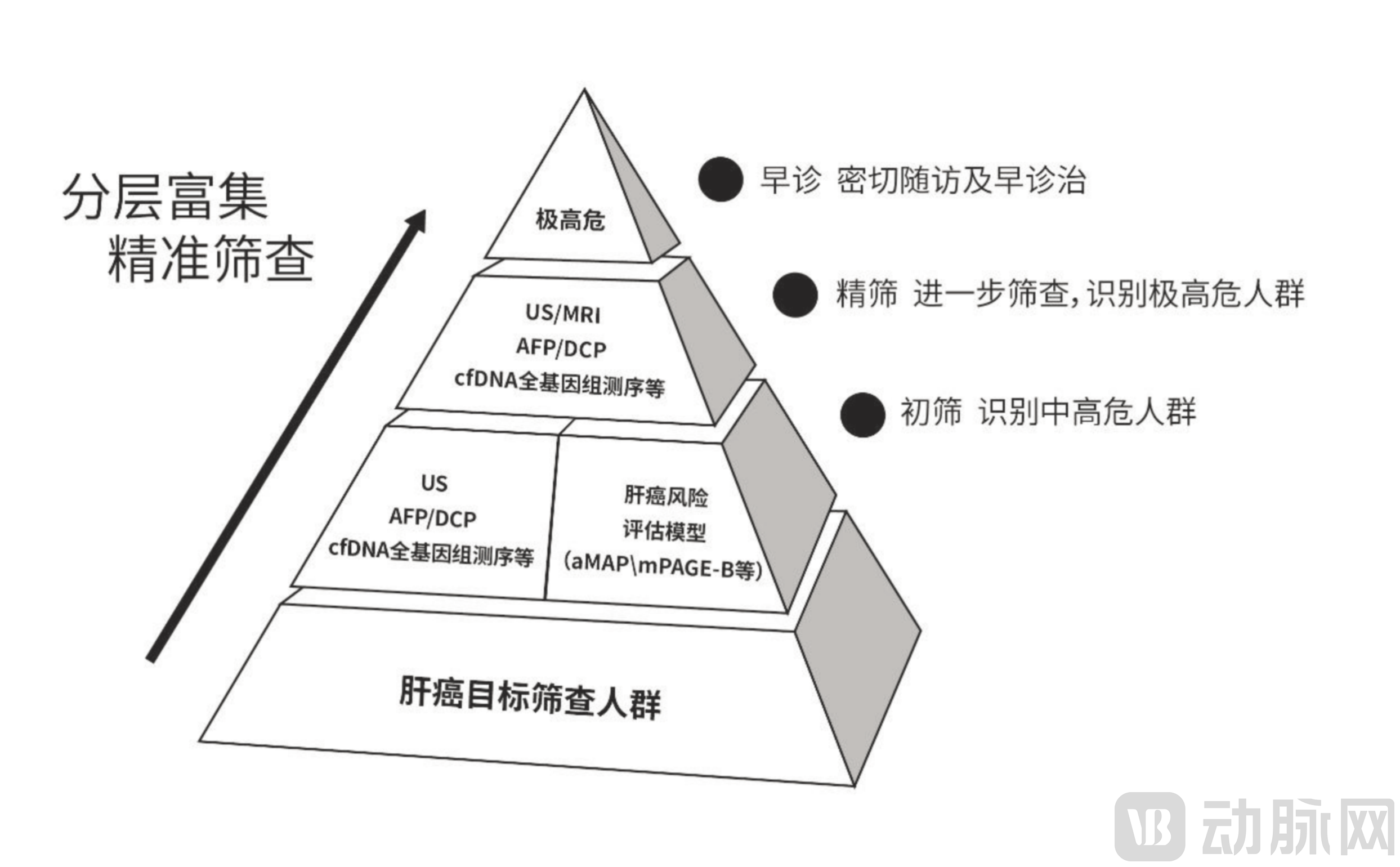
“Pyramid” Model for Early Screening of Liver Cancer
Note: US refers to abdominal ultrasound; MRI refers to magnetic resonance imaging; AFP refers to alpha-fetoprotein; DCP refers to des-gamma-carboxy prothrombin.
Whole-genome sequencing of cell-free DNA (cfDNA) has been incorporated into the “pyramid” model, playing a significant role. The Consensus states that initial screening may utilize imaging modalities (e.g., ultrasound), serum biomarkers (e.g., AFP/DCP), and liver cancer risk assessment models (e.g., aMAP). For individuals who wish to undergo a comprehensive evaluation of their hepatocellular carcinoma risk, liquid biopsy approaches such as cfDNA whole-genome sequencing may be selected for initial screening after thorough communication with the patient.For individuals with low-risk cfDNA whole-genome sequencing results, subsequent routine screening with ultrasound (US) and alpha-fetoprotein (AFP) every 6–12 months, along with further screening, is recommended; if test results indicate high risk, management and monitoring should follow protocols for very-high-risk populations.For individuals identified as at moderate-to-high risk during initial screening, further evaluation using refined screening methods can be employed to enrich the identification of those at very high risk, such asIf whole-genome sequencing of cfDNA indicates high risk, it suggests that the risk of hepatocellular carcinoma is elevated to very high risk.For the extremely high-risk population, the most rigorous stratified management and monitoring intervals will be implemented, with close follow-up to ensure early diagnosis and treatment.
AsThe World’s First Expert Consensus Focused on Early Screening for Liver Cancer"Expert Consensus on Early Screening Strategies for Liver Cancer in China"Emphasizing Effective Early Screening and Diagnosis for High-Risk Populations of Liver Cancer, detailed plans have been proposed for the target population, screening methods, and screening procedures for early liver cancer screening.It provides a practical and feasible approach for screening and early diagnosis of hepatocellular carcinoma (HCC) in high-risk clinical populations, representing an active exploration of HCC screening strategies tailored to China’s national conditions.
The “Expert Consensus on Early Screening Strategies for Liver Cancer in China” introduces liquid biopsy techniques such as whole-genome sequencing of cell-free DNA (cfDNA), cfDNA methylation, cfDNA gene mutations, and microRNA (miRNA), pointing out that"Liquid biopsy 'can serve as a supplement to personalized screening or diagnosis, further refining high-risk populations to identify patients with very early-stage/ultra-early-stage hepatocellular carcinoma at extremely high risk,'"Affirmed the value of liquid biopsy in early screening for liver cancer.
Among them, the Consensus emphasizes that, compared with traditional liver cancer screening methods,Whole-genome sequencing of cfDNA is unaffected by the screened individuals' history of liver disease, clinical pathological features, or geographic region, and demonstrates superior performance over existing serum biomarker assays in the screening and diagnosis of very early-stage/early-stage hepatocellular carcinoma.
Conventional methods for early screening of liver cancer suffer from low accuracy and poor compliance, limiting the accessibility and coverage of early detection. Utilizing a multi-dimensional HIFI scoring system based on whole-genome sequencing of cell-free DNA (cfDNA), the sensitivity and specificity for distinguishing liver cancer from non-liver cancer cases reach 95.42% and 97.91%, respectively. For patients who test negative for alpha-fetoprotein (AFP) or des-gamma-carboxy prothrombin (DCP), cfDNA whole-genome sequencing still demonstrates high detection sensitivity, ranging from 90.9% to 96.9%, thereby significantly reducing the rate of missed diagnoses in clinical practice. Moreover, for very early-stage (Stage 0) and early-stage (Stage A) liver cancer, the accuracy of cfDNA whole-genome sequencing surpasses that of both AFP and DCP testing.
Given its stable performance, excellent reproducibility, and high accuracy, cfDNA whole-genome sequencing is expected to become the ideal and preferred method for liver cancer screening in the future.
The Consensus innovatively incorporates cell-free DNA (cfDNA) whole-genome sequencing into the entire workflow of initial screening, refined screening, and early diagnosis of liver cancer, adding a powerful tool to clinical early screening practices and underscoring the strong endorsement of cfDNA whole-genome sequencing by industry experts. Guided by the Consensus, cfDNA whole-genome sequencing will help improve diagnostic accuracy, enhance patient compliance, and advance the prevention and control of liver cancer in China. The Consensus also sends a positive signal to the genetic testing industry, ushering in new development opportunities.
With the establishment of the “pyramid” model for early liver cancer screening and expert consensus endorsing whole-genome sequencing of cell-free DNA (cfDNA), a clear and well-defined workflow has been provided for early detection. This also introduces more highly sensitive and specific screening technologies to clinical practice, significantly improving screening accuracy and promoting the standardized and rapid development of the clinical early liver cancer screening industry.
It is understood that the cfDNA whole-genome sequencing technology for early liver cancer screening mentioned in the “Consensus” has already yielded mature commercial outcomes—Huirui Gene’s early liver cancer screening product, “Laisining,” was launched in August 2020, providing a 6- to 12-month earlier warning compared to traditional methods.It enables precise screening for liver cancer, early differential diagnosis of benign and malignant liver nodules, and dynamic monitoring of postoperative recurrence in high-risk populations with liver disease, thereby helping liver cancer patients achieve longer survival and significantly improving their quality of life. Meanwhile, Huirui Gene is leveraging its universal underlying technology to expand into early screening and diagnosis for multiple cancer types. Over the next three to five years, the company aims to deliver research outcomes on early screening and diagnosis for 5–8 high-incidence, high-risk cancers in China, and advance the industrial commercialization of the corresponding projects.
About PreCar
The PreCar project was jointly initiated in 2018 by Academician Wang Hongyang from the National Center for Liver Cancer, Professor Hou Jinlin from Nanfang Hospital of Southern Medical University, and Huirui Genomics, with an investment exceeding RMB 200 million.It is the first and only ultra-large-scale prospective cohort study project for early liver cancer screening based on NGS technology in China, and it is currently the largest and fastest-progressing prospective cohort study for liver cancer worldwide.
In February 2021, the first research findings from the PreCar project, published in the prestigious international journal *Cell Research*, demonstrated that the PreCar-based cell-free DNA (cfDNA) whole-genome sequencing technology for early hepatocellular carcinoma (HCC) screening is the most accurate HCC early screening method reported to date in clinical settings for distinguishing between individuals with and without HCC. In April, the Phase II extended clinical application study of the PreCar project was announced, aiming to expand its scope from early HCC screening to comprehensive disease management throughout the entire course of HCC.
References:
“Expert Consensus on Early Screening Strategies for Liver Cancer in China,” Chinese Journal of Hepatology, 2021, 29(6):515-522