

Shi Xuemin Academician: Pioneer of the Shi's Stroke Unit Therapy Bringing Acupuncture to Every Corner of Traditional Chinese Medicine
In 2009, the American documentary *9000 Needles* was released, bridging the gap between the public and Traditional Chinese Medicine (TCM) acupuncture. The film follows Devin Dearth, an American bodybuilder in his prime, who was left bedridden with paralysis due to a massive brainstem hemorrhage. After conventional Western medical treatments yielded limited results, he regained his health through TCM acupuncture therapy. The title derives from the fact that Devin received over 9,000 needle insertions throughout the complete course of his TCM treatment.
Upon its release, the documentary immediately sparked a “acupuncture fever” across the United States, further concretizing the therapeutic efficacy of Traditional Chinese Medicine (TCM) acupuncture and enhancing its international image.
Devin Dearth was treated by Academician Shi Xuemin at the First Teaching Hospital of Tianjin University of Traditional Chinese Medicine, who employed the “Awakening the Brain and Opening the Orifices” acupuncture therapy, a method widely disseminated both domestically and internationally.
The “Xingnao Kaiqiao” (Awakening the Brain and Opening the Orifices) acupuncture method is an acupuncture therapy established by Academician Shi Xuemin in 1972, specifically targeting stroke, which is recognized worldwide as one of the three major intractable diseases. This therapy halts neuronal death at a rate substantially faster than drug absorption, thereby enabling simultaneous emergency intervention and rehabilitation, and has pioneered a new approach to stroke treatment.
Over the subsequent half-century, Academician Shi Xuemin continuously explored new applications and expanded the scope of acupuncture, repeatedly surpassing his own research milestones. On June 12, at the inaugural Peking University Health Science Center Forum on Innovative Development of Integrated Traditional Chinese and Western Medicine, Academician Shi once again shared with the broader TCM community his research findings on the “Awakening the Brain and Opening the Orifices” acupuncture technique.
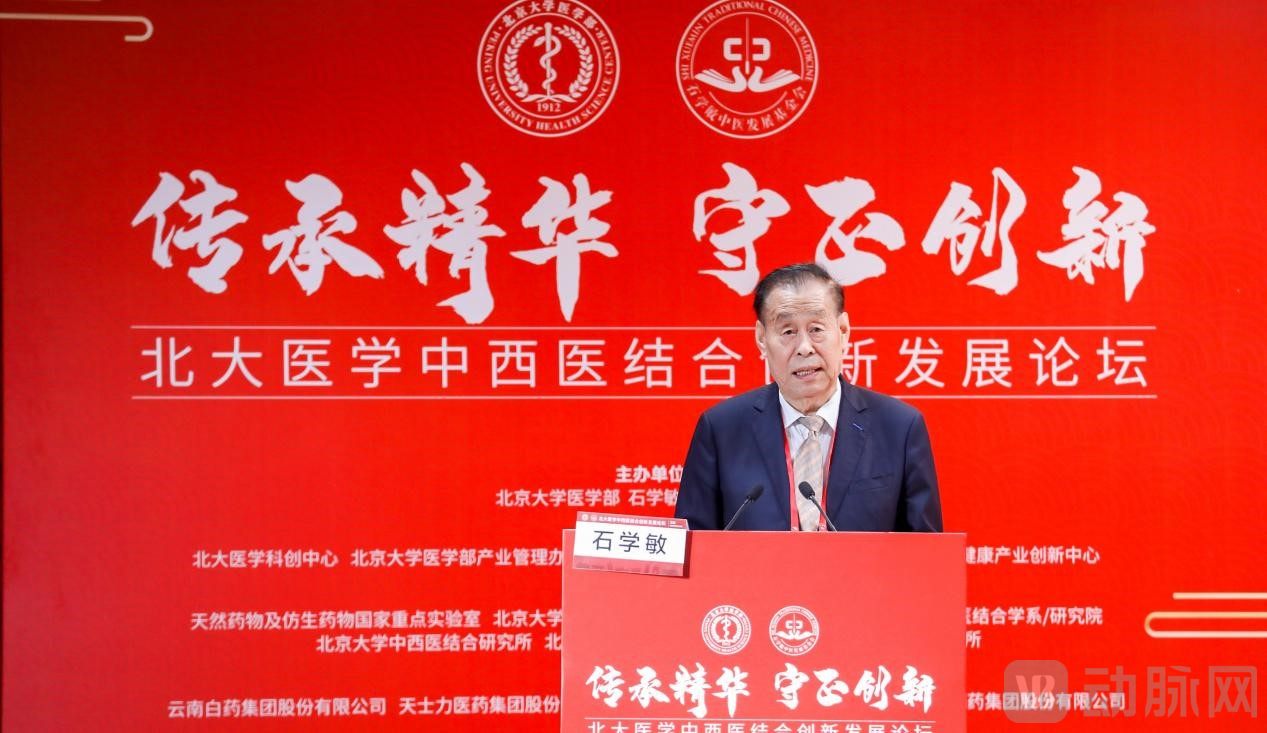
The Peking University Health Science Center Forum on Innovative Development of Integrated Traditional Chinese and Western Medicine, co-hosted by Peking University Health Science Center and the Shi Xuemin Traditional Chinese Medicine Development Foundation, aims to promote the innovative development of integrated traditional Chinese and Western medicine, fully leverage the complementary advantages of both systems, foster active innovation, significantly enhance research capabilities in the integration of Chinese and Western medicines, better serve the health of the general public, and fulfill its responsibilities in advancing the healthcare industry.
The forum, themed “Inheriting the Essence, Upholding Integrity, and Innovating,” focuses on the field of integrated traditional Chinese and Western medicine, which plays a vital role in safeguarding public health, aiming to promote the development of integrated traditional Chinese and Western medicine in the new era toward a broader scope and higher standards.
It is worth noting that this forum was of an exceptionally high caliber, as evidenced by its organizers. Peking University Health Science Center, the organizer, is China’s first institution of Western medicine, entrusted with the national mission of cultivating high-caliber medical professionals and pioneering original medical research. The Shi Xuemin Traditional Chinese Medicine Development Foundation also plays a significant role in promoting the translation of TCM research achievements into practical applications, fostering talent development, and ensuring the inheritance and advancement of Traditional Chinese Medicine.
This forum focused on hot topics and cutting-edge issues in the fields of integrated traditional Chinese and Western medicine, basic research, pharmaceutical research, clinical research, and collaborative development. It explored innovative advancements in the integration of traditional Chinese and Western medicine, bringing together over 400 participants, including practitioners in integrated traditional Chinese and Western medicine, hospital administrators, clinicians, and investment institutions. The event garnered more than 6 million online views.
In his address, Academician Shi Xuemin stated, “We should actively engage in exchanges and cooperate with sincerity to promote the substantial development of the integration of traditional Chinese and Western medicine. Only through repeated study and research, and by continuously gaining insights and summarizing experiences in clinical practice, can we achieve improvement, promotion, and innovation on the basis of inheritance. In-depth research and scientific summarization of Chinese and Western medicines, as well as the rich heritage of global medical science, will play a positive role in advancing life sciences research. We are committed to dedicating our lifelong efforts to the cause of integrating traditional Chinese and Western medicine.”
In 1962, Academician Shi Xuemin graduated from the Traditional Chinese Medicine program at Tianjin University of Traditional Chinese Medicine. Two years later, due to his outstanding performance, he was selected by the former Ministry of Health to join the Advanced Acupuncture Training Program in Beijing, where he was trained as a physician for international medical services. Over the past five decades, Academician Shi has lived up to this trust, visiting more than 100 countries and regions worldwide, helping TCM acupuncture blossom across the globe.
After successfully developing the “Awakening the Brain and Opening the Orifices” acupuncture technique in 1972, Academician Shi Xuemin subsequently invented “Naoxuesuan Tablets” and “Danqi Hemiplegia Capsules” based on this theoretical framework. By implementing a combined approach of acupuncture and pharmacotherapy, he pioneered new strategies for the treatment of cerebrovascular diseases.
In the 1980s, Academician Shi Xuemin established the “Quantitative Science of Acupuncture Manipulation” and conducted related research. He formulated new definitions and quantified operational parameters for the reinforcing and reducing techniques of needle rotation, thereby promoting the standardization, dosing, and normalization of traditional acupuncture manipulations. This work filled a gap in the development of acupuncture and moxibustion science and has been widely applied in the treatment of various refractory and complex diseases.
After decades of exploratory research, Academician Shi Xuemin gradually developed a comprehensive, unique, and standardized integrated Traditional Chinese Medicine (TCM) treatment protocol for stroke—known as the “Shi’s Stroke Unit Therapy.” This protocol centers on the “Awakening the Brain and Opening the Orifices Acupuncture Method” and “Danqi Hemiplegia Capsules,” complemented by rehabilitative training, dietary management, psychological intervention, and health education.
Regarding the development path of traditional Chinese medicine (TCM), Academician Shi Xuemin believes that TCM may have two potential trajectories: one following its traditional course, and the other identifying an optimal integration point between the essence of TCM and modern science to promote standardized and regulated development. He stated that “syndrome differentiation is the soul of TCM.” By strengthening TCM research using modern scientific methods and emphasizing the combination of TCM syndrome differentiation with Western medical disease diagnosis, the two systems can be organically integrated in clinical practice, thereby providing direction for the integration of traditional Chinese and Western medicine.
Academician Shi Xuemin stated that the development of Traditional Chinese Medicine (TCM) will undergo a phase characterized by “the blooming of a hundred flowers and the contending of a hundred schools.” To promote the advancement of TCM, policy-level measures should support renowned formulas, medicinal products, and TCM techniques with specialized expertise and heritage value. Efforts should be intensified in scientific research by assembling relevant talent and providing resources for both applied and fundamental studies to elucidate effective mechanisms and underlying logic. At the educational level, theoretical instruction and clinical practice should be organically integrated through two teaching approaches: modular coursework and standardized clinical training.
“Health is humanity’s greatest wealth, and physicians are the guardians of human health, bearing an enduring responsibility! I will continue to administer acupuncture to patients; though my strength may be modest, my resolve is unwavering!” Shi Xuemin has translated these words into action. Even in his eighties, he remains actively engaged on the front lines of traditional Chinese medicine clinical practice.
Stroke, known in ancient Traditional Chinese Medicine as "brain wind-stroke," "brain disease," or "cerebrovascular disease." As is well known, stroke is one of the four major diseases posing a significant threat to human health. It has the highest incidence rate in China, and its high mortality rate and frequent sequelae impose a substantial burden on families and society.
Since the 1980s, Academician Shi Xuemin and his team have conducted systematic research on stroke at the First Teaching Hospital of Tianjin University of Traditional Chinese Medicine. As the earliest established and largest Grade-A tertiary traditional Chinese medicine (TCM) medical institution in Tianjin, the hospital boasts 2,000 beds and is capable of providing medical services to diverse patient populations from around the world.
There are six or seven etiologies of stroke. The “Xingnao Kaiqiao” (Awakening the Brain and Opening the Orifices) acupuncture method is a therapeutic principle and acupuncture technique developed specifically for the fundamental pathogenesis of stroke, in which pathological factors such as blood stasis, liver wind, and phlegm-turbidity obstruct the brain orifices, leading to “orifice closure with concealed spirit, and failure of the spirit to guide qi.” This approach primarily selects acupoints along the yin meridians and the Du Meridian, and emphasizes standardized quantification of needling techniques, distinguishing it from traditional point selection and acupuncture methods.
The fact that traditional Chinese medicine (TCM) acupuncture has been passed down for thousands of years undoubtedly attests to its inherent value. Academician Shi Xuemin and his team devoted more than a decade to in-depth clinical and basic research on various acupuncture techniques and dosages, identifying underlying patterns from their findings. “This approach differs from the conventional practices described in standard textbooks, which often lack personalized, evidence-based protocols tailored to individual patients.”
Over more than 40 years of clinical practice, Academician Shi Xuemin and his team have gradually established diagnostic and therapeutic standards as well as an evaluation system for acupuncture treatment of stroke and its complications. In recent years, they have conducted comprehensive and systematic evaluations of its efficacy using diverse research methods and approaches, thereby generating high-quality clinical evidence. Furthermore, by integrating advanced scientific technologies, they have systematically elucidated the scientific basis and therapeutic mechanisms underlying acupuncture’s efficacy in stroke treatment.
“Combined Acupuncture and Herbal Therapy” is an innovative treatment for cerebrovascular diseases developed by Academician Shi Xuemin. The herbal component refers to Danqi Hemiplegia Capsules, which he developed.
The formulation of Danqi Piantan Capsules includes Astragali Radix, Salviae Miltiorrhizae Radix et Rhizoma, Chuanxiong Rhizoma, Hirudo, Artificial Calculus Bovis, and Acori Tatarinowii Rhizoma, exerting the functions of replenishing qi, promoting blood circulation, resolving phlegm, and extinguishing wind. Studies have demonstrated that, compared with control group Chinese patent medicines, Danqi Piantan Capsules can significantly improve neurological deficits in stroke patients, enhance quality of life, and exhibit a favorable safety profile. Danqi Piantan Capsules have gained international recognition; since research commenced in 2007, more than ten papers have been published abroad, with the highest impact factor reaching 7.041.
Academician Shi Xuemin and his team have achieved remarkable results with their integrated acupuncture-and-medication therapy for ischemic stroke, which combines the “Awakening the Brain and Opening the Orifices” acupuncture technique with Danqi Hemiplegia Capsules. This approach has been designated as a scientific and technological achievement promotion project by the Ministry of Science and Technology and the National Administration of Traditional Chinese Medicine. It has been promoted throughout China and to more than 60 countries and regions worldwide, establishing a globally influential technical platform.