

CGM Sector Surges with Over $1.4B in Funding as Hillhouse, Sequoia, and Tencent Back Key Players
The CGM Sector Is Heating Up Again!
Continuous Glucose Monitoring (CGM) is a real-time or continuous blood glucose monitoring product that differs from fingerstick blood testing for patients with diabetes. CGM automatically captures continuous dynamic glucose profiles for up to 14 days without the need for blood sample collection, addressing pain points in traditional diabetes management such as the necessity of finger pricks for blood sampling, incomplete monitoring of glucose dynamics, and the cumbersome nature of carrying equipment. In addition to CGM, other major products for diabetes glucose management include insulin pumps.
How Hot Is the CGM Sector? On May 18, MicroTech Medical rushed to list on the Hong Kong Stock Exchange. Prior to its IPO, the company completed a RMB 575 million financing round, led by Taikang Qianzhen Fund under Taikang Investment, with Tencent and IDG Capital as co-lead investors.
Meanwhile, in the past month, Jiunuo Medical, Kailian Medical, and Kelite Medical have all secured substantial financing. Notably, Kailian Medical, a domestic manufacturer of insulin pumps, completed two rounds of financing in less than a month.
In addition to well-known institutions such as Hillhouse Capital, Legend Capital, and Yunfeng Capital, recent market moves also include Yuwell, a leading domestic medical device manufacturer. Yuwell Medical announced its plan to acquire a 50.99% equity stake in Kailite, a continuous glucose monitoring (CGM) company, for RMB 366 million. Additionally, it will assume Ascensia Diabetes Care’s outstanding capital contribution obligation of RMB 42 million under the previous round of financing agreements, bringing the total investment to RMB 408 million. With years of deep engagement in blood glucose monitoring, Yuwell’s investment of over RMB 400 million underscores its strong commitment to the CGM sector.
All of a sudden, the CGM sector has regained momentum, with some investors telling VCBeat that they are reevaluating this space. Why emphasize “re”? Because between 2017 and 2018, the CGM industry also attracted significant attention, as domestic companies such as Yuyi Technology, MicroTech Medical, Kailian Medical, Kalite, Jiunuo Medical, and Shunzhi Technology successively secured financing. However, after this wave of collective fundraising, China’s CGM industry did not take off as rapidly as expected. To this day, Abbott still commands over 99% of the market.
Why Has the Domestic Blood Glucose Control Sector Regained Momentum This Year? Is the Renewed Attention from Numerous Institutions Driven by the Industry’s Breakthrough of Previous Development Bottlenecks, or Merely Another Round of Costly Lessons?
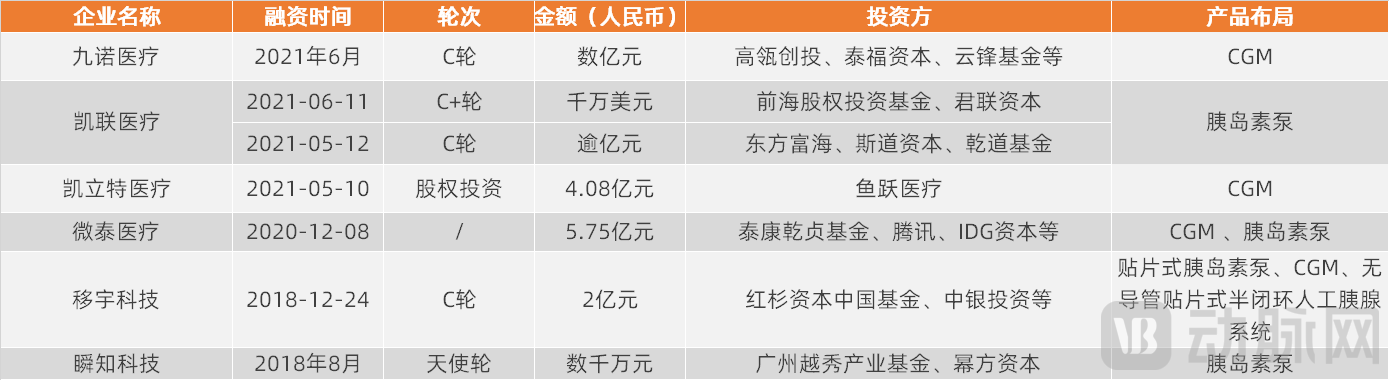
Financing Status of Key Players in the Diabetes Management Sector
Reviewing the development of the continuous glucose monitoring (CGM) industry, the FDA approved CGM products for market launch in 2006. In 2009, CGM products entered the Chinese market, and domestically produced CGMs from Sinocare and Medtrum emerged around 2012. Currently, the global CGM market is predominantly dominated by Dexcom, Medtronic, and Abbott. In 2020, revenue from Abbott’s flagship FreeStyle Libre series exceeded $2 billion, with continued strong growth in 2021; sales revenue reached $830 million in the first quarter of 2021.
However, China's CGM industry started early but has developed slowly.
Theoretically, China has over 100 million patients with diabetes, of whom 5%–10% have type 1 diabetes. In theory, all patients with type 1 diabetes are potential users of continuous glucose monitoring (CGM) products. The CGM user base also includes patients with gestational diabetes and those with type 2 diabetes undergoing intensive therapy. With an average annual expenditure of approximately RMB 10,000 per patient, the theoretical annual market size for CGM in China could reach around RMB 50 billion.
However, while the vision is idealistic, reality is harsh. In China, due to cost considerations and inadequate market education, although there is a large base of patients with diabetes, few are willing to pay for continuous glucose monitoring (CGM) systems.
China’s continuous glucose monitoring (CGM) market only began to develop in earnest after Abbott’s FreeStyle Libre product entered the country in 2017. In just three years, by 2020, the FreeStyle Libre series generated RMB 760 million in revenue in the Chinese market. Although China’s CGM market is growing rapidly, its penetration rate remains low.
Why Is CGM Adoption Low Among China’s Large Population of Type 1 Diabetes Patients? An Industry Insider Cites Three Main Reasons.
First, there are differences in payment systems, which directly determine the varying scales of market size.The primary markets for CGM are the United States and Europe, both of which have mature commercial insurance payment systems. Patients in these regions have greater financial capacity and stronger purchasing power for CGM products. In China, the Abbott FreeStyle Libre scanner is priced at nearly RMB 500 on its Tmall flagship store, with sensors also costing around RMB 500 each, resulting in an annual expense of slightly over RMB 10,000. For self-paying patients, fingerstick blood glucose testing offers a more cost-effective alternative.
Second, although domestically produced products have a price advantage, their performance needs to be improved.Overall, it has been difficult for domestically produced products to achieve a balance among cost-effectiveness, user comfort, and accuracy. Abbott’s ability to generate over RMB 700 million in revenue after entering the Chinese market is largely attributable to the fact that, for an extended period, domestic products failed to match Abbott’s quality standards.
Third, the domestic in-hospital market has yet to be unlocked., the hospital market requires more local high-level evidence to support and enhance its application in domestic hospitals.
Contrary to popular belief, the primary market for Continuous Glucose Monitoring (CGM) is not limited to the out-of-hospital consumer segment; in China, the in-hospital market size is even comparable to that of the out-of-hospital sector.
From the perspective of application scenarios, blood glucose monitoring in the hospital market is not limited to the endocrinology department but is also utilized in eight major departments, including cardiology, intensive care units (ICU), and orthopedics. Patients require strict glycemic control prior to surgery. In terms of frequency, testing occurs more often in the hospital setting, where blood glucose monitoring is highly frequent, potentially reaching 6–8 times per day.
In terms of unit price, in-hospital blood glucose monitoring differs from personal self-monitoring of blood glucose (SMBG) due to its unique characteristics and complexity. It imposes stricter requirements on the accuracy, anti-interference capability, operational standardization, and quality control of blood glucose meters. In-hospital blood glucose monitoring predominantly utilizes imported products, which also command higher unit prices.
With diverse application scenarios, high frequency of use, and high unit price, the market size for in-hospital blood glucose monitoring using CGM is also substantial.
However, even among China’s top-tier (Grade 3A) hospitals, the adoption rate of continuous glucose monitoring (CGM) remains low, and academic awareness of CGM within China’s professional market still requires improvement.
In the United States and Europe, with the innovation and maturation of continuous glucose monitoring (CGM) technology, indicators for diabetes glycemic management have also been updated. Time in Range (TIR)—the duration during which blood glucose levels remain within the target range—has gradually gained attention. The American Diabetes Association’s (ADA) newly published *Standards of Medical Care in Diabetes—2020* points out that TIR is an important indicator for reflecting patients’ glycemic stability and monitoring complications.
In China, clinicians’ awareness of Time in Range (TIR) continues to grow, and TIR was incorporated into the 2020 Chinese Guidelines for the Prevention and Treatment of Type 2 Diabetes. Looking ahead, increasing the penetration of TIR in China’s hospital market will require more high-quality, localized evidence.
The three major factors—affordability gaps, lagging product performance, and limited penetration in the hospital market—have resulted in persistently low adoption rates of continuous glucose monitoring (CGM) systems in China. According to estimates by Essence Securities, the global CGM penetration rate was approximately 5% in 2020; in the United States, the penetration rate among patients with type 1 diabetes reached 35%, whereas it stood at only 0.6% in China.
The low penetration rate also indicates that the market is far from saturated. This year, the CGM market has regained momentum, with multiple companies securing substantial financing and once again attracting investor attention. The key driver behind this resurgence is the CGM industry’s breakthrough of previous critical bottlenecks.
First, domestic companies have achieved breakthroughs in the core performance of continuous glucose monitoring (CGM) systems, with all parameters of CGM products reaching industry-leading levels.
CGM companies that secured financing this year have basically completed product upgrades and iterations, adopting in needle designSoft Needle Delivery Systemreplacing rigid needles; in terms of calibration technology, Chinese companies have also achievedCalibration-FreeBreakthroughs: These two breakthroughs have significantly enhanced the comfort of CGM use.
Furthermore,The true barrier to CGM lies in achieving mass production, with the mass production of CGM soft needles representing a significant technical challenge.Moreover, yield rate is not a primary concern in laboratory-scale production. Once mass production begins, ensuring the yield rate of CGM products becomes a major challenge. Industry insiders note that even Medtronic’s yield rate is only around 65%.
In terms of yield rate, domestic enterprises have also achieved significant breakthroughs. Jiunuo Medical, which has received investment from Hillhouse Capital, has made groundbreaking advances in semi-permeable membrane materials, dehydrogenase technology, blood glucose prediction algorithms, data mining and interaction, soft cannula delivery systems, wireless transmission systems, and ecosystem development.
Another major breakthrough for domestically produced devices lies in cost reduction. For Chinese companies seeking to expand their market share in the out-of-hospital sector dominated by Abbott, pricing is key.Cost reductions primarily stem from process optimization and technical adjustments. Taking Jiunuo Medical as an example, the company leverages dehydrogenase technology to significantly lower the cost of continuous glucose monitoring (CGM) systems.
In terms of market breakthroughs, due to the slower volume growth in the domestic market, some companies have achieved breakthroughs in expanding into overseas markets in recent years. The existing market space for CGM in overseas markets is larger than that in the domestic market. The European market has lower entry barriers and more mature distribution channels. Therefore, major domestic CGM companies have already established their presence in the European and American markets.
As previous bottlenecks in CGM development are overcome, the CGM industry is once again attracting capital attention. This round of investment fervor may not necessarily aim to cultivate a Chinese CGM company capable of fully capturing Abbott’s market share.Drawing on the market landscape of the multi-billion-dollar blood glucose meter industry, the sector is dominated by four major players—Abbott, Johnson & Johnson, Bayer, and Roche—which collectively hold 70%–80% of the market share, while the remaining 20%–30% is fragmented among more than 100 companies. In the CGM market, even securing the top position within the second tier can yield a market share worth $500 million to $1 billion.
In the traditional blood glucose meter sector, technical barriers are low. The entire blood glucose monitoring industry is characterized by a multitude of companies and products, severe homogenization, intense competition, and market space that is approaching its ceiling. Consequently, leading enterprises such as Yuwell and Sinocare have increased their R&D investment and mergers and acquisitions in the CGM segment.
Comprehensive dynamic glucose management should consist of a closed-loop system formed by continuous glucose monitoring (CGM) and an insulin pump. The insulin pump replaces insulin pens and syringes; compared with these traditional delivery methods, the insulin pump can maintain stable blood glucose levels throughout the day.
The closed-loop diabetes solution provided to patients by linking CGM with an insulin pump is known as the “artificial pancreas.” The artificial pancreas refers to a system that employs a series of control algorithms to effectively integrate an insulin pump with continuous glucose monitoring, enabling real-time, continuous monitoring, treatment, and management of blood glucose levels. Unlike static, discontinuous insulin delivery and blood glucose monitoring, the artificial pancreas achieves dynamic closed-loop management of blood glucose levels by closely mimicking the function of a healthy pancreas.
Can the Surge in CGM Popularity Propel Insulin Pumps to New Heights?
From the perspective of the current market landscape, the domestic insulin pump market is dominated by Medtronic. Compared with the CGM market, the scale of the domestic insulin pump market is smaller.
According to data disclosed in MicroTech Medical’s prospectus, the global insulin pump market was valued at approximately US$5.6 billion in 2020, with the patch-style insulin pump segment accounting for around US$1 billion and the traditional tubed insulin pump segment reaching US$4.6 billion. Within this context, China’s insulin pump market was sized at US$125 million.
The overseas CGM market has a large installed base, while the domestic market offers broad growth potential. In contrast, the insulin pump market currently remains relatively small in scale, with steady growth rates.
For patients, although insulin pumps demonstrate favorable clinical outcomes, their user-friendliness remains to be improved. Existing insulin pumps have not yet achieved miniaturization comparable to that of continuous glucose monitoring (CGM) systems. Striking a balance between patient friendliness and cost-effectiveness remains challenging for insulin pumps.
Therefore, from a technical perspective, it is an industry consensus to make insulin pumps smaller and more portable to enhance user convenience.However, the overall structure of insulin pumps is complex. Therefore, integrating numerous components into a more compact device presents significant technical challenges. Achieving miniaturization while balancing costs to ensure affordability for the majority of patients remains another major challenge.
In China, MicroTech Medical, the developer of the Equil patch insulin pump, has filed a prospectus with the Hong Kong Stock Exchange. The patch insulin pump is smaller, lighter, and tubeless, allowing it to be worn directly on the body. In terms of sales performance, Equil generated RMB 24.684 million in revenue in 2019 and RMB 34.742 million in 2020. Since its launch, the patch insulin pump has not rapidly captured existing market share; Equil accounted for only 3% of insulin pump sales volume in 2020. The domestic insulin pump market remains dominated by Medtronic and SOOIL.
Currently, tethered insulin pumps still hold a dominant position in the market. The demand for insulin pumps is shifting towards intelligence, simplicity, and closed-loop management, rather than mere miniaturization.
As the CGM industry takes off, a cohort of domestic leading enterprises is poised to emerge. Drawing on the decades-long development of blood glucose meters, although the penetration rate of China’s blood glucose monitoring industry currently stands at only 10%, it has already given rise to industry leaders such as Sinocare and Yuwell. The CGM sector is currently in its early stages of development, with significant potential for explosive growth and vast market opportunities ahead. Multiple domestic leading companies are expected to become key participants in this expanding landscape.
What Kind of Enterprises Can Weather Economic Cycles? As an industry serving both B-end and C-end markets, the CGM sector imposes high demands on companies’ R&D and manufacturing capabilities, as well as their marketing and operational prowess. Furthermore, observing entrepreneurs who have truly weathered economic cycles,Their greatest commonality lies in their sustained commitment to the blood glucose management industry, backed by decades of professional expertise. Moreover, they remain highly focused, consistently striving to introduce superior products to the Chinese market—a fundamental competency that enterprises in this field must cultivate.
Reference: Targeted by Investors, Why Are Continuous Glucose Monitors So Popular? Sharing of Domestic and International CGM Market Data — Tangtan
Continuous Glucose Monitoring (CGM): A Nascent Hundred-Billion-Yuan Blue Ocean Market — Huachuang Securities, Recommendation: Maintain