

Chinese Medtech Stars Enter the Intracranial Mechanical Thrombectomy Arena: Xinwei, Genetron Health, and Peijia Medical Lead the Surge
One Person’s Stroke, the Whole Family’s Burden: Emergency Treatment for Stroke Patients Has Long Been a Hot Topic in the Medical Field. Stroke, medically known as cerebral apoplexy, is an acute cerebrovascular disease characterized by high incidence, high disability rates, and high mortality. Cerebral apoplexy can be divided into ischemic stroke and hemorrhagic stroke, with acute ischemic stroke (AIS) accounting for approximately 60%–80% of all cases.
Currently, intravenous thrombolysis is the primary treatment for ischemic stroke. According to the "Chinese Guidelines for Diagnosis and Treatment of Acute Ischemic Stroke 2018," adhering to the principle of prioritizing intravenous alteplase thrombolysis, intravenous thrombolysis is the preferred method for vascular recanalization (Class I recommendation, Level A evidence). However, this therapy has limited efficacy in patients with acute large vessel occlusion-induced ischemic stroke and features a narrow therapeutic window, being applicable only to stroke patients within 4.5 hours of symptom onset (international standard).
In recent years, mechanical thrombectomy, with its extended therapeutic time window, has emerged as a new direction in the treatment of ischemic stroke. Mechanical thrombectomy primarily utilizes stent retrievers and aspiration catheters, each corresponding to distinct therapeutic approaches. Stent retriever thrombectomy involves deploying a stent into the vessel to capture the thrombus, which is then removed en bloc from the body. This device was listed by the Cleveland Clinic as one of the “Top 10 Medical Technology Innovations of 2016.” In contrast, aspiration catheter thrombectomy entails advancing a catheter through the vasculature to the site of the thrombus and applying negative pressure to directly aspirate the clot, demonstrating higher rates of vascular recanalization in clinical trials. It can be used not only as a standalone therapy but also in conjunction with stent retrievers.
Across the entire mechanical thrombectomy sector, foreign companies continue to dominate the market. European and American enterprises were the first to enter the field, developing multiple first-of-their-kind products and maintaining a leading pace of development.Globally, Stryker’s Trevo ProVue thrombectomy device, Medtronic’s Solitaire stent, Johnson & Johnson’s Revive SE stent system, and Penumbra’s thrombus aspiration device hold substantial market shares.China's mechanical thrombectomy market developed relatively late, but domestic companies have been committed to achieving import substitution with Chinese-made products, thereby benefiting more patients in China.
The reality before us is that the mechanical thrombectomy sector has many participants but few mature products, with most companies yet to achieve profitability. Despite being favored by capital and anticipated in clinical practice, the development of this field in China appears somewhat lagging. For medical device companies, challenges extend beyond technical hurdles to include considerations of development stages, promotion, and sales. However, more companies are focusing not on current profits or losses, but on the long-term prospects of the entire thrombectomy device market.
What exactly makes the mechanical thrombectomy market attractive to companies, and how should Chinese enterprises address the issue of sustained losses?
Why Does China Need to Develop Intracranial Mechanical Thrombectomy? For Relevant Medical Device Companies, It Is Not Only an Urgent Clinical Need but Also a Comprehensive Market Consideration.
High Clinical Demand: Stroke Is the Leading Cause of Death and Disability Among Chinese Adults
Globally, acute ischemic stroke poses a significant burden, affecting numerous patients and their families. According to the World Health Organization, one in every six people worldwide is at risk of stroke, and every six seconds, someone dies from or suffers permanent disability due to stroke. Furthermore, the "China Stroke Prevention and Treatment Report 2018" indicates that stroke is the leading cause of death and disability among adults in China. Over the past three decades, the incidence of stroke in China has risen sharply, with an estimated 1.96 million deaths annually attributed to stroke nationwide.
For patients with acute ischemic stroke, the effective time window for intravenous thrombolysis is limited to 4.5 hours, whereas mechanical thrombectomy extends the therapeutic window. In 2015, The New England Journal of Medicine published five pivotal positive trials on thrombectomy, demonstrating that mechanical thrombectomy significantly improves outcomes in patients with large vessel occlusion and reduces disability and mortality rates. Subsequently, updated guidelines issued in China and the United States established endovascular therapy, primarily stent retriever thrombectomy, as the mainstay treatment for acute large vessel occlusion.
Currently, mechanical thrombectomy can be used in combination with intravenous thrombolysis or as a standalone treatment for patients who are not candidates for intravenous thrombolysis. The academic community has long debated whether intravenous thrombolysis can be bypassed in favor of direct mechanical thrombectomy. To address this question, 41 advanced stroke centers in China jointly conducted the DIRECT-MT study, aiming to investigate whether patients with acute ischemic stroke (AIS) due to large intracranial artery occlusion could undergo direct mechanical thrombectomy without prior intravenous thrombolysis. On May 7, 2020, the results of the DIRECT-MT study were published in the New England Journal of Medicine. The results showed thatFor patients with acute anterior circulation large vessel occlusion ischemic stroke within 4.5 hours of onset, mechanical thrombectomy alone yields functional outcomes non-inferior to those achieved with intravenous alteplase thrombolysis combined with mechanical thrombectomy.
If mechanical thrombectomy can be directly performed on patients with acute ischemic stroke (AIS) within 4.5 hours of onset in clinical practice, it would not only accelerate the treatment process by eliminating the need for prior intravenous thrombolysis but also reduce medication costs. Consequently, the mechanical thrombectomy market is poised for a new surge. However, due to the high technical complexity and elevated cost of thrombectomy devices, this stage remains premature.
Capital Favor: Over 100 Million Raised in Multiple Funding Rounds Within Two Years
Given the time constraints associated with pharmacological thrombolysis, the importance of mechanical thrombectomy has become increasingly prominent. According to Peijia Medical’s prospectus, the number of mechanical thrombectomy procedures in China increased from 4,100 in 2014 to 14,500 in 2018, representing a compound annual growth rate (CAGR) of 36.9%, and is projected to reach 87,500 by 2025. Driven by the rising volume of mechanical thrombectomy procedures, the corresponding market size for related devices has also expanded, growing from RMB 56.2 million in 2014 to RMB 197.4 million in 2018, at a CAGR of 36.9%.
Moreover, judging from the corporate financing trends in the mechanical thrombectomy sector over the past two years, capital has also favored this track. Between 2020 and 2021, companies in the mechanical thrombectomy space completed multiple rounds of financing, with substantial total amounts. In addition,Over the past two years, Peijia Medical and GenesisCare have successfully listed on the Hong Kong Stock Exchange, while HeartCare Medical has passed the HKEX listing hearing, with its margin financing subscription oversubscribed by more than 300 times.
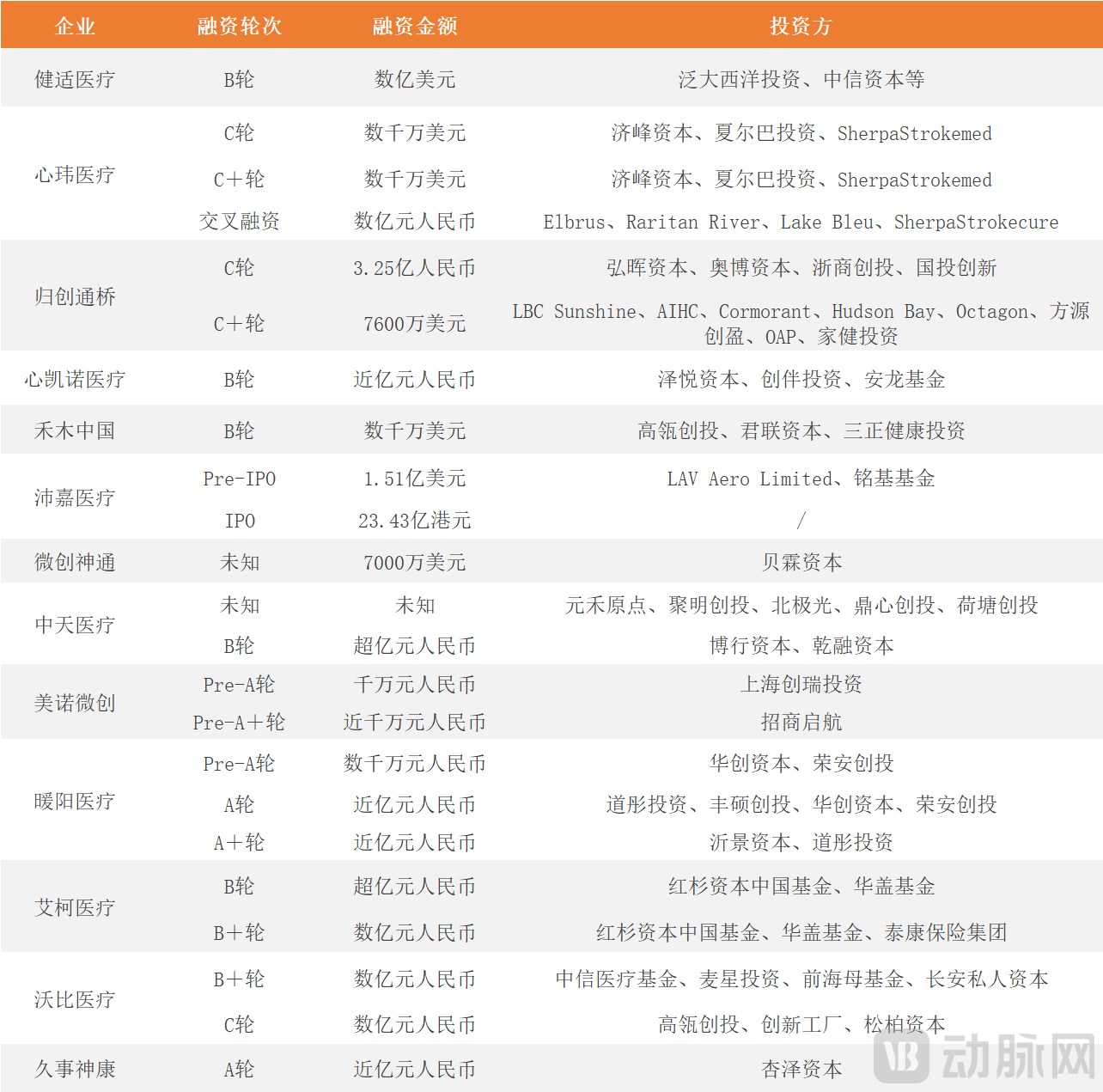
Financing Activities of Domestic Thrombectomy Device Companies in China (2020–2021) (Incomplete Statistics)
Prior to 2018, no domestically produced thrombectomy devices had been approved in China, and the entire mechanical thrombectomy industry had yet to develop. At that time, large foreign corporations such as Medtronic and Stryker monopolized the Chinese market, with the NMPA having approved Medtronic’s Solitaire thrombectomy stent and Stryker’s Trevo ProVue stent. UntilIn May 2018, Jiangsu NICO's Reco thrombectomy stent received approval from the NMPA., the localization process for intracranial thrombectomy devices has gradually gotten on track.
Jiangsu Nico is a medical device company founded in 2011, dedicated to introducing advanced foreign technologies into China. It developed the first domestically approved thrombectomy stent product. In May 2020, its Nevida microcatheter also received approval from the National Medical Products Administration (NMPA). This product is designed as a one-to-one match for the Reco thrombectomy stent and is used for delivering the Reco stent. In the same month,Jianshi Medical Acquires Jiangsu Nico for Hundreds of Millions of RMB. As a “young” medical device company, Jianshi Medical has established an integrated full-industry-chain model encompassing R&D, manufacturing, and sales.
Jianshi Medical is gradually expanding its footprint in the neurointerventional field.In January 2021, it completed the acquisition of Hongyi Medical, thereby establishing a strategic partnership with Penumbra., introduced Penumbra’s NMPA-approved intracranial thrombus aspiration catheter. Globally, Penumbra undoubtedly holds a leading position in the field of thrombus aspiration catheters. The two acquisitions have strengthened Jieshi Medical’s comprehensive capabilities in mechanical thrombectomy, with the potential to form a more diverse and complete product portfolio.
For more than two years after Jiangsu Niko’s Reco stent received approval, no domestically produced thrombectomy devices gained regulatory clearance. This is primarily because the development cycle for thrombectomy devices is lengthy and requires substantial upfront investment, demanding that companies possess sufficient financial resources and capabilities. Moreover, thrombectomy stents and aspiration catheters are classified as Class III medical devices, subject to stringent review by the National Medical Products Administration (NMPA). Consequently, although several companies have entered the market, none have successfully launched new products.
Two years later, in August 2020, MicroPort NeuroTech’s thrombectomy system received approval from the NMPA.Captor Thrombectomy Stent is the first domestically developed multi-segment radiopaque thrombectomy stent, benchmarked against Medtronic’s Solitaire stent product.In December 2020, MedZenith began the commercial launch of its Captor device. MedZenith’s competitive advantage lies in providing a comprehensive product portfolio for stent retriever thrombectomy procedures. The company has four products for ischemic stroke approved by the National Medical Products Administration (NMPA): the Captor Thrombectomy Device, Fullblock Occlusion Balloon Catheter, ExtraFlex Distal Access Catheter, and SupSelek Microcatheter.
In September 2020, the Jiaolong Stent Retriever from Zebra Medical (Guichuang Tongqiao) received approval from the NMPA. Zebra Medical was formed in 2019 through the merger of Guichuang Medical, which specializes in peripheral interventions, and Zhuhai Tongqiao, which focuses on neurointerventions. According to the company’s IPO prospectus, it isThe only domestic enterprise in the neurointerventional medical device sector that has developed a full portfolio of products across five major categories: ischemic, hemorrhagic, stenosis, carotid artery, and vascular access devices.. The Jiaolong intracranial thrombectomy stent is one of its core products, featuring an innovative side-opening helical ascending structure, and has previously obtained EU CE certification.
In May 2021, MindNova Medical’s SkyFlow thrombectomy stent received approval from the National Medical Products Administration (NMPA). The stent features a double-helix structure with multi-segment radiopacity, including a 3-mm-diameter thrombectomy stent designed for use in small intracranial vessels.As of May 2021, MicroPort NeuroTech’s full line of thrombectomy products—including the SkyFlow Thrombectomy Device, SkySurfer Distal Access Catheter, SkyGuard Balloon Guide Catheter, SkyWay Microcatheter, and SkyLoach Intracranial Balloon Dilatation Catheter—have all obtained CE certification from the European Union., providing a complete thrombectomy solution for patients with acute ischemic stroke.
In addition, Peijia Medical and MicroPort NeuroTech are both active in the field of mechanical thrombectomy. Peijia Medical has developed the Shenyi stent retriever, and as of January 29, 2021, patient enrollment for the relevant clinical trials had been fully completed. MicroPort NeuroTech previously invested in Rapid Medical, the developer of the world’s first adjustable thrombectomy stent, becoming one of its shareholders. It also serves as the exclusive agent for the registration and market promotion in Greater China of Rapid Medical’s three flagship products: the Tigertriever thrombectomy stent, the Comaneci aneurysm embolization assistance device, and the Tigertriever13 distal thrombectomy device. In May 2021, MicroPort NeuroTech made additional investments, becoming the largest shareholder of Rapid Medical. MicroPort NeuroTech plans to refine its product portfolio for ischemic and hemorrhagic conditions over the next two years, gradually achieving a dual stent retriever product combination, a combined stent and aspiration thrombectomy product combination, and a balloon-protected combined thrombectomy product combination in the ischemic segment.
It is evident that domestic companies are committed to expanding their product portfolios by developing devices such as microcatheters and distal access catheters compatible with thrombectomy stents, thereby providing acute ischemic stroke patients withA Complete Set of Surgical Solutions。
Unlike stent retrievers, the development of intracranial thrombus aspiration catheters has been relatively slow worldwide.In October 2011, the Penumbra thrombus aspiration catheter became the first product approved by the NMPA.. Despite active R&D efforts by companies such as Peijia Medical, Scienta Medical, and HeartCare MedTech, no domestically produced aspiration catheter received approval in China during the nearly decade-long period from late 2011 to early 2021, leaving the country facing severe monopoly by imported products. It was not until May 2021 that Hemu (China) Bioengineering Co., Ltd.’s Afentta Intracranial Thrombus Aspiration Catheter System received approval from the National Medical Products Administration (NMPA) for market launch, becoming the first domestically produced thrombus aspiration catheter to be approved.
Hemu China is a key overseas sci-tech innovative medical device enterprise introduced through investment promotion in Weihai City, specializing in the R&D and manufacturing of neurointerventional devices. The thrombus aspiration catheter system recently approved for Hemu ChinaBetter suited to the vascular conditions of Chinese patients, featuring superior flexibility and pushability, not only achieving breakthroughs in key technologies but also delivering improved vascular recanalization outcomes.
As of June 25, 2021, a total of 11 thrombectomy stents and 3 aspiration catheters had been approved in the Chinese market, including 4 domestically produced thrombectomy stents and 1 domestically produced aspiration catheter.
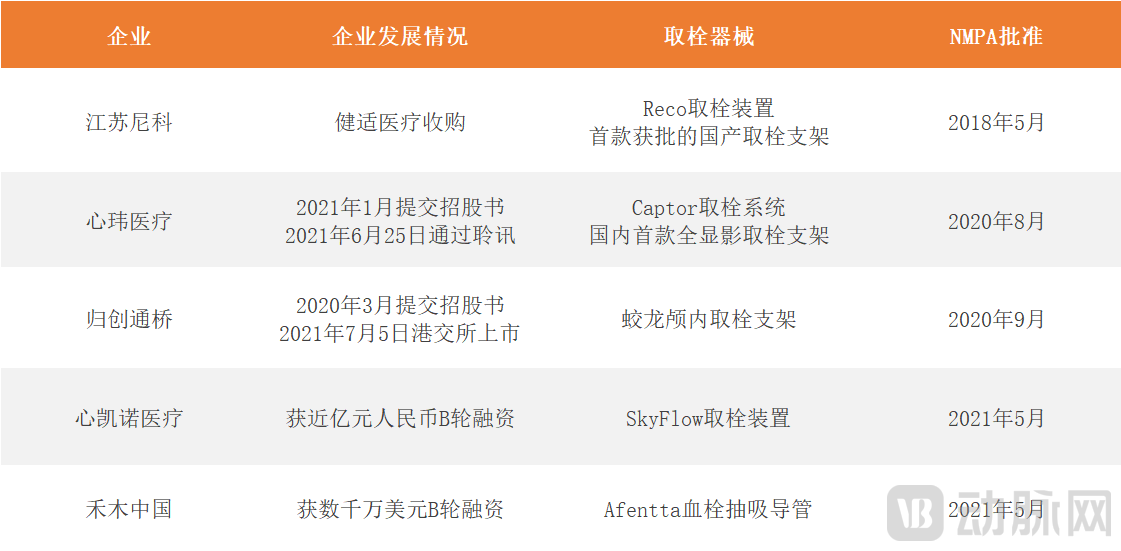
As of July 8, 2021, Approved Domestic Intracranial Thrombectomy Devices
Drawing on the strengths of others and studying the paths of pioneers greatly benefits latecomers. For domestic companies, it is not enough to merely benchmark their products against those of multinational giants such as Medtronic, Stryker, and Johnson & Johnson; they must also learn from these companies’ market strategies.
Mechanical thrombectomy originated in the United States. The first-generation intracranial thrombectomy device was the Merci retriever, a mechanical spiral thrombectomy device developed by Concentric Medical, which received FDA approval for clinical use in 2004. Subsequently, in 2008, the FDA approved the Penumbra thrombectomy system, a novel aspiration catheter for thrombectomy. Medtronic’s Solitaire was the first stent-based thrombectomy device to be used clinically, receiving FDA market approval in 2012. In the same year, the FDA approved Stryker’s Trevo ProVue thrombectomy device, the first fully visible thrombectomy stent on the market. Since then, Medtronic and Stryker have monopolized the global mechanical thrombectomy market, leveraging their pioneering products and strong corporate backgrounds.
Medtronic and Stryker have adopted the “R&D + Acquisition“The approach involves enhancing capabilities through mergers and acquisitions while pursuing independent R&D. In December 2015, Medtronic acquired Lazarus Effect, whose Lazarus Cover technology further improves Medtronic’s Solitaire thrombectomy stent. During thrombus removal, the device uses nitinol to encase both the stent and the thrombus, preventing embolization.”
As the world's largest orthopedic medical device company, Stryker in 2011Acquisition of Boston Scientific's Neurovascular Division, including devices and products for ischemic stroke. In the same year,Stryker Acquires Concentric Medical, Developer of the First Intracranial Thrombectomy Device, continuing to expand its stroke treatment business.
Compared with these two multinational giants, Johnson & Johnson entered the mechanical thrombectomy market at a later stage. Codman Neuro, the neurosurgery division under Johnson & Johnson, developed the ReVive SE, a self-expanding intracranial thrombectomy device. The first-generation and second-generation ReVive SE devices received EU CE certification in 2011 and 2013, respectively. Subsequently, in April 2017, Codman Neuro announcedAcquired Neuravi, a medical device company focused on thrombectomy, which developed the vascular recanalization device EmboTrap and its second-generation product, EmboTrap II.。
In October of the same year, Johnson & Johnson chose to divest its Codman Neuro neurosurgery division, which was acquired by Integra LifeSciences for $1.045 billion. This transaction did not include Codman Neuro’s neurovascular products or pharmaceutical distribution business. Subsequently, Johnson & Johnson launched a new platform, Cerenovus, to continue advancing treatments for ischemic and hemorrhagic stroke. To date, the Cerenovus platform has introduced the third-generation EmboTrap III product.
In the early stages of mechanical thrombectomy development, Johnson & Johnson broke the market monopoly through innovative products. The most notable feature of its distal-closing thrombectomy device, EmboTrap II, is its double-layer basket design, which can effectively capture various types of thrombi. In 2018, *Stroke* published the results of the ARISE II clinical trial on the EmboTrap II thrombectomy stent.The overall vascular recanalization rate of this stent is as high as 92.5%., demonstrating superior vascular recanalization efficacy compared to Solitaire and Trevo ProVue. In May of the same year, the EmboTrap II thrombectomy stent received FDA approval. It was not until October 2020 that Johnson & Johnson announced the official market launch of this stent product.
Large enterprises entered the market early, possess strong capabilities, and offer broad product lines; these advantages have cemented their leading positions. In such a market landscape, how should small and medium-sized enterprises (SMEs) find their niche?
Acandis is a German medical device company specializing in the prevention and treatment of stroke. Its self-expanding thrombectomy stent, Aperio, features technological innovations with a composite mesh design that alternates between open and closed cells, enabling superior clot capture. Available in a variety of models, it is the first thrombectomy stent with a diameter under 4 mm, allowing for effective treatment of smaller clots.
Rapid Medical has focused on enhancing operational performance. Its Tigertriever thrombectomy stent enables remote control, allowing medical personnel to deploy and adjust the stent’s outer diameter by manipulating a slider. Furthermore, the Tigertriever stent utilizes a unique 3D braiding technology, with each braided filament being radiopaque, ensuring full visibility throughout the thrombectomy procedure. Additionally, to accommodate varying patient vascular anatomies, the company has developed stents in various specifications, launching the world’s first small-profile thrombectomy stent capable of removing clots from distal regions within the brain.The Tigertriever stent-retriever thrombectomy device was approved for the National Medical Products Administration (NMPA) Special Review Program for Innovative Medical Devices in May 2020, entering the “green channel” for special review.
It is evident that there is no technical gold standard for thrombectomy stents yet, leaving substantial room for innovation. Optimization is possible in terms of stent materials, specifications, and performance. Furthermore, small enterprises have a more focused business scope, enabling them to fully leverage existing resources. For instance, Rapid Medical has capitalized on its operational advantages by developing additional thrombectomy stent products based on the Tigertriever.
Compared with stent retrievers, the development of aspiration catheters for thrombectomy is more challenging and has progressed relatively slowly. Since the FDA approved the Penumbra aspiration catheter in 2008, few new catheter products have been introduced to the intracranial vascular aspiration market, leaving a significant gap that some companies have identified as a strategic opportunity.
In 2006, Terumo Corporation, a large medical device company headquartered in Tokyo, Japan, acquired MicroVention. Subsequently, Terumo continued to develop products for the treatment of ischemic stroke and launched the Eric stent retriever, which features a large intraluminal clot-capture surface area, thereby reducing procedural time. Meanwhile, MicroVention introduced the Sofia Plus aspiration catheter. In contrast to the thrombectomy stent market, which is dominated by major corporations such as Medtronic and Stryker, Terumo’s aspiration catheters hold a significant share of the global market.
In the United States, thrombus aspiration catheters are employed in approximately 80% of device-based interventions for ischemic stroke. The efficacy of vascular recanalization serves as a critical entry point for companies; by achieving a breakthrough in this technology, domestic Chinese enterprises can make significant strides into the mechanical thrombectomy market.
Turning our attention to domestic enterprises, the mechanical thrombectomy market holds significant potential, with related companies securing substantial financing. However, during this period of rapid development, these enterprises face numerous challenges.
Global Giants Leverage First-Mover Advantage to Establish Strategic Patent Monopolies
Foreign companies entered the market early and hold numerous patents for first-of-their-kind products and broadly defined thrombectomy devices. They may take legal action against domestic manufacturers if their products are deemed to fall within the scope of these invention patents, posing a significant obstacle to the development of Chinese enterprises. In addition to patent barriers, the safety of intracranial thrombectomy devices is also critical. Given the complex structure of intracranial vessels and the narrow therapeutic window for stroke treatment, thrombectomy products must be rapid and effective while ensuring safety. In November 2020, industry giant Stryker voluntarily recalled specific models and batches of its thrombectomy stents due to core wire fracture issues, classified as a Class II recall. However, according to data from the National Medical Products Administration (NMPA), recalls of thrombectomy devices remain relatively rare.
The thrombectomy device market has yet to achieve scale, characterized by low profitability and significant losses.
In 2019, the penetration rate of mechanical thrombectomy was 3% in the United States, compared to only 0.6% in China. Furthermore, the clinical adoption of thrombectomy devices remains low in China. The high cost of these devices continues to be a significant barrier, especially when contrasted with thrombolytic drugs that are covered by medical insurance.
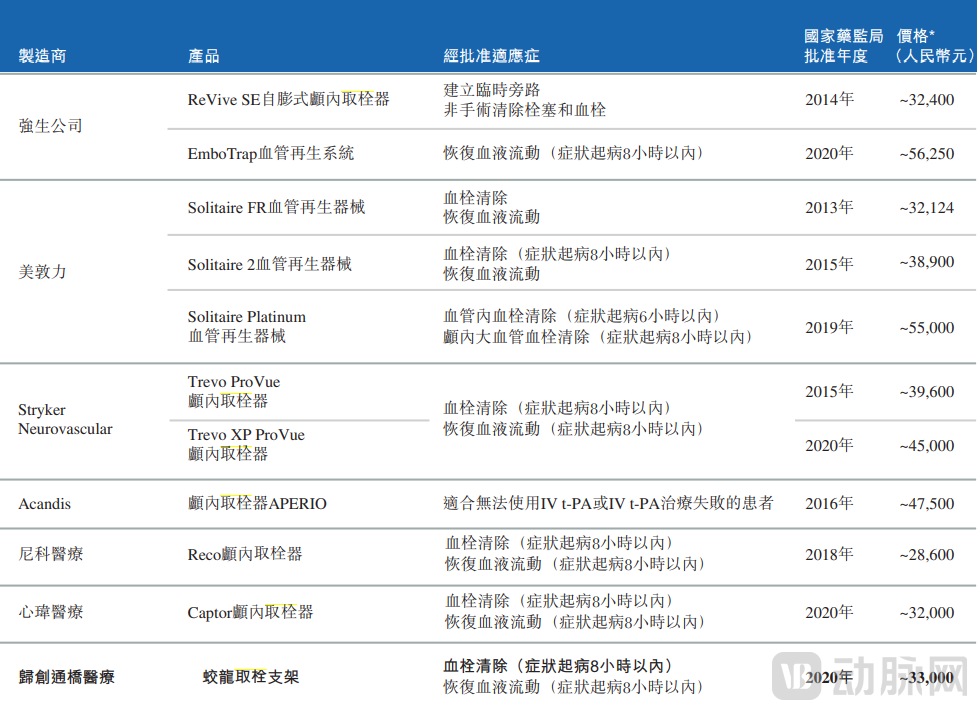 Prices of Some Thrombectomy Stents Source: Zendo Medtech Prospectus
Moreover, the early-stage research and development of thrombectomy stents and aspiration catheters is characterized by long cycles and high investment, resulting in a slower commercialization process for related companies. According to the prospectus of Xinwei Medical, the company generated RMB 7.293 million in revenue during the first nine months of 2020, primarily from sales of distal access catheters and microcatheters. The company incurred a loss of RMB 67.745 million, with R&D and administrative expenses accounting for the majority, totaling RMB 60.595 million. This indicates that domestic enterprises need to promote the adoption of mechanical thrombectomy procedures to enhance product penetration and market share.
Furthermore, the limited market penetration of mechanical thrombectomy is not solely attributable to R&D challenges; significant obstacles also exist in post-launch promotion and sales. In the treatment of acute ischemic stroke, time is of the essence, as both initial pharmacological thrombolysis and subsequent mechanical thrombectomy have narrow therapeutic time windows. Many patients either fail to recognize the onset of symptoms or cannot reach a hospital in time, leading to severe consequences. Therefore, proactive disease education can help patients seek timely treatment more effectively. Moreover, it is not only patients who face barriers; many primary-care hospitals are unable to perform mechanical thrombectomy due to high procedural thresholds and product procurement issues. Hospital-side promotion cannot rely solely on internal efforts or social forces; enterprises must also actively participate to secure potential users for themselves.
However, generally speaking, China and even the world are still in the early stages of development of mechanical thrombectomy, which may be a good opportunity for domestic companies to "overtake on the curve." In this high-difficulty field, enterprise development is inherently slow, and with clinical and social support, the prospects for mechanical thrombectomy in China are promising.
There is significant room for market expansion.
Compared with coronary intervention, the neurointerventional market is still in its early stages of development and has not yet matured. In terms of products, there is significant room for innovation in thrombectomy devices, while stent products can be optimized in radiopacity, indications, and time windows. According to the prospectus of Jiecheng Tongqiao, the company plans to achieve full radiopacity of its stents in the next step and expand the indications to include patients within 8 to 20 hours after stroke onset.
Furthermore, there are few foreign companies in China’s mechanical thrombectomy market, leaving substantial room for growth for domestic enterprises. Chinese companies are rapidly expanding, with multiple firms concurrently developing domestically produced thrombectomy stents and aspiration catheters. These products are priced lower than imported alternatives and benefit from regional advantages in promotion and sales.
Strong Social Support and National Emphasis on Stroke Treatment
The “2018 Chinese Guidelines for Early Endovascular Diagnosis and Treatment of Acute Ischemic Stroke” propose that thrombectomy may be considered for patients with ischemic stroke within 6 to 24 hours after onset. The extension of the time window for endovascular intervention to 24 hours in clinical practice has defined the advantages of mechanical thrombectomy. Moreover, in recent years, China has been vigorously establishing stroke centers.Establishment of a Green Channel for Stroke Emergency Care, providing one-stop services through multidisciplinary collaboration among the emergency department, neurosurgery, and neurology departments, thereby streamlining multiple processes including registration, initial consultation, triage, laboratory testing, and imaging examinations. Six years have passed since the first batch of national stroke centers was officially designated in June 2015. As of June 2021, there were 30 model advanced stroke centers and 375 advanced stroke centers in China.
Furthermore, China is cultivating physicians proficient in the knowledge and techniques of mechanical thrombectomy, thereby building a talent pool to support the application of thrombectomy devices. Mechanical thrombectomy is a neurointerventional procedure with considerable technical complexity; previously, it was performed only by a limited number of Grade 3A hospitals. Currently, however, multiple hospitals across China, including some smaller county- and city-level institutions, are capable of performing mechanical thrombectomy.
In the early stages of mechanical thrombectomy development, whether domestic companies can achieve breakthroughs through sustained accumulation may still require more time.