

Denovo Biopharma Files for STAR Market IPO: Reviving Failed Drugs with Biomarkers to Tap into Billion-Dollar Oncology and CNS Markets
On June 30, according to the Shanghai Stock Exchange, the IPO application of Suoyuan Biomedicine (Hangzhou) Co., Ltd. (hereinafter referred to as “Suoyuan Biomedicine”) has been accepted. The company plans to list on the STAR Market of the Shanghai Stock Exchange. The joint sponsors are Great Wall Securities and China Securities Co., Ltd., and the joint lead underwriters are China International Capital Corporation.
Prior to its initial public offering, Suoyuan Biomedicine completed four rounds of financing:
In July 2015, Suoyuan Biomedicine completed its Series A financing, raising tens of millions of RMB. The investing institutions included Jinshi Investment and Guangzhou Yuexiu Industrial Fund.
In October 2019, Suoyuan Biomedicine completed its Series B financing round, raising RMB 300 million. The participating investors included Jiuyou Capital, Xiantong Capital, Fenxiang Investment, Zheshang Industry-Finance Integration, Yuexiu Capital, Qianzhan Capital, and Wenfang Technology. iCapital served as the exclusive financial advisor for this financing round.
In June 2020, Suoyuan Biomedicine completed its Series C financing round, raising RMB 590 million. The investing institutions included CICC Qide Innovative Biopharmaceutical Equity Investment Fund, Jiuyou Capital, Fenxiang Investment, CITIC Securities Investment, Xiantong Capital, Yingke Capital, Guozhong Capital, and Kaitou Hanrun Investment, among others.
In December 2020, Suoyuan Biomedicine completed its Series D financing round, raising nearly RMB 300 million. The investing institutions included CICC Qide Fund, Yingke Capital, China Resources Pharmaceutical Industry Investment Fund, Paradise Silicon Valley, Heda Biopharmaceutical Fund, Hangzhou Industrial Asset Management, Xiantong Capital, Houxin Health Investment, and Zheshang Industry-Finance Integration, among others.
For its listing on the STAR Market, Suoyuan Biomedicine plans to publicly issue no more than 129.371118 million A-share ordinary shares, aiming to raise RMB 1.634 billion. After deducting issuance expenses, the proceeds will be entirely allocated to the research and development of innovative drugs and the construction of marketing networks.
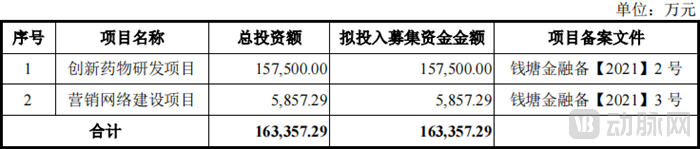
Use of Proceeds, Source: Prospectus
Suoyuan Biomedicine was established on December 23, 2011, as a joint venture by Denovo Biomarkers and Xianju Pharmaceutical. Denovo Biomarkers contributed RMB 23.1 million, accounting for 70% of the registered capital, in the form of equity valued at its “platform technology for identifying pharmacosensitivity biomarkers through reverse whole-genome scanning.” Xianju Pharmaceutical contributed RMB 9.9 million in cash, accounting for 30% of the registered capital.
This intangible asset (hereinafter referred to as the “Biomarker Platform Technology”) originated from Luo Wen, Chairman of Suoyuan Biomedicine. Between 2002 and 2010, while Mr. Luo was employed at Ligand Pharmaceuticals, the company had a drug candidate that failed to meet its endpoints in Phase III clinical trials. For a mid-sized biotechnology company like Ligand, abandoning a drug pipeline would entail significant financial losses. Under Mr. Luo’s leadership, Ligand developed a platform technology for biomarker discovery, which successfully identified a biomarker for this drug.
However, despite being listed on NASDAQ for nearly two decades, Ligand remained unprofitable. Driven by capital market pressures, the company underwent a major restructuring, and the drug in question was sold to Eisai Co., Ltd. This experience of corporate divestiture and asset sale convinced Luo Wen that the biomarker platform he had developed could help restore value to drugs that had failed in clinical trials. After Ligand’s acquisition, Luo Wen purchased the rights to this biomarker platform technology as a service invention and founded Suoyuan Biomedicine.
Since its establishment, Suoyuan Biomedicine has leveraged its Biomarker platform to conduct study design, sample stratification, sample processing, whole-genome scanning, and analysis of scanning results. If candidate biomarkers are identified based on the analysis, independent validation is performed; upon successful independent validation, the biomarkers are finally confirmed. Subsequently, Suoyuan Biomedicine conducts biomarker-guided clinical trials.By systematically leveraging previously cryopreserved clinical samples (such as blood and plasma) to identify biomarkers predictive of drug efficacy, this platform serves as the core cornerstone for Suoyuan Biomedicine’s rapid and efficient development of first-in-class innovative drugs.
Biomarker-based precision medicine therapies can provide patients with more effective, personalized treatment plans, particularly in the fields of oncology and rare disease prevention and treatment. Compared with traditional new drug development models, the greatest advantage of biomarker-based strategies lies in their ability to accurately screen patients for clinical trial enrollment through biomarker development, thereby targeting medications to responsive populations and significantly improving clinical trial success rates. According to industry statistics, the Phase III success rate exceeds 70%, and the overall success rate from Phase I clinical trials to approval is approximately 26%—more than three times higher than the 8% observed in traditional new drug development models.
From the perspective of patent protection, under the traditional new drug development model, the 20-year patent term for a New Chemical Entity (NCE) leaves only about 10 years remaining at the time of market approval. In contrast, biomarker-based new drug development strategies can effectively extend the period of patent protection by leveraging novel biomarkers.
Furthermore, to gain a clearer understanding of the mechanism of action of “biomarker + drug,” Suoyuan Biomedicine will continue to conduct research on the biomarker-guided mechanism of action (MOA) of its drugs.Suoyuan Biomedicine acquires or licenses failed drugs from their original developers, leveraging its Biomarker platform to identify predictive biomarkers of efficacy, namely pharmacogenomic biomarkers. These biomarkers can predict whether a drug will be effective, thereby guiding clinical trials and clinical medication.
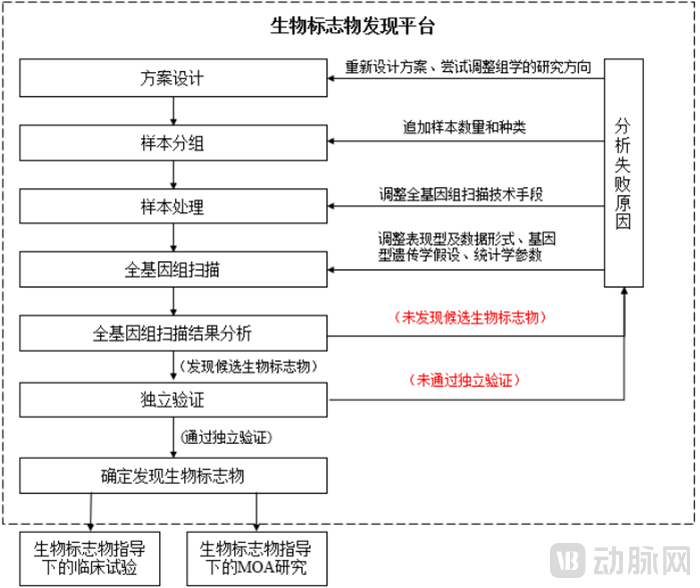
Specific Operational Workflow of the Biomarker Discovery Platform, Source: Prospectus
Not only does Chairman Luo Wen possess exceptional R&D capabilities, leading the development of a Biomarker discovery platform that breathes new life into "failed drugs," but the core R&D team members at Suoyuan Biomedicine also boast strong overseas educational backgrounds and outstanding R&D expertise. Their scientific backgrounds span numerous fields, including pharmacy, clinical medicine, molecular biology, bioinformatics, genomics, proteomics, cytology, and immunology. Many of the company’s R&D and management professionals have worked for many years at renowned international pharmaceutical companies such as Johnson & Johnson, Novartis, and AstraZeneca, accumulating extensive experience in new drug development, commercialization, and pharmaceutical enterprise management.
Under the leadership of a professional team,Suoyuan Biomedicine has obtained 40 invention patents in major countries and regions, including 10 granted in China and 30 granted overseas.The patents cover methods for discovering pharmacogenomic biomarkers, new drug structures, crystal forms, and more, providing comprehensive patent protection for the company’s products.
Suoyuan Biomedicine focuses on oncology and central nervous system diseases with unmet clinical needs., the company has selected First-in-class drugs as its key development targets. By leveraging its Biomarker discovery platform, it aims to increase the success rate of new drug development, reduce R&D costs, and shorten the development cycle. Currently, Suoyuan Biomedicine has five global First-in-class drug candidates and two Class 1 new drug candidates in its R&D pipeline, all of which have undergone Phase II/III clinical trials by their original developers.
Suoyuan Biomedicine has secured global rights to five innovative drugs—DB102, DB103, DB104, DB105, and DB106—as well as global rights excluding China (including Hong Kong, Macao, and Taiwan) for two other innovative drugs, DB107 and DB108. To date, Suoyuan Biomedicine has independently initiated two international Phase III clinical trials for first-line treatments of malignant tumors, and one Phase Ib pharmacokinetic (PK) clinical trial in China for central nervous system (CNS) disorders. The company also plans to submit an application in the second half of 2021 for an international Phase IIb clinical trial for a CNS disorder.
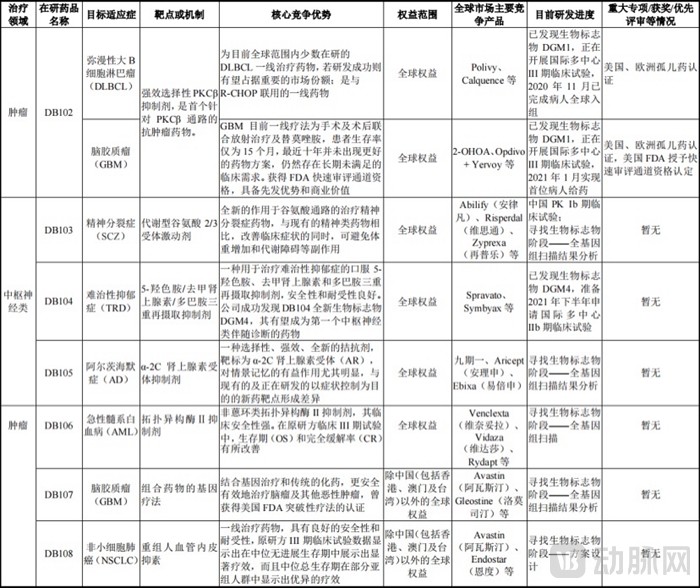
Progress in the R&D of Core Products, Source: Prospectus
Suoyuan Biomedicine’s core investigational product is DB102 (Enzastaurin), a first-in-class innovative drug licensed from Eli Lilly in 2014. As a targeted therapy, DB102 exerts direct effects by inducing tumor cell death and inhibiting tumor cell proliferation, as well as indirect effects by suppressing tumor-induced angiogenesis. Structurally, DB102 is an acyclic bisindolylmaleimide and a potent, selective PKCβ inhibitor. Currently, no new drugs targeting the entire PKC family have been approved for marketing worldwide.
DB102 was initially developed by Eli Lilly, which conducted over 60 clinical studies on various tumors, with more than 3,000 cancer patients receiving DB102 treatment, thereby generating extensive data on its safety and efficacy. Leveraging its Biomarker Discovery Platform, Suoyuan Biomedicine performed large-scale genomic analysis on samples from Eli Lilly’s Phase III clinical trials. By integrating clinical indicators through big-data computational analysis, the company identified a set of biomarkers predictive of drug efficacy, designated as DGM1 (Denovo Genomic Marker 1).
In the treatment of diffuse large B-cell lymphoma (DLBCL) and glioblastoma (GBM), DB102 has demonstrated favorable safety and potential therapeutic efficacy in biomarker-positive patients.DB102 has received Orphan Drug Designation from the U.S. Food and Drug Administration (FDA) and the European Commission (EC) for the treatment of diffuse large B-cell lymphoma (DLBCL) and glioblastoma (GBM), respectively; furthermore, the U.S. FDA has granted DB102 Fast Track designation for the treatment of glioblastoma (GBM).
DB102 is undergoing an international, multicenter Phase III clinical trial for DLBCL, with unblinding expected in mid-2022. Meanwhile, the international, multicenter Phase III clinical trial of DB102 for GBM has completed dosing of the first patient, with interim analysis anticipated in mid-2023 and unblinding in 2025.
In addition, Suoyuan Biomedicine independently identified DGM4 as the biomarker for DB104 through its proprietary biomarker discovery platform. Clinical studies completed by the original developer and retrospective analyses conducted by the company have demonstrated that DB104 exhibits a favorable safety profile and potential therapeutic efficacy in biomarker-positive patients with treatment-resistant depression (TRD).DB104 is scheduled to apply for an international multi-center Phase IIb clinical trial in the second half of 2021, with the potential to become the first central nervous system (CNS) drug utilizing precision medicine.
Suoyuan Biomedicine leverages its biomarker discovery platform as a cornerstone to tap into the hundred-billion-dollar market for oncology and central nervous system disorders, pioneering a novel model for innovative drug development.
According to a Frost & Sullivan report, the global market size for antineoplastic drugs grew from $83.2 billion in 2015 to $143.5 billion in 2019, accounting for 7.5% and 10.8% of the global pharmaceutical market share, respectively, with a compound annual growth rate (CAGR) of 14.6%.
While the global incidence of central nervous system (CNS) tumors is on the rise, the number of newly approved drugs for CNS diseases remains limited, with agents featuring novel mechanisms of action being particularly rare. Nevertheless, CNS diseases account for a top-five share of the global pharmaceutical market.
In 2019, the market size for central nervous system (CNS)-related therapies reached $118 billion, and is projected to rise to $129.3 billion by 2024. With the aging of the population and continuous growth in the global population, the incidence and mortality rates of cancer worldwide are rapidly increasing. The oncology market accounts for the largest share of the global pharmaceutical market; in 2019, the market size for cancer-related treatments reached $260.4 billion, and is expected to grow rapidly to $381.2 billion by 2024.
However, as Suoyuan Biomedicine’s core products have not yet entered the commercialization stage and no product sales revenue has been generated, the company has continued to incur losses. For the years 2018, 2019, and 2020, the net profit attributable to ordinary shareholders of the parent company was RMB -103.4798 million, RMB -133.7322 million, and RMB -223.2201 million, respectively.
For the years 2018, 2019, and 2020, Suoyuan Biomedicine’s R&D expenses were RMB 82.9582 million, RMB 111.5255 million, and RMB 172.7046 million, respectively. Among these, the proportion of R&D expenses attributable to projects that had entered Phase III clinical trials was relatively high, accounting for 86.05%, 82.92%, and 74.38% of the total annual R&D expenses, respectively. As Suoyuan Biomedicine continues to advance its ongoing clinical trials and promotes future commercialization, with more drug candidates entering clinical trial stages, the Company’s R&D expenses may increase substantially. In the foreseeable future, Suoyuan Biomedicine is expected to have accumulated uncovered losses and will continue to incur losses.
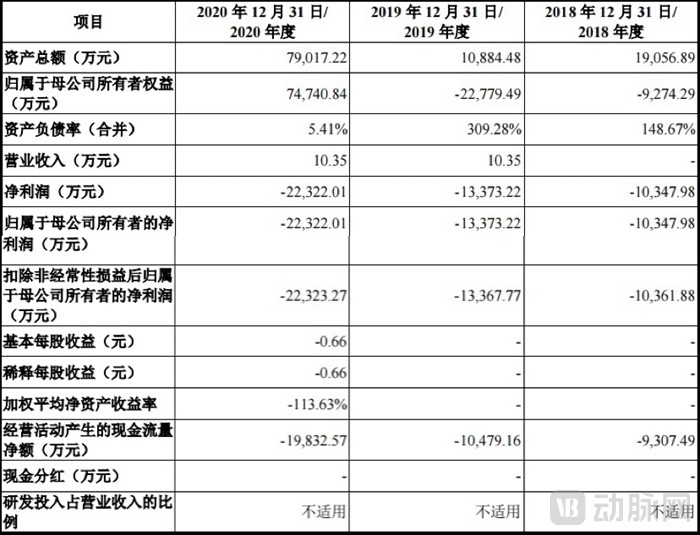
Key Financial Data and Metrics, Source: Prospectus
Suoyuan Biomedicine’s core technologies and innovative model are not only deeply integrated with the industry but also disrupt the traditional paradigm in which new drug developers typically require over $1 billion and more than a decade to bring a single new drug to market.However, a brand-new model is inevitably subject to skepticism.
When VCBeat previously interviewed Suoyuan Biomedicine, the company’s team remained remarkably composed in the face of skepticism: “When Suoyuan was raising its angel round, many questioned whether we could acquire drug pipelines from major pharmaceutical companies. After securing the pipelines, doubts shifted to whether we could identify biomarkers. Now that we have identified the biomarkers, we continue to advance steadily according to our established roadmap.” When Suoyuan Biomedicine ultimately reaches the pinnacle of success, all skepticism will naturally dissipate.
In the future, Suoyuan Biomedicine will continue to enrich its R&D pipeline layout by introducing products with forward-looking potential and broad market prospects. The company will acquire late-stage clinical failure drugs in the fields of oncology and central nervous system disorders, while also focusing on large-molecule drugs and gene therapies. In terms of new drug development, Suoyuan Biomedicine will leverage its unique biomarker discovery platform to accelerate the identification of biomarkers for its existing pipeline candidates and actively advance international multi-center clinical trials.