

Panther Medical Files for Hong Kong IPO: Aiming for the Billion-Dollar Smart Minimally Invasive Surgical Instrument Market

Panther Healthcare
Surgical Medical Device Manufacturer
On June 29, 2021, Panther Healthcare submitted its prospectus to the Main Board of the Hong Kong Stock Exchange.
From its establishment in 2002 to the submission of its prospectus in 2021, Panther Healthcare embarked on a journey spanning nearly two decades. A review of Panther Healthcare’s development history reveals that the company demonstrated significant “ambition” and maintained a clear strategic direction from its inception. In 2002, Panther Healthcare was founded in Beijing, initially engaging in the distribution of sutures and beginning to establish its marketing network. Although the distribution business generated substantial profits for Panther Healthcare at the time, the company did not rest on its laurels. Instead, it charted a different course, pursuing the more challenging yet promising path of independent research and development of minimally invasive medical devices.
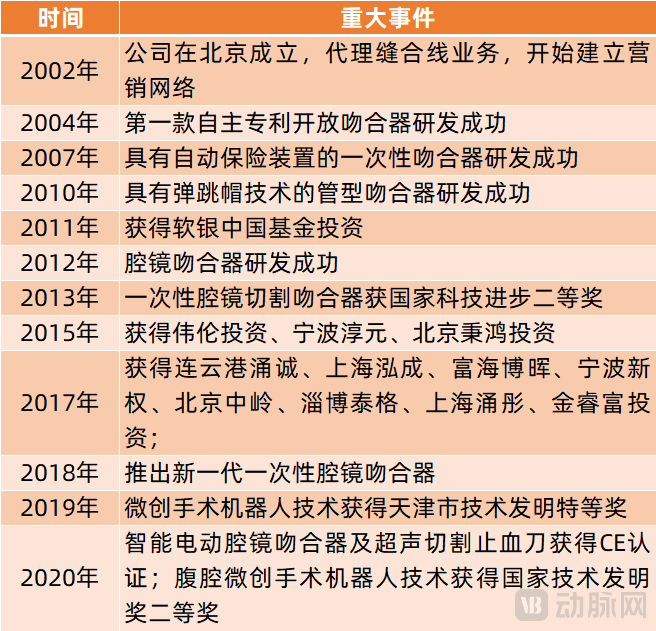
(Panther Healthcare's Development History)
It is worth noting that Panther Healthcare has not abandoned its marketing network; instead, it has cultivated this network into one of the company’s core competitive advantages. In the early stages of development, the marketing network provided ample financial support for Panther Healthcare’s independent R&D efforts. Following product approval and market launch, the network has become a powerful tool for the company’s marketing and promotion initiatives.
Currently, Panther Healthcare is able to provide clinical markets with surgical staplers (including endoscopic staplers, intelligent staplers, and open staplers), as well as other instruments and accessories required for minimally invasive and open surgeries (such as ultrasonic scalpels and disposable hernia repair devices). According to the prospectus, Panther Healthcare has obtained Class III and Class II medical device certifications in China for 3 and 61 products, respectively. Furthermore, among its core products, 7 have received FDA clearance, 21 products have obtained CE certification, and 11 products have achieved MDSAP certification.
Meanwhile, Panther Healthcare also distributes sutures, hernia repair meshes, and vascular titanium clips produced by third parties.As of now, Panther Healthcare has more than 300 models of products on the market.
In terms of R&D layout, Panther Healthcare currently has 19 candidate products, including six potential Class III medical devices and 13 potential Class II medical devices. Among them, two products have obtained CE certification and are currently undergoing product registration procedures in China.
According to Panther Healthcare’s prospectus: “Leveraging our comprehensive product portfolio, we aim to provide a ‘one-stop’ surgical toolkit that makes minimally invasive surgery safer, simpler, faster, and more affordable.”
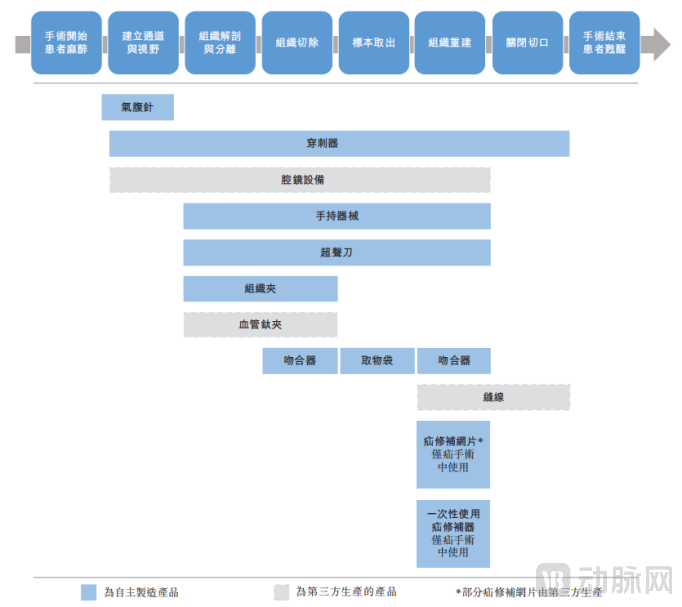
(Panther Healthcare's Product Pipeline Layout)
According to Frost & Sullivan, Panther Healthcare has established a sales network covering all provinces in China. This network reaches the largest number of hospitals among domestic stapler manufacturers, making it the most extensive sales network among Chinese stapler manufacturers. Driven by product quality and marketing channels, Panther Healthcare ranked first in sales volume (including exports) among Chinese stapler manufacturers in 2020, accounting for 14.3% of the total sales volume of domestic stapler manufacturers.
In addition, in 2020, Panther Healthcare’s products were exported to more than 60 countries, including Brazil, Spain, Turkey, Italy, and Canada. From 2016 to 2020, the company ranked first in export sales among domestic stapler brands for five consecutive years.
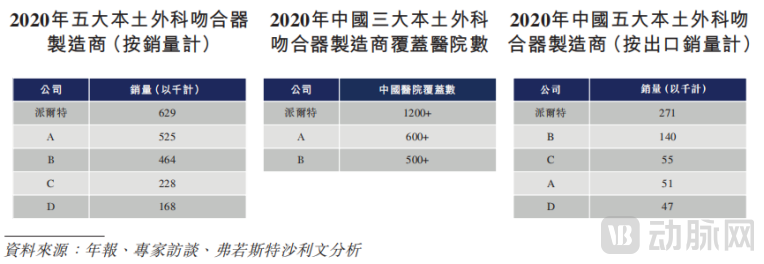
Thus, it is evident that Panther Healthcare is the undisputed leader in the field of domestically produced surgical staplers.
In fact, Panther Healthcare targets the entire field of intelligent minimally invasive surgical instruments, with staplers being only one of its core products.
Data shows that minimally invasive surgery is gradually becoming the mainstream approach, owing to its advantages such as minimal trauma, rapid postoperative recovery, reduced patient pain, and lower risk of infection. Correspondingly, the market for minimally invasive surgical instruments is experiencing a period of rapid growth.
According to data provided by Frost & Sullivan in Panther Healthcare’s prospectus, the market size of China’s minimally invasive surgical instruments and accessories increased from RMB 11.7 billion in 2016 to RMB 19.2 billion in 2020, representing a compound annual growth rate (CAGR) of 13.1%. The market is projected to reach RMB 42.3 billion by 2025, with a CAGR of 17.1% from 2020 to 2025.
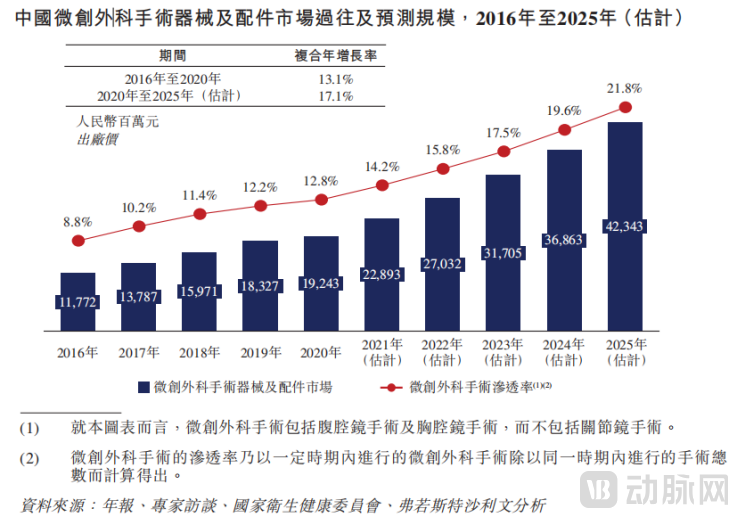
(Historical and Forecast Market Size and Penetration Rate of the Chinese Market for Minimally Invasive Surgical Instruments and Accessories)
The prospectus reveals that the penetration rate of minimally invasive surgery varies significantly across hospitals in China. In 2020, the penetration rates of minimally invasive surgery in tertiary general hospitals, secondary general hospitals, and other general hospitals were 14.1%, 11.4%, and 3.4%, respectively. On the other hand, minimally invasive surgery offers greater advantages over open surgery and has gained widespread recognition from both patients and surgeons. It is believed that driven by factors such as medical consortia, tiered diagnosis and treatment systems, medical education, and academic promotion, along with marketing efforts by relevant enterprises, the penetration rate of minimally invasive surgery in primary care hospitals in China will increase substantially, leading to significant expansion of the market for minimally invasive surgical instruments and accessories.
In addition to the continuous increase in penetration rate, three other major factors will also accelerate the development of China's market for minimally invasive surgical instruments and accessories.
First, in the field of intelligent minimally invasive surgical instruments, innovative products developed by domestic enterprises have reached technological levels comparable to those of foreign competitors. For instance, Panther Healthcare, a leading Chinese manufacturer of intelligent minimally invasive surgical instruments, obtained CE certification for its products in September 2020 and has since exported them to numerous countries and regions worldwide, with product performance and quality gaining recognition in overseas markets. It is foreseeable that technological breakthroughs by domestic companies will further expand the market for minimally invasive surgical instruments and accessories in China.
Second, China has introduced a series of policies to encourage the research and development of innovative medical devices, thereby promoting the growth of the market for minimally invasive surgical instruments and accessories. For instance, registration applications for products with outstanding clinical value will receive priority review, shortening the approval timeline. Additionally, certain provinces and municipalities have begun exploring procurement policies that prioritize domestically produced products in hospitals, resorting to imported products only when domestic options fail to meet requirements. It is believed that as these policies related to registration, regulation, and procurement are fully implemented, China’s minimally invasive surgical instrument market will undergo significant transformation, ushering in a golden period of development for domestic enterprises.
Third, domestic innovative enterprises are actively expanding their exports by leveraging high-quality products and cost-control advantages. The prospectus reveals that after achieving technological breakthroughs, Chinese manufacturers are making significant inroads into export markets such as India, Southeast Asia, and South America, driven by their high-quality minimally invasive surgical instruments and accessories, as well as competitive pricing.In 2020, Panther Healthcare exported surgical staplers to more than 60 countries and regions worldwide. From 2016 to 2020, the company ranked first in export sales volume among Chinese surgical stapler brands for five consecutive years. In 2020, overseas sales revenue accounted for 40.0% of Panther Healthcare's total revenue.
Overall, minimally invasive surgery represents an inevitable trend in the history of surgical practice, and the market for minimally invasive surgical instruments is poised to expand and mature over time.
Public data indicates that the minimally invasive surgical instrument market primarily comprises seven key segments: staplers, handheld instruments, energy-based surgery devices, sutures, biomaterials, hernia repair products, and tumor ablation systems. Among these, laparoscopic and intelligent staplers constitute the largest segment within the market for minimally invasive surgical instruments and accessories, accounting for 27.9% of China’s overall market in 2020, with this share projected to reach 30.2% by 2025.
According to the prospectus, the market size of surgical staplers in China increased from RMB 3.887 billion in 2016 to RMB 6.893 billion in 2020, and is expected to reach RMB 15.211 billion by 2025, representing a compound annual growth rate (CAGR) of 17.2%. Among these, the market size of intelligent staplers grew from RMB 320 million in 2016 to RMB 988 million in 2020, with a CAGR of 32.4%, accounting for 14.3% of the overall Chinese surgical stapler market in 2020. It is projected to reach RMB 5.41 billion by 2025, constituting 35.6% of the total market size.
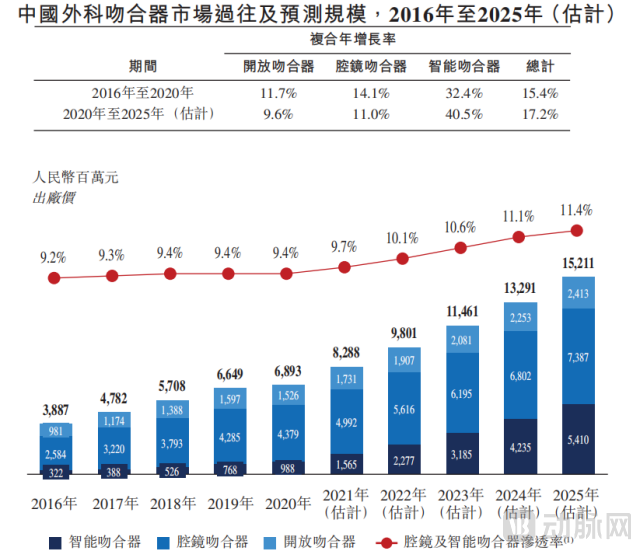
(Overview of the Chinese Surgical Stapler Market)
In response to the rapidly growing market for intelligent staplers, Panther Healthcare has strategically positioned itself in advance. Its latest third-generation intelligent laparoscopic stapler enables fully one-handed operation, with electrically driven functions including firing/retraction, jaw closing/opening, and articulation/360-degree rotation.
Panther Healthcare stated: “The third-generation intelligent endoscopic stapler is expected to be suitable for anastomosis in gastric, pulmonary, and gastrointestinal surgeries. It has currently obtained CE certification and is undergoing clinical trials in China.”
The prospectus reveals that Panther Healthcare’s intelligent stapler offers five major advantages over existing products on the market: First, its fully electric, stepless rotation prior to cutting and suturing, firing and retraction, and jaw closing and opening makes surgeries safer, more efficient, and more convenient. Second, it is designed for single-use only, reducing the risk of cross-infection. Third, it features stronger staple cartridge compatibility and lower costs. Fourth, it incorporates color-differentiation technology, chip recognition, real-time tissue thickness detection, and intelligent firing control, which enhance suturing performance and reduce the risk of injury caused by operational errors. Fifth, staple cartridge replacement is simple, resulting in a shorter clinical learning curve.
Combining the aforementioned advantages, Panther Healthcare’s intelligent stapler is expected to rapidly capture market share upon its launch.
Frost & Sullivan predicts that the market size of surgical staplers in China will reach RMB 15.211 billion in 2025, with domestic brands accounting for 48.4% and foreign brands for 51.6%. Based on this forecast, VCBeat believes that Panther Healthcare, as a leading enterprise in the field of domestic surgical staplers, will achieve significant breakthroughs by leveraging its high-quality intelligent staplers and extensive marketing network.
As a critical segment of the overall minimally invasive surgical device market, the ultrasonic scalpel market has expanded from RMB 1.022 billion in 2016 to RMB 2.008 billion in 2020, representing a compound annual growth rate (CAGR) of 18.4%. It is projected to reach RMB 6.11 billion by 2025, with a CAGR of 24.9% during the 2020–2025 period. Amid this rapid expansion, Frost & Sullivan forecasts that the ultrasonic scalpel market will account for 14.4% of the overall minimally invasive surgical device market by 2025.
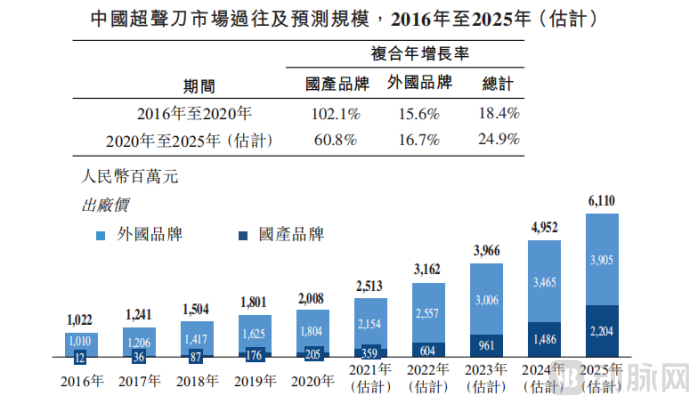
(Overview of the Chinese Ultrasonic Scalpel Market)
In response to the rapidly expanding ultrasonic scalpel market, Panther Healthcare is developing its second-generation ultrasonic scalpel. The first-generation device has obtained CE certification and is scheduled for launch in the Chinese market in 2022.
Panther Healthcare states: “The second-generation ultrasonic scalpel is expected to be used in general surgery, thoracic surgery, gynecology, pediatrics, and plastic surgery. Compared with existing products on the market, the second-generation ultrasonic scalpel is equipped with a rapid intelligent self-diagnostic system that reduces preoperative preparation time; features an ultrasonic handpiece and blade design with larger amplitude, generating higher energy to ensure smooth cutting and safe hemostasis during surgery; offers high- and low-performance blade options to meet the needs of different surgical procedures; utilizes a reusable activation handle connected to the transducer, helping to lower maintenance costs; and employs intelligent tissue cutting management technology to minimize thermal tissue injury.”
According to Frost & Sullivan, the penetration rate of ultrasonic scalpels in the United States reached 27% in 2020, whereas it was only 1.1% in the Chinese market. This indicates substantial growth potential for the domestic ultrasonic scalpel market. As disclosed in Panther Healthcare’s prospectus: “We believe that Panther Healthcare’s continuous technological innovation and product refinement will help us capture a larger market share in China’s growing ultrasonic scalpel market.”
As an emerging market, laparoscopic surgical robots are experiencing rapid growth. According to the prospectus, the volume of robot-assisted laparoscopic surgeries in China surged from 18,000 cases in 2016 to 47,000 cases in 2020, representing a compound annual growth rate (CAGR) of 27.4%. The number is projected to reach 481,000 cases by 2025, with a CAGR of 59% from 2020 to 2025.
With the rapid growth in surgical volume, the market for laparoscopic surgical robots is also set to expand significantly. According to Frost & Sullivan data, China’s laparoscopic surgical robot market grew from RMB 680 million in 2016 to RMB 2.19 billion in 2020, and is projected to reach RMB 13.1 billion by 2025.
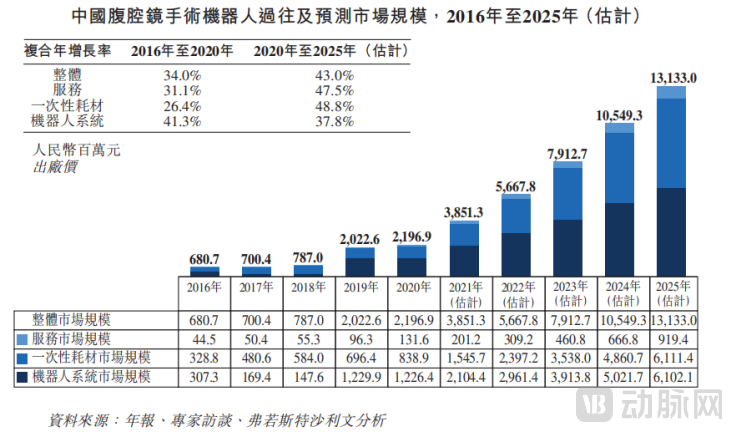
(Overview of Laparoscopic Surgical Robots in China)
Among these, the disposable consumables, customer services, and robotic systems in the field of laparoscopic surgical robots are expected to achieve compound annual growth rates (CAGRs) of 48.8%, 47.5%, and 37.8%, respectively, from 2020 to 2025.
According to reports, robot-assisted laparoscopic surgery can overcome most of the limitations of traditional laparoscopic surgery, offering advantages such as high operational precision, strong flexibility, good repeatability and stability, and reduced susceptibility to human physiological factors. However, as a high-end medical device, laparoscopic surgical robots involve key technologies—including human-robot interaction, remote control, and robotic systems—as well as artificial intelligence, presenting a high technical barrier. According to the prospectus disclosed by Panther Healthcare, the company expects to launch its laparoscopic surgical robot product in 2024.
Vicent Surgical Robotics, a company acquired and majority-controlled by Panther Healthcare, offers products including medical robots and associated consumables. This surgical robot is expected to be applicable to surgeries in cardiothoracic, general, urogenital, and gynecological departments. It holds the promise of reducing reliance on surgeons’ technical skills and practical experience, enhancing precision, simplifying operational procedures, and shortening operation time.
The prospectus reveals that this surgical robot employs active master-slave control technology, enabling its unmanned robotic arms to hover at any position during surgery without extraneous movements from the master controller, thereby reducing surgical risks. Its intraoperative adjustment mechanism saves operative time and enhances ease of operation. The immersive 3D visual display offers lower latency and a greater depth of field, ensuring flexible manipulation and more precise visualization. Furthermore, the system can integrate CT and ECG images for real-time comparison with the surgical field view, providing surgeons with reliable reference information.
According to Frost & Sullivan, as of now, there are no commercially available domestically produced laparoscopic surgical robots in China, and Panther Healthcare’s laparoscopic surgical robot is one of the few products still in the development stage. As disclosed in Panther Healthcare’s prospectus: “We believe that our first-mover advantage and the innovative features of our laparoscopic surgical robot will position Panther Healthcare favorably in the competition within this emerging market.”
In addition to staplers, ultrasonic scalpels, and surgical robots, Panther Healthcare has also expanded its portfolio to include other surgical instruments and accessories such as sutures, hernia repair devices, disposable trocars, disposable titanium vascular clips, and disposable tissue clips. To date, Panther Healthcare offers more than 300 product models for sale.
The prospectus shows that Panther Healthcare’s revenues in 2018, 2019, and 2020 were RMB 229 million, RMB 302 million, and RMB 308 million, respectively. The vast majority of Panther Healthcare’s revenue comes from surgical staplers, with stapler products accounting for 89.1%, 91.6%, and 84.5% of annual revenue in 2018, 2019, and 2020, respectively.
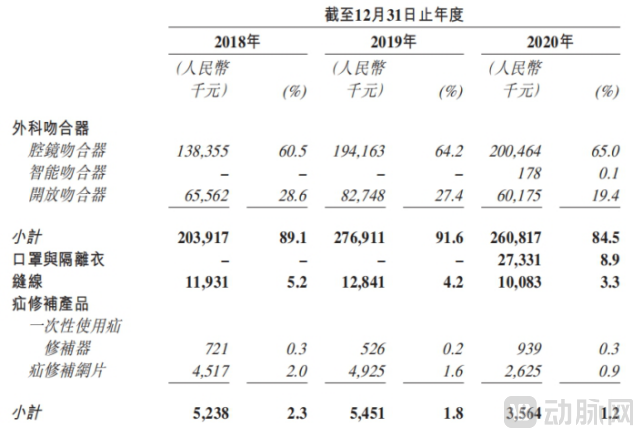
(Image source: Prospectus)
Panther Healthcare’s revenue has maintained continuous growth because the company provides a comprehensive suite of solutions for minimally invasive surgery, continually enriches and iterates its product portfolio, and leverages forward-looking R&D strategies, cutting-edge technology, robust commercialization capabilities, and an excellent sales network.
Specifically, Panther Healthcare has developed a comprehensive suite of solutions for minimally invasive surgery, including surgical staplers, disposable hernia repair devices, trocars, and tissue closure clips.
Meanwhile, Panther Healthcare continues to innovate and is currently developing products such as the third-generation intelligent endoscopic stapler, the second-generation ultrasonic scalpel, and endoscopic surgical robots, laying the foundation for a more diversified product portfolio.
In addition, as of December 31, 2020, Panther Healthcare had a total of 37 R&D personnel, accounting for 10.3% of its total workforce, with all core R&D members possessing over ten years of experience in the research and development of surgical instruments.
Panther Healthcare’s sales team is relatively stable, with the majority of its regional managers having served for more than 10 years. Meanwhile, Panther Healthcare has established an extensive distributor network. As of December 31, 2020, the company had built a network comprising 495 distributors, covering all provinces in China as well as more than 60 overseas countries and regions. In 2018, 2019, and 2020, revenue contributed by distributors accounted for 94.0%, 94.1%, and 96.4% of Panther Healthcare’s total revenue, respectively.
Data from the National Medical Products Administration (NMPA) indicates that there are numerous domestic products on the market in fields such as surgical staplers and hernia repair, leading to increasingly fierce competition. In light of this scenario, what are Panther Healthcare’s plans? How will it maintain its competitive edge?
The prospectus shows that Panther Healthcare will highlight its advantages from the following five aspects.
First, continuously expand market share and consolidate industry position. Panther Healthcare plans to closely follow the technological development trends in surgical instruments, continuously broaden sales channels, and integrate third-party high-end product resources to enhance its capability to provide comprehensive solutions, thereby further increasing its market share in China’s minimally invasive surgical instruments and accessories market and boosting its competitiveness in overseas markets.
Second, further enrich the product pipeline, accelerate the commercialization of candidate products, and seek acquisition opportunities. Panther Healthcare considers R&D capability to be one of the primary engines for its future growth, and accordingly plans to accelerate the clinical research and commercialization of candidate products, continuously enhancing its ability to provide packaged surgical solutions. Additionally, Panther Healthcare plans to diversify its product portfolio by strengthening R&D efforts and acquiring related companies.
Third, expand production capacity and enhance intelligent manufacturing capabilities. Panther Healthcare plans to meet the potentially significant surge in demand resulting from centralized volume-based procurement by expanding its production capacity, thereby strengthening cost control and management efficiency to boost competitiveness. The company will install additional automated equipment for production, assembly, and packaging to enable 24/7 operations, while also expanding its production team in line with capacity growth to satisfy rising demand over the next five to ten years. Meanwhile, Panther Healthcare will acquire advanced production equipment to elevate its intelligent manufacturing standards and optimize manufacturing processes for high-end surgical staplers, meeting the requirements of both domestic and international markets. By producing certain core components of high-end surgical staplers in-house, the company aims to reduce reliance on external component suppliers, strengthen its bargaining power, and lower costs.
Fourth, further enhance brand awareness. Panther Healthcare plans to boost its brand influence through various channels, including training exchanges, academic promotion, and new media publicity, thereby strengthening physicians’ confidence in its products and fostering brand loyalty, which will in turn drive product sales and utilization.
Fifth, attract and retain top talent. Panther Healthcare plans to attract high-quality R&D, production, and sales professionals, recruit additional mid-to-senior-level technical personnel, strengthen its R&D team, optimize its talent structure, and ensure the sustainability of R&D activities through an incentive system to retain high-caliber talent. Meanwhile, Panther Healthcare plans to collaborate with universities and research institutions to continue cultivating and recruiting talent.