

Chinese Scientist Yang Hui, 35, Unveils Nation’s First Fully Indigenous Gene-Editing Platform and Files IPO Prospectus
“The 21st century is the century of biology.” This statement has been reiterated for over a decade, yet tangible progress has only begun to emerge in the past two years. With the large-scale return of overseas Chinese scholars and the continuous output of scientific achievements, China’s biomedical research sector is experiencing unprecedented prosperity.
Researcher Yang Hui from the Institute of Neuroscience, Chinese Academy of Sciences, remarked with a smile, “It is only 2021. If we divide the 21st century into early, middle, and late periods, we are still in the early stage. This century, which belongs to biology, has just begun.”
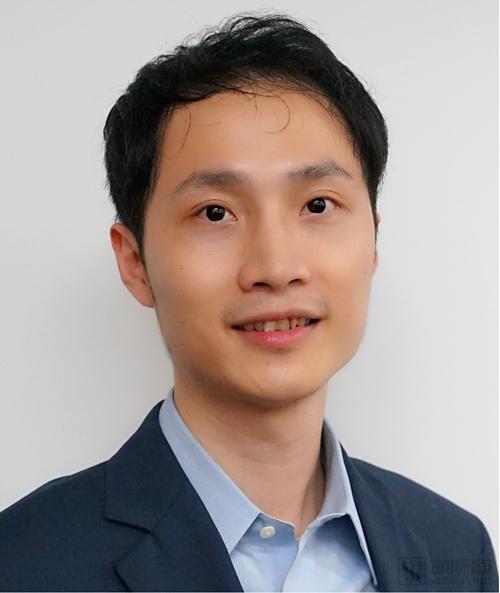
Researcher Yang Hui, Institute of Neuroscience, Chinese Academy of Sciences
As a young scientist who came of age in China’s rapidly advancing research landscape, 35-year-old Yang Hui had already achieved the “Grand Slam” of publishing in the three premier journals—Science, Nature, and Cell—several years ago, unquestionably establishing him as a standout among the new generation of biological researchers.
In his conversations with VCBeat, Yang Hui consistently demonstrated the rigor expected of a scientist and a distinctive sense of national confidence. He is currently undergoing a transformation in his personal growth, which includesThe transition from a young scientist to a leader of a research team also entails the shift from a researcher to an entrepreneur.
CRISPR/Cas9, a gene-editing tool that has advanced rapidly in recent years, is often referred to as “genetic scissors.” This system originally evolved in bacteria and archaea as an immune defense mechanism against invading viruses and foreign DNA. However, through simple system assembly and functional induction, researchers have transformed CRISPR/Cas9 into a precise tool capable of targeting specific genes for DNA sequence modification.
When CRISPR/Cas9 took the academic world by storm, Yang Hui had just arrived in the United States to begin his postdoctoral research. With years of dedicated expertise in gene editing, he immediately recognized the future application potential of the CRISPR/Cas system. He quickly collaborated with his close colleagues from the same mentorship lineage, leveraging his prior continuous explorations in the field, and completed two related studies within a few months. These findings were published in the prestigious international biology journal Cell in April 2013 and September 2013, respectively.
With several outstanding research achievements, Yang Hui successfully completed his postdoctoral work at the Whitehead Institute for Biomedical Research in just a year and a half.At the time, Yang Hui faced two paths: one was to remain abroad and continue his research in a mature academic environment; the other was to return to China and serve as a builder in an environment that, while not yet fully mature, was experiencing rapid growth. With little hesitation, Yang Hui chose to return to China, contributing his efforts to the advancement of the nation’s scientific research enterprise.
“Yang Hui told us that before he returned to China, Harvard University had extended an olive branch by inviting him for an interview, but he declined. ‘I never considered staying abroad. Prior to my departure, I had already collaborated with the Institute of Neuroscience, Chinese Academy of Sciences (ION-CAS), and engaged in exchanges with senior researchers there. My research focus at the time was on animal models, where China holds significant advantages in primate model resources. Therefore, even before going abroad, I had decided that my overseas journey was solely for exchange and learning, and I was determined to return. Studying abroad enriched my experience and knowledge, while comparisons revealed that domestic institutions also offer comparable academic atmospheres and research conditions, perhaps lacking only specialized talent in certain fields. This strengthened my resolve to return. The academic atmosphere at the Institute of Neuroscience makes me feel comfortable; the academic environment is very open, and supporting resources are abundant. I am excited to work and conduct research in such an environment,’ Yang Hui recalled.”
After returning to China to take up a position at the Institute of Neuroscience, Yang Hui has maintained his academic acumen and dedication to rigorous research, achieving repeated successes in top-tier journals such as Science, Nature, and Nature Protocols. As he delved deeper into CRISPR/Cas systems, Yang observed that the world’s leading gene-editing scholars were increasingly shifting their focus toward clinical applications, and he gradually became aware of the substantial gap between his own research efforts and clinical practice.Ultimately, a chance opportunity prompted Yang Hui to make the decisive move into industry, ensuring that the technology he had diligently developed would no longer remain confined within an ivory tower.
“In 2015, a colleague from our institute and I attended a conference on spinal muscular atrophy (SMA) at Fujian Medical University. Other experts present shared the current state of diagnosis and treatment in this field. Only when you are close to clinical practice can you truly grasp the nearly devastating impact that a rare disease can have on so many families. Many patients with severe SMA die within the first two years of life; those with milder forms may suffer from lower-limb paralysis and require long-term care from family members. Among rare diseases, SMA is relatively fortunate, as there are already approved medications available. However, for many other rare diseases, no effective treatments are currently available. If our technological capabilities could accelerate the development of therapies for these conditions by even a single day, we could help save more patients,” said Yang Hui.
By 2018, Yang Hui felt that the time was ripe and prepared to enter the industry to embark on a new career venture. At this point, his only concern was whether the Institute of Neuroscience would support his decision. Therefore, he sought advice from senior mentors at the Chinese Academy of Sciences.The senior mentor’s response was equally straightforward and clear. He advised Yang Hui not to deliberately distinguish between working in a laboratory or at a company, emphasizing that realizing one’s value is not confined to any specific setting. Whether in a lab or a corporate environment, Yang Hui should go wherever best supports his professional aspirations.
The veteran’s words reassured Yang Hui, and thus began his journey in translating scientific research into practical applications.
After several years of effort, the company he founded is rapidly advancing in line with his original vision, striving to improve the well-being of more patients with rare diseases through gene-editing technology.
“There are actually many commonalities between the two roles. The company’s product R&D is still in the preclinical stage, which is very similar to my work in the laboratory. The slight difference is that the academic lab is more open-ended; we are not limited to gene editing, and I support any valuable scientific research. In contrast, industrial translation requires a more focused approach. We must center our efforts on developing a series of technical tools and products for diseases that currently lack effective treatment options,” said Yang Hui.
Although Yang Hui has achieved success in both scientific research and translational medicine, a concern has long lingered in his mind.
For an extended period after returning to China, Yang Hui made the CRISPR/Cas9 system a central focus of his research, achieving a series of notable results. In particular, in two papers published in Science and Nature in 2019, Yang’s team, in collaboration with other groups, employed GOTI (Genome-wide Off-target analysis by Two-cell embryo Injection), a gene-editing off-target detection method they independently developed. Their work revealed that BE3, a widely used CRISPR/Cas9-based single-base editor at the time, caused unpredictable off-target effects at both the DNA and RNA levels. This finding indicated that the classic version of BE3 posed significant safety risks.
That is to say, as a gene-editing technology that has entered the clinical stage, the safety and accuracy of CRISPR/Cas9 still need to be improved.
Moreover, the deeper he delved into his research, the more he realized that although he had conducted extensive work on off-target effects to optimize the CRISPR/Cas9 system, all of these efforts were built upon patented technologies owned by others.The CRISPR/Cas9 system is not a gene-editing platform with independent intellectual property rights in China. Although the current environment remains relatively open, there is still a possibility of facing critical technological bottlenecks in the future.
Yang Hui used a vivid analogy to explain his concerns: “CRISPR/Cas9 is like the Windows or iOS operating system for a computer. No matter how much you optimize the system or develop additional features on it, if the patent holder ever revokes your license, all your previous efforts will be rendered futile. Moreover, DNA-level editing inherently carries safety risks that are nearly impossible to avoid. If an editing error occurs, the edited cells could potentially become cancerous at any time.”
Guided by this consideration, Yang Hui has long been driven by the ambition to develop a gene-editing system with independent intellectual property rights in China that is safer and more efficient than the CRISPR/Cas9 system.
This idea was ultimately translated into concrete action. Through the efforts of Yang Hui and his laboratory team, they successfully identified two novel proteins in the Cas family, Cas13x and Cas13y, and leveraged these discoveries to develop a new RNA editing technology.
In May 2021, *Nature Methods* published the research findings of Yang Hui’s team. Following the publication, numerous laboratories both in China and abroad proactively contacted Yang Hui, seeking to obtain this tool for further research.
“This is a milestone achievement that will inspire me to continue my in-depth research,” said Yang Hui. He expressed his hope that his R&D outcomes would provide inspiration for all scholars in the field of gene therapy.
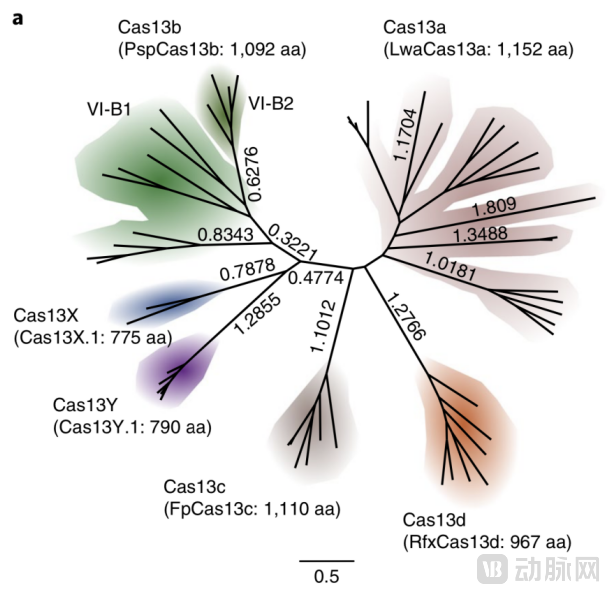
Phylogenetic Tree of the Cas13 Protein Family
In this article, Yang Hui’s team first compared the functional differences between their newly identified Cas13x.1 and Cas13y.1 proteins and other members of the same family. Knockdown assays demonstrated that Cas13x.1 and Cas13y.1 exhibit stronger knockdown activity than the previously studied Cas13a and Cas13b. This suggests that RNA editing systems built around Cas13x.1 or Cas13y.1 could potentially achieve higher editing efficiency than those based on the Cas13a/Cas13b platforms.
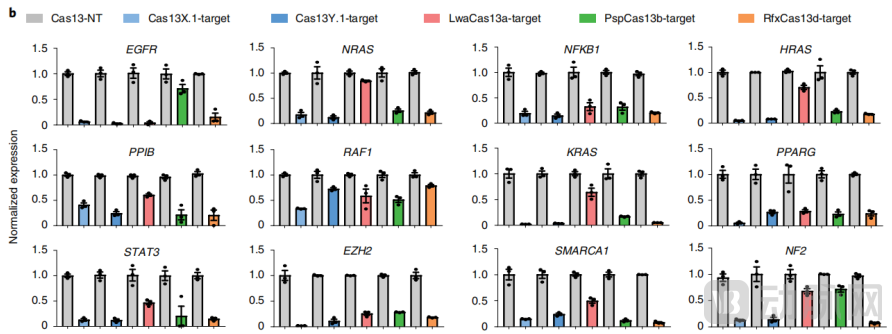
Comparison of Gene Editing Efficiency of Different Cas13 Family Proteins on 12 Distinct Endogenous Transcripts
This is indeed the case. Yang Hui’s team subsequently focused on investigating the editing capabilities of Cas13x.1, revealing that Cas13X.1 achieves significantly higher editing efficiency than Cas13a in major editing application scenarios.
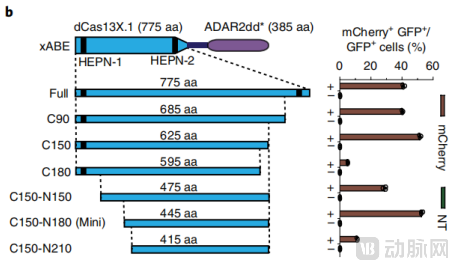
Comparison of Gene Editing Efficiencies of Different Truncated Forms of Cas13X.1
Yang Hui’s team further reduced the molecular weight of Cas13x.1 and fused it with an RNA single-base editor to enable RNA single-base editing. After evaluating several different truncated variants, the team identified a smaller variant, C150-N180 (Mini), which retains the functional activity of the Cas13x.1 protein. This reduction in molecular weight enhances the flexibility of the system for future applications.
Yang Hui explained the published article, stating: “The Cas13-based RNA editing system was not pioneered by us; previously, researchers predominantly utilized Cas13a, Cas13b, and Cas13d. After conducting in-depth research on this system, we identified several significant limitations. Consequently, we mined novel proteins from the same family that are smaller in size, exhibit higher editing efficiency, and demonstrate lower off-target rates. Based on these findings, we have established our own patent portfolio.”
With its own portfolio of patents, Yang Hui will increasingly focus on RNA editing in future industrial commercialization, building products upon underlying technologies with independent intellectual property rights to achieve complete “Created in China + Intelligently Manufactured in China.”
As a new generation of homegrown Chinese scientists, Yang Hui has personally witnessed the tremendous changes in China’s scientific research environment over the past decade.
“When I was pursuing my Ph.D., the only domestic institution that could compare with its international counterparts was the Chinese Academy of Sciences. The overall research capabilities of universities were still in the process of being established. However, things changed rapidly after 2010, when the state began to invest heavily and a large number of scientists returned from overseas, bringing about earth-shaking changes to China’s scientific research environment. In the years since I completed my postdoctoral research and returned to China, I have clearly observed that the quality of academic publications has been steadily improving, indicating that the infrastructure for basic scientific research has been continuously enhanced. For instance, the research environments in Beijing and Shanghai have now reached the world’s most advanced levels, trailing only slightly behind hubs like Boston, known as the ‘Bio-Silicon Valley,’” said Yang Hui.
"Driven by strong national support and a wave of Chinese scholars returning home, China's scientific research endeavors, particularly in the life sciences, have entered a decade of vigorous growth."As a representative figure among the high-caliber young researchers of the new generation, Yang Hui believes that the emergence of these emerging scientists precisely signifies that China’s domestic research system is rapidly converging with international standards.“Scientific progress is driven by the creativity of young people. For instance, in the field of CRISPR, several renowned scientists at the Broad Institute achieved fame at a young age. This is essentially how foreign research systems operate: a cohort of young researchers diligently pursues in-depth studies, while senior scientists consistently guide their direction.”
Yang Hui’s laboratory continues to expand, now boasting a large team of dozens, primarily composed of postdoctoral fellows. In selecting trainees, Yang Hui adopts a highly open-minded approach; prior publications and awards hold little weight for him. It is sufficient that students possess solid fundamental experimental skills and maintain clear logical reasoning in their research design.
Yang Hui believes that the most important factor is for students to possess their own intrinsic motivation, whether it be the desire to publish high-impact papers, the aspiration to become a Principal Investigator (PI) in the future, or the interest in pursuing a career closer to clinical practice. Therefore, Yang Hui primarily provides overarching guidance in the laboratory, leaving the experimental details to the students’ independent exploration: “Currently, nearly half of the research projects in our lab are initiated by the students themselves. In our laboratory environment, if anyone adopts a slack attitude, there is no need for me to intervene; they will quickly fall behind and choose to leave on their own.”
It is precisely because young scholars like Yang Hui are leading research teams that China’s scientific research enterprise has gradually developed the capacity for independent “self-sustenance.”Regarding the development of the next generation of researchers, Yang Hui believes that the “overseas-degree-only” mindset is no longer advisable: “It is right to go abroad to broaden one’s horizons and to understand the environment and culture at the world’s leading research institutions. However, the core scientific research should be conducted back in China. Given the substantial support now available for biomedical research and development in China, young scientists should devote their prime years to contributing domestically. From my personal perspective, I sincerely hope to provide more opportunities for young researchers in the future, granting them greater space to fully unleash their potential.”
References:
Chunlong Xu et al.Programmable RNA editing with compact CRISPR–Cas13 systems from uncultivated microbes.Nature Methods 18,499-506(2021).