

WeDoctor Twice Named 'China Best Managed Company,' Driving a Digital Responsibility-Based Healthcare System
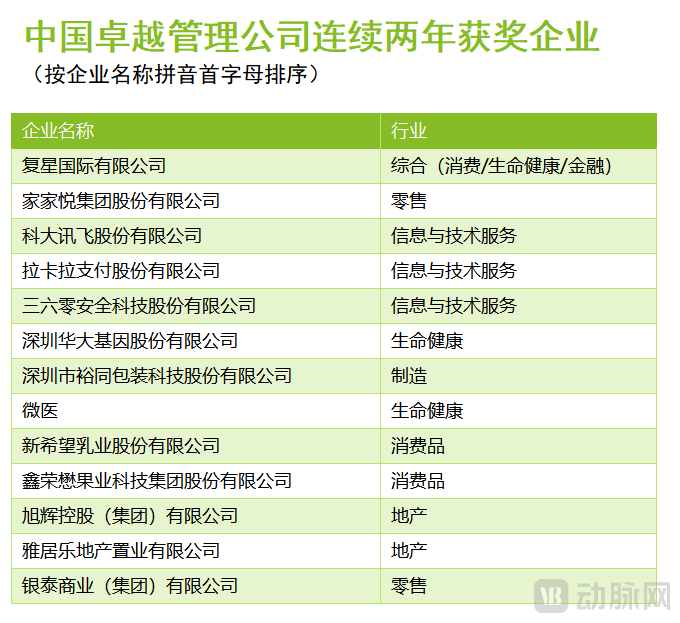
Recently, the list for the third edition of “Best Managed Companies” (BMC) in China was released. WeDoctor, China’s largest digital healthcare platform, joined 13 other industry leaders such as Fosun and iFlytek on the “Two-Year Consecutive Award Winners” list, recognized for its outstanding performance and unique competitiveness in the digital health sector.

The BMC program was established in Canada in 1993 and has since been promoted in numerous countries worldwide, officially launching in China in 2018. As the only assessment initiative in China that comprehensively evaluates the management systems of private enterprises, the BMC program involves rigorous screening and coaching of participating companies by its organizers—Deloitte China, Harvard Business Review (Chinese Edition), the Hong Kong University of Science and Technology School of Business, and Bank of Singapore—culminating in the release of an annual ranking. Following six months of research, evaluation, and communication, 42 companies were ultimately selected for the 2021 list.
Compared with the previous two editions, the 3rd BMC Awards not only selected and evaluated companies based on the four pillars of “strategy, capability, commitment, and financial strength,” but also thoroughly assessed their ability to adapt to the new market order in the post-pandemic era and their progress in sustainable development. It is reported that the 42 award-winning companies this year had an average revenue of RMB 24.4 billion, a year-on-year revenue growth rate of 22%, and a return on equity (ROE) of 18%.
2021 marked the inaugural year of China’s 14th Five-Year Plan, a period presenting both opportunities and challenges for the private sector. According to Zhang Xiaochun, Co-founder and Vice Chairman of WeDoctor, in the post-pandemic era, the key for enterprises to enhance their future competitiveness and achieve excellence lies in adapting to the new market order, uncovering industry-specific demands and value, and conducting meaningful, sustainable business.
“Healthy China” has been elevated to a national strategy. In the past, the health industry focused heavily on indicators such as the proportion of total health expenditure to GDP, the growth rate of per capita total health expenditure, and annual hospital revenue. However, underlying these metrics is a fee-for-service payment model, which has inevitably led to a “price-differential model” in healthcare services, fostering phenomena such as overtreatment, over-testing, and overprescription.
“The ‘new challenges’ of the post-pandemic era, in our view, call for a ‘return’ of the industry’s business model—‘returning’ to the needs of consumers (patients) and payers, and ‘returning’ to the essence of healthcare services that prioritize health outcomes,” shared Zhang Xiaochun at the conference.

To this end, over the past decade, WeDoctor has been driven by technology and innovation, gradually building a health-centered accountable care system by establishing a platform that integrates key service elements such as healthcare providers, payers, and supply chains. By leveraging digital healthcare and health maintenance services, it aims to break away from the traditional treatment-centric model, effectively implement an “accountability for health” framework, and ultimately enhance the accessibility and effectiveness of medical and health services to meet users’ growing demand for improved health outcomes.
WeDoctor is also emerging as an organizer and enabler driving the implementation of accountable care systems. As of December 31, 2020, WeDoctor’s digital health platform had connected more than 7,800 hospitals and over 270,000 registered physicians, accumulated 220 million registered users, and operated 27 internet hospitals, 17 of which enabled direct medical insurance settlement, making it the largest digital healthcare service platform in China.
Taking chronic disease management as an example, WeDoctor’s diabetes management program, launched through its internet hospital, has helped users achieve a glycated hemoglobin (HbA1c) control rate of approximately 64.1%, significantly higher than the industry average of 30%. Meanwhile, statistics on management outcomes from Tianjin Huanghe Hospital within the “close-knit medical consortium” between February and June 2021 showed that the HbA1c target attainment rate among enrolled diabetic patients increased by 14%, and the standardized management rate rose by 15% compared to the local average. In Tai’an, Shandong Province, WeDoctor introduced China’s first city-level chronic disease management service model enabling direct settlement via medical insurance. By 2020, this model reduced the average patient visit time for chronic diseases from 2–3 hours to 30 minutes, decreased the average cost per prescription by 12.7% compared to 2019, and simultaneously reduced local medical insurance fund expenditures for chronic disease care.
“The White Paper on the Third China Best Managed Companies Project” points out that most first-class enterprises with enduring success possess “unique business value.” At the same time, these companies have long-term goals beyond profit and firm, distinctive core values, balancing economic benefits with social value and aligning with the long-term sustainable development interests of stakeholders.
Zhang Xiaochun stated, “WeDoctor is also putting into practice the initiative proposed this year by the BMC project, integrating the concept of sustainable development into corporate strategy and daily operations. By focusing on users’ health needs and enhancing industry efficiency through its services, WeDoctor leverages a digital accountable care system to continuously integrate various service elements, thereby promoting sustainable development for itself and the entire industry.”