

55 Years, 300 Ventures: Lessons from the University of Utah, America’s Top University for Research Commercialization
China’s scientific and technological achievement commercialization sector is in a phase of rapid growth. Policies have been fully liberalized, and the flexible allocation of proceeds from service inventions has boosted researchers’ enthusiasm for commercializing their findings. The implementation of the Law of the People’s Republic of China on Promoting the Commercialization of Scientific and Technological Achievements clearly demonstrates support for this endeavor. Furthermore, the 14th Five-Year Plan explicitly calls for “strengthening intellectual property protection and significantly improving the effectiveness of the transfer and commercialization of scientific and technological achievements.”
If the enactment of the Bayh-Dole Act once represented a watershed moment for research translation in the United States, then the intensive rollout of policies in China over the past two years signals that research translation will undoubtedly become the central theme of China’s industrial development in the next 5–10 years.
Professional technology transfer agencies are a critical link in the commercialization of scientific research. According to relevant surveys cited in the "2020 Annual Report on the Commercialization of Scientific and Technological Achievements in China (Higher Education Institutions and Research Institutes)," 77.3% of institutions believed that self-established technology transfer offices played a significant role in the transfer and commercialization of their achievements. However, only 19.3% of institutions have actually established such offices, falling short of one-third. Moreover, there is a pronounced shortage of specialized personnel; 54% of technology transfer staff are part-time employees, and 53.4% of institutions did not even report any technology transfer personnel.
Against this backdrop, we aim to provide greater reference and support for the advancement of scientific research translation in China by analyzing and studying exemplary cases from leading domestic and international universities and research institutions.If your organization has unique insights into the translation of scientific research, you are also welcome to contact us.
The University of Utah, located in Salt Lake City, may not be considered a top-tier institution globally. In various global university rankings, it often falls outside the top 100 and typically ranks just within the top 50 among U.S. institutions. Yet, despite its seemingly average academic standing, the university consistently ranks high in lists measuring research commercialization and technology transfer.
In the 2017 report “The Best University for Technology Transfer” released by the Milken Institute, the University of Utah achieved the highest score in the Comprehensive Index of Technology Transfer and Commercialization among U.S. universities. This comprehensive index is composed of scores across four key dimensions: patents, licensing agreements, licensing revenue, and startup formation. Although the University of Utah did not rank at the very top in any single dimension, it demonstrated strong performance across all categories. Notably, among its four component scores, the university’s patent and licensing agreement scores were relatively lower, both falling below 90 (out of a maximum of 100), whereas its licensing revenue and startup formation scores were each approximately 94.
Clearly, despite not holding an advantage in basic research, the University of Utah has leveraged its strong capability in translating scientific findings into practical applications to make full use of limited resources, thereby achieving greater success from a commercialization perspective.The University of Utah’s ability to outpace numerous prestigious institutions and top the rankings hinges on its targeted investments and unique insights in research translation. Therefore, this article aims to identify the key drivers behind the University of Utah’s success in research translation by reviewing its historical development and analyzing its operational models.
The Bayh-Dole Act, enacted in the United States in 1980, is regarded as a watershed moment in the history of U.S. research commercialization. It formally assigned ownership of inventions to research institutions, thereby directly incentivizing the commercialization of patented technologies through commercial interests. Consequently, following the enactment of the Bayh-Dole Act, major U.S. universities began establishing their own Technology Transfer Offices (hereinafter referred to as TTOs).
The University of Utah had already recognized the opportunity and strategically positioned itself in scientific research translation 15 years before the enactment of the legislation.In 1965, the University of Utah established its Technology & Venture Commercialization (TVC) office for the first time, initiating efforts to promote the commercialization of its internal scientific research.Given the immature legal and regulatory framework, the technology transfer initiatives at the University of Utah did not initially progress smoothly. There were no clear outputs from 1965 to 1969, and it was not until 1970 that the first startup was successfully spun off. During the decade from 1970 to 1980, only seven enterprises were commercialized.
Nevertheless, these early initiatives helped the University of Utah accumulate substantial experience in research commercialization. Shortly after the enactment of the legislation, starting in 1983, the University achieved steady outputs in research commercialization, with multiple university spin-off startups established each year, marking the first surge in the history of the University of Utah’s research commercialization efforts.
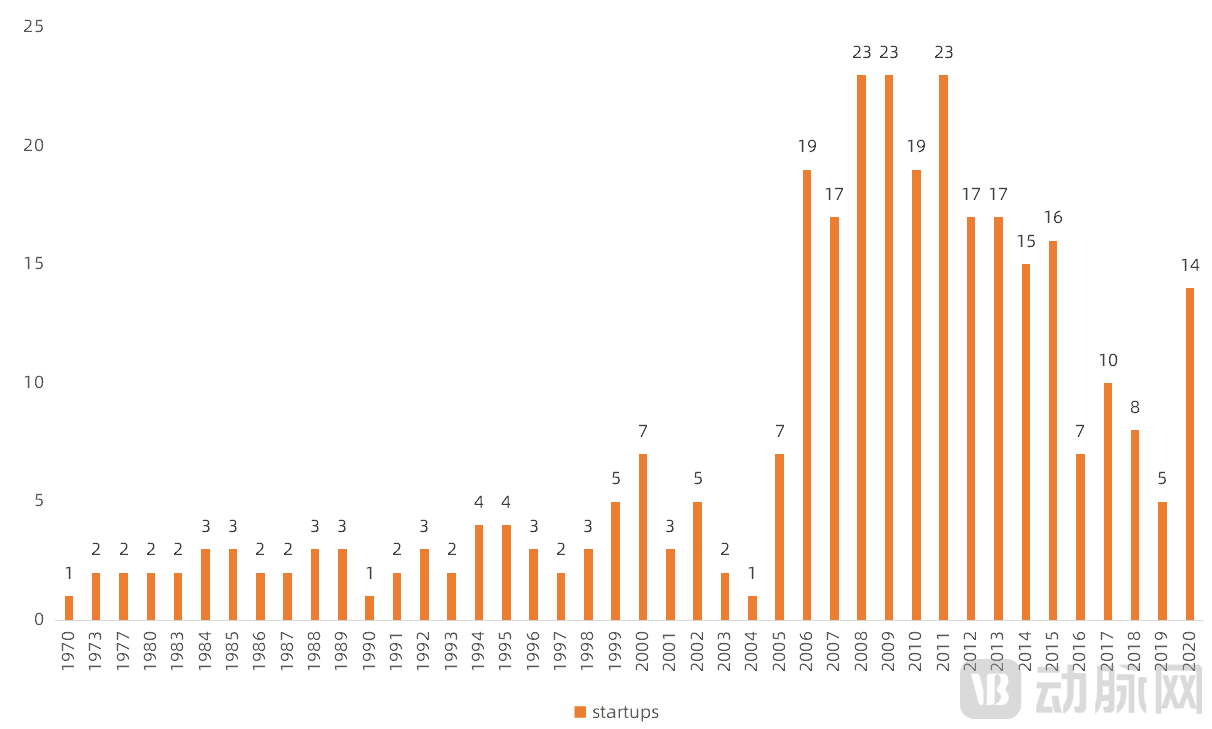
Number of Spin-off Companies Generated by the University of Utah Over the Years
Since the start of the 21st century, the University of Utah has further accelerated its pace in research commercialization. By 2006, the number of spin-off companies from the University of Utah had reached 100, marking the onset of a second wave of technology transfer at the institution. In 2006 alone, 19 start-ups were spun off from the university, and over the following decade, the university maintained an average annual creation rate of approximately 20 start-ups.As of 2020, the University of Utah had spawned more than 300 startups.
In 2019, the University of Utah conducted a survey on technology venture creation (TVC), targeting all 7,000 faculty members and other stakeholders across the university. In this survey, nearly all respondents agreed that there should be a central office authorized by the university leadership to further expand technological innovation and commercialization.
Therefore, at the end of 2020, the University of Utah announced the establishment of the PIVOT Center (Partners for Innovation, Ventures, Outreach & Technology Center).The new center is built on the foundation of TVC, inheriting all its core functionalities. It serves as a hub for collaboration among industry, academia, and government entities, accelerating the translation of scientific research into practical applications through dual pathways: internal promotion and external cooperation.
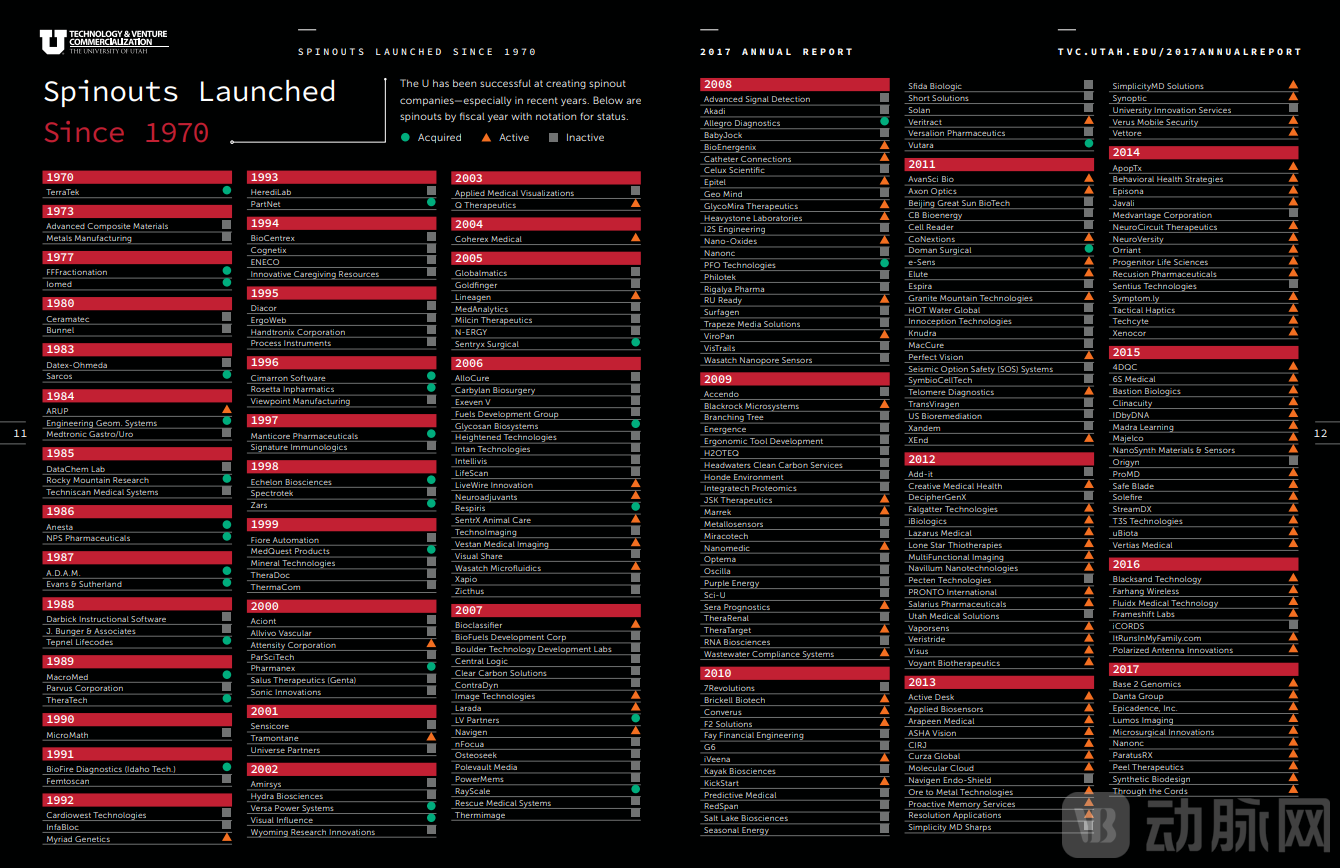
List of University of Utah Spin-offs, 1970–2017
Among the companies incubated by the University of Utah, few have emerged as overnight success stories. The most prominent in recent years is likely Recursion Pharmaceuticals, an AI-driven drug discovery company that listed on the Nasdaq in April 2021 and currently boasts a market capitalization exceeding $6 billion. Another well-known enterprise is Myriad Genetics, a pioneer in molecular diagnostics founded in 1992, which has maintained steady growth over the past three decades.
Although it lacks star enterprises, the University of Utah still demonstrates outstanding performance in research commercialization thanks to its stable conversion rate. Between 2011 and 2017, spin-off companies from the University of Utah secured over $300 million in total financing and more than $70 million in grants, while mergers and acquisitions involving these spin-offs amounted to over $5.7 billion.
Such circumstances also make the research translation model at the University of Utah more universally applicable.Scientific research translation is not limited to star projects, just likeKeith Marmer, Head of the PIVOT CenterAs often mentioned in interviews: “For us, the most important thing is the positive impact that scientific research translation brings to society as a whole.” Star projects can drive substantial industrial growth on their own, while smaller projects, if they achieve agglomeration effects, can likewise bring about a paradigm shift across the entire industry.
In the absence of significant technological advantages, the PIVOT Center employs a standardized pathway for technology transfer, ensuring that every innovation within the university has ample opportunity to flourish. This process is open not only to faculty and researchers but also to enrolled students. Any member of the university community has the opportunity to advance their creative ideas toward commercialization.
Specifically, the PIVOT Center breaks down the commercialization process of inventions into eight steps:
1. Starting with an idea:Ideas often stem from researchers’ own studies and may even have resulted in partial patents.
2. Disclosure:It takes only a few minutes for inventors to disclose their ideas on the relevant pages of the PIVOT Center’s website. Upon submission, the PIVOT Center immediately assigns professional technology managers to conduct a preliminary assessment of the submitted content and discuss the invention and its commercialization potential with the inventor.
In preparing disclosure materials, PIVOT will need to review all information related to the invention, including publicly published literature, specific records and dates of research materials, whether third-party materials or intellectual property were used in the research, and other collaborators who contributed to the invention. These factors may all relate to future intellectual property protection issues.
3. Review Process:Following an initial assessment by technology managers, a team of experts will step in to discuss and evaluate the potential behind the invention with the inventor from multiple dimensions, including development stage, market size, commercial opportunities, intellectual property protection, funding requirements, and possible commercialization pathways. They will also design subsequent work steps and compile their findings into an analysis report.
4. Intellectual Property Protection:Inventions that have entered this stage have already demonstrated commercialization potential, at which point patent protection for the inventions should be prioritized.In terms of intellectual property, the PIVOT Center chooses to collaborate with independent attorneys specializing in IP protection, rather than relying solely on its own resources.Inventors and patent attorneys will actively collaborate to seek intellectual property protection for inventions. Many independent attorneys have technical backgrounds, enabling them to better understand the value behind an invention and identify key aspects that require patent protection.
5. Commercialization of the Invention:PIVOT Center works with inventors to advance the commercialization of their inventions. This process may involve launching a startup or directly licensing the technology to companies with established commercialization capabilities. PIVOT collaborates with inventors to evaluate various options until the optimal commercialization strategy is identified.
6. Licensing:Once the commercialization pathway has been determined, the PIVOT Center will engage in discussions on licensing with commercial entities, adhering to the principle of fairness. As mentioned above, the licensee may be an established commercial enterprise or a startup specifically founded to capitalize on the invention. In the case of a startup, the role played by the inventor within the company may vary depending on specific circumstances, including the company’s business plan, management team, and external investors.
While employed by the company, inventors may continue to hold their positions at the university. In the event of a conflict of interest between the two parties, the University of Utah has a dedicated “Office of Conflict of Interest” to address such issues.
7. Provision of Products and Services:Following the execution of the license, the PIVOT Center will maintain communication with the licensee to continuously optimize the commercial value of the products/services.
8. Profit Distribution:The PIVOT Center will allocate revenues in accordance with the University of Utah’s policies. Where possible, a portion of the income will also be used to further advance the future commercialization of other university inventions.
This comprehensive technology transfer process stems from TVC’s prior explorations, further refined by the PIVOT Center.Throughout the entire commercialization process, the PIVOT Center was involved every step of the way, seeking external assistance at key stages. This nearly “concierge-level” translation process is primarily necessary because inventors often have expertise only within their specific professional domains, while lacking clarity on the pathway to transform a technology into a final product; they may also not have an entirely accurate grasp of the commercial potential of their own technologies. Therefore, to improve the success rate of scientific and technological translation, only such a “concierge-level” process can ensure that no oversights occur during the translation from research to market.
As can be seen from the above process, the PIVOT Center has established a highly refined workflow for translating scientific research into practical applications. However,They seem to believe that providing “nanny-level” support solely during the research commercialization process is insufficient. To further improve the survival rate of spin-off companies, comprehensive services must continue to be provided during the early stages of corporate development. This is precisely the objective of the Startup 360 program promoted by the PIVOT Center.
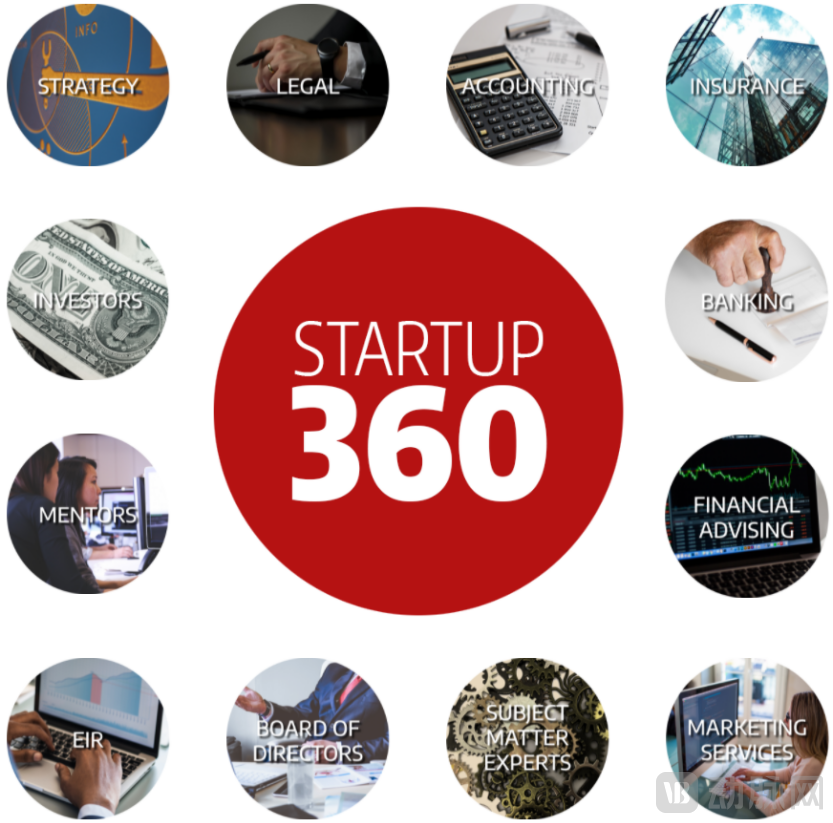
Startup 360
“We had this idea three and a half years ago. We are no longer concerned with how many startups we launch in a year; instead, we focus on how many ‘high-quality’ startups we can incubate. We care about how many enterprises truly create social value and generate positive impact. The completion of patent licensing is merely the beginning of the entire project. Therefore, we believe it is essential to provide 360-degree entrepreneurial support to these companies, which was our original intention in undertaking this initiative,” Keith Marmer mentioned in an interview.
According to Keith Marmer, the two most critical factors for a startup’s success are capabilities and resources. Accordingly, the suite of services offered by the Startup 360 program is structured around these two dimensions.
In terms of capability building, Startup 360 primarily enhances entrepreneurs’ capabilities through three distinct programs: Resident Mentors, Resident Entrepreneurs, and Resident Managers.The PIVOT Center’s official website indicates that it currently hosts two resident mentors, four resident entrepreneurs, and three resident managers. These three distinct roles are designed to help inventors rapidly transition into the mindset of entrepreneurs.
In terms of resources, the PIVOT Center has pooled its accumulated assets into a resource pool and injected them into the Startup 360 program.These resources are almost entirely provided by external partners. Startup 360 can connect entrepreneurial teams with corresponding services in corporate strategy, financing, finance, legal affairs, financial instruments, and even corporate insurance.
Startup 360 is an extension of the PIVOT Center’s initiatives toward backend startups. On the frontend, the PIVOT Center is also gradually extending its reach to the origins of research, aiming to engage earlier in key areas.
For innovative projects in the field of novel therapies, the PIVOT Center offers a dedicated accelerator—the University of Utah Therapeutics Acceleration Hub (U2TAH).Unlike Startup 360, U2TAH focuses on earlier stages.U2TAH will identify promising therapeutic candidates within the university and intervene rapidly. It will first assist researchers in designing development roadmaps for each technology; then secure internal and external resources to advance products toward clinical application; and ultimately seek licensing or partnership opportunities for high-value assets.
The operational logic of U2TAH corroborates what Keith Marmer mentioned in an interview: to “trace backward” all the way to the source laboratory, considering the potential for future outcomes from the very beginning. This may well represent the future direction of scientific research translation—focusing on translational outcomes at the source, thereby enabling research findings to realize their value more rapidly.
Guided by this philosophy, the PIVOT Center has established a series of specialized accelerators.In addition to U2TAH, there are also Altitude Lab, the Orthopedic Innovation Center Accelerator, and Summit Venture Studio.In addition to intervening at an earlier stage, these accelerators share another commonality: their respective fields—medicine, pharmacy, and computer science—are all traditional strengths of the University of Utah. Currently, nearly all the startups featured on the PIVOT Center’s official website operate within these domains.
In summary, the key factors contributing to the University of Utah’s success in research translation over the past five decades can be primarily attributed to the following four points:
1. Start early and accumulate experience;
2. Deeply engage in every stage of scientific research translation, providing “concierge-level” support;
3. Integrate external resources and build a resource network;
4. Focus on priority breakthroughs in disciplines of strength;
This entire framework holds significant reference value for China’s scientific research translation endeavors. Currently, the domestic landscape for translating scientific research into practical applications remains immature. Adopting a broad-brush approach that treats all research outcomes uniformly not only results in low success rates but also risks causing high-quality projects to fail prematurely due to insufficient foundational investment, before their value can be fully realized.
In contrast, ifIt may be more suitable for the current stage of China’s scientific and technological achievement commercialization that universities and research institutes first make preliminary assessments of the commercial viability of their research outcomes, then concentrate on achieving breakthroughs in several key priority projects by integrating external resources, thereby accumulating experience and continuously refining their technology transfer processes.