

ASC Therapeutics Submits IND for ASC-618, a Next-Gen Gene Therapy Reducing AAV Dose by 90% Through Enhanced Protein Secretion for Hemophilia A

ASC Therapeutics
Gene Therapy Product Developer
At 10:00 a.m. Eastern Time on July 7, 2021, gene therapy biotechnology company ASC Therapeutics announced that its gene therapy drug ASC-618 had received clearance for its Investigational New Drug (IND) application from the U.S. FDA, officially initiating clinical trials in the United States and becomingThe First Chinese-Founded Company in the Gene Therapy Field to Receive FDA IND Approval. It is reported that the ASC-618 pipeline primarily targets adult patients with hemophilia A, offering hope for a cure through exogenous clotting factor replacement therapy.
ASC Therapeutics, founded in 2008 and headquartered in the San Francisco Bay Area of California, has strategic operations in both the United States and China. The company possesses unique allogeneic cell therapy and precise gene modification technologies, establishing its international leadership in cell therapy, precision gene editing, and gene therapy. Furthermore, it is the first high-tech enterprise to hold exclusive global and Chinese patent licenses for gene editing therapies, gene therapies, and cell therapy technologies.
Since its establishment in 2008, ASC Therapeutics has secured tens of millions of US dollars in Series A and Series B financing from several internationally renowned biotechnology venture capital firms during its development, and was twice named by Nature Biotechnology in April 2014 and September 2016 as “Top 10 Global Companies Leading in Precision Gene Editing Application Technologies”。
VCBeat (WeChat ID: vcbeat) conducted an exclusive interview with Dr. Jiang Ruhong, Founder and CEO of ASC Therapeutics, providing an in-depth analysis of the company’s gene therapy pipeline and elucidating how its unique “high-secretion” gene therapy strategy addresses the key limitations of traditional gene therapies constrained by AAV viral vectors.
Dr. Jiang Ruhong graduated from the Department of Biology at Fudan University in 1986, obtained his Master’s degree from Beijing Agricultural University (now China Agricultural University) in 1991, and earned his Ph.D. from Oklahoma State University in the United States in 1997. After graduation, he pursued further studies at Baylor College of Medicine in Texas, where he completed his postdoctoral fellowship in the renowned laboratory of Dr. Douglas Burrin. During this period, he published more than 40 academic papers covering various fields, including human genetics, pharmacogenomics, and animal disease models.
Notably, the research team led by Dr. Jiang Ruhong previously developed Familion, the first personalized medicine diagnostic testing technology in the U.S. market.TM, the technology generated over $12 million in market profits in 2007. Meanwhile, before founding ASC Therapeutics, Dr. Jiang held key technical and managerial positions at several U.S. biotechnology and pharmaceutical companies. He previously served as General Manager of MicuRx Pharmaceuticals, Inc. in China, with full responsibility for its operations in the country.
After years of dedicated cultivation and accumulated expertise, ASC Therapeutics spent over seven years following its establishment to build an advanced genome editing platform—TARGATTTM、TARGATTTM- Alt and CRISPR technology platforms. TARGATT is a large-fragment gene insertion technology, while CRISPR/Cas9 is a renowned gene knockout tool. The complementary “addition and subtraction” approach can theoretically support ASC Therapeutics in performing the majority of gene editing operations. The company leverages its unique allogeneic cell therapy and revolutionary second-generation gene therapy to treat difficult-to-treat rare diseases.
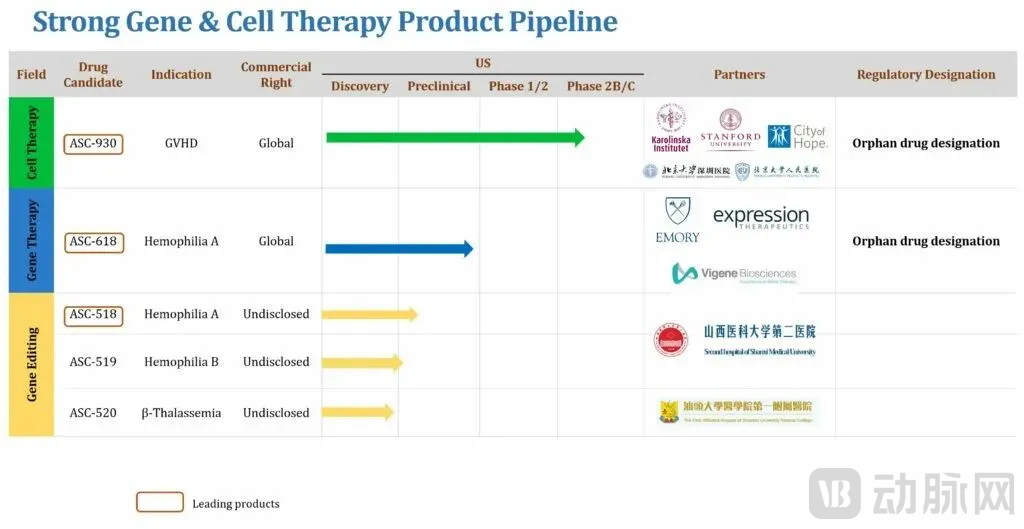
In 2015, after completing the establishment of the aforementioned technology platform, ASC Therapeutics began searching for suitable gene therapy products. The company initially focused on allogeneic cell therapy. ASC Therapeutics developed allogeneic decidual stromal cells (DSCs) and established the ASC-930 pipeline for the treatment of steroid-refractory acute graft-versus-host disease (SR-aGvHD).
Currently, this pipeline has also become ASC Therapeutics’ most advanced pipeline, with the company conducting Phase II clinical trials of the therapy in the United States. Dr. Jiang Ruhong also stated that the rapid progress of ASC-930 has accelerated the validation of ASC Therapeutics’ platform portfolio.
From gene therapy in its broadest sense to the more challenging, narrowly defined form, this is the logic behind ASC Therapeutics’ tiered pipeline strategy. Narrowly defined gene therapy specifically refers to a therapeutic approach that involves delivering normal exogenous genes into cells via vectors such as recombinant adeno-associated virus (AAV) or lipid nanoparticles for direct replacement or supplementation. ASC Therapeutics further categorizes this type of gene therapy into basicGene Replacement Therapyand more challengingGene Editing Therapy。
Gene Replacement TherapyThis approach involves introducing therapeutic genes into cells, where the gene fragments do not integrate into the host cell’s DNA but instead remain as independent episomes outside the chromosomes. By leveraging the cell’s own transcription and translation machinery, these episomal genes produce the target protein to treat the disease. This is also the mechanism of action of ASC-618, an innovative drug developed by ASC Therapeutics that has recently received Investigational New Drug (IND) approval in the United States. ASC-618 primarily targets hemophilia A in adults, with the liver serving as the target organ. Since adult hepatocytes rarely divide, this ensures the stability of adeno-associated virus (AAV)-mediated transduction after entry into the cells.
However, this therapeutic strategy appears to be ineffective against rapidly dividing pediatric hepatocytes, so ASC Therapeutics has adopted a second, more challenging “Gene Editing Therapy"to treat pediatric hemophilia. The distinction of gene-editing therapy lies in the fact that, after the therapeutic gene is delivered into cells, the gene fragment integrates directly into the cellular DNA, where it is permanently retained and remains functional through cell division. This constitutes the mechanism of action of ASC-518, ASC Therapeutics’ third core pipeline candidate, for the treatment of pediatric and patients of all ages with hemophilia A."
Meanwhile, ASC Therapeutics has become the first company globally to adopt this next-generation gene-editing therapy for the treatment of hemophilia A, effectively addressing the critical challenge of diminished therapeutic efficacy in pediatric hemophilia A patients due to the loss of AAV viral vectors during cell division. ASC Therapeutics expects to advance ASC-518 into clinical trials in the second quarter of 2022.
In the treatment of genetic diseases using gene editing, ASC Therapeutics holds a significant advantage with its proprietary “high-secretion” protein optimization strategy, which achieves therapeutic efficacy equivalent to conventional AAV vector therapies using only one-tenth of the viral load.
Dr. Jiang Ruhong explained to VCBeat that there are approximately three approaches to optimizing gene therapy:
1. Improve the transfection efficiency of viral vectors;
2. Construct improved genes to achieve higher expression levels;
3. The expressed protein is more extensively secreted from the cells.
In layman’s terms, the therapeutic gene delivered by AAV is ultimately an exogenous substance to the host organism. Its transcription and translation within cells are subject to comprehensive interference from various factors. Key determinants of gene therapy efficacy include the transduction efficiency of AAV vectors into target cells, the level of therapeutic gene expression within cells, the proper folding of the expressed protein from its secondary to tertiary structure, and its successful secretion outside the cell after post-translational modifications such as methylation, thereby enabling it to exert its therapeutic effect.
ASC Therapeutics introduced specialized genetic modifications during gene construction, andunfold protein response(UPR)A series of optimizations have been implemented, significantly enhancing the secretion efficiency of intracellular therapeutic proteins during gene therapy, enablingAchieves equivalent therapeutic protein secretion levels at only 1/10 the dose of traditional AAV vectors., delivering equivalent efficacy while significantly reducing hepatotoxic side effects associated with gene therapy. Its safety and high efficiency will serve as a strong competitive advantage for ASC Therapeutics’ future portfolio of gene therapy products upon their market launch.
Currently, ASC Therapeutics is planning to establish a globally leading GMP manufacturing base and clinical trial center for gene editing and cell therapy in China. By integrating technological advantages from the United States and effectively leveraging its successful experience in the development, registration, and approval of cell and gene therapy products in the U.S., the company aims to facilitate the clinical trials and regulatory approval of these products in China. Meanwhile, the company has launched its Series C financing round, aiming to raise $100 million, primarily to accelerate the advancement of its two gene therapy pipelines, ASC-618 and ASC-518, into clinical research stages.