

UCI Mind Symposium: Advancing Frontiers in Alzheimer's Research and Therapy
On June 26, the UCI Institute for Memory Impairments and Neurological Disorders (UCI Mind) and the University of California, Irvine Chinese Alumni Association (UCICAA) jointly hosted an online thematic session on “Latest Research and Treatment Approaches for Alzheimer’s Disease.”
The conference was moderated by Ms. Qingli Zhou, CEO of the U.S.-based project accelerator EcoKMC, and Dr. Hye-Won Shin, Chief Scientific Officer of Chiron Total, a medical project marketing and research institution at UCI. Dr. Joshua Grill, Director of the UCI Mind Institute, delivered the keynote address, with assistance in interpretation provided by Ms. Ruobing Li, Geriatrics and Patient Care Coordinator at UCI MIND.
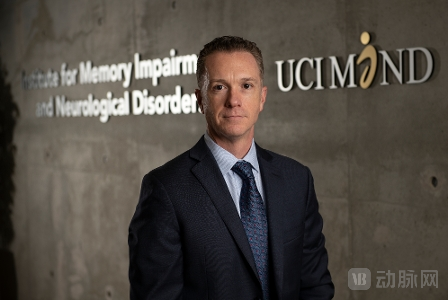
Director of the UCI Mind Institute – Dr. Joshua Grill
According to WHO data, the prevalence of Alzheimer’s disease among the global population aged 65 and older is 4–7%. There are at least 50 million people living with dementia worldwide, 60–70% of whom have Alzheimer’s disease.
In China, the prevalence of Alzheimer’s disease among individuals aged 65 and older is 5.56%, with approximately 10 million patients, ranking first worldwide. Amid rapid population aging, the challenges of addressing and treating Alzheimer’s disease are becoming increasingly severe.
The University of California, Irvine Institute for Memory Impairments and Neurological Disorders (UCI MIND) is a non-profit research organization and one of the 32 Alzheimer’s Disease Research Centers designated by the National Institutes of Health (NIH). Its research team comprises more than 100 scientists from over 20 different academic departments across UCI, conducting multiple cutting-edge studies on Alzheimer’s disease.
To actively promote awareness, treatment, prevention, diagnosis, and care of Alzheimer’s disease and related dementias, Dr. Grill delivered an insightful presentation on the risk factors, preventive strategies, and research advances in Alzheimer’s disease.
Dr. Grill stated that genes and heredity are major contributing factors to Alzheimer’s disease. Although current research has identified more than 30 disease-causing genes, this is still insufficient for predicting Alzheimer’s disease through genetic testing.
In addition, environmental factors and lifestyle habits also have a significant impact on Alzheimer’s disease. Therefore, Dr. Grill advocates for regular exercise, a healthy diet, improved sleep quality, and mental engagement, all of which are highly beneficial to cardiovascular and brain health and can slow the progression of dementia.
However, there are cases where individuals still develop Alzheimer’s disease despite adhering to all the aforementioned recommendations. Therefore, Dr. Grill believes that early diagnosis of Alzheimer’s disease is crucial. Given the prolonged course and substantial burden of Alzheimer’s disease, an early diagnosis enables patients to actively participate in interventional training while they still retain decision-making capacity, thereby slowing disease progression.
After nearly 19 years, the U.S. FDA has approved its first new drug for Alzheimer’s disease, Aduhelm (Aducanumab), sparking global debate; some patients have already received their first dose of the newly approved medication.
Regarding the approval of this new drug, Dr. Grill stated that there are currently only five drugs available on the market for Alzheimer’s disease, and these medications can only alleviate symptoms in patients without influencing the progression of the disease.
On June 7, the FDA-approved Aduhelm, a monoclonal antibody administered via intravenous infusion, binds to amyloid deposits in the patient’s brain, thereby activating the immune system to clear these protein accumulations.
New Alzheimer’s Drug Approved: Exciting Yet ControversialThe controversy stems from the results of two Phase III clinical trials for the drug: one demonstrated significant efficacy, while the other showed only marginal benefits. Despite failing to gain support from the FDA’s advisory committee, the drug still received FDA marketing approval. With an astonishing annual price tag of $56,000, the decision prompted several advisory committee members to resign in protest.
Dr. Grill lamented, “Although the approval of the new drug has been highly controversial, it remains a significant milestone. We are well aware that we still have a long way to go in Alzheimer’s disease research.”
As a leading research institution in Alzheimer’s disease, UCI Mind received more than $40 million in NIH funding in 2020. What specific work has UCI Mind carried out?
Dr. Grill stated, “UCI Mind conducts numerous diverse studies, but our greatest pride lies in a long-term longitudinal study. Each year, we invite volunteers to undergo assessments of neurological function, memory, psychological status, and cognition to monitor annual changes; some participants have been followed for over two decades. Furthermore, we encourage these volunteers to pledge brain donation, enabling us to correlate postmortem brain biomarkers with the data collected during their long-term follow-up.”
“Our research targets the early stages of the disease, focusing on individuals aged 55 and older who do not exhibit symptoms of dementia. Brain imaging in this population may reveal amyloid deposition, indicating an increased risk of developing Alzheimer’s disease. Early intervention to clear amyloid deposits in these individuals holds significant potential for effectively preventing the disease.”
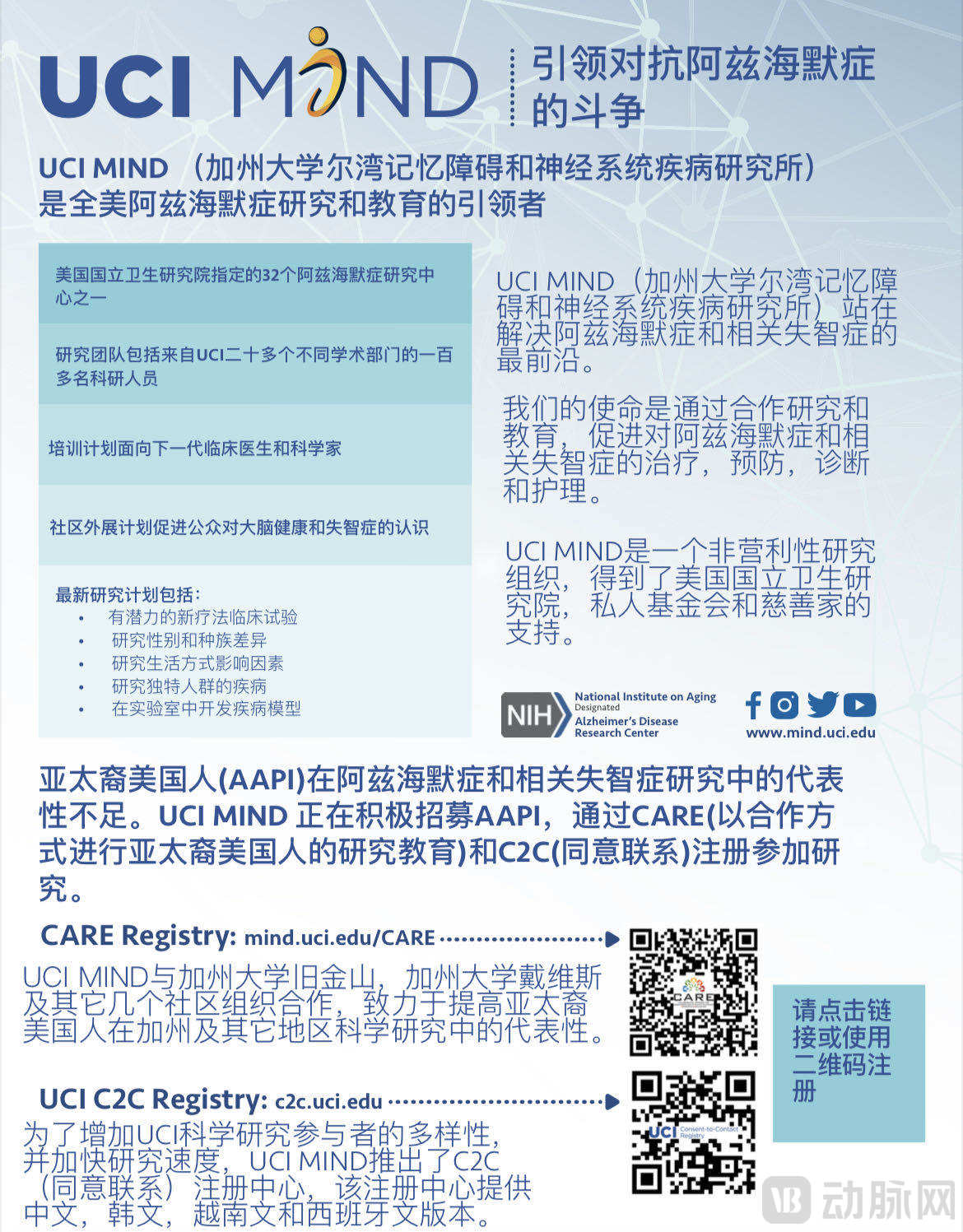
Introduction to UCI Mind and Volunteer Registration Portal
Dr. Grill stated that the current primary participants in this study are concentrated among highly educated White individuals, with Asian American volunteers accounting for less than 3%. The research project is significantly lacking in volunteer support from diverse cultural and ethnic backgrounds.
To enhance the diversity of participants in UCI’s scientific research and accelerate the pace of discovery, UCI Mind has specifically launched the C2C Registry and established the Care Registry in collaboration with several community organizations, including the University of California, Davis.
Dr. Grill calls on volunteers aged 55 and above (including but not limited to this group) to actively enroll in two research registries, learn about the research projects, undergo simple tests, and then determine their eligibility for participation, thereby contributing to the early conquest of Alzheimer’s disease.