Sina Medicine and CCID Consulting Release the '2021 Top 100 Biopharmaceutical Industry Parks Ranking'
Text | Wang Ning
2021 marked the inaugural year of China’s 14th Five-Year Plan. The CCID Consulting Pharmaceutical and Health Industry Research Center, in collaboration with Sina Medicine, conducted an in-depth analysis of central and local biomedical industry policies based on the current development status of biomedical industrial parks. By assessing future trends in the biomedical sector, they released the “Top 100 Biomedical Industrial Parks List (2021)” under the theme “Riding the Waves of the 14th Five-Year Plan: Embarking on a New Journey,” aiming to provide intellectual support for decision-making by biomedical park administrators and reference for the industry.
The 14th Five-Year Plan period represents a significant historical window for China’s high-quality economic and social development. This ranking comprehensively optimizes the original “Three Powers” model, guided by the five new development concepts of “innovation, coordination, greenness, openness, and sharing.” It reconstructs an evaluation framework comprising eight dimensions and sixteen indicators to assess the development level of the biopharmaceutical industry across 386 national-level industrial parks in China (including 168 National High-Tech Industrial Development Zones and 218 National Economic and Technological Development Zones; notably, Suzhou Industrial Park is classified as a National Economic and Technological Development Zone for the purposes of this report, despite its dual status).
Table: "Eight-Dimensional" Assessment Model
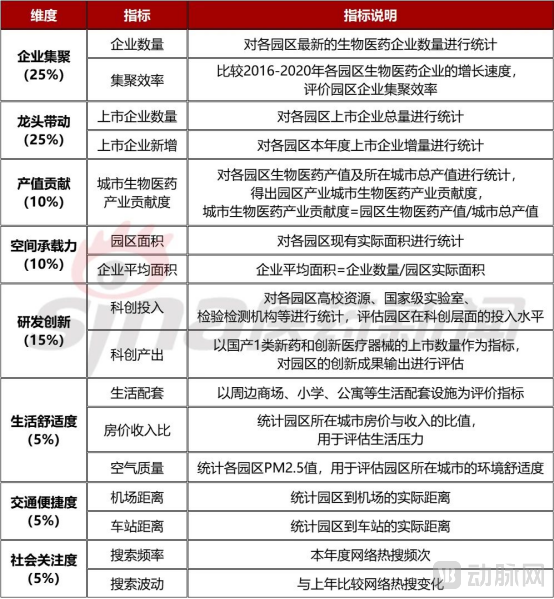
Data source: CCID Consulting, July 2021
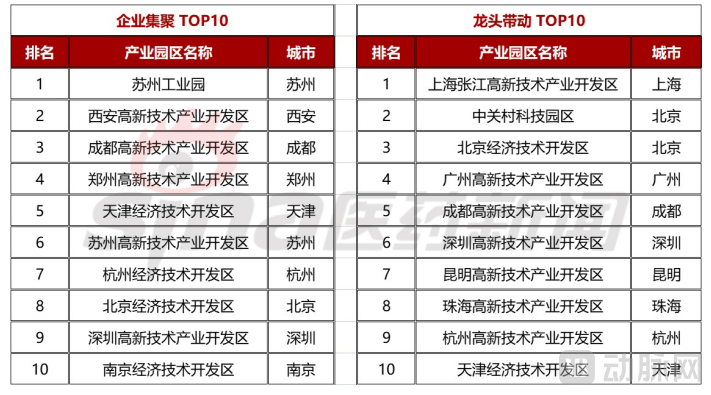
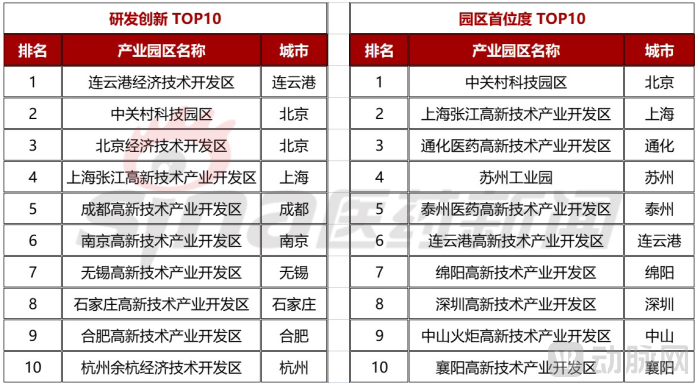
“Top 100 Biopharmaceutical Industrial Parks in 2021” adopts a “1+8” ranking system, comprising one main list and eight sub-lists (see the appendix for details). The main list conducts a comprehensive assessment of the development level of the biopharmaceutical industry in all national-level industrial parks, selecting the top 100 national-level parks with the strongest overall competitiveness in biopharmaceutical industry development in 2021. The sub-lists rank the top ten parks respectively across eight dimensions: enterprise agglomeration, leadership by leading enterprises, output value contribution, spatial carrying capacity, R&D innovation, livability, transportation convenience, and public attention.
Overall, the regional distribution of the Top 100 industrial parks remains uneven, although the situation has improved compared to 2020.In 2021, the uneven regional distribution of China’s top 100 biomedical industrial parks remained prominent, with 56 parks located in the eastern region, 18 in the central region, 17 in the western region, and 9 in the northeastern region. Compared with 2020, the imbalance in the number of parks across regions has been somewhat alleviated. The number of top 100 parks in the eastern region decreased by 4 from 2020, with its share dropping from 60% to 56%; the central region saw an increase of 1 park, raising its share from 17% to 18%; the western region added 2 parks, increasing its share from 15% to 17%; and the northeastern region gained 1 park, lifting its share from 8% to 9%.
In terms of enterprise agglomeration, the industrial park rankings reveal that those with higher standings exhibit a more balanced industrial chain structure.The number of downstream enterprises clustered in biopharmaceutical industrial parks is significantly higher than that of midstream and upstream enterprises. The industrial chain structure of top-ranked biopharmaceutical industrial parks is more balanced, while those ranked lower have considerable room for improvement in their industrial chain segments.From the perspective of the sectors in which companies operate, industrial parks show greater enthusiasm for pharmaceutical companies than for medical device companies.Among the top 100 industrial parks, 32 exhibit a relatively balanced agglomeration of pharmaceutical and medical device companies; as many as 64 parks show a preference for clustering pharmaceutical companies, while only four favor medical device enterprises.
In terms of leading industry drivers, top-tier industrial parks have demonstrated a significant clustering effect for listed companies, with nearly half of all listed medical device and biopharmaceutical enterprises concentrated within the top 100 industrial parks.Overall, the number of listed biopharmaceutical companies distributed across industrial parks decreases as the park rankings decline. The top 20 parks account for 61.27% of all listed companies among the top 100 parks. In terms of industry sectors, listed companies clustered in the top 100 parks are primarily concentrated in the medical device and chemical pharmaceutical fields, representing 33.10% and 27.46%, respectively. Notably, nearly half of the listed companies in the medical device and biopharmaceutical sectors are clustered within the top 100 parks.
In the dimension of R&D innovation, the monopoly position of traditional leading industrial parks over innovative achievements is gradually being broken.In 2020, the National Medical Products Administration (NMPA) approved a total of 18 domestically produced Class 1 new drugs, 15 of which originated from ten industrial parks, including the Lianyungang Economic and Technological Development Zone, Zhongguancun Science Park, and the Beijing Economic-Technological Development Area. In the same year, the NMPA approved 23 domestically produced innovative medical devices, with 18 of them emerging from twelve industrial parks, such as the Shenzhen High-Tech Industrial Development Zone and the Shanghai Zhangjiang Hi-Tech Park. Compared with 2019, a greater number of biopharmaceutical industrial parks were involved in the launch of domestically produced Class 1 new drugs and innovative medical devices in 2020.
In terms of park contributions, the contribution of the biopharmaceutical industry in cities with traditionally advantageous parks is gradually being overtaken.Cities with traditional leading biopharmaceutical parks generally exhibit a high contribution from the biopharmaceutical industry, while cities with emerging parks show a significant upward trend in industrial contribution and are gradually catching up with their traditional counterparts. On one hand, this reflects the increasing emphasis local governments place on the biopharmaceutical sector, which has become a key driver of high-quality local economic development. On the other hand, it underscores the intensifying competition among regions for high-quality industrial resources and factors.
In terms of spatial carrying capacity, new-generation industrial parks exhibit strong spatial carrying capabilities but have significant disadvantages.The average land area of the top 100 industrial parks is 156 square kilometers, with an average of 301 enterprises per park. There is a significant disparity in spatial carrying capacity between traditional leading parks and emerging parks. On one hand, traditional leading parks that have spearheaded the development of China’s biopharmaceutical industry—such as Zhongguancun Science Park, Shanghai Zhangjiang Hi-Tech Park, and Suzhou Industrial Park—are generally facing insufficient existing spatial carrying capacity. On the other hand, many emerging parks, despite their large planned areas, fail to effectively attract enterprises due to imprecise positioning, inadequate location-based supporting facilities, low industry recognition, weak brand influence, and limited policy-making capabilities, resulting in substantial vacant space.
In terms of transportation convenience, next-generation industrial parks offer superior accessibility, promising a bright future.The average distance from each biopharmaceutical park to the airport is 39.8 kilometers, and to the railway station is 25.1 kilometers. Due to their later planning stages, new-generation biopharmaceutical industrial parks have given more comprehensive consideration to location and transportation, resulting in greater convenience. Although location and transportation are not decisive factors in a park’s competitive strength, and their impact on overall competitiveness is far less significant than that of R&D innovation, enterprise clustering, and leadership by key enterprises, convenient transportation directly facilitates the coordinated interaction of industrial factors across regions.
Living Environment Dimension: The new-generation industrial park is located in an urban area with a high level of livability.Regarding the housing price-to-income ratio, an excessively high ratio can lead to the outflow of highly skilled labor. The prohibitively high housing prices in industrial parks within economically developed regions have created opportunities for highly skilled talent to relocate to emerging-generation parks with relatively lower living pressures. In terms of air quality, among the top 100 industrial parks, 41 were rated as "Excellent," with an Air Quality Index (AQI) of 50 or below (a higher AQI indicates poorer environmental quality). In recent years, domestic environmental governance has yielded positive results, and the overall air quality in these industrial parks remains good.
From a societal perspective, high-tech industrial development zones in central and western China bear greater expectations for the growth of the biopharmaceutical industry.In terms of geographic distribution, among the top 10 biomedical industrial parks with the highest social attention, Xi’an High-Tech Industrial Development Zone ranked first. Other parks, including Chengdu High-Tech Industrial Development Zone, Zhengzhou High-Tech Industrial Development Zone, Changsha High-Tech Industrial Development Zone, Hefei High-Tech Industrial Development Zone, and Chongqing High-Tech Industrial Development Zone, also made the list, demonstrating the robust rise of high-tech industrial development zones in central and western China.
Biopharmaceutical Industrial Parks Will Achieve “Four Accelerations” During the 14th Five-Year Plan PeriodAgainst the backdrop of high-quality development during the 14th Five-Year Plan period, the growth of biopharmaceutical industrial parks will be driven by four key forces: high-standard planning and construction, high-position industrial clusters, high-efficiency technological innovation, and highly collaborative service environments. These parks will accelerate their development toward specialization with distinctive features, digitalization and intelligence, green and environmentally friendly practices, and multi-dimensional integration encompassing industry convergence, industry-city integration, and regional integration.
The development pattern of China’s biopharmaceutical industry is transitioning from a “tripartite balance” to a structure characterized by “seven clusters and three belts.” Traditionally, the country’s leading biopharmaceutical industrial parks have been concentrated in the Beijing-Tianjin-Hebei region, the Yangtze River Delta, and the Pearl River Delta, forming a tripartite landscape. However, as issues such as diminishing spatial capacity and rising production and living costs in these established hubs become increasingly prominent, there is a marked trend of corporate spillover. Meanwhile, emerging industrial parks surrounding these traditional strongholds, which started developing later, offer substantial spatial capacity and lower production and living costs, giving them significant advantages in undertaking industrial transfer. In terms of regional transfer trends, the biopharmaceutical industry is shifting from east to west, gradually forming three major urban belts across different spatial dimensions: the Frontier Energy-Releasing Urban Belt, the Transfer-Accepting Urban Belt, and the Distinctive Rise Urban Belt. Consequently, the original “tripartite balance” is evolving into seven major urban agglomerations that lead the development of the biopharmaceutical industry: the Beijing-Tianjin-Hebei Urban Agglomeration, the Yangtze River Delta Urban Agglomeration, the Pearl River Delta Urban Agglomeration, the Middle Reaches of the Yangtze River Urban Agglomeration, the Central Plains Urban Agglomeration, the Chengdu-Chongqing Urban Agglomeration, and the Guanzhong Plain Urban Agglomeration.
Figure: Changes in the Development Landscape of China's Biopharmaceutical Industry
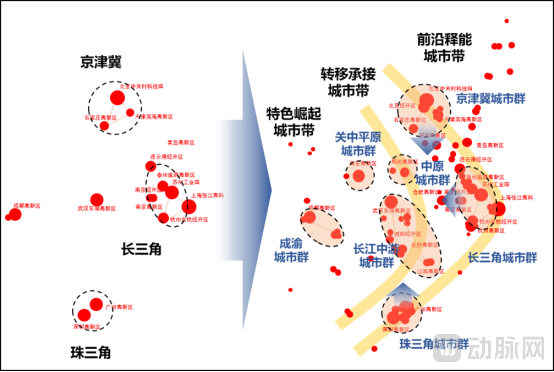
Graphic Design: CCID Consulting, July 2021
Pinpointing Strategic Positioning and Leveraging Industrial Synergy to Drive High-Quality Development in the Biopharmaceutical SectorBy leveraging industrial synergy and adopting multiple strategies—such as aligning with trends, harnessing external momentum, and creating new momentum—we can promote the high-quality development of the biopharmaceutical industry. Different regions possess distinct developmental DNA and varying industrial foundations. Therefore, each industrial park must identify its comparative advantages and establish a differentiated industrial positioning based on its unique characteristics during the development process.On one hand, it is essential to fully consider the synergistic effects between the park and surrounding industrial parks. If a park is located near traditional hubs with established advantages, has limited R&D resources, but offers ample space for industrial expansion along with lower production and living costs, it should avoid direct competition in R&D innovation with these neighboring traditional hubs. Instead, it should adopt a differentiated strategy by focusing on supporting R&D services, manufacturing, and distribution as its key development directions.On the other hand, full consideration must be given to the synergy among various internal elements within the park, maximizing the empowering potential of talent, capital, policies, and other factors. In terms of development pathways, industrial parks should adhere to the theme of “high-quality development,” guided by clear industrial positioning and driven by integration and synergy. Self-elevation should be achieved through three approaches: aligning with trends, harnessing momentum, and creating momentum. First, parks must continuously monitor industrial development opportunities, grasp changes in regional dynamics, and make forward-looking layouts that align with industry trends. Second, parks should thoroughly analyze the relationship between their key development areas and the broader biopharmaceutical industry, as well as the relationship between the park and the wider region. By integrating and analyzing internal and external resources and establishing cooperation channels both internally and externally, parks can achieve growth by leveraging external momentum. Third, parks should identify the unique characteristics of their biopharmaceutical industry development and build a distinctive brand to expand their influence by hosting high-end industry conferences, releasing reports on industrial support achievements, and organizing industry exchange events.
Main List: Top 100 Biopharmaceutical Industrial Parks in 2021
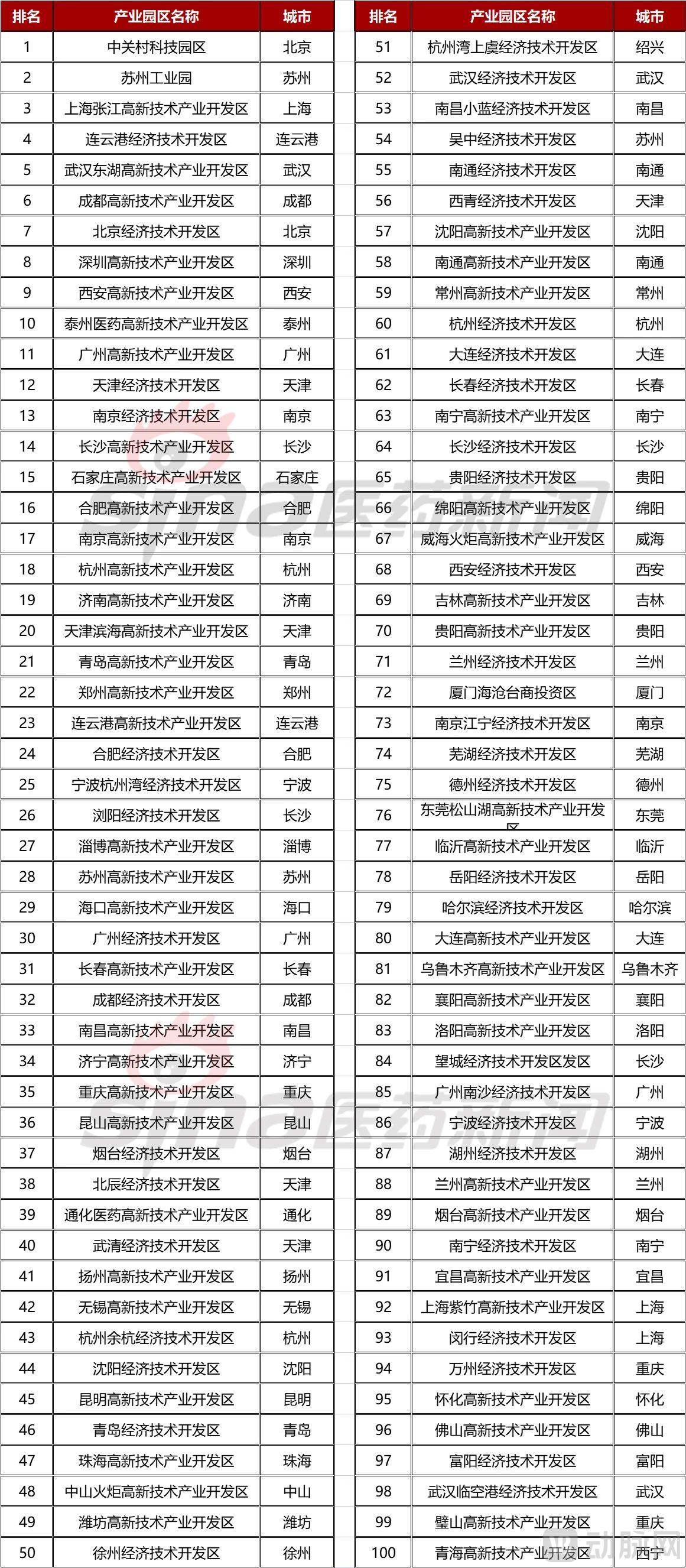
Sub-ranking
For more information, please visit the “Sina Medicine (sinayiyao)” WeChat official account and read the original article to view the full report.