

SWORD Health Secures $85 Million Series C Funding Amid 8x Revenue Surge and 93% User Satisfaction

Sword Health
Digital Remote Physical Therapy Service Provider

General Catalyst
Venture Capital Firm

BPEA
Private Equity Investment Firm

Founders Fund
Venture Capital Firm

Khosla Ventures
Venture Capital Firms

Transformational Capital
Innovative Healthcare IT and Services Company

Highmark Ventures
Venture Capital Firm

BOND
Venture Capital Firm
Musculoskeletal (MSK) diseases, a leading cause of chronic pain and disability, affect over 2 billion people globally and 50% of the U.S. population. In the United States, spending on MSK care exceeds the combined costs of cancer and mental health treatment, accounting for one-sixth of total healthcare expenditures. As the largest cost driver in healthcare, the MSK market surpasses $100 billion.
Current treatment recommendations for musculoskeletal (MSK) conditions indicate that multimodal interventions addressing the physiological, psychological, and social dimensions of pain are most effective and should be implemented prior to relying on pharmacotherapy, imaging, or surgery. However, most patients do not receive adequate care, leading to unnecessary, and even excessive, use of opioids and surgical procedures.
There is a gap between the demand for physical therapy and rapid societal development. People remain heavily reliant on one-on-one therapeutic interactions, yet this model is not scalable. For most individuals, accessing conventional physical therapy remains prohibitively expensive and largely unattainable.
How to Solve This Problem: Digital Physical Therapy Company SWORD Health Offers Its Solution.
Sword Health is a Portuguese startup offering digital remote physical therapy services. Leveraging its proprietary motion sensors, the company captures patients’ movement data and facilitates online communication with digital therapists. These therapists provide real-time feedback and guidance to help patients complete rehabilitation sessions, delivering personalized training instructions that enable patients to carry out their rehabilitation plans at home.
SWORD Health Announces Completion of $85 Million Series C FinancingRecently, SWORD Health announced the completion of an $85 million Series C financing round. The round was led by General Catalyst, with participation from BOND, Highmark Ventures, BPEA, Khosla Ventures, Founders Fund, Transformation Capital, and Green Innovations. The proceeds will be used to build a musculoskeletal (MSK) platform that leverages SWORD Health’s virtual physical therapy program to deliver significant cost savings for users.
According to Crunchbase data, SWORD Health has completed seven rounds of financing totaling $134.5 million to date.
On April 27, 2015, SWORD Health received approval from the European Commission and secured €1.3 million in funding as part of the Horizon 2020 SME Support Programme. SWORD Health was the first startup to advance to Phase 2 of this programme.
On July 1, 2015, SWORD Health received a €1.3 million grant from the European Union’s Executive Agency for Small and Medium-sized Enterprises (EASME).
On April 16, 2018, SWORD Health secured $4.6 million in seed funding, with the round led by Green Innovations, Vesalius Biocapital III, and several anonymous investors. The funds will be used to accelerate the development of new digital therapeutics and drive the company’s business growth.
On April 16, 2019, SWORD Health secured $8 million in Series A funding, led by Khosla Ventures, with other investors undisclosed. The company will use these funds to further advance clinical validation of its products, continue engineering-driven product improvements, scale its business operations, expand its footprint in North America, and bring its platform to more households.
On February 27, 2020, SWORD Health secured $9 million in Series A funding. The round was led by Khosla Ventures, with participation from Founders Fund, Green Innovations, Lachy Groom, Vesalius Biocapital, and Faber Ventures. This brings SWORD Health’s total Series A funding to $17 million.
On January 29, 2021, SWORD Health secured $25 million in Series B funding. The round was led by Todd Cozzens, Managing Partner at Transformation Capital and former healthcare investor at Sequoia Capital. Existing investors Khosla Ventures, Founders Fund, Green Innovations, Vesalius Biocapital, and Faber also participated in this investment. This round brought SWORD Health’s total fundraising to $50 million. Just six months later, SWORD Health raised $85 million in Series C funding.
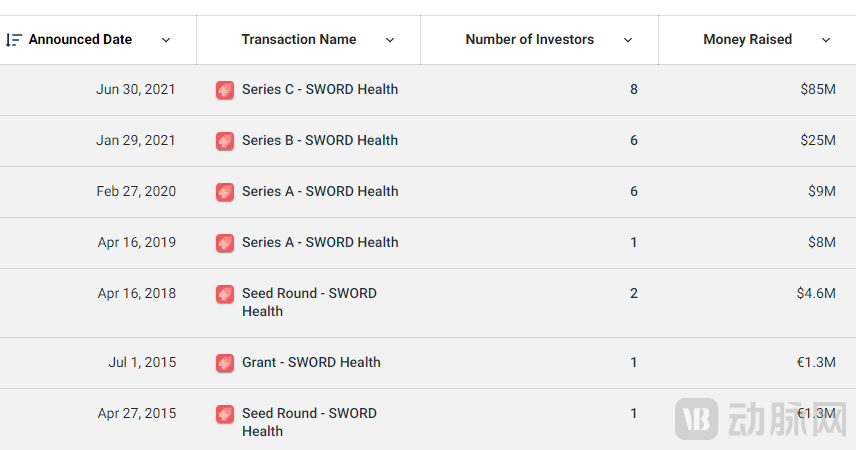
Image source: Crunchbase
SWORD Health’s consecutive funding injections were driven by its significant commercial success in 2020, during which the company’s revenue grew eightfold and its active user base increased nearly fivefold, making it one of the fastest-growing providers of virtual musculoskeletal care services. SWORD Health stated that it would leverage these funds to enhance product capabilities, expand industry partnerships, and drive adoption among users, health plans, and alliance partners within the benefits management ecosystem.
In recent years, the growing number of patients suffering from chronic pain conditions such as cancer-related pain and migraines, coupled with population aging, has been driving sustained growth in global demand for the pain management industry over the next decade. According to a research report by the UK-based market consulting firm Brisk Insights, the global market for pain management pharmaceuticals and medical devices reached $37.8 billion in 2015, with a projected compound annual growth rate (CAGR) of 4.3% from 2015 to 2022, reaching $50.8 billion by 2022.
According to incomplete statistics from the VCBeat database, there were a total of 58 financing events for companies related to digital therapeutics for pain between 2010 and June 15, 2020.
From a global perspective, investment and financing projects in digital therapeutics for pain reached a small peak in 2014. In 2017, the concept of digital health gained momentum in China, leading to an increase in funded projects. The capital market for pain-related digital therapeutics also remained relatively active in the first half of 2020.
Focusing solely on the United States, the pain management sector is currently experiencing intense competition, with a surge of diverse enterprises entering the market. From an investment perspective, digital therapeutics companies are favored by capital, with standout representatives including Hinge Health, Kaia Health, and N1-Headache. Hinge Health and Kaia Health primarily target musculoskeletal (MSK) pain, such as lower back pain and knee pain, while N1-Headache focuses mainly on migraine. Most digital therapeutics companies in pain management are relatively more focused on specific subfields of chronic pain.
SWORD Health also focuses on MSK care, but unlike Hinge and Kaia, it combines Hinge’s business model with Kaia’s home-based exercise programs to develop its product offerings and expand the scope and depth of its services.
First, SWORD Health also adopted Hinge’s B2B2C model. It introduces its products to major companies, including benefits providers, offering digital MSK solutions for their healthcare plans, and thereby reaches end users through these corporate healthcare programs.
In 2021, SWORD Health partnered with Portico Benefit Services to provide a digital therapeutic program for musculoskeletal pain as part of the organization’s ELCA Primary Health Benefits Plan.
In 2020, SWORD Health partnered with BridgeHealth, a provider of Centers of Excellence programs, to deliver in-home physical therapy (PT). Members requiring surgery can access SWORD Health’s online prehabilitation and postoperative rehabilitation support, thereby further improving surgical outcomes, reducing complications, and shortening the time needed to return to work.
Second, the SWORD Health team has researched and developed a “digital physical therapist.” Leveraging sensors with “high-precision motion tracking” combined with cutting-edge artificial intelligence technology, Sword Health aims to expand the reach of physical therapy in response to the global shortage of physical therapists. Its flagship product, Sword Phoenix, provides patients with interactive rehabilitation exercises under the supervision of remote physical therapists.
By attaching motion sensors to corresponding locations on the patient’s body and leveraging AI-driven technology, real-time movement data can be captured with immediate feedback provided, enabling physical therapists to guide treatment based on this data. With Sword Health, medical teams can extend their therapeutic reach into each patient’s home, thereby freeing up time to care for more patients.
Validated by research from SWORD Health, the platform demonstrates a 93% user satisfaction rate, a 64% reduction in users’ intent to undergo surgery, and a 34% cost savings for users. The company’s developed therapies show a 30% improvement in efficacy compared to traditional physical therapy (PT). Experimental evidence proves that SWORD Health’s home-based care therapy surpasses the current standard of care for traditional physical therapy in musculoskeletal (MSK) conditions. It is also the only solution offering rehabilitation programs for chronic, acute, and post-surgical conditions affecting the lower back, shoulders, neck, knees, elbows, hips, ankles, wrists, and lungs.
Based on the outcomes of the collaboration between SWORD Health and Danaher Health and Welfare, Amy Broghammmer, Benefits Manager at Danaher Health and Welfare, stated that SWORD Health’s solution has achieved notable results among its employees. “After 12 weeks, we observed an 80% reduction in surgical intent, a 49% reduction in pain, and a 72% increase in productivity.”
Currently, Sword Health is furthering collaborations with insurance companies, national health services, health maintenance organizations, and healthcare providers across Europe, Australia, and the United States. The company maintains offices in New York, Chicago, Salt Lake City, Sydney, and Porto.
However, it is also important to note that this niche sector already has established leaders; SWORD Health’s largest competitor, Hinge Health, previously reached a valuation of $3 billion. According to Virgílio Bento, co-founder of SWORD Health, the company’s valuation exceeds $500 million.
Nevertheless, Bento considers these to be “two entirely different practices in building healthcare companies,” noting that SWORD Health focused exclusively on developing its own sensors during its first four years. “What we aimed to do was reinvest all gross profits into building a platform that delivers greater value to patients.”