

Nanobubble Pioneers the Blue Ocean of Hydrogen Medicine with Innovative Health Solutions
For most people, “hydrogen medicine” is clearly an unfamiliar term. Although research on hydrogen medicine has been continuously conducted and papers have been published both domestically and internationally in recent years, public awareness of it remains very limited.
What Exactly Is Hydrogen Medicine? Current research indicates that the therapeutic efficacy of hydrogen gas is grounded in its ability to mitigate oxidative damage and reduce inflammation, suggesting significant potential for clinical applications. Furthermore, hydrogen has been found to exert biological effects in areas such as anti-apoptosis, anti-allergy, and the promotion of energy metabolism.
Hydrogen medicine had already taken shape by the late 20th century. However, its widespread public recognition began in 2007, when Japanese scholar Shigeo Ohta published a study in Nature Medicine demonstrating that inhalation of 2% molecular hydrogen exerted therapeutic effects against cerebral ischemia-reperfusion injury. Although this was initially an animal study, the unique ability of hydrogen to selectively neutralize reactive oxygen species opened up a new direction for medical research.
Given that hydrogen molecules demonstrate significant efficacy in disease prevention, treatment, and regulation, and act by addressing the underlying causes rather than merely alleviating symptoms during disease progression, they are particularly well-suited for daily health management. However, as an emerging field still under exploration and development, hydrogen medicine inevitably requires professional guidance for corporate growth, along with time and patience to refine products. This is precisely where Shanghai Nanobubble Technology Co., Ltd. (hereinafter referred to as “Nanobubble”) holds its competitive advantage.
It is understood that Nanobubble was established in July 2014 in Shanghai Zhangjiang Pharma Valley. As a high-tech enterprise focused on the translational biomedical applications of hydrogen molecules using nanobubble technology, it has secured dozens of core (invention) patents. Its technologies are at an internationally advanced level, and the company has earned a strong reputation in the field of hydrogen medicine both domestically and abroad. In this interview, VCBeat speaks with Mu Hualun, founder of Nanobubble, to gain insights into the company’s development and strategic layout in the emerging field of hydrogen medicine.
The Journey Continues: Innovators in the New Hydrogen Medicine Arena
Based on past experience, it seems difficult to associate Mu Hualun, a former executive at a telecommunications company, with the healthcare industry.
This cross-industry transition from the telecommunications sector to the medical and health industry stems from Mu Hualun’s judgment on market trends. Over the past few decades, the telecommunications industry experienced rapid growth fueled by demographic dividends driven by continuous population increase. Throughout this process, Mu Hualun, as a practitioner in the telecommunications industry, personally witnessed the power of these trends.
As the aging of China’s population continues to deepen, what demand does this trend bring? The answer is health. To identify a niche segment within the health industry for market entry, Mu Hualun led his team in a three-year industry review and conducted field research in Japan, which ranks among the top countries globally in addressing aging-related challenges, thereby gaining exposure to the emerging field of hydrogen medicine.
During his continuous study of hydrogen medicine, Mu Hualun also came into contact with Professor Sun Xuejun (Professor and Doctoral Supervisor at Naval Medical University), a key advocate and promoter of the development of China’s hydrogen medicine industry. In 2014, with the completion of the prototype development, Mu Hualun officially embarked on his entrepreneurial journey in the broader health and wellness sector. He named the company “Nanuobabo,” a transliteration of the term “nanobubble,” which reflects a core technology underlying Nanuobabo’s product research and development: the integration of water and hydrogen gas through nanobubbles.
Entrepreneurship is destined to be an arduous journey of continuously meeting and responding to challenges. As an emerging field, hydrogen medicine suffers from limited awareness among both consumers and healthcare industry practitioners, which has, to some extent, hindered corporate development. In light of this reality, Nanobabber, currently in its growth stage, has raised a series of critical questions: How can the true value of hydrogen medicine be realized? What are the optimal application scenarios for hydrogen medicine? And where lie the boundaries of its applications?
To address these challenges and better integrate technology with product development and market demands, Nanobubble has assembled a large pool of experts as its academic partners. This initiative provides support for steering technological direction and accessing specialized academic resources during the company’s growth. In terms of team building, Nanobubble consistently adheres to high-standard configurations and a commitment to long-term value creation, fostering strong team cohesion and ensuring the steady progress of all business operations.
Overcoming the Challenges in Preparing Hydrogen-Rich Solutions Based on Nanobubble Solubilization Technology
A professional team and the right corporate culture are clearly prerequisites for a company to enter the market, but whether a company can truly establish itself in the market depends on product performance and breakthrough innovations in core technologies. Specifically, how does Nanobubble leverage technology to empower hydrogen health products?
First, in the area of hydrogen production. Currently, Shanghai Nanobubble Technology Co., Ltd. employs PEM (Proton Exchange Membrane, also known as Hydrogen Ion Exchange Membrane) pure water electrolysis technology. Building on this foundation and through continuous refinement and improvement, the company has independently developed a third-generation zero-gap CCM (Catalyst-Coated Membrane) membrane electrode assembly, achieving nanoscale spacing between electrodes. This technology for producing hydrogen via pure water electrolysis not only offers advantages such as high efficiency and high-purity hydrogen generation but also demonstrates excellent thermal balance, making it a highly safe method of hydrogen production. Furthermore, Shanghai Nanobubble is actively laying out future-oriented “cutting-edge technologies.” Its non-precious metal catalyst electrolysis components currently under development can significantly reduce the cost of core components, potentially even “disrupting” the entire industry’s cost structure.
Second, in the preparation of hydrogen-rich water. At present, besides direct inhalation of hydrogen gas, drinking hydrogen water is also a widely used form of hydrogen health products. However, in practical applications, how to stably dissolve hydrogen gas, which is poorly soluble in water, into water is the key point and difficulty in the research and development of hydrogen health devices.
Fortunately, nanobubbles have proven to be an ideal technology for enhancing the solubility of poorly soluble gases in the liquid phase. Their unique physical properties, including excellent stability and long lifespan (relative to application scenarios), enable hydrogen to remain dissolved in water for extended periods. This significantly increases the hydrogen content in water, allowing for the preparation of supersaturated hydrogen-rich solutions with concentrations several times higher than the saturation level, even under ambient temperature and pressure conditions.
Currently, there are four main methods for generating nanobubbles: pressurization, cavitation, high-speed rotary cutting, and membrane separation technology. Due to differences in technical principles, the nanobubble preparation techniques suitable for different scenarios also vary. At present, the nanobubble physical hydrogen dissolution technology independently developed by Nanobaobo generates nanobubbles ranging from 10 to 230 nm through membrane separation technology, thereby achieving rapid preparation of supersaturated hydrogen water with concentrations exceeding 2500 ppb, addressing the challenges of slow and difficult hydrogen dissolution. This technology is a global first.
Third, in terms of product applications. Leveraging its existing hydrogen production and dissolution technologies, Nanobubble has currently established a product portfolio spanning the health, beauty, and medical sectors. The company has developed a series of hydrogen-based wellness products, including hydrogen water cups, hydrogen inhalers, hydrogen water generators, and hydrogen bath machines, thereby addressing diverse consumer needs ranging from ingestion to topical application.
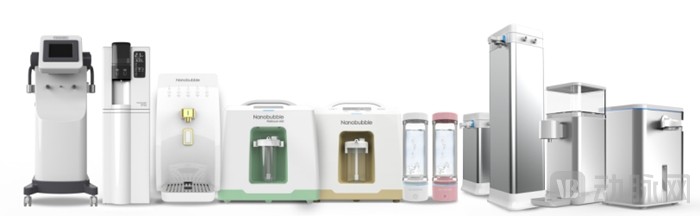 Nanobubble Series Products
Through innovation and breakthroughs in core technologies and components, Nanobubble not only enhances the competitive advantage of its own products but also provides high-quality core components to the industry, thereby empowering the development of the industry and its supply chain.
Actively Expanding the Boundaries of Hydrogen Medicine Applications to Promote Standardized Industry Development
Although hydrogen medicine has broad application prospects, it is undeniable that China currently lacks comprehensive industry standards for the hydrogen medicine sector. Moreover, as hydrogen is a colorless and odorless gas, consumers find it difficult to estimate the concentration of hydrogen in health products through subjective perception, or even to determine whether hydrogen is present at all. This has, to some extent, hindered the development of the industry.
This issue clearly requires continuous professional conduct standards and relevant policies from numerous practitioners within the industry to address. As a participant in the hydrogen medicine industry, Nanobubble has participated in the drafting and release of group standards, while also collaborating with industry experts and professional organizations to explore the formulation of industry standards, promoting the standardized development of the hydrogen medicine field.
Meanwhile, Nanobubble has established industry-academia-research collaborations with multiple institutions, including the China Health Promotion Foundation, the Shanghai Institute of Applied Physics of the Chinese Academy of Sciences, the Hydrogen Science Center at Shanghai Jiao Tong University, the Huikang Hydrogen Medicine Research Center, Naval Medical University, Nanjing General Hospital of the Nanjing Military Command, Huashan Hospital, Zhongshan Hospital, Peking Union Medical College Hospital, Changhai Hospital, and the Fourth Affiliated Hospital of Harbin Medical University. It provides technical support for dozens of hydrogen medicine research projects, actively expanding the application boundaries of hydrogen medicine.
Regarding the future development of the company, Nanobubble also has its own plans. In Mu Hualun’s view, talent is the driving force behind corporate growth. To attract more outstanding professionals to the team, Nanobubble has launched an employee stock ownership plan (ESOP) to fully mobilize employee enthusiasm.
Meanwhile, Shanghai Nanobubble Technology Co., Ltd. is actively advancing the regulatory registration applications for certain medical devices and conducting corresponding evidence-based medical research. In the future, the company will continue to expand market collaboration channels across various regions and steadily broaden its market coverage.
Furthermore, Nanobubble is strengthening its collaborations with professional medical institutions by fully leveraging the advantages of multidisciplinary and multi-sector expertise. The company also seeks to partner with capital investors whose strategic focus aligns more closely with its professional direction, aiming to achieve resource integration rather than mere financial aggregation.
Delving into an emerging field is never an easy endeavor. Throughout its corporate development, Shanghai Nanobubble Technology Co., Ltd. will remain true to its original mission and uphold its core values, striving to better align its products with market needs, with the aim of benefiting a broader population.