

Delonix Bioworks Secures Nearly RMB 100 Million in Seed Funding to Revolutionize Vaccine Development with Synthetic Biology
On April 7, 2021, Synbiobeta released its Q1 2021 market report on the synthetic biology sector. The report showed that financing in Q1 2021 more than doubled year-over-year compared to Q1 2020, and increased more than tenfold compared to Q1 2017.
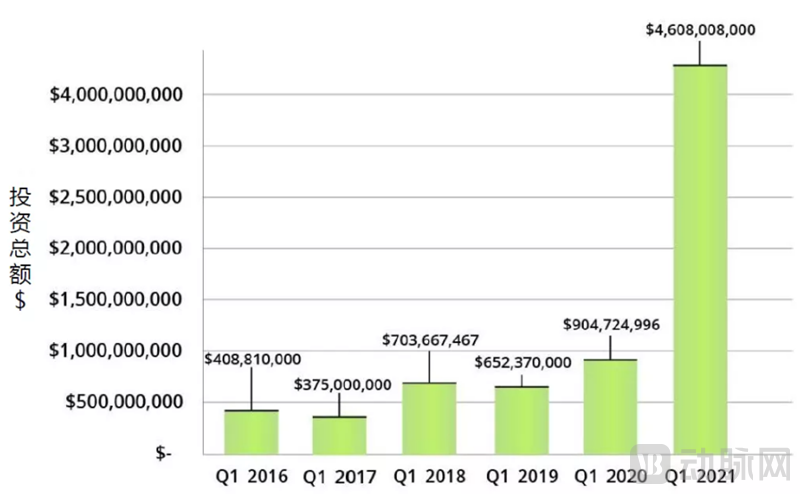
Total Investment in the Synthetic Biology Sector from 2016 to Q1 2021
In Q1 2021 alone, investment in the field of synthetic biology surpassed the total amount invested over the 11 years from 2009 to 2019, and was only slightly lower than the full-year investment in 2020. If the current funding rate remains unchanged, the synthetic biology industry is projected to grow by 200%–400% compared with 2020. 2021 is poised to become a record-breaking year for synthetic biology investment.
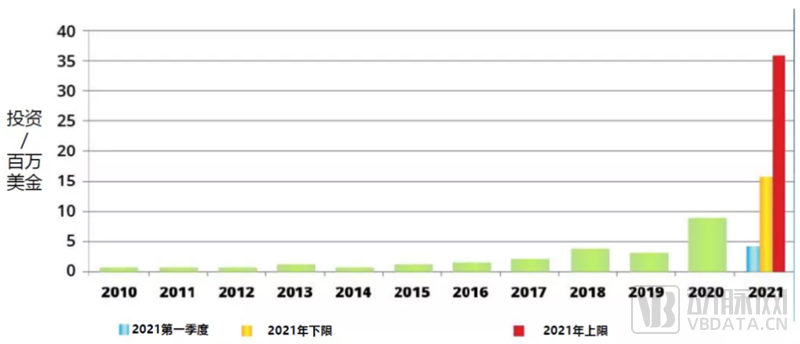
Investment Trends in Synthetic Biology in Recent Years and Market Investment Forecast for 2021
As global financing in the synthetic biology sector heats up, Chinese domestic synthetic biology companies are keeping pace: On April 22, Huaheng Biotechnology listed on the STAR Market, becoming the second “synthetic biology stock” to go public on this board after Cathay Biotech. In the first half of 2021, four synthetic biology startups publicly disclosed financing news, each securing large-scale funding in the hundreds of millions of yuan.
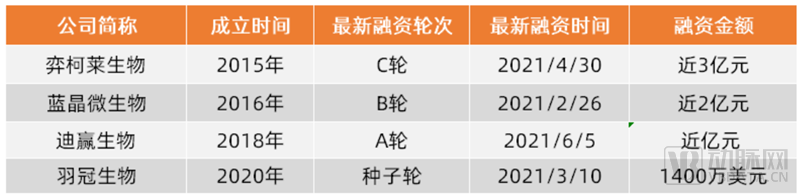
Major Financing Events in China’s Synthetic Biology Sector in the First Half of 2021
Delonix Bioworks (Chinese name: Yuguan Biology; hereinafter referred to as “Delonix”), as the youngest synthetic biology company among them, has certainly made a striking impression. Shortly after its establishment, it secured substantial investments from prominent funds such as the Boehringer Ingelheim Venture Fund (BIVF), IDG Capital, and ZhenFund, thereby attracting significant attention and curiosity within the industry.
Founded in late 2020 and headquartered in Shanghai, China, Delonix is committed to leveraging innovative approaches in synthetic biology toDevelopment of Synthetic Vaccines and Live Biotherapeutic Products for Infectious Diseases and Tumorsto address global public health security challenges. Its synthetic biology and antigen discovery platforms enable the rational design and reprogramming of pathogenic bacteria, thereby facilitating the rapid development of safer and more effective vaccines.
What “unique strengths” does this early-stage synthetic biology startup possess, given that it has attracted endorsement from so many renowned investment institutions right from its inception? VCBeat examinesDr. Qiubin Lin, Founder and CEO of DelonixConducted an exclusive interview.
The bond among the three core team members of Delonix Bioworks bears similarities to the backgrounds of team members at many renowned synthetic biology companies—they all participated in the International Genetically Engineered Machine (iGEM) competition and were among the earliest pioneers of synthetic biology in China.
iGEM, short for the International Genetically Engineered Machine Competition, originated as an on-campus contest at the Massachusetts Institute of Technology (MIT). Due to the high quality of the scientific research projects presented, MIT expanded the competition in 2005, extending it from within the institute to the entire North American region. Starting in 2006, numerous international teams began participating, marking the competition’s transition to a global scale.
In 2007, teams from five universities, including Tianjin University, Tsinghua University, and Peking University, were among the earliest participants in the iGEM competition. That same year, Lin Qiubin began his freshman year in Bioengineering at Tianjin University. Driven by a passion for biotechnology, Lin was quickly drawn to the iGEM competition, in which senior students were participating, thus forging an enduring bond with synthetic biology over the following decade. Through his involvement in iGEM, Lin met Professor Huang Jiandong, the faculty advisor for the University of Hong Kong’s iGEM team, under whose supervision he completed his doctoral degree. During his studies at HKU, Lin connected with Zhang Baozhong, who was pursuing a PhD focused on vaccines. Under Professor Huang’s guidance, the two conducted extensive research in synthetic biology, vaccines, and cancer immunotherapy, yielding numerous promising data outcomes. This solid foundation of early-stage research laid the groundwork for the establishment of Delonix Bioworks.
Delonix Bioworks’ unique expertise in bacterial antigen discovery, disease biology, and synthetic biology, its fruitful explorations in medical translation, and its well-coordinated, world-class R&D team are key reasons why numerous prominent investment firms hold the company in high regard. Currently, China’s synthetic biology industry is in its early stages of development, making high-quality teams like Delonix—boasting a fully interdisciplinary background in synthetic biology and years of cohesive collaboration—highly sought-after targets that investors are eager to secure.
Dr. Lin Qiubin provided further elaboration: “As a highly integrated and interdisciplinary field, synthetic biology cannot succeed simply by assembling scientists from diverse backgrounds; the barriers to entry are, in fact, quite substantial. While it is relatively easy to find a scientist specializing in vaccines, another in tumor immunotherapy, or others with different professional expertise, this does not mean that a mere combination of such individuals constitutes an effective synthetic biology team. At times, success requires the inspiration and intuition cultivated through years of cross-disciplinary engagement.”
Currently, antimicrobial resistance (AMR) has become one of the major threats to global public health. It is projected that by 2050, AMR will cause approximately 10 million deaths annually. Traditional vaccine technologies have repeatedly encountered setbacks in developing vaccines against drug-resistant bacteria; for instance, no vaccine against methicillin-resistant Staphylococcus aureus (MRSA) has been successfully launched on the market to date.
Leveraging its team’s unique expertise in bacterial antigen discovery, disease biology, and synthetic biology, Delonix Bioworks precisely targets critical pain points in the market. The company’s lead pipeline is a synthetic vaccine project directed against drug-resistant bacteria, focusing on addressing antimicrobial resistance (AMR). The nearly RMB 100 million in financing secured in March will accelerate the development of its AMR synthetic vaccine program and further enhance its existing technology platform.
Since the advent of the first vaccine (the smallpox vaccine, used to combat smallpox) in 1796, humanity has embarked on a journey of over 200 years in exploring disease prevention through vaccination. Looking back at history, vaccination has enabled humans to largely eradicate devastating diseases that once posed significant threats to human survival, such as smallpox, poliomyelitis, and diphtheria. However, more than two centuries later, the methods and principles underlying vaccine development appear to have changed little from those of over 200 years ago.
As a highly traditional industry, vaccine R&D relies heavily on historical precedents. Both inactivated vaccines and recombinant vaccines fall under the conventional category of vaccines developed against viral or bacterial antigens. When suitable antigens are difficult to identify, vaccine development often hits a bottleneck, thereby introducing an element of “luck” into the process.
Take respiratory syncytial virus (RSV) as an example. Respiratory syncytial virus (RSV) is the most significant cause of seasonal lower respiratory tract infections in infants and young children, and the leading cause of death from viral infections in newborns. Statistics show that there are approximately 64 million cases and 160,000 deaths globally each year due to RSV. In efforts to combat this formidable disease, researchers have been working on developing an RSV vaccine for over 50 years, yet no vaccine has been approved to date.
By integrating engineering principles and leveraging emerging technologies such as gene synthesis, editing, and network regulation, synthetic biology enables the “writing” of new life forms or the modification of existing ones. This approach breaks away from traditional biological research paradigms and is regarded as the “Third Biotechnology Revolution,” following the discovery of the DNA double helix structure and the completion of the Human Genome Project.
Can synthetic biology technologies break through the bottlenecks of traditional drug development, thereby driving transformative advances in vaccine development and accelerating the advent of the era of precision medicine? Delonix Bioworks has pioneered such efforts in China.
The Delonix team is not content with relying on the body’s natural immune response after direct vaccine administration. Instead, it aims to leverage synthetic biology technologies to rationally design vaccine strains, thereby enabling precise prediction and control of their behavior within the human body, ultimately enhancing vaccine safety and efficacy.
Leveraging the concept of existing live attenuated bacteria and the latest advances in synthetic biology, the Delonix team has developed an innovative synthetic biology vaccine technology, which was awarded the 2020 Boehringer Ingelheim Innovation Award.
Dr. Lin Qiubin told VCBeat that the Delonix team would focus primarily on bacterial vaccine development during its initial growth phase, translating into commercial applications the high-quality research achievements the team had previously accumulated in this field. This also serves as a proof of concept for Delonix’s new research strategy, demonstrating that vaccines with improved safety and efficacy can be developed through novel rational design approaches enabled by synthetic biology.
In the mid-to-late stages of its development, the Delonix team will devote greater efforts to tackling oncological diseases, expanding upon its prior research in bacteria-mediated cancer therapy. Overall, vaccines and oncology remain the two key focus areas that Delonix will continue to prioritize and target.
Over the past decade, breakthrough advances in various technologies have accelerated the development of synthetic biology as if a fast-forward button had been pressed.
Continuous advancements in DNA reading, writing, and editing technologies, coupled with the ongoing reduction in the time and cost of DNA sequencing, are driving the development of synthetic biology in multiple ways. The declining cost of key raw materials for gene synthesis—namely, oligonucleotides—has also stimulated market demand for synthetic biology products. Meanwhile, biofoundries (platform-based production companies) are continuously enhancing their technical capabilities in designing, manufacturing, and testing novel microorganisms. The rapid development of infrastructure, including informatics and computational tools, has significantly expanded the capacity to analyze and edit designed genes.
At the national policy level, major technologically advanced countries have successively issued supportive policies to encourage the development of the synthetic biology industry, making this field a strategic battleground for leading global powers. In recent years, the Chinese government has continuously provided robust support to the synthetic biology sector by introducing a comprehensive package of incentive policies and actively collaborating with universities and research institutes to establish supporting infrastructure, thereby promoting the vigorous growth of China’s synthetic biology industry. Synthetic biology has now entered a fast lane of development in a new era.
In terms of talent, a growing number of young synthetic biology professionals are being cultivated in large numbers, while many outstanding young Chinese talents abroad are returning home to pursue their careers. The continuous aggregation of high-quality talent and enterprises in China has further attracted a significant influx of premium industrial capital. We believe that the development momentum in the field of synthetic biology has become unstoppable, with major transformations on the horizon.