

Baidu Health Empowers Public Hospitals' Digital Transformation with AI-Driven Precision Matching and Integrated Service Ecosystem
Internet healthcare is entering a brand-new phase.
Since last year,Driven by the needs of epidemic prevention and control, public hospitals have been actively establishing internet hospitals.According to data from the National Health Commission, as of March 2021, the number of internet hospitals in China exceeded 1,100, up from 269 in October 2019, representing an increase of over 300%, with the vast majority being public hospitals.
It is important to recognize that public hospitals, as the mainstay of China’s healthcare service system, hold a substantial pool of high-quality physician resources. Therefore, their entry into the market has undoubtedly brought new growth momentum to the development of internet-based healthcare.
However, after about a year of operation, it was found that the development of internet hospitals in public hospitals encountered numerous problems. According to data from the Health Circle Research Institute,Over 90% of Internet Hospitals Are in a "Zombie" State: Built but Unused, some doctors are reluctant to practice on their own internet hospital platforms.
The underlying reason is that building an “Internet Hospital” is not simply a matter of shifting medical resources from offline to online.On the one hand, internet healthcare differs from offline care in terms of cognition and business models; therefore, public hospitals need to understand and improve user experience. On the other hand, the uneven distribution of offline medical resources continues to be reflected online; for instance, the internet hospitals affiliated with renowned Grade A tertiary hospitals tend to siphon users away from other public hospitals. More importantly, as the business model for internet healthcare remains immature, public hospitals face challenges in achieving sustainable operations.
In summary, most public hospitals lack online traffic entry points, and their digital platforms face challenges such as scarce user bases and low operational efficiency.Therefore, how to assist public hospitals in building internet hospitals has become an important trend and opportunity for the internet healthcare industry.
How Can Public Hospitals Break Through the Operational Bottlenecks of Internet Hospitals?
To answer this question, it is necessary to clarify thatThe advantages of public hospitals lie in their robust offline comprehensive medical service capabilities, as well as the reputation and resources accumulated over time.
Therefore, in the process of digitalization,Deep integration between public hospitals and internet enterprises with strengths in traffic acquisition, branding, and technology may be one approach to addressing operational challenges faced by internet hospitals.
Along this path,Baidu Health is seizing opportunities.At the “2021 Baidu Health Tribute to Healers Gala” (hereinafter referred to as the “Tribute to Healers Gala”) held on July 11, Baidu Health announced that it is building a precision doctor-patient matching engine to accurately connect users with hospitals and physicians, thereby supporting the high-quality development of public hospitals.
“Due to limitations in public awareness and healthcare-seeking habits, the utilization of medical resources in China is currently suboptimal. Patients often seek specialized care for minor ailments, while doctors and hospitals are unable to reach those with genuine, corresponding needs. Against this backdrop, Baidu Health is committed to leveraging its strengths to build a precision doctor-patient matching engine, using AI to accurately identify and facilitate precise connections between users, hospitals, and physicians,” said Yang Minglu, General Manager of Baidu Health.
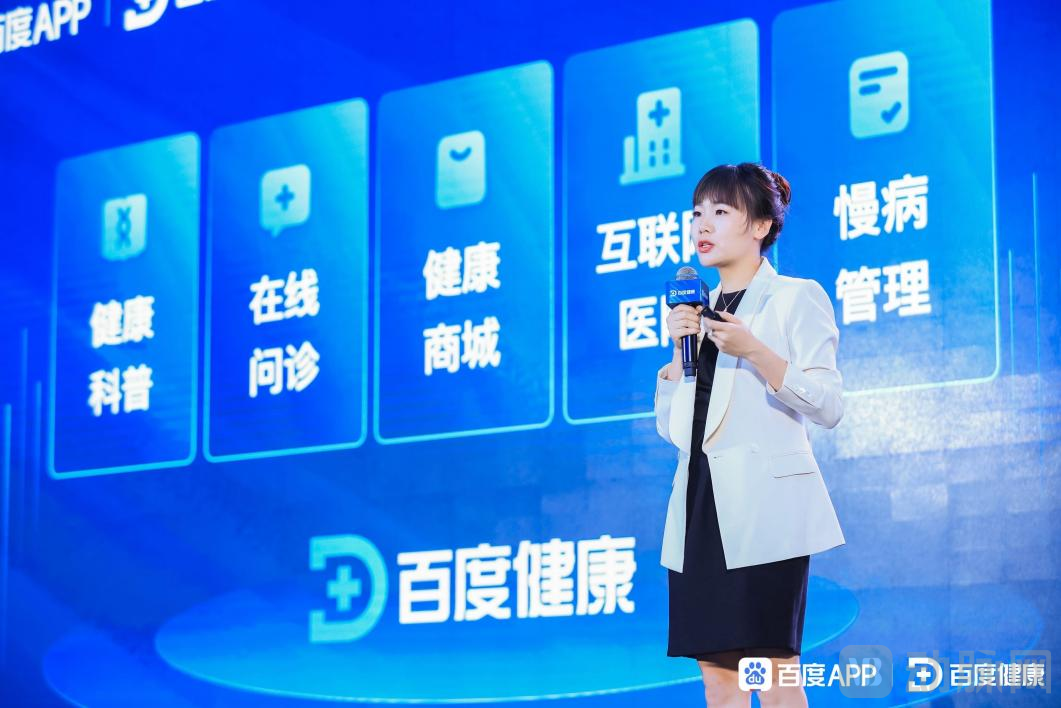 (Yang Minglu, General Manager of Baidu Health)
As early as April this year, Baidu Health launched the “100 Cities, 100 Hospitals Initiative” at its strategic press conference, providing one-stop services—including pre-consultation for specific diseases, appointment registration, online follow-up visits, home medication delivery, and follow-up management—to 300 hospitals across 100 cities in China, thereby promoting the establishment of internet hospitals by public hospitals.This strategic deployment is undoubtedly a measure to drive the continued and in-depth implementation of the strategy,
How does Baidu Health facilitate the digital transformation of public hospitals? Or, in other words,On What Basis Can Baidu Health Empower Public Hospitals?
Specifically,Baidu Health can precisely direct patients with specific diseases to public hospitals and doctors through its “Precision AI Engine” and “Refined Operations,” while enhancing the online service capabilities of public hospitals and building physicians’ personal brands, thereby empowering both doctors and hospitals.Behind this lies the advantage that Baidu Health has continuously built upon its robust, precise traffic within the “content ecosystem + service ecosystem.”
First, search has become the core gateway for users to access health information: Baidu Health records an average of 200 million daily content searches, providing a precise mechanism for Baidu to understand user pain points. According to publicly available data from Baidu Health, its daily active users have exceeded 100 million.
Faced with a vast volume of precise traffic and demand, Baidu Health can match doctors in public hospitals with the most suitable patients, thereby improving the efficiency of supply-demand matching.
Furthermore, Baidu Health continues to expand into diverse service scenarios, having established related businesses such as online consultations, appointment scheduling, online pharmacy services, health management, and health insurance.
Taking online consultations as an example, Baidu Health obtained the internet hospital license from Hainan Yilai in April last year and currently handles over 2 million online medical consultation requests daily.
For instance, in the realm of health management, Baidu Health launched the “Diabetes Center” last August. Leveraging the advantages of Baidu’s big data and AI technologies, it created an innovative service model featuring precise “diagnosis and treatment + health management.” This marked the industry’s first introduction of a new model for specialized internet hospitals that integrate medical services and patient care. In April this year, Baidu Health further expanded its efforts by establishing the Andrology Center in collaboration with the Chinese Society of Sexual Medicine. The center aims to provide more authoritative and media-rich health education for men while delivering more precise and professional “diagnosis and treatment + health management” service solutions.
Leveraging its diversified service capabilities, Baidu Health provides patients at public hospitals with a one-stop suite of services—including pre-consultation for specific conditions, appointment registration, online follow-up visits, home medication delivery, and follow-up management—thereby enhancing user stickiness and expanding the scope of medical services offered by public hospitals.
In addition, within its content ecosystem, Baidu Health has launched Baidu Health Medical Encyclopedia. The platform currently collaborates with over 1,500 top medical experts, and its entries receive an average of more than 20 million page views per day.
“With the advent of the internet, many physicians have expressed a desire to understand what health education content is most needed by the public within their respective specialties. This user-demand-driven feedback loop offers significant benefits in helping physicians create more effective health education materials,” Yang Minglu told VCBeat.

In other words,Baidu Health Medical Encyclopedia: Engaging a growing number of top-tier experts in the creation of health science popularization content.
In terms of specific operations, Baidu Health also empowers doctors, hospitals, and users through its precise doctor-patient matching engine.On one hand, Baidu Health leverages AI technology to analyze user inquiries; on the other, Baidu collaborates with public hospitals and physicians to establish a comprehensive database of public hospital doctors, creating a tagging system that highlights each hospital’s and doctor’s areas of expertise. Building on this foundation, Baidu uses AI technology in conjunction with the hospital tagging system to achieve efficient and precise matching between patients and doctors/hospitals, thereby enabling “precise patient triage and referral” and improving the connectivity efficiency between high-quality medical resources and patients in need.
As can be seen,Within its precise traffic pool, Baidu Health’s “content ecosystem” and “service ecosystem” have established a robust platform with substantial user demand. On this platform, Baidu Health is leveraging its “precision AI engine” and “refined operations” to accurately direct patients with specific diseases to public hospitals and physicians, thereby empowering both doctors and hospitals.
In this process, both users and hospitals (doctors) achieve a win-win outcome. Baidu Health starts with the precise needs of users, matching them with the most suitable doctors; meanwhile, doctors can fully leverage their expertise and strengths to provide patients with an enhanced medical experience. From a broader perspective, this also helps optimize the utilization of valuable medical resources and advances the goal of tiered diagnosis and treatment.
Baidu Health continues to strengthen its healthcare service capabilities.
Based on key strategic initiatives in the first half of this year, Baidu Health has undertaken the following actions: In January, Baidu Health launched nucleic acid testing services and introduced a vaccine protection plan; in March, it partnered with CanSino Biologics to jointly create a “health science popularization + vaccine appointment” service platform; in April, it established an Andrology Center, collaborating with the Chinese Society of Sexual Medicine to deliver authoritative chronic disease management services for men’s health.
Not only that,Baidu Health is also strengthening and supplementing its service-side value chain through external investments.For example, in June, Baidu invested in two companies: it led the Series B financing round for Youlai Doctor, an online health science popularization platform, with a funding amount of nearly RMB 200 million; and it participated as a co-investor in the new round of financing worth USD 270 million for Yaoshibang, a pharmaceutical internet platform.
It is worth noting that both Youlai Doctor in the field of health science popularization and Yaoshibang in the field of intelligent pharmaceutical supply chain are leaders in their respective niche industries.Baidu’s investments clearly reflect its emphasis on the complementarity between these companies and itself, thereby enhancing the Baidu Health ecosystem in terms of content and services.
From a granular perspective, by acquiring a stake in Youlai Doctor, Baidu Health will enhance its physician operational capabilities, increase innovation in diversified health science popularization services such as short videos and live streaming, and strive for a dominant position at the traffic source of the healthcare industry. After investing in Yaoshibang (Pharmacist Help), Baidu can leverage Yaoshibang’s robust supply chain resources, which connect pharmaceutical companies with offline retail terminals. With significant advantages in SKU coverage, pricing, and sales outlet distribution, Yaoshibang can help Baidu improve its pharmaceutical fulfillment capabilities by introducing merchant onboarding and providing supply chain services. In the future, the two parties will also join forces to empower pharmaceutical companies by building integrated digital marketing solutions that bridge online and offline channels as well as in-hospital and out-of-hospital settings.
It can be seen that,Whether through in-house development or external investment, Baidu Health continues to deepen and strengthen its medical service capabilities by leveraging platform resources.“In the past year or two, we have observed that the market lacks effective channels or solutions tailored to the public healthcare system to help it enhance its online medical services,” said Yang Minglu. She noted that a prerequisite for empowering public hospitals and physicians is for Baidu Health to integrate and refine the entire service chain.
Therefore, although Baidu Health has already established five major service systems—health science popularization, online consultation, chronic disease management, health e-commerce, and internet hospital services—it continues to invest resources and capital to better meet users’ multi-layered health needs, aiming to provide more comprehensive and effective empowerment solutions.
It is worth noting that the internet hospital system, developed through a collaboration between Baidu Health and Cangzhou People’s Hospital, officially launched at the end of last month. Reportedly, the system will provide one-stop services—including pre-consultation for specific conditions, appointment registration, online follow-up visits, home medication delivery, and follow-up management—to users in Cangzhou and across China.As the first internet hospital launched through a collaboration between Baidu Health and a public hospital, the Cangzhou People’s Hospital Internet Hospital marks the official launch of Baidu Health’s model for empowering public hospitals.
Data shows that China currently has 12,000 public hospitals (National Bureau of Statistics, 2018 data) and 3.867 million registered physicians (National Health Commission). “However, we are currently facing an information gap between supply and demand sides, as well as uneven distribution of resources,” Yang Minglu told VCBeat. For hospitals, digital transformation, improved efficiency in diagnosis and treatment management, and enhanced patient care experiences are critically important. For physicians, the key lies in leveraging the internet to maximize their professional impact, enabling patients to find the most suitable doctors rather than solely seeking out top specialists at Grade III Class A hospitals, thereby achieving optimal utilization of medical human resources.
Therefore,Going forward, Baidu Health will continue to deepen its service capabilities and collaborate with the public healthcare system to fully leverage the connective role of internet platforms, thereby driving improvements in industry efficiency.
The uneven distribution of medical resources has long been a challenging issue in China.
For instance, in terms of geographic distribution, high-quality medical resources are concentrated in economically developed cities and the eastern coastal regions, while the service capacity of rural primary healthcare and community healthcare has consistently lagged behind.
For example, in terms of the distribution of physician resources, tertiary hospitals have siphoned off a large number of high-quality physicians, while other hospitals have weaker appeal to such talent. It is important to note that non-tertiary hospitals in China serve a broader population: according to Frost & Sullivan, among the more than 30,000 hospitals in China, tertiary hospitals account for only 8%.
It is against this backdrop that difficulties in accessing medical care and its high cost have become structural drawbacks in the development of China’s healthcare industry.
Therefore,Leveraging the power of the Internet to break through the high walls of hospitals, enabling medical resources such as doctors, treatment plans, and medications to transcend geographical barriers and reach patients across various locations, has become an important approach and pathway for improving the current state of healthcare.Internet hospitals are undoubtedly a key vehicle in this wave.
This is because internet hospitals not only provide health consultations and clinical services, but also offer high-frequency services such as health education to boost user engagement, while extending into low-frequency medical services including pharmaceutical care and user health management. Moreover, internet hospitals possess inherent advantages in integrating with public medical insurance or collaborating with commercial health insurers, thereby addressing a longstanding challenge in healthcare delivery: identifying suitable payers.
Thus, it is evident that across the entire industry, not only Baidu Health but also giants such as JD Health, AliHealth, and Ping An Good Doctor are actively establishing internet hospitals. Furthermore, among native players in the digital healthcare sector, companies like WeDoctor, Yuanxin Technology, Weimai, and Medlinker are also proactively expanding their presence from their respective strategic perspectives.
As stated by Mao Qunan, Director of the Department of Planning, Development, and Informatization of the National Health Commission, at the “Baidu Health Tribute to Medical Professionals Ceremony,” “China is currently advancing the two major strategies of Healthy China and Digital China. Therefore, in the implementation of the Healthy China strategy, attention should be paid to leveraging the advantages of digital technologies. Medical professionals should actively engage in health communication efforts, and we hope that more high-quality platforms will dedicate themselves to this meaningful cause.”
Baidu Health’s empowerment of public hospitals in building their internet hospital platforms represents a key strategic initiative to leverage its technological strengths and participate in the new digital health infrastructure. It also reflects a forward-looking layout aimed at expanding its partner ecosystem and fostering a virtuous healthcare ecosystem.
Amid this trend, an increasing number of new entrants are joining the market, bringing greater possibilities to the entire industry. This, in turn, will help foster a more robust and vibrant healthcare ecosystem.
A New Landscape Is Unfolding, and the Healthcare Industry Is Set for a Transformation.