

Brii Biosciences, Founded by GSK Veteran Dr. Zhi Hong, Debuts on HKEX with Focus on Infectious Diseases and CNS Therapies

Brii Biosciences
Innovative Drug Research and Development Service Provider
On July 13, 2021, Brii Biosciences Limited (hereinafter referred to as “Brii Biosciences-B,” SEHK: 02137) was officially listed on the Stock Exchange of Hong Kong. The IPO price was set at HK$22.25 per share. A total of 112 million shares were issued in this listing, including 55.79 million shares offered publicly and 55.79 million shares placed internationally. The opening share price on the day of listing was HK$21.40 per share.
Brii Biosciences, founded in December 2017, is a biotechnology company based in China and the United States.Dedicated to advancing therapies for major infectious diseases (such as hepatitis B virus (HBV), human immunodeficiency virus (HIV), and multidrug-resistant (MDR) or extensively drug-resistant (XDR) Gram-negative bacterial infections) and other conditions with a significant public health burden (such as central nervous system (CNS) disorders).
Under the leadership of a professional scientific research team and with continued increased investment from strong institutional investors, Brii Biosciences has established its presence in infectious diseases, the third largest therapeutic area in the global pharmaceutical market. Throughout human history, infectious diseases have consistently posed significant threats to public health. Due to their high transmissibility, infectious diseases can spread rapidly among large populations, causing substantial public health challenges and socioeconomic burdens. The ongoing COVID-19 pandemic and the worldwide spread of other infectious diseases serve as prominent evidence of this reality.
So, what makes Brii Biosciences, which went public today, so appealing? Let’s start with the story of its founders.
Dr. Hong Zhi is the Co-founder and Chief Executive Officer of Brii Biosciences, with over 25 years of experience in the biopharmaceutical industry. Prior to founding Brii Biosciences, Dr. Hong served as Senior Vice President and Head of the Infectious Diseases Therapeutic Area at GlaxoSmithKline (GSK) from 2007 to 2018. He led the highly successful development of two major projects: the three-drug HIV regimens Tivicay and Triumeq, and the injectable HIV treatment Cabenuva.He is also regarded as a key architect behind GSK’s resurgence and success in the research and development of drugs for HIV/AIDS and infectious diseases.
However, the path to development was not without its challenges. In 2013, GSK’s bribery scandal in China came to light, severely damaging the reputation of this pharmaceutical giant with over 300 years of history. In early 2016, Dr. Hong Zhi stepped up to the challenge, transitioning from back-end new drug R&D to front-end market operations in China to help GSK restore its former glory. This was no easy task, but through the aggressive introduction of essential medicines for tuberculosis, HIV/AIDS, and other critical conditions, as well as active collaboration with government bodies and public welfare organizations, Dr. Hong successfully restored GSK’s reputation in China.
Furthermore, Dr. Hong is a public health advocate who has assisted the U.S. and EU governments (DTRA, BARDA, NIH, and IMI) as well as charitable organizations (the Bill & Melinda Gates Foundation and the Wellcome Trust) in establishing multiple public-private partnership projects. During his tenure at GSK, he spearheaded the establishment of the GlaxoSmithKline Institute for Infectious Diseases and Public Health in Beijing. After leaving GSK, he founded Ardea Biosciences, which was later acquired by AstraZeneca. He has also held leadership positions at ViroPharma Pharmaceuticals and Schering-Plough Research Institute (now part of Merck & Co.).
In 2018, when many believed that Hong Zhi could retire with honor, he remained true to his original aspirations and resolutely embarked on an entrepreneurial journey in the latter half of his life, establishing Brii Biosciences, a company dedicated to meeting the needs of Chinese patients.
In this regard, Yunfeng Capital, a shareholder of Brii Biosciences, stated: “What matters most to us is that Dr. Hong Zhi is a founder with extensive experience and passion in the field of infectious diseases. When discussing the company’s positioning and strategic planning, he has consistently emphasized that Brii Biosciences is committed to developing first-in-class innovative therapies and introducing cutting-edge technologies such as siRNA to China. Therefore, Yunfeng Capital is eager to support entrepreneurs like Dr. Hong Zhi to jointly accelerate the rapid development of new drugs for infectious diseases in China and around the world.”
Prior to this IPO, Brii Biosciences completed three rounds of financing: an $86.51 million Series A round in December 2018, a $172 million Series B round in August 2020, and a $155 million Series C round in March 2021. Currently,Brii Biosciences’ shareholders include ARCH Venture Partners, WuXi Healthcare Ventures, Boyu Capital, Yunfeng Capital, Sequoia Capital, Blue Pool Capital, Invesco Developing Markets Fund, GIC, Primavera Capital Group, Hillhouse, and Capital Group.
In this IPO, Morgan Stanley and UBS served as joint sponsors for Brii Biosciences.Eleven cornerstone investors, including Invesco, UBS AM, RBC, Lingjian, Qifeng Capital, Yunfeng Fund, Sequoia Capital, Boyu Capital, Sage Partner, Pulin Capital, and Athos Capital, lent their support, accounting for 47.52% of the offering.
Currently, Brii Biosciences has established a pipeline of more than 10 innovative candidate products targeting infectious diseases and central nervous system (CNS) disorders, covering projects from preclinical to clinical stages.
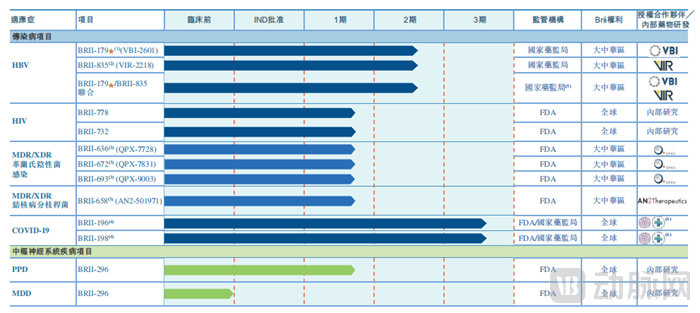
Pipeline, Source: Prospectus
Specifically, the core product BRII-179 induces and maintains HBV-specific B-cell and T-cell immune responses that establish and sustain immune control, while BRII-835 targets and inhibits the production of immunosuppressive HBV antigens by the immune system. The mechanisms of action of BRII-179 and BRII-835 are complementary, offering advantages over other currently available therapies. BRII-179 contains VBI’s Sci-B-Vac®The vaccine contains identical recombinant protein components and is the only approved third-generation prophylactic vaccine currently on the market. It comprises all three HBV surface antigens and features a potent adjuvant system specifically designed to induce and enhance host immune responses.
BRII-835 is a GalNAc-conjugated siRNA that inhibits all HBV antigens (namely, HBV S, PreS1, PreS2, Core, e, and X antigens), thereby exerting direct antiviral or suppressive effects. This viral suppression reduces and eliminates secreted viral antigens that are believed to impede the normal functioning of the host’s immune system. The combination of BRII-179 and BRII-835 is underpinned by a robust scientific rationale for differentiation, and we believe it may break immune tolerance and achieve higher cure rates compared with other current therapies for HBV infection.
Currently, Brii Biosciences has completed the Phase 1b/2a multi-regional clinical trial (MRCT) of BRII-179 at sites in China, New Zealand, Australia, Thailand, and South Korea. BRII-179 demonstrated a favorable safety profile, with no serious adverse events (SAEs) reported among patients. Regarding BRII-835, Vir Biotechnology (the licensing partner) has completed a Phase 1b/2a study in patients with chronic hepatitis B virus (HBV) infection in several Asia-Pacific (APAC) countries. The study found that BRII-835 was well tolerated, with no safety signals observed.
On the other hand, Brii Biosciences’ HIV, COVID-19, and CNS candidate products are initially targeted at the U.S. market, which has greater demand or willingness to address the HIV and COVID-19 pandemics, depression, and other mood disorders. Taking HIV treatment as an example, Brii Biosciences is developing a novel therapeutic regimen for people living with HIV, offering a once-weekly single-tablet regimen (QW STR) for oral administration. The current standard of care includes many once-daily single-tablet regimens (QD STR), requiring patients to take medication daily for life. Brii Biosciences aims to improve the quality of life for people living with HIV by eliminating the daily reminder of their condition associated with routine treatment.
Brii Biosciences submitted Investigational New Drug (IND) applications to the U.S. Food and Drug Administration (FDA) in December 2020 and March 2021, respectively, to support the development of BRII-778 and BRII-732. The Company initiated dosing in Phase I clinical trials for BRII-778 and BRII-732 in the United States in March 2021 and May 2021, respectively, and plans to commence a global Phase 2b combination study in the United States in the third quarter of 2022 to evaluate once-weekly subcutaneous therapy (QW STR) with BRII-778 and BRII-732, with the aim of achieving potential commercial launch by 2028.
Brii Biosciences has chosen HBV and HIV as its two key areas of focus, primarily due to the enormous market potential of these two fields.
According to the relevant report by Frost & Sullivan,The global market size for infectious disease drugs is projected to grow from $128.2 billion in 2019 to $197.6 billion in 2034., making it the third-largest therapeutic area globally. Among the four subsegments of infectious diseases (namely, antivirals, antibiotics, antifungals, and other anti-infectives), antivirals are expected to contribute the most to overall market growth and remain the largest subsegment within infectious diseases. The antiviral market is projected to grow from $55.3 billion in 2019 to $116.7 billion in 2034, representing the highest growth rate.
China’s infectious disease pharmaceutical market is projected to grow rapidly at a faster pace than the global market, increasing from USD 32.6 billion in 2019 to USD 58.2 billion in 2034 (excluding vaccines). Similar to the global market, antiviral drugs are expected to be the fastest-growing segment within the infectious disease sector, reaching a market size of USD 25.2 billion by 2034.Among these, HBV and HIV drugs account for a significant proportion of the antiviral drug market in China.The share of China’s HBV and HIV drug market in the overall market is projected to increase from 50.7% in 2019 to 78.0% by 2034, primarily driven by the introduction of more innovative antiviral therapies, such as next-generation HBV drugs.
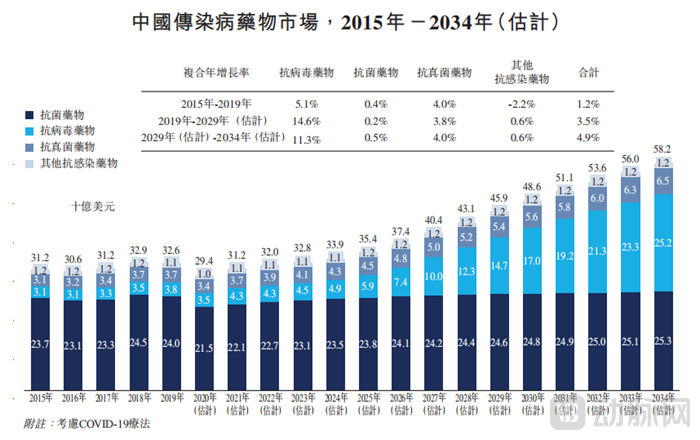
China’s Infectious Disease Drug Market (Source: Prospectus)
Specifically, there are two reasons for choosing the HBV field as the primary direction for development.
First, China has the world's largest population of HBV patients., but the current rates of diagnosis and treatment for HBV infection remain relatively low.Over the past few years, healthcare expenditure in China has been growing rapidly, which has driven and is expected to continue driving a significant improvement in the diagnostic capabilities of primary healthcare institutions, thereby increasing the diagnosis rate of hepatitis B virus (HBV) patients in rural areas. Subsequently, these higher diagnosis rates are expected to prompt an increasing number of HBV-infected individuals to seek treatment, thus driving the growth of the HBV treatment market.
Second, all antiviral drugs for hepatitis B virus (HBV) in China, including nucleos(t)ide analogues (NAs) and interferons, have been included in the National Reimbursement Drug List (NRDL), thereby creating a large patient population for HBV therapies.Given the large population of hepatitis B virus (HBV) patients in China, innovative HBV drugs approved by the National Medical Products Administration (NMPA) are highly likely to be included in the National Reimbursement Drug List (NRDL), thereby improving access to these novel therapies. Furthermore, as patient awareness of HBV increases, a growing number of patients are willing to receive treatment in China, driving growth in the HBV treatment market.
In addition to the similarly large patient population, there are four other reasons for choosing HIV as the primary area of development.
① Global awareness of HIV is continuously increasing.The Joint United Nations Programme on HIV/AIDS (UNAIDS) has established the “90-90-90 targets,” aiming to ensure that by 2020, 90% of people living with HIV know their status, 90% of those diagnosed receive antiretroviral therapy (ART), and 90% of patients on ART achieve viral suppression. Governments worldwide have also placed high priority on the prevention and treatment of HIV infection and have introduced corresponding policy support. This is expected to further help expand the market for HIV treatment and prevention.
② Innovative solutions addressing the current shortage of HIV medications.Existing studies have shown that patients prefer long-acting medications, which allow for treatment at longer intervals, and that most patients favor oral administration over intravenous infusion and other therapies requiring administration by healthcare professionals. Therefore, the market launch of long-acting oral antiviral drugs is expected to drive market growth following their commercial release.
③ High prevalence in China.In China, the growth in the number of people living with HIV (with a compound annual growth rate of 10.4% from 2015 to 2019) has been far more rapid than the global increase. It is projected that by 2034, over 2.5 million people in China will be infected. Over the past decade, there have been more than 50,000 newly diagnosed cases each year, posing significant challenges to China’s public health system.
④ Increased access to treatment opportunities in China.In 2019, only a small proportion of HIV patients in China had access to innovative HIV therapies. To improve access to medicinal treatments and reduce the proportion of out-of-pocket expenses borne by patients, the Chinese government has continuously optimized its free antiretroviral drug coverage list and the National Reimbursement Drug List (NRDL). Driven by these and other medical insurance policies, a growing number of HIV-infected patients are gaining access to innovative therapies (such as single-tablet regimens [STRs]), which will drive growth in the HIV treatment market.
Overall, although China has substantial demand for infectious disease drugs, particularly antiviral agents, the current supply of innovative therapies remains limited. Driven by the anticipated launch of novel antiviral drugs, a favorable regulatory environment, heightened awareness of disease prevention and control, accelerated diagnostic processes, greater treatment acceptance, and the Chinese government’s increasing willingness to reimburse for these medications, China’s infectious disease drug market is projected to experience significant and rapid growth.
Beyond these two core areas, Brii Biosciences has rapidly established a broad and robust pipeline of innovative internally developed and in-licensed drug candidates, specifically targeting infectious diseases and central nervous system (CNS) disorders, to address substantial unmet medical needs across diverse geographic markets.
In 2018, facilitated by Yunfeng Capital, Brii Biosciences established a strategic partnership with Alibaba Health, a company within the Yunfeng ecosystem, during its early stages of formation., the two parties pioneered a digital data-sharing collaboration model, helping Brii Biosciences build its competitive advantage in the field of digital healthcare.
Although the pipeline products are scarce and market demand is substantial, the primary risks associated with Brii Biosciences’ business, operations, intellectual property, and financial prospects largely depend on the success of its drug candidates, which are currently in preclinical or clinical development.
As Brii Biosciences currently has no products approved for commercial sale, the company has continued to incur operating losses since its establishment, the vast majority of operating losses were attributable to research and development expenses and administrative expenses.As Brii Biosciences needs to conduct further research and development activities, continue clinical development of candidate drugs, seek regulatory approvals, launch the commercialization of pipeline products, and expand its team size, it is expected that Brii Biosciences will maintain a high level of R&D investment for at least the next few years.
Following this IPO, Brii Biosciences also plans to allocate the majority of the funds to product research and development.: 55% of the net proceeds will be allocated to the HBV functional cure program; 15% is expected to be allocated to the HIV program to fund ongoing and planned clinical trials and regulatory filing preparations for BRII-778 and BRII-732; 15% will be allocated to the MDR/XDR Gram-negative bacterial infection program; 5% will be used to fund ongoing and planned clinical trials and regulatory filing preparations for BRII-296; and 10% will be allocated to early-stage pipeline, business development initiatives, working capital, and general corporate purposes.
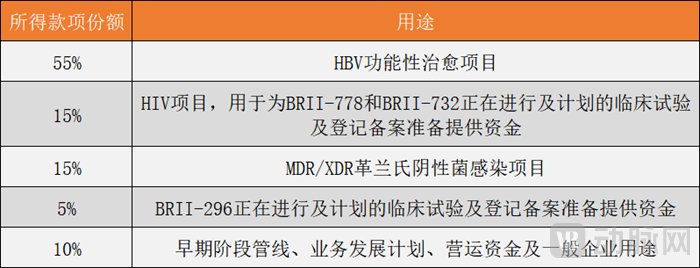
Use of Funds
Looking ahead, Brii Biosciences will continue to leverage its R&D and commercial expertise to make innovative medicines more affordable, enabling patients in China to access novel therapies earlier. While remaining focused on meeting the needs of Chinese patients, Brii Biosciences will also strive to pursue cross-border collaborations, integrating its R&D strengths with the expertise and specialties of its partners to jointly improve health outcomes for patients worldwide.