

Bridging the Growing Medical Talent Gap: DXY Talent Addresses Surging Demand and Diversified Roles
“There is a significant shortage of medical professionals; DXY Talent has already partnered with hospitals and physicians in its short-video content to encourage people to pursue careers in medicine.” This remark was made by Shuai Yuhuan, Vice President of DXY and Head of DXY Talent.
From July 9 to 11, 2021, the 4th China Hospital Development Conference, guided by the Human Resources Management Professional Committee of the Chinese Society of Management Science and hosted by DXY, was held, with 800 industry professionals attending to discuss hospital human resources and brand building.
On the demand side, talent shortages—particularly of high-end professionals—have once again become a frequent topic among hospital directors and HR managers. Meanwhile, with the rapid development of the healthcare industry in recent years, the demand for medical talent has increased, giving rise to diverse, cross-disciplinary roles that represent a new trend in workforce needs. On the supply side, however, two-thirds of medical students are considering changing careers after graduation, posing a significant risk of talent attrition. Against the backdrop of the industry’s continued high-speed growth, how can the gap between the supply and demand for medical talent be addressed? VCBeat conducted an exclusive interview with Shuai Yuhuan to explore this issue.
The 14th Five-Year Plan proposes accelerating the expansion of high-quality medical resources and achieving a more balanced regional distribution. The General Office of the State Council has made corresponding arrangements in its Key Tasks for Deepening the Reform of the Medical and Healthcare System in 2021, including launching pilot projects for National Medical Centers and the second batch of Regional Medical Centers, and coordinating and advancing the construction of Regional Medical Centers during the 14th Five-Year Plan period. Efforts will be intensified to strengthen the development of public medical and health institutions, while actively supporting the growth of privately run healthcare providers.
The "2021 Report on the Development of Medical Talent in China," released at this Hospital Development Conference, provides a more detailed set of figures. According to incomplete statistics, in the aftermath of the COVID-19 pandemic, multiple provinces and municipalities have separately introduced investment plans for healthcare institution construction, increasing the number of newly built hospitals and public health institutions, and encouraging public hospitals to implement a multi-campus model. For example, the Shenzhen-centered metropolitan area will add at least 30 tertiary hospitals over the next 5–10 years; Tianjin Municipality will build 59 new hospitals over the next 15 years; and Henan Province plans to add 162 medical institutions by 2025.
As high-quality medical resources expand, new campuses of public hospitals are built, and privately-run healthcare continues to develop, talent remains a key resource, and the demand for talent by medical institutions will continue to grow.
Meanwhile, with the rapid development of the healthcare industry in recent years, the demand for medical talent among relevant institutions within the sector has also increased, primarily manifested in two aspects.
First, the rapid development of the healthcare industry has given rise to a large number of service providers in specialized segments, such as third-party medical service institutions, health management companies, and wellness and elderly care centers, all of which require corresponding medical talent for support. The "2021 Report on the Development of Medical Talent in China," released by Dingxiang Talent, points out that in recent years, a group of pioneering physicians have taken the lead in leaving public hospitals to establish or join new types of health institutions, thereby serving as role models for other medical professionals.
Secondly, cross-industry integration is accelerating, driving up demand for interdisciplinary talent. Amid the digital wave, technologies such as the internet, big data, cloud computing, 5G, and artificial intelligence are increasingly converging with healthcare, giving rise to emerging interdisciplinary fields—including internet-based healthcare, medical AI, and healthcare big data—as well as corresponding specialized roles. These positions require not only healthcare professionals but also multidisciplinary talents with a medical background, placing higher demands on their mastery of domain-specific professional knowledge.
Shuai Yuhuan noted that data from DINGXIANG Job Recruitment shows that in the past, employers were mainly hospitals, pharmaceutical companies, and biotechnology firms. The “Other Types” category primarily included universities, laboratories, and medical journals, accounting for a relatively small proportion. However, there has been a significant shift in employer types over the past two years. “The latest backend data from DINGXIANG Talent reveals that ‘Other Types’ of employers now account for as high as 14% of the total, with job openings including physicians for internet hospitals, medical operations editors, and medical product managers.”
Therefore, overall, the healthcare talent market is characterized by sustained growth in demand, diversification of job roles, and an increasing need for multidisciplinary professionals.
“Medical graduates used to have limited career options, with most pursuing clinical roles, but that is no longer the case. This presents a mixed blessing for recruitment platforms,” said Shuai Yuhuan. On the positive side, user-oriented recruitment platforms can offer diverse job opportunities to physicians and medical students, helping them secure satisfactory positions and thus fully demonstrating the platforms’ value. On the negative side, there are significant challenges on the talent supply side.
The “2021 Report on the Development of Medical Talent in China” surveyed medical students’ career intentions. The data show that 65.2% of medical students have considered changing careers after graduation, with 11.7% stating they would definitely not pursue their field of study. As a future supplement to the workforce talent pool, medical students’ career choices will directly affect the supply–demand dynamics in the medical talent market.
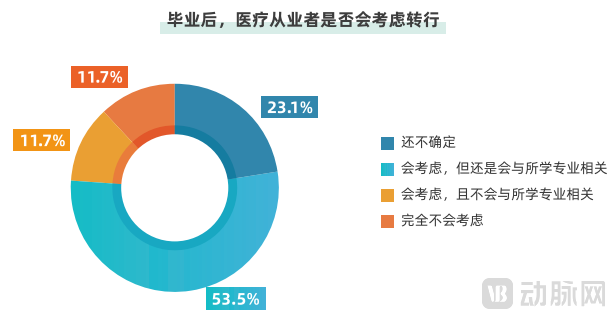
Image source: DXY Talent, "2021 China Healthcare Talent Development Report"
Dingxiang Talent has consistently analyzed the migration trends of healthcare professionals, revealing a prevalent flow from northwestern to southeastern regions. In 2020, 42.1% of job applications were submitted by candidates from northwestern areas (including Northwest, Southwest, North, and Northeast China) to southeastern regions (East, Central, and South China), whereas only 6.7% applied in the opposite direction. This indicates that talent is gravitating toward economically developed regions with a high concentration of large Grade A tertiary hospitals.
“Backend data shows that some job seekers, even if they do not meet the hiring requirements of major cities or top-tier tertiary hospitals, still compete to submit their resumes; whereas certain county-level hospitals have highly suitable positions, yet these candidates are unwilling to apply.” Shuai Yuhuan believes that the aspiration to “climb higher” is understandable, but the entrenched mindset on the supply side regarding employment, coupled with the relative inadequacy of grassroots medical institutions in developing disciplinary platforms, has resulted in an imbalance in the regional distribution of medical talent—a situation that will be difficult to rectify in the short term.
Furthermore, Shuai Yuhuan noted that in the post-pandemic era, healthcare professionals have shown a stronger preference for employment in public hospitals. On one hand, following the impact of the pandemic, medical talent generally perceives public hospitals as offering greater stability. On the other hand, declining compensation in private hospitals has reduced their attractiveness to talent. According to survey data from the “2021 China Healthcare Talent Development Report,” in 2021, incomes at private hospitals in first-tier and non-first-tier cities decreased by 13% and 10%, respectively, compared with 2018; similarly, incomes at tertiary and secondary private hospitals fell by 11% and 14%, respectively, relative to 2018 levels.
It is evident that a disparity exists between the supply and demand sides of medical talent: the pipeline of future professionals faces attrition risks, while homogeneous career perceptions have led to an uneven distribution of talent across various dimensions.
How to Narrow the Supply-Demand Gap for Medical Talent? This Requires Discussion from Multiple Levels.
At the policy level, top-level design is being strengthened to safeguard the supply of medical talent and promote balanced development of the talent structure. The Guiding Opinions of the General Office of the State Council on Accelerating the Innovative Development of Medical Education (hereinafter referred to as the “Opinions”), issued in 2020, proposes actively expanding enrollment for undergraduate medical programs, increasing support for the training of medical professionals within pilot reforms of admissions in basic disciplines, gradually scaling up the training of tuition-free, directionally contracted medical students to enhance the occupational appeal of grassroots healthcare services, and accelerating reforms to the compensation system for general practitioners while broadening their career development prospects.
As the “Opinions” continue to be implemented, the healthcare sector will see a larger and higher-quality pipeline of talent; policy incentives favoring grassroots levels are also expected to alleviate the uneven distribution of medical professionals.
At the level of human resource utilization in medical institutions, it is essential to balance talent attraction with sustained internal capacity building (“blood-making”). Currently, public hospitals hold significant advantages over private institutions in terms of compensation and benefits, as well as discipline development. Therefore, private medical institutions, in particular, need to strengthen their own internal capacity for cultivating talent.
At the conference, Lu Daopei Medical Group, Zhengzhou Daqiao Hospital, and other institutions shared their experiences in talent selection, utilization, development, and retention. Notably, Zhengzhou Daqiao Hospital has established a unique talent management system through self-sustained “blood-making” capabilities, tiered talent development, precise talent retention strategies, and emotion-based retention initiatives. Since its restructuring from the Railway Ministry’s Bridge Bureau Staff Hospital in 2004, when it had only over ten medical staff members, the hospital has expanded to currently employ more than 260 healthcare professionals. The hospital’s services have also experienced rapid growth; since 2019, the number of deliveries has exceeded 100,000 cases, making it the largest water-birth hospital in China.
Finally, from the perspective of social forces represented by recruitment platforms and other institutions, it is necessary to eliminate information asymmetry between supply and demand, achieve optimal person-job matching, and create a high-quality environment for the professional development of healthcare talent.
“For example, DXY Talent has applied AI technology to recruitment by extracting key fields from resumes to recommend more suitable positions for job seekers. AI technology not only learns static resume information but also dynamically tracks applicants’ submission behaviors, enabling more accurate assessment of their job-seeking intentions and thereby recommending increasingly appropriate roles,” introduced Shuai Yuhuan. In addition, DXY Talent has launched recruitment formats aligned with current new media communication trends, such as live-streamed job postings and online career fairs, to attract greater attention from healthcare professionals seeking employment. Looking ahead, DXY Talent will provide more specialized services and products to employers and collaborate with health IT vendors to launch human resource management tools, thereby empowering healthcare institutions.
Shuai Yuhuan further stated that, in addition to maintaining lifelong learning in their professional competencies, physicians also need to develop soft skills as workplace professionals, such as PowerPoint presentation and public speaking, doctor-patient communication techniques, and new media content creation. To this end, DXY Talent has launched the Workplace E-Academy to help doctors and nurses enhance their professional soft skills. “In short, making healthcare professionals more proficient is the unwavering pursuit and goal of DXY Talent.”
At the conference, Li Tiantian, founder and chairman of DXY, also noted that DXY provides continuous support across all stages of a physician’s career, including clinical practice, scientific research, professional promotion, examinations, employment, and academic activities. The company also delivers high-quality services and data to assist hospitals with talent recruitment, brand promotion, and overall operations. “We believe that sustained investment and effort can continuously improve the practice environment for physicians, encouraging more young people to don the ‘white coat’.”