

Global MedTech Giants Target the Booming $10B Venous Intervention Market: A New Profit Growth Frontier
Recently, interest in venous interventional medical devices has been on the rise.
From the perspective of clinical attention, although vascular surgery in China started relatively late, it has developed rapidly.Nowadays, the development of vascular surgery departments has become a key focus for primary-care hospitals, and venous diseases are indeed one of the main conditions prompting patients to seek care in vascular surgery. In China, the development of venous intervention-related devices is advancing at an ever-accelerating pace.
The fundamental reason behind the rising attention to the venous intervention industry is the high prevalence of venous diseases, which account for a significant proportion of peripheral vascular diseases and whose incidence rates are increasing year by year.
In this emerging market, which domestic companies possess comprehensive technical platforms and robust pipelines? Who has the strength to compete with imported brands for a share of the rapidly growing peripheral venous intervention market? VCBeat (WeChat ID: vcbeat) has conducted an analysis of this sector.
Venous intervention is a segment of the peripheral intervention market, and the domestic venous intervention market in China is experiencing rapid growth. In 2013, the market size for venous intervention devices in China was only RMB 370 million. By 2017, the market size had grown to RMB 890 million. This rapid growth trend is expected to continue rising swiftly alongside the increasing clinical application of venous intervention procedures.By 2022, the market size will reach RMB 3.1 billion, with a compound annual growth rate (CAGR) of 28.4%.
Venous diseases mainly include three major categories: varicose veins, deep vein thrombosis, and iliac vein compression.The patient populations for these three major diseases are substantial. In 2019, the number of patients with varicose veins in China reached as high as 390 million; there were 1.5 million patients with deep vein thrombosis; and the incidence of iliac vein compression affected 700,000 individuals, a figure projected to reach 2 million by 2030. This vast patient base offers immense growth potential for the venous intervention sector.
The most common disease affecting veins is varicose veins (VV), which occurs when superficial veins become dilated, swollen, and tortuous, or when venous valve insufficiency is present.
According to Frost & Sullivan, the number of varicose veins patients in China increased from 371 million in 2015 to 390 million in 2019, representing a compound annual growth rate (CAGR) of 1.8%. The large patient population continues to raise the ceiling for the varicose veins interventional treatment market.
Treatment options for varicose veins include traditional great saphenous vein stripping, foam sclerotherapy, and energy-based ablation therapy.
Energy Ablation Therapy is an emerging minimally invasive interventional technique that utilizes the thermal energy of laser, microwave, or radiofrequency waves to destroy and ultimately occlude veins. Among current energy ablation therapies, radiofrequency ablation is the mainstream approach.
Both the American Venous Forum and the National Institute for Health and Care Excellence recommend endovenous thermal ablation as the first-line treatment for varicose veins. However, in China, the methods currently adopted by most medical institutions are traditional high ligation and stripping of the great saphenous vein trunk and sclerotherapy.
With the rapid development and enhanced understanding in vascular surgery, emerging radiofrequency ablation therapy is replacing traditional stripping surgery.
Against this backdrop, the volume of radiofrequency ablation procedures has grown rapidly. In China, only 2,700 patients underwent radiofrequency ablation for varicose veins in 2015, a figure that surged to 26,300 by 2019, representing a compound annual growth rate (CAGR) of 76.9%.
In addition to varicose veins, a common chronic venous disease, venous disorders also include deep vein thrombosis (DVT), the “silent killer” that can lead to pulmonary embolism with a high mortality rate.
Interventional surgical treatment has become the first-line therapy for lower extremity deep vein thrombosis in China, primarily comprising four procedural types: catheter-directed thrombolysis (CDT), percutaneous mechanical thrombectomy (PMT), percutaneous transluminal angioplasty (PTA) combined with stent implantation, and inferior vena cava filter (IVCF) placement.
Inferior vena cava filters (IVCFs) primarily serve an interceptive function; they are implanted in large veins to trap large thrombi and prevent them from traveling to the lungs. Catheter-directed thrombolysis (CDT) involves the direct infusion of thrombolytic agents into the thrombus via a thrombolysis catheter.
Percutaneous Mechanical Thrombectomy (PMT) primarily employs rotational turbine or hydrodynamic principles to fragment or aspirate thrombi, thereby rapidly clearing or reducing the thrombus burden. Compared with Catheter-Directed Thrombolysis (CDT), PMT can be performed in a shorter timeframe, reduces the usage of thrombolytic agents, and shortens hospital stays. Currently, thrombus aspiration procedures for Deep Vein Thrombosis (DVT) are experiencing rapid growth in China.
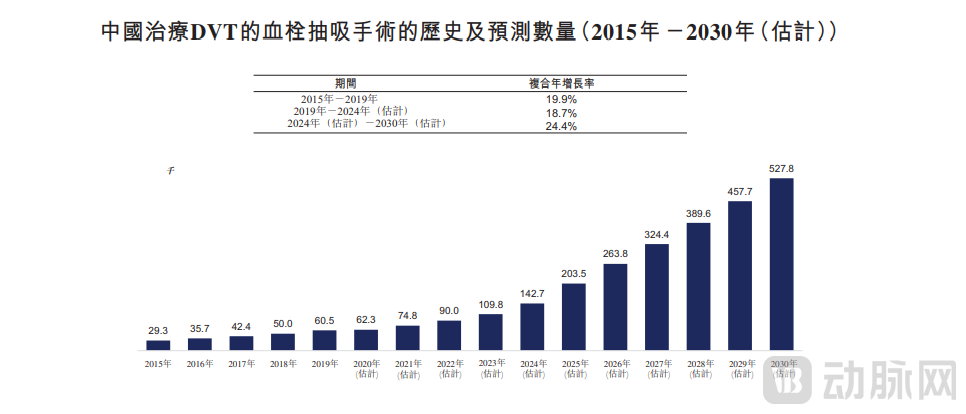
Data source: Frost & Sullivan
In the field of venous interventions, there is another emerging therapeutic area: the treatment of pulmonary embolism.
Simply put, pulmonary embolism occurs when the deep vein thrombosis (DVT) mentioned above causes an obstruction in the pulmonary artery during its return journey to the heart.Pulmonary embolism is currently one of the three most common fatal cardiovascular diseases, characterized by high incidence, high disability rate, and high mortality.
Anticoagulation or thrombolytic therapy is currently the most commonly used treatment strategy, but it carries a high risk of major bleeding. Therefore, over the past five years, several devices have been introduced to the market; many thrombectomy devices originally designed for treating venous thromboembolism have been repositioned and iteratively redesigned for use in pulmonary embolism.
It is anticipated that the treatment of pulmonary embolism will also become a significant market segment for thrombectomy products in the future.This emerging market remains untapped in China, with a large number of imported and domestically produced devices poised for launch.
Iliac Vein Compression Syndrome (IVCS) is also a common condition in the field of venous diseases. IVCS refers to the compression of the iliac vein by the iliac artery crossing over its anterior aspect, leading to changes such as intraluminal adhesions, luminal stenosis, or occlusion, which subsequently impede iliac venous blood flow and result in a series of clinical symptoms. The primary medical device indicated for Iliac Vein Compression Syndrome is the iliac vein stent.
In China, the venous intervention market is still in its introductory phase. The devices used for interventional treatment of venous diseases are predominantly supplied by importers, particularly active interventional devices.
First, let’s examine the radiofrequency ablation market in the field of varicose veins. Currently, all radiofrequency ablation products marketed in China are imported.
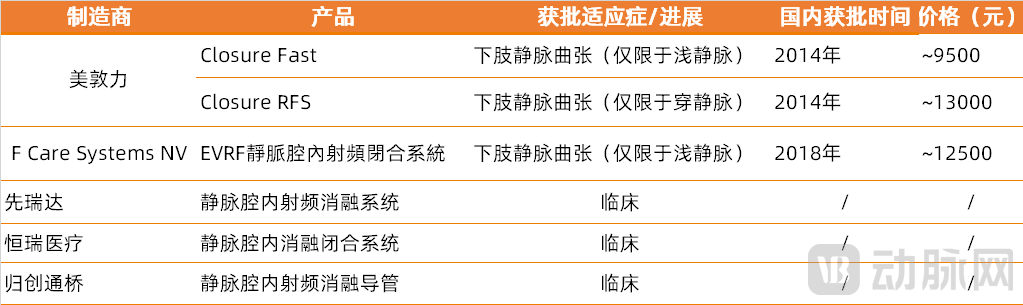
Radiofrequency Ablation Products Approved in China & Products Under Development
Radiofrequency ablation primarily involves two key technologies: radiofrequency generators and ablation catheters. The manufacturing of radiofrequency ablation systems and the control of energy sources represent core technical challenges. According to Frost & Sullivan, many domestic players in the Chinese market can only manufacture catheters and lack the capability to independently develop radiofrequency generators, which significantly undermines their products’ competitiveness. Moreover, radiofrequency generators can be utilized in various clinical treatments, meaning that mastery of this technology can simultaneously open doors to multiple interventional fields.
Among domestic manufacturers, three companies are developing radiofrequency ablation systems and catheters, with Acotec being the only peripheral intervention manufacturer that possesses both radiofrequency generators and radiofrequency catheter devices.
The market landscape characterized by import monopoly also exists in the thrombectomy aspiration market. All nine peripheral mechanical thrombectomy products currently marketed in China are from imported companies. Furthermore, although approved thrombectomy aspiration products can be used in the peripheral system according to their indicated indications, they are more commonly used for coronary aspiration in actual clinical practice.Currently, Boston Scientific's AngioJet dominates the market for peripheral vascular aspiration devices in clinical practice.
AngioJet utilizes high-velocity water jets to fragment and aspirate thrombi. Thrombolytic agents, such as urokinase, are added to the jet stream. This technique involves thrombolysis combined with thrombus aspiration rather than mechanical cutting, making it more suitable for fresh thrombi. However, due to the use of thrombolytic agents, there is an elevated risk of bleeding and myoglobinuria.
In China, Acotec has been developing its peripheral aspiration platform since 2019, establishing a full-line solution ranging from aspiration pumps to aspiration catheters. Acotec’s peripheral aspiration system is expected to be the first domestically produced peripheral aspiration system approved by the National Medical Products Administration (NMPA).
Iliac vein stents are currently monopolized by imported products and are primarily used to treat iliac vein stenosis. At present, only two iliac vein stent products have been approved in China: Zilver Vena from Cook Medical and Venovo from BD Medical.
Five iliac vein stents in China are currently in clinical trials and will soon be launched on the market. It is foreseeable that fierce competition will emerge in the iliac vein stent sector. Currently, Cook Medical’s iliac vein stent is priced relatively high, with a winning bid price of RMB 28,000. As more domestically produced products enter the market, the prices of iliac vein stents are expected to drop significantly.
The vena cava filter market is the only one where domestically produced products hold a high market share. Domestic vena cava filters received approval relatively early; there are currently seven marketed vena cava filter products in China, two of which are domestically produced.
The global venous intervention market is experiencing rapid development, particularly in China, where the market is just beginning to scale up. The neurointerventional sector has already seen the emergence of Penumbra, which reported revenues exceeding $300 million in 2019. Who has the potential to become the “Penumbra” of the peripheral intervention field?
Major listed companies in the peripheral venous intervention field in China include Acotec (which has passed the HKEX hearing), Lifetech Scientific, MicroPort Endovastec, and JetMed.
Xianjian Technology’s venous intervention products primarily consist of inferior vena cava (IVC) filters. MicroPort Endovastec focuses its business on aortic interventions, and has currently initiated R&D for multiple products in the venous space, including iliac vein stent systems, IVC filters, and venous thrombectomy devices. JetMed has currently laid out a product portfolio that includes IVC filters, iliac vein stents, and radiofrequency ablation catheters.
AcuMedica has adopted a differentiated strategy in venous intervention, focusing its R&D efforts on breaking through high barriers with radiofrequency ablation systems and thrombus aspiration products.
In the blue ocean of varicose vein treatment, Acotec is one of the few domestic vascular intervention companies that has independently developed a radiofrequency (RF) generator with advanced functionality. The Acotec RF generator can rapidly reach the target ablation temperature and automatically adjust its output to maintain the ablation temperature within a safe range.Furthermore, Priora’s radiofrequency (RF) generator is applicable to a variety of indications—such as electrophysiology-related RF ablation, tumor-related RF ablation, and even peripheral artery denervation ablation—featuring multiple operating frequencies and compatibility with a wide range of catheter types.
The radiofrequency ablation system developed by Acotec has entered the clinical research phase. It is expected to break the monopoly of imported products after its future market launch, providing domestic physicians with a comprehensive radiofrequency ablation solution.
In addition, in the deep vein thrombosis market, Acotec has established a thrombus aspiration platform and developed a peripheral thrombus aspiration system tailored to the needs of the peripheral intervention field, which includes disposable suction connecting tubes, an aspiration pump, and thrombus aspiration catheters.Xianruida is one of the few companies in China capable of manufacturing both aspiration pumps and aspiration catheters.
Acandis holds a dominant position in the field of drug-coated balloons for peripheral arterial interventions and possesses established channel and market advantages in the peripheral intervention sector. Consequently, market uptake of its products is expected to be relatively easy following the approval of its peripheral venous intervention products.
In the emerging market of venous interventions, major domestic interventional device companies have recognized this opportunity. The ultimate leader will be determined by comprehensive strengths, including innovation capabilities, deep clinical understanding, R&D prowess, and execution ability. Acandis possesses extensive experience in peripheral interventions and has built reserves across four key technology platforms: drug-coated technology, aspiration platform technology, polymer material technology, and radiofrequency ablation technology. With venous intervention as a strategic focus, Acandis is poised to become the leading player in this field.
Reference: "Office Workers'" Common Ailment—Lower Extremity Varicose Veins—Xiaoxiang Famous Doctors
A Comprehensive Review of Treatment Techniques for Lower Extremity Varicose Veins: Laser? Radiofrequency? CHIVA? — Dr. Zhang Qiang
Qi Wei, Vice President of Hechuang Capital: Interventional Therapy for Pulmonary Embolism—The Most Valuable New Track in the Interventional Field Over the Next Decade — Hechuang Capital
Advances in the Application of Debulking Techniques for Peripheral Artery Disease—Xiaolang Jiang, Zhihui Dong, Weiguo Fu