

3D Tribe: Pioneering High-Temperature PEEK 3D Printing to Bridge Additive Manufacturing and Medical Implants
The Third Industrial Revolution, represented by 3D printing, is characterized by digitization, AI-driven manufacturing, and the application of new materials.
——The Economist
3D printing, also known as additive manufacturing, is defined in contrast to “subtractive manufacturing.” Most commonly used material processing techniques are based on subtractive manufacturing, which involves shaping objects by removing or cutting away raw materials. In contrast, additive manufacturing constructs objects directly through the layer-by-layer accumulation of raw materials.
Compared with traditional subtractive manufacturing, 3D printing offers advantages such as the ability to produce items with complex geometries without increasing costs, no requirement for specialized manufacturing skills, and reduced waste generation, making it suitable for low-volume, customized, and geometrically complex products.
After more than 30 years of development, 3D printing has gradually matured and formed a relatively complete industrial chain. In its downstream applications, healthcare is an industry that can be deeply integrated, as medical devices such as surgical guides, medical implants, and dentures have high requirements for personalized customization.
3DPro, a company approaching its 15th year in the 3D printing industry, is currently focusing on strategic expansion into the medical sector. Its independently developed medical-grade PEEK 3D printer, “Niu Mowang,” was launched in 2019 and has garnered significant attention within the industry.

Medical Specialty Equipment - Niumowang KB3/KB3M Source: 3DPro
Now that “Niu Mo Wang” has been upgraded to a new generation, 3DPro’s blueprint in the medical field has become clearer. Based on this, VCBeat conducted an interview with Mr. Xu Jianhui, founder of 3DPro.
From distributing foreign products to independent R&D, and from equipment manufacturing to application services, Xu Jianhui has accompanied the enterprise through its 14-year journey.
Xu Jianhui, a graduate of Beihang University with a major in Computer-Aided Design and Manufacturing (CAD/CAM), planted the seeds of his interest in 3D technology during his student years.
After graduation, he worked successively at the Shanghai Aircraft Manufacturing Factory and Daheng Technology. During this period, he not only gained a deeper understanding of traditional manufacturing but also had his first hands-on exposure to 3D printing technology, becoming highly optimistic about its development prospects. Thus, the seed of 3D printing was sown.
Confucius said, “At thirty, I stood firm; at forty, I had no doubts.” In his 38th year, Xu Jianhui made the decision to start a business.
Why is the company named “3DPro”?
“3D technology will transform every aspect of our lives in the future. I believe that a community of professionals engaged in 3D design, creativity, and manufacturing will emerge. United by their passion for 3D technology, they will form a tribe—hence the company name ‘San de Buluo’ (3D Tribe).””
This team brings together technical talent from both domestic and international markets. Its Technical Director, Mr. Rainer Guenther, hails from Germany. Since 1986, he has served as an engineer and Technical Director at REMA GmbH in Germany, accumulating extensive practical experience, particularly with in-depth expertise in Fused Deposition Modeling (FDM) technology.
Mr. Ye Lingyi, Director of Application Expansion, graduated from Shanghai Jiao Tong University. He furthered his studies at the University of Liverpool in the UK, where he earned a Ph.D. in Advanced Laser Material Processing, specializing in cross-industry research and development of 3D printing applications.
3DPro is also set to welcome a new team member with extensive experience in channel expansion and development, who will play a key role in its future overseas market expansion.
In addition to its core team, 3DPro boasts a wealth of talent specializing in the integration of medicine and engineering. As the company’s 3D printing business is strategically focused on the healthcare sector, there is a strong demand for professionals who can effectively communicate with clinicians while applying engineering methodologies to solve practical problems.
There is a shortage of such interdisciplinary talents in medicine and engineering. 3DPro’s primary solution relies on internal cultivation, namely, continuously accumulating practical experience through hands-on collaboration with healthcare industry clients. Currently, it has established an R&D team centered around German engineers.
Xu Jianhui appeared more at ease when introducing the business and technology of 3DPro(Shanghai)Technology Co.,Ltd.
3DPro’s business primarily comprises three major segments: sales of 3D printing materials, sales of equipment (including both distributed and proprietary products), and printing services, with equipment sales currently serving as the core focus.
The most distinctive and advantageous products and services are the PEEK high-performance 3D printing series, with their most prominent features lying in the printing materials and printing technology.
PEEK (polyether ether ketone) is a high-performance material with excellent mechanical properties, corrosion resistance, and high-temperature tolerance. Its long-term operating temperature can reach up to 260°C, enabling it to withstand various extreme and harsh working environments. Due to its superior comprehensive performance, it is regarded by the engineering community as “one of the most promising materials of the 21st century.”
Research on PEEK materials is also a hot topic in the medical community, as they exhibit excellent biocompatibility and an elastic modulus close to that of human bone. When used as implant materials, they do not cause adverse reactions due to metal ion leaching and can, to some extent, mitigate or even eliminate the stress shielding effect, thereby facilitating integration between the implant and bone tissue.
Furthermore, PEEK material does not produce artifacts under CT and MRI scans, which is more conducive to postoperative observation. This means that in the medical field, it will be an ideal material for artificial bones, and may even replace the currently widely used titanium alloy materials in more scenarios in the future, with broad application prospects.
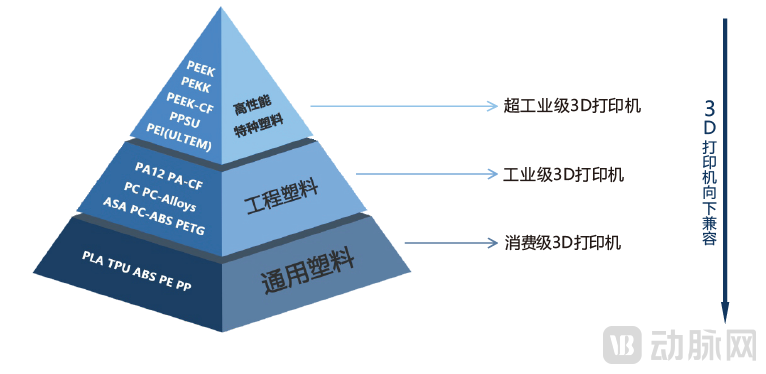
Plastic Performance Pyramid Source: 3DPro
However, this material is relatively expensive, limiting its widespread application. Nevertheless, 3D printing can reduce material waste, thereby offsetting its high cost. Yet, to achieve practical application of PEEK materials, technical challenges in printing technology must still be overcome.
3DPro focuses on FDM printing technology for thermoplastic materials, a widely applicable technique with relatively low technical barriers. However, PEEK has a high melting point of 343°C and is highly sensitive to temperature fluctuations. This not only requires the printer to operate at high temperatures but also demands precise thermal control to prevent product deformation during the printing process.
The difficulty of printing PEEK materials is widely acknowledged within the industry. The fact that even some international 3D printing giants have been slow to launch their own PEEK 3D printing solutions further underscores the technical challenges involved.
To address the challenges of warpage and deformation during high-temperature printing while ensuring material performance, temperature control is the key solution, representing the core technological advantage of 3DPro.
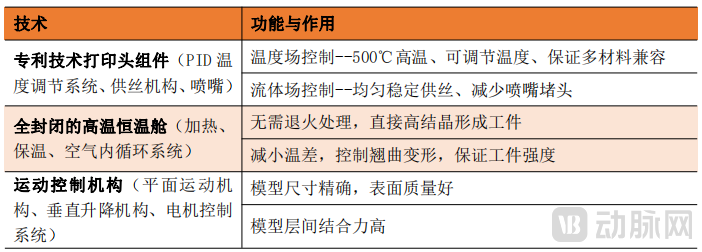
Source: 3DPro Tribe
Parts printed by 3DPro using patented technology do not require annealing, saving both time and costs. Meanwhile, the printed products exhibit a Z-axis tensile strength (interlayer bonding force) that is 50% higher than that of similar competitors.
Of course, 3DPro did not start its R&D from scratch. As Xu Jianhui stated, “We are standing on the shoulders of giants.”
On one hand, during the agency period, 3DPro accumulated and absorbed a significant amount of technology and expertise from Stratasys. On the other hand, Shanghai Jiao Tong University serves as the technical backbone for 3DPro. 3DPro has established collaborative partnerships with the School of Mechanical Engineering and the School of Medicine at Shanghai Jiao Tong University, particularly in expanding applications within the medical field.
In fact, 3DPro has deep-rooted ties with Shanghai Jiao Tong University (SJTU). Its predecessor was Shanghai SJTU Huigu Digital Equipment Technology Co., Ltd. (hereinafter referred to as “SJTU Huigu”), an enterprise affiliated with SJTU. In response to the policy mandating the separation of universities and their affiliated enterprises, SJTU Huigu was required to operate independently, leading to the establishment of 3DPro on this foundation. The two parties collaborated in the research and development of the 3DPRO 3D scanners and printers, which have achieved world-leading standards.
3DPro had limited technical accumulation in its early startup phase, primarily serving as a distributor for Stratasys’s flagship 3D printing products.Amid changes in the global trade landscape and driven by its own business development needs, 3DPro has embarked on independent research and development.
Xu Jianhui said, “Since we are named ‘3D Tribe,’ we carry a certain sense of mission. We aim to better promote 3D technology and hope to deliver social benefits.”
Before the launch of their self-developed products, they made relentless technical efforts, or as they put it, pursued specialization, excellence, and depth. They aimed to deliver high-quality solutions in every niche segment and establish industry benchmarks. Only with these foundations in place could the company achieve rapid growth.
3DPro began independent research and development in 2017. In 2019, its first self-developed medical-grade PEEK high-performance material 3D printer, “Niu Mowang,” made its debut, further solidifying 3DPro’s foundation within the industry.
The name “Bull Demon King” also embodies the aspiration of 3DPro: “to print exceptional materials using our own cutting-edge equipment.” Today, version 2.0 of the “Bull Demon King” has been freshly launched.
Currently, 3DPro’s self-developed products that have been launched include the dedicated medical device “Niu Mo Wang,” the industrial equipment “Sheng Chan Xian,” and the desktop PEEK 3D printer “Xiao P Hai.” In the niche market of PEEK material printing, it has secured a leading position through its high-temperature printing technology and has received numerous awards.
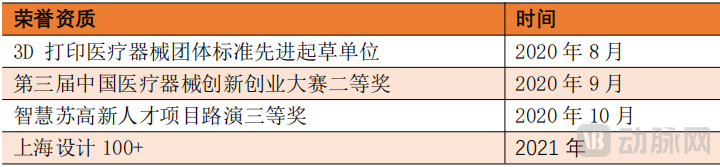
Honors Received in 2020-2021 Source: 3DPro
According to an industry report by Ping An Securities, China’s 3D printing industry is projected to reach a scale of tens of billions of U.S. dollars in 2023. As an industry matures, the downstream application and service sector inevitably accounts for the largest share of output value. Currently, the downstream application market for 3D printing is gradually expanding, and it is estimated that by 2025, the market size of 3D printing services will account for approximately 58% of the overall market.
Healthcare is poised to become a flourishing domain for 3D printing, with the current aging trend providing ample room for its development in the medical sector. 3DPro (Shanghai) Technology Co., Ltd. has already established collaborations with Shanghai Ninth People’s Hospital, the First Affiliated Hospital of Army Medical University, Xijing Hospital, and Zigong Fourth People’s Hospital. Looking ahead, the company stated that it will continue to deepen its engagement in 3D-printed medical devices and expand the application scenarios of its products.
More practically, realizing these plans requires support in multiple areas, including talent and funding. 3DPro has stated that it is preparing to raise funds in the near future to promote the expansion and upgrading of its R&D, production capacity, and market presence.