

ClinBrain: The Quiet Leader in China's $100B Medical Big Data and AI Market
Since the millennium, hospital informatization has advanced vigorously. Starting with Hospital Information Systems (HIS) centered on the digitalization of business processes, the industry has progressed through the “business process digitization” era—marked by Clinical Information Systems (CIS) focused on standardizing clinical practices, and mobile internet technologies aimed at extending medical services—and is now advancing into a new era of intelligent applications underpinned by big data, namely “Medical Big Data + AI.”
The transition of eras signifies the renewal of demands. In the era of "digitalization of business processes," the mainstream medical digitalization sector was dominated by several established vendors. With the advent of the "Medical Big Data + AI" era, hospital needs in clinical care, scientific research, and management have become further refined. Enhancing hospital management efficiency and disciplinary capabilities has become a top priority for high-quality hospital development—objectives that traditional medical digitalization products cannot fulfill.
As the once-fragmented healthcare digitalization market is reshaped by technology, a wave of health IT startups has emerged. These companies aim to address the data silos left over from the period of hospital transformation by starting with the standardization and post-structuring of hospital data, while effectively leveraging digitization and artificial intelligence technologies to progressively unlock the inherent value of healthcare big data.
Thus, “medical big data” has become the hottest buzzword for startups and transforming enterprises in recent years. Whether in primary markets, secondary markets, or various healthcare industry conferences, providers and vendors of medical big data services have begun to emerge, along with concepts such as medical data governance and intelligent healthcare. However, the development and delivery of medical big data solutions are highly challenging and resource-intensive endeavors, requiring years of accumulation to establish relatively high barriers to entry. In this landscape, who is the understated king?
Founded in 2013, ClinBrain chose a path from day one that was “exceptionally arduous” but later proven to be “absolutely correct.” Co-founder Qin Xiaohong had been engaged in software development and product design for Hospital Information Systems (HIS) and Electronic Medical Records (EMR) at well-known domestic enterprises since 2002, overseeing the delivery of business systems for numerous large Grade A tertiary hospitals. This experience gave him profound insight into the phenomenon of “data silos” within hospitals. Since its inception, the company’s primary and most persistent challenge has been to integrate data from hundreds of systems provided by dozens of vendors across a hospital into a unified data platform, without relying on interfaces from third-party business system providers such as HIS or EMR vendors.
“In the first three to five years, identifying the data models of business system databases from different vendors was extremely challenging. Due to vast discrepancies in field naming conventions—ranging from Chinese abbreviations and English terms to hybrid Chinese-English nomenclature—and a lack of cooperation from vendors who withheld their data dictionaries, we had to rely entirely on manual effort. We painstakingly analyzed each field and each workflow one by one. Over the years, this gradual accumulation of experience has evolved into a robust knowledge base. Today, we can automatically identify data models across different versions for more than 500 business system vendors.” Recalling the arduous journey of the past, Qin Xiaohong described it as vividly as if it had happened just yesterday.
However, data integration and aggregation are merely the first step in building medical big data infrastructure; a more challenging task lies ahead: the issue of data quality.
First, due to the historical scarcity of domestic standards for medical digitalization, healthcare IT vendors developed their business systems entirely based on proprietary, enterprise-defined specifications. Even fundamental data elements, such as “gender,” were not defined in accordance with national standards. Second, hospital information systems were designed merely to ensure operational workflow continuity, with little regard for data quality. This neglect has resulted in various data integrity issues, including mismatches between master and detail tables, incorrect logical relationships, and data inconsistencies. Finally, clinicians often failed to adhere to standardized documentation practices when writing medical records and diagnostic reports. The widespread use of unstructured, habit-based clinical documentation by physicians has significantly hindered the high-quality execution of scientific research and quality control initiatives.
During this big data governance process, ClinBrain has built an extensive library of healthcare industry standards and medical terminologies. It has implemented standardized mapping for non-standard data, post-structuring for unstructured data, and cleansing for dirty data. Over more than eight years of accumulation, the company has honed its capability to build high-quality hospital data platforms, earning a strong reputation within the industry.
“ClinBrain’s big data platform boasts the most comprehensive data dimensions, with over 10,000 clinical data fields alone. In comparison, its data quality is indeed excellent, providing comprehensive, accurate, and high-quality data support for hospital operational management, performance evaluation, and clinical research,” said Zheng Tao, an architect in the Information Department of West China Hospital.
Since partnering with West China Hospital, ClinBrain has increasingly gained the favor of authoritative tertiary Grade-A hospitals. “We are honored to have established a collaboration with West China Hospital. Being selected by West China Hospital was akin to undergoing a selection process as rigorous as the ‘Gaokao’ (China’s National College Entrance Examination). After completing the top-level design for healthcare big data, West China Hospital provided a ten-year business data environment within the hospital. Technical experts from the Hospital’s Information Department designed a ‘Gaokao-style’ examination to validate capabilities in medical big data technology, covering dimensions such as data integration, data modeling, data quality, data search, data mining, and artificial intelligence. Thirty-seven vendors participated in this eight-month evaluation, and ClinBrain ultimately emerged as the ‘top scorer,’ thereby securing the opportunity to collaborate with West China Hospital!” recalled Qin Xiaohong, reflecting on the process through which ClinBrain “gained admission” to West China Hospital.
In addition, Ruijin Hospital, ranked fourth in the Fudan University Hospital Rankings, has selected ClinBrain among numerous vendors to jointly build a medical big data governance platform and application platform. Other top-100 authoritative Grade A tertiary hospitals collaborating with ClinBrain include the First Affiliated Hospital of Naval Medical University, the First Affiliated Hospital of Army Medical University, Fudan University Shanghai Cancer Center, and Shanghai Mental Health Center. Furthermore, many leading provincial and municipal hospitals, such as Guizhou Provincial People's Hospital, Hubei Provincial People's Hospital, Guangxi Zhuang Autonomous Region People's Hospital, the First Affiliated Hospital of Shandong First Medical University, Foshan First People's Hospital, and Suzhou Municipal Hospital, have also successively chosen ClinBrain to construct their big data platforms.
In the healthcare digitalization industry, reputation has always been paramount. Adhering to a low-profile and pragmatic approach, the company has turned every hospital client into a “premium case study,” thereby converting its strong reputation into market strength. Thanks to this strategy, statistics based on publicly available bidding and award data from hospital big-data platforms show that ClinBrain has achieved a cumulative market share of 28.69% over the past six years, firmly securing its position as the industry leader.
Amidst today’s complex and volatile international landscape, domestic technology companies are compelled to pursue independent innovation and self-reliant research and development. As a pioneer and leader in the hospital big data industry, ClinBrain has adhered to a strategic commitment to independent innovation and in-house R&D since its inception. The journey has been long and arduous. From developing proprietary ETL tools and natural language processing (NLP) systems to building independent metadata management and big data visualization platforms, every step involved overcoming numerous challenges. Nevertheless, to avoid dependence on foreign technologies and tools, ClinBrain has blazed a trail through these obstacles, establishing its own proprietary technologies across data integration, data governance, and intelligent data applications, while securing relevant invention patents and software copyrights.
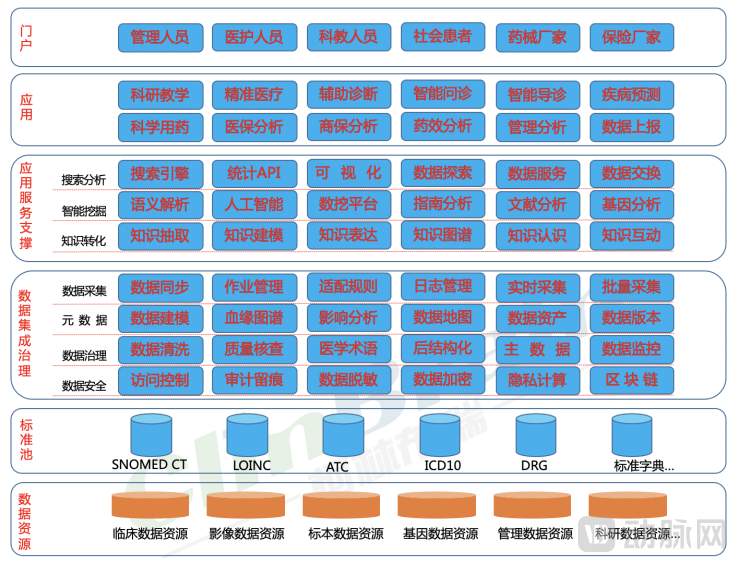
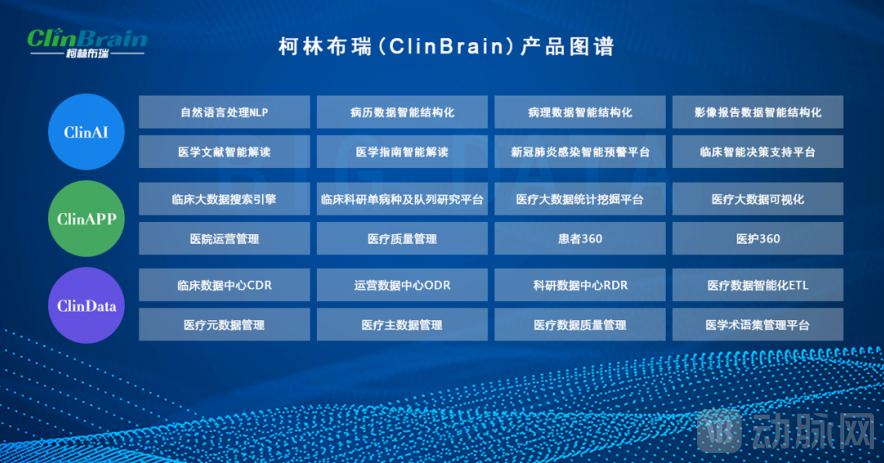
Building upon the foundational technologies of medical big data, ClinBrain has developed its “ClinData” series of data middle-platform and data governance products, centered on Clinical Data Repository (CDR), Operational Data Repository (ODR), Research Data Repository (RDR), intelligent ETL for medical data, medical metadata management, medical master data management, and medical data quality management. It has also established its “ClinAPP” series of medical data application products, represented by a clinical big data search engine, platforms for single-disease and cohort studies in clinical research, a medical big data statistical mining platform, medical big data visualization, hospital operational management, medical quality management, Patient 360, a 360-degree competency model for medical, nursing, and technical staff, and performance evaluation for public hospitals. Furthermore, it has formed its “ClinAI” series of intelligent medical products, featuring natural language processing (NLP), intelligent structuring of medical record data, intelligent interpretation of medical literature and clinical guidelines, an integrated platform for intelligent prevention and management of venous thromboembolism (VTE), an intelligent decision-making platform for rare diseases, and an intelligent early warning platform for COVID-19 infection.
Leveraging a high-quality medical big data platform, the company’s competitive advantages in developing medical AI products have become increasingly prominent. Its offerings—ranging from the existing integrated intelligent prevention and management platform for venous thromboembolism (VTE) and the intelligent decision-making platform for rare diseases, to the clinical decision support systems under development for diverse clinical scenarios—have garnered strong recognition from hospital users.
These products have been successfully implemented in hospitals, delivering substantial benefits. In terms of research support, clinicians at West China Hospital have adopted the clinical big data search engine as a routine tool in their research workflows, with over 8,000 user sessions per month. After the single-disease research module was deployed in the Department of Gastrointestinal Surgery at Ruijin Hospital, more than 45 papers were published within one year, including 23 indexed by SCI, with a cumulative impact factor exceeding 70. All research projects and single-disease initiatives at the Shanghai Mental Health Center are built on the big data platform constructed by ClinBrain. Regarding performance evaluation support for public hospitals, in addition to providing robust support for mega-hospitals such as West China Hospital and Ruijin Hospital, several medium-sized hospitals have also achieved remarkable results thanks to high-quality data platforms. Notably, the Shanghai Integrated Traditional Chinese and Western Medicine Hospital ranked second nationwide in the performance assessment of integrated TCM and Western medicine hospitals, and Chengdu Fifth People’s Hospital ranked first among municipal hospitals.
For years, ClinBrain has adhered to a development model centered on “self-sustaining revenue generation as the primary driver, with capital infusion as a supplementary support.” “The medical digitalization industry is fundamentally different from the internet sector; companies cannot grow simply by burning cash. Whether offering data-driven or AI-powered solutions, they must ultimately address users’ real-world problems and convince them to pay for these services. The strength of a company’s self-sustaining revenue capability genuinely reflects the level of recognition its products receive from healthcare institutions. ClinBrain remains committed to this commercialization path, prioritizing product excellence and market competitiveness to ensure steady growth. That said, we highly value the catalytic role of capital. Following our Series A and B funding rounds, we have recently launched our Series C financing,” said Liu Huanchun, founder of ClinBrain, when asked why the company has maintained such a low profile in the investment community.