

MedAlliance Submits IPO Prospectus Highlighting Its Breakthrough Sirolimus Drug-Coated Balloon SELUTION SLR

MedAlliance
Developer, Manufacturer, and Distributor of Drug-Device Combination Products
Drug-Coated Balloon (DCB) combines balloon angioplasty technology with drug-eluting technology. By attaching antiproliferative agents to the balloon surface, it delivers the drug into the local vascular wall of the lesion upon balloon inflation, thereby inhibiting smooth muscle hyperplasia.
As“Intervention Without Implantation”As an emerging technological concept, drug-coated balloons are used in coronary and peripheral arterial interventions. Compared with drug-eluting stents (DES), they demonstrate superior efficacy in treating small vessel disease, bifurcation lesions, and in-stent restenosis (ISR) of the coronary arteries.
Currently, in the coronary and peripheral intervention markets, most drug-coated balloons (DCBs) utilize paclitaxel coatings. Paclitaxel is a commonly used agent for both DCBs and drug-eluting stents (DES) due to its rapid absorption rate and prolonged drug retention. However, paclitaxel-based DCBs and DES are associated with issues such as long-term embolization caused by coating particle detachment and suboptimal performance within calcified vessels. Consequently, the majority of DES have previously shifted towards using rapamycin (sirolimus) coatings.
However, rapamycin suffers from low lipophilicity, slow tissue absorption, and poor stability, making it difficult to adhere to the balloon surface. Furthermore, in the case of drug-coated balloons (DCBs), balloon expansion within the vessel causes occlusion and cessation of blood flow, resulting in a very short drug release duration.The use of rapamycin alone is not very effective.。
To further optimize the efficacy and safety of drug-coated balloons and make rational use of sirolimus, relevant companies need to invest significant effort in drug-coating technology. MedAlliance is one such company; its core product, Selution SLR, is a sirolimus-eluting drug-coated balloon indicated for the treatment of arteriovenous fistulas (AVF), in-stent restenosis of coronary arteries, primary coronary artery disease, and below-the-knee (BTK) peripheral lesions.
MedAlliance is a medical technology company founded in 2008, headquartered in Switzerland, with manufacturing facilities in Irvine, California; Glasgow, United Kingdom; and Singapore.
As one of the founders of MedAlliance, John Shulze assembled the initial engineering team and has served as the lead designer for the company’s Selution SLR drug-coated balloon technology. He previously co-founded Albion Instruments, where he developed laser-based instruments for the precise measurement of anesthesia depth and respiratory/gas exchange in patients undergoing general anesthesia. Meanwhile, he is alsoCo-founder of Biosensors (Biosensors International), designed the company's first drug-eluting stent with a biodegradable polymer coating.
Jeffrey B. Jump is the Chairman and Chief Executive Officer of MedAlliance, with nearly 40 years of experience in the international medical device industry. He was previously with a company listed on the Singapore Exchange.CEO of Biosensors, having worked at the company for 13 years. During this period, Biosensors evolved from a startup into the world’s fourth-largest manufacturer of coronary stents, trailing only Abbott, Boston Scientific, and Medtronic.
Meanwhile, Jeff has also served as a non-executive director at multiple medical device companies, including Symetis (acquired by Boston Scientific) and PneumRx (acquired by BTG). He currently serves as an independent board member of Impulse Dynamics and as Chairman of the Board of Aleva Neurotherapeutics S.A.
Furthermore, Scott Addonizio serves as Chief Operating Officer of MedAlliance, with over 24 years of experience in the medical device industry. He possesses specialized expertise in balloon and stent manufacturing, and is“Dual-Helix Design Stent” Patent’s Primary Holder, this patent provides support for all OrbusNeich stent platforms. Currently, he also serves as a Director of OrbusNeich Medical, overseeing its global operations.
MedAlliance’s core product, Selution SLR, is a sirolimus-eluting balloon that provides sustained drug release. Utilizing the latest generation of drug-coating technology, it aims to achieve efficacy and safety comparable to those of drug-eluting stents, while leaving no residue in the human body.Selution enables controlled, sustained release of sirolimus for up to 90 days of therapy.。
This drug-eluting balloon has achieved a new breakthrough in drug-coating technology, featuring globally patented coating technology.
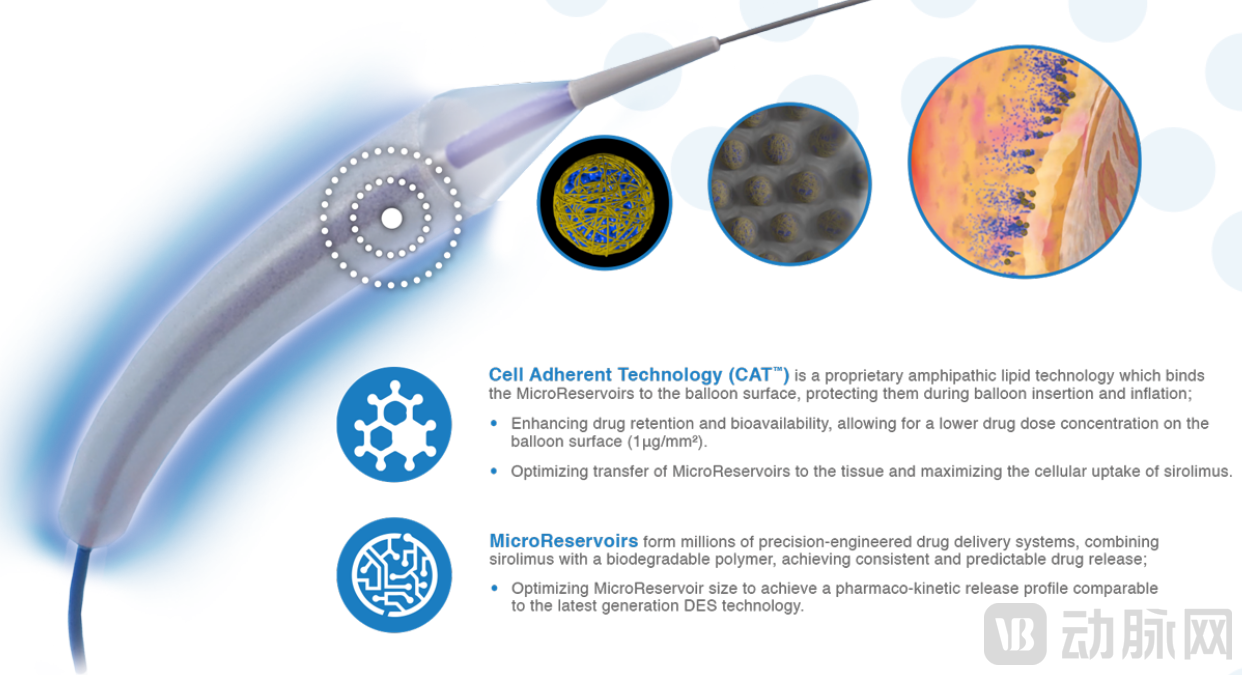
Source: MedAlliance Official Website
MicroReservoir Micro-Reservoir Technology
Composed of a biodegradable polymer blended with the anti-restenotic drug sirolimus, forming on the balloon surfaceMillions of Precision Drug Delivery Systems, achieving controlled and sustained drug release. MedAlliance optimizes the size of its micro-reservoirs to achieve a pharmacokinetic release profile comparable to that of the latest generation of DES technologies.
CAT Cell Adhesion Technology
A proprietary amphiphilic lipid technology that coats microreservoirs onto the balloon surface and protects them during balloon intervention and expansion. This technology also enhances the absorption and bioavailability of sirolimus, reduces the drug concentration remaining on the balloon surface (1 μg/mm²), and maximizes drug transfer efficiency.
Specifically, the CAT technology functions in three steps, which MedAlliance officially categorizes as “Mechanical,” “Electrostatic,” and “Biological.” First, the balloon expansion process within the body is optimized to ensure that the drug coating adheres closely to the vessel wall. Due to ionic interactions, the drug coating is absorbed into the vascular wall. Meanwhile, the drug coating is lipophilic, enabling it to bind with the lipid cells of the vessel wall.
To accommodate the varying vascular conditions of different patients, MedAlliance offers a wide range of balloon specifications. For instance, in coronary interventions, MedAlliance provides the Selution SLR balloon in diameters ranging from 1.50 mm to 5.00 mm and lengths from 10 mm to 40 mm.
Meanwhile, MedAlliance is continuously expanding the indications for the Selution SLR balloon, the first sirolimus-eluting balloon specifically designed for the treatment of peripheral vascular disease. Previously,Selution SLR has received FDA Breakthrough Device Designation four times for its indications in arteriovenous fistulas, in-stent restenosis of coronary arteries, infra-popliteal peripheral artery disease, and primary coronary artery disease.
In February 2020, MedAlliance announced that its Selution SLR for the treatment of peripheral artery disease received CE marking approval from the European Union. Subsequently, the company’s Selution SLR balloon obtained a second CE marking approval in May 2020 for the treatment of coronary artery disease. The product is currently marketed in all countries that recognize the CE mark.
To evaluate the safety and efficacy of Selution in treating long tibial artery occlusive lesions (TASC C and D) in patients with critical limb ischemia (CLI), MedAlliance conducted the PRESTIGE BTK study at Singapore General Hospital. CLI is a severe form of peripheral artery disease that reduces blood flow to the limbs, often causing pain or ulcers; if left untreated, it can lead to amputation.
The 12-month clinical outcomes of this study were presented at the 2021 LINC Congress. A total of 25 patients with a mean age of 64 years were enrolled, among whom 88% had diabetes and 44% had advanced renal failure. Clinical follow-ups were conducted at 1, 3, 6, and 12 months. The primary patency rate was 78%, and the wound healing rate was 81%. Target lesion revascularization was not required in 93% of patients, and the amputation-free survival (AFS) rate reached 84%. These results remained consistent through the six-month follow-up period.
Furthermore, in 2021, MedAlliance initiated four Investigational Device Exemption (IDE) studies with the FDA for the following indications: in-stent restenosis of coronary arteries, superficial femoral artery lesions, below-the-knee arterial lesions, and arteriovenous fistulas.
In May 2018, Shenzhen Salubris Pharmaceuticals Co., Ltd. (hereinafter referred to as “Salubris”) entered into a collaboration with MedAlliance,Acquired the intellectual property rights, technical information, and exclusive licensing rights for MedAlliance’s sirolimus-eluting balloon Selution in mainland China for USD 10 million using its own funds.. In addition, Nuotai International Co., Ltd., a wholly-owned subsidiary of Salubris, injected tens of millions of US dollars into MedAlliance on two occasions, becoming one of its shareholders.
Previously, Nuotai had planned to transfer all of its shares in MedAlliance. This equity transfer will not affect Salubris’s exclusive licensing rights for Selution in mainland China. Currently, Salubris is developing a peripheral drug-eluting balloon catheter for femoral and popliteal artery interventions, which is based on MedAlliance’s Microreservoir and CAT technologies.
Furthermore, on March 17, 2021, MedAlliance completed a private equity financing round totaling USD 50 million, with CITIC Capital’s Trustar Capital (a new brand launched by the private equity investment division of CITIC Capital Holdings Limited) as the investor. The proceeds from the financing will be used to fund the commercialization of Selution SLR and support its global clinical programs, including four new FDA Investigational Device Exemption (IDE) studies added this year. Meanwhile,Xinchen Capital Becomes the Company’s Single Largest Shareholder。
In 2019, the FDA issued a risk warning letter to cardiologists, stating that paclitaxel-coated balloons and paclitaxel-eluting stents for the treatment of peripheral artery disease may increase mortality. Due to concerns regarding the toxicity and therapeutic efficacy of paclitaxel, most drug-eluting stents on the market have largely shifted to using rapamycin (sirolimus). The clinical efficacy of rapamycin has been confirmed; however, it is not yet widely used in balloon catheters, with relevant clinical trials currently underway.
Concept Medical, a company specializing in vascular interventional drug delivery devices, has launched the SIRONA randomized controlled trial. SIRONA is the world’s first randomized controlled trial comparing sirolimus-coated drug-coated balloons (DCBs) (Concept Medical’s MagicTouch PTA, which has previously received FDA Breakthrough Device designation and EU CE marking) with paclitaxel-coated drug-coated balloons for the treatment of femoropopliteal artery lesions. The trial commenced in April 2021 and is expected to enroll 478 patients, with the primary endpoint being vessel patency at 12 months.
Furthermore, Concept Medical is conducting the FUTURE BTK trial to evaluate the efficacy of the MagicTouch PTA balloon compared with standard balloon angioplasty in treating below-the-knee (BTK) arterial disease in patients with critical limb ischemia (CLI). This isThe First Global Randomized Controlled Trial Using Sirolimus-Coated Balloons to Treat BTK Lesions。
In the domestic market, in addition to Salubris introducing MedAlliance’s drug-coating technology to develop sirolimus-eluting balloon catheters, Blue Sail Medical has achieved innovation based on limus-class drugs. Its patented drug BA9 is a derivative of rapamycin and exhibits superior lipophilicity compared to the latter.In December 2020, Jiwei Medical, a subsidiary of Blue Sail Medical, officially launched the pre-market clinical trial for its Biolimus-eluting coronary balloon catheter product, DCB-BA9.This trial will compare the safety and efficacy of sirolimus-coated coronary drug-coated balloons (DCBs) versus paclitaxel-coated coronary DCBs in the treatment of in-stent restenosis (ISR).
Whether rapamycin or BA9, both are intended to replace or supplement paclitaxel-coated drug-eluting balloons for the treatment of coronary artery disease or peripheral vascular disease. However, related innovations and clinical trials both domestically and internationally remain in their early stages; whether they can replicate the success trajectory of drug-eluting stents remains to be seen.