

MRG002 Demonstrates Rapid Partial Response in Heavily Pretreated HER2-Positive Metastatic Breast Cancer Patient Following T-DM1 Failure
Breast cancer has surpassed lung cancer to become the leading cause of cancer globally, posing a severe threat to women’s life and health. Anti-HER2 therapy serves as the cornerstone of treatment for patients with HER2-positive breast cancer. Currently, overcoming drug resistance has become a key focus of research efforts. A multicenter, open-label, dose-escalation and expansion Phase I study of MRG002, a novel anti-HER2 antibody-drug conjugate (ADC) developed by Lepu Biopharma, is currently underway for the treatment of HER2-positive advanced solid tumors. A patient with HER2-positive advanced breast cancer who had progressed after multiple lines of prior therapy was treated at the First Hospital of Jilin University under the care of Associate Chief Physician Lv Zheng and Attending Physician Jia Lin. After only two cycles of MRG002 treatment, her hepatic metastases shrank from 15.97 mm to 10.01 mm, achieving a partial response (PR). The patient demonstrated good tolerability during treatment.
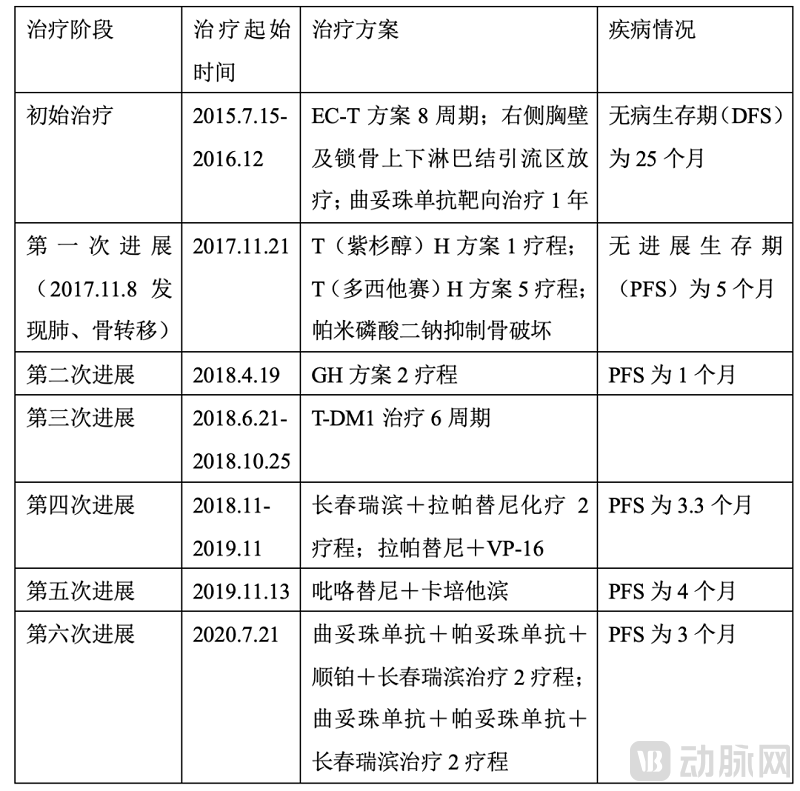
Initial Consultation Findings: Postmenopausal female. Six years ago, the patient underwent modified radical mastectomy of the right breast for "breast cancer." Postoperative pathology revealed grade III invasive ductal carcinoma of the right breast, with a tumor mass measuring 3.5 cm × 3 cm × 2.5 cm. No carcinoma was observed in the nipple or any quadrant. Metastatic carcinoma was found in the axillary lymph nodes (6/15). Immunohistochemistry results: ER (-), PR (-), HER2 (3+), Ki67 (+60%). The postoperative diagnosis was stage IV invasive ductal carcinoma of the right breast. The patient has undergone six lines of therapy, including lapatinib and T-DM1. Currently, there are no effective treatment options available.
Table 1 Treatment Course of the Patient
Comprehensive assessment of the patient revealed an ECOG performance status of 1, measurable lesions per RECIST v1.1 criteria, and fulfillment of all eligibility criteria. The informed consent form was signed on April 20, 2021, and the patient was enrolled to receive MRG002 treatment on May 10, 2021. At baseline, the patient had multiple metastases (lung and liver). The first imaging assessment was conducted during Cycle 2 of treatment on June 21, 2021, which showed a reduction in the hepatic metastatic lesion from 15.97 mm to 10.01 mm (Figure 1), corresponding to a partial response (PR). The patient demonstrated good tolerability throughout the treatment period, with most adverse events being Grade 1.
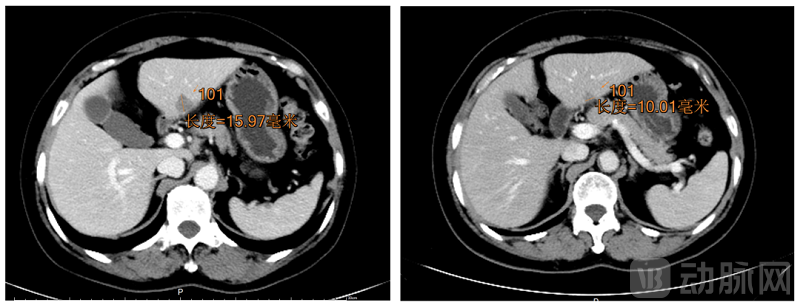
Figure 1. Changes in liver metastases (left: baseline liver metastasis measuring 15.97 mm; right: liver metastasis reduced to 10.01 mm after 2 weeks of MRG002 treatment)
Breast cancer has surpassed lung cancer to become the most prevalent cancer globally, posing a serious threat to women’s life and health. Among these cases, HER2-positive breast cancer accounts for approximately 20%–25%. The advent of trastuzumab has significantly improved the prognosis for this patient population. However, with prolonged survival and the widespread application of targeted therapies, drug resistance has emerged as a critical clinical challenge requiring urgent resolution. More than a century ago, Paul Ehrlich, the renowned German scientist and Nobel Laureate in Physiology or Medicine, proposed the concept of the “magic bullet.” With advances in biotechnology and continuous breakthroughs in monoclonal antibody development, “magic bullets” represented by antibody-drug conjugates (ADCs) have brought new hope to the field of oncology treatment and have become a prominent focus in antibody drug research and development both domestically and internationally.
This multicenter, open-label, dose-escalation and expansion Phase I clinical study aimed to evaluate the safety, tolerability, efficacy, and pharmacokinetic profile of MRG002 in patients with HER2-positive advanced solid tumors. Preliminary results were presented at the 2021 Chinese Society of Clinical Oncology Annual Progress Symposium (BOC) and Best of ASCO® 2021 China (BOA) on July 2–3, 2021. MRG002 demonstrated a favorable safety profile, with an objective response rate (ORR) of 50.0% and a disease control rate (DCR) of 81.3% among 16 evaluable breast cancer patients. These encouraging data further confirm the clinical potential of antibody-drug conjugate (ADC) therapies.
Currently, for HER2-positive advanced breast cancer, the standard first-line treatment recommended by multiple domestic and international guidelines is trastuzumab plus pertuzumab. Second-line options include T-DM1, the first antibody-drug conjugate (ADC) in the field of breast cancer, and pyrotinib, a small-molecule tyrosine kinase inhibitor (TKI). There is no consensus yet on third-line treatment, with several ADCs actively being explored and developed. Looking back at the diagnosis and treatment course of this breast cancer patient, the disease progressed after multiple lines of anti-HER2 targeted therapies (including trastuzumab, pertuzumab, T-DM1, and pyrotinib), chemotherapy, and radiotherapy. The patient was then enrolled in a clinical study and received MRG002. After just two cycles of treatment, significant shrinkage of liver metastases was observed, yielding an efficacy evaluation of partial response (PR). MRG002 remained effective in patients with HER2-positive advanced breast cancer previously treated with T-DM1, demonstrating its potent antitumor efficacy, which is attributed to its unique structure and innovative mechanism of action. MRG002 consists of glycoengineered trastuzumab conjugated to MMAE via an enzyme-cleavable vc linker. The high-affinity trastuzumab specifically binds to HER2 antigens on the surface of tumor cells, leading to internalization and release of the cytotoxic payload MMAE. This effectively inhibits tubulin polymerization, thereby interfering with microtubule-related functions such as mitosis, ultimately killing tumor cells. In the current landscape of research progress in anti-HER2 therapy for breast cancer, MRG002 demonstrates robust antitumor activity even in patients previously treated with T-DM1; similar results have only been observed in studies related to DS-8201. Secondly, adverse reactions during treatment were manageable. The innovatively modified trastuzumab in MRG002 features selectively higher levels of fucosylation in the Fc region, resulting in reduced binding of the Fc region to effector immune cells. This minimizes the potential cytotoxic effects of MRG002 on immune cells, thereby preserving the patient’s immune function. As follow-up time extends, researchers will continue to monitor the efficacy and safety of MRG002.
Currently, the multicenter, open-label, Phase I clinical study of MRG002 for dose escalation and expansion in patients with HER2-positive advanced solid tumors is actively ongoing. Notably, the abstract titled “FIH Phase I dose escalation and expansion study of anti-HER2 ADC MRG002 in patients with HER2 positive solid tumors” was accepted for presentation at the 2021 European Society for Medical Oncology (ESMO) Annual Meeting. Meanwhile, clinical studies of MRG002 in patients with HER2-low locally advanced or metastatic breast cancer are also being planned. We look forward to the release of further research results, bringing new hope to these patients!
(Case provision and full-text review: Jia Lin, Attending Physician, and Lv Zheng, Associate Chief Physician, The First Hospital of Jilin University)