

QuanHong Tech Develops AI-Powered Endoscopy Assistance System to Enhance Diagnostic Accuracy and Reduce Missed Lesions
Precision medicine is a novel medical paradigm that integrates modern technological approaches with traditional medical methods. It aims to maximize individual and societal health benefits by selecting and applying appropriate diagnostic methods accurately for each patient, thereby delivering more effective, safe, and cost-efficient healthcare services.
In the field of endoscopy, AI-assisted systems integrated with big data technology represent one of the best embodiments of the concept of precision medicine.
Guangzhou Quanhong Technology Co., Ltd. (hereinafter referred to as "Quanhong Technology"), a company dedicated to the development of precision medicine endoscopy assistance systems.An endoscopic assistance system that integrates AI-assisted and image fusion technologies is currently under development., to improve the accuracy of endoscopic examinations and contribute to safeguarding the health of the Chinese population.
QuanHong Technology is located in the Guangdong Medical Valley Nansha Industrial Park in Guangzhou. As one of China’s economic powerhouses, Guangzhou is also at the forefront of innovation in the healthcare industry. Established in 2014, Guangdong Medical Valley is a comprehensive investment and incubation platform dedicated to the medical device and biopharmaceutical sectors.
Leveraging its strategic advantage, QuanHong Technology participated in the “2021 ‘Maker Guangdong’ Biopharmaceutical SME Innovation and Entrepreneurship Competition” hosted by Guangdong Medical Valley, competing alongside other medical innovation enterprises.
For the examination of gastrointestinal diseases, particularly early-stage cancers, early detection and prompt treatment are crucial for effective disease control and improved survival rates. Endoscopy and endoscopic biopsy, as the gold standard for screening, hold significant importance for patients.
However, traditional medical endoscopy has two main limitations. First, the examination takes a relatively long time. In the current conventional workflow, an initial inspection is performed using a white-light endoscope; if abnormalities are detected, the endoscope is switched to other imaging modes to re-examine the suspicious areas and determine whether surgical intervention is necessary.
Second, due to factors such as the quality of bowel preparation, the physician’s skill level and experience, and fatigue, there is a significant rate of missed detections during examinations. This is particularly true in the early stages of cancer, where lesions are difficult to identify, making the examination more challenging and further increasing the miss rate. It is reported that the detection rate for early-stage upper gastrointestinal tumors in China is very low, amounting to less than 10%.
QuanHong Technology is currently developing a targeted endoscopy assistance system. Its AI-assisted recognition system can identify suspicious areas in a single pass during endoscopic examinations, which not only saves examination time but also improves the diagnostic accuracy rate. The core of its technology lies in two aspects: AI-assisted recognition and real-time multi-image fusion.
In AI-assisted recognition, serving as a doctor’s second pair of eyes, AI can assist physicians in making clinical judgments and reduce the likelihood of missed or misdiagnoses.After learning from a sufficient number of samples, AI performs recognition and judgment, and annotates suspicious areas on the images to support physicians' diagnoses.
The cloud-based database currently employed by Quanhong Technology comprises data samples collected from endoscopic equipment at Norwegian hospitals. Its AI-assisted recognition system can currently identify and diagnose serrated polyps, benign conventional adenomas, mucosal or superficial submucosal cancers, and deep submucosal cancers, achieving a diagnostic accuracy rate of 95% with AI assistance.
In terms of real-time multi-image fusion, QuanHong Technology’s advantage lies in its ability to fuse images in real time, displaying them directly during the physician’s diagnostic process.Currently, its multi-lens composite functionality has been granted an invention patent. This feature enables real-time fusion of standard endoscopic images with those acquired under Narrow Band Imaging (NBI) mode.
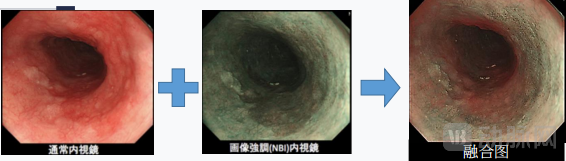
Schematic Diagram of Image Fusion Source: QuanHong Technology
NBI utilizes specialized blue light illumination to observe the mucosal surface, enabling the differentiation of lesion morphology without the need for chromoendoscopy, thereby facilitating the detection of early-stage gastrointestinal cancers. Multi-modal medical image fusion can compensate for information deficits inherent in single-modality imaging, resulting in fused images that are more conducive to clinical diagnosis.
Furthermore, endoscopy-assisted systems simplify the entire examination process, appropriately reducing the technical proficiency required of physicians and thereby contributing to the wider adoption of endoscopic procedures.Traditional endoscopy demands high technical proficiency from physicians, necessitating extensive training. China faces a high incidence of gastrointestinal cancers and substantial diagnostic and treatment needs, yet there is a significant shortage of endoscopists.
The use of endoscopy-assisted systems to aid physicians in examinations can, to a certain extent, reduce the technical difficulty of the procedure. This not only accelerates examination speed and alleviates patient discomfort but also further enhances the penetration rate of endoscopic screening.
The commercialization of medical products requires repeated trials to ensure their safety. According to QuanHong Technology, the research and development cycle for its endoscopy assistance system spans three to five years. Although QuanHong Technology was formally registered and established relatively recently, the company had already begun laying the groundwork for its research on the endoscopy assistance system more than a year ago.
During the early-stage R&D, the focus was primarily on software feasibility, specifically achieving real-time image fusion for multi-lens endoscopes. This phase of development lasted one year and was implemented in small bowel imaging, yielding favorable results. Throughout the process, Taipei Medical University provided guidance and assistance for the software development.
Currently, Quanhong Technology is planning and integrating its hardware and software components. In the area of AI-assisted recognition, the company is also seeking collaborations with more hospitals to expand its cloud-based database, thereby providing more training samples for its AI algorithms. The overall project is expected to advance to the animal testing stage this year. Based on the experimental results, Quanhong Technology will apply for certifications from the NMPA and the FDA, with the product anticipated to launch on the market around 2023.
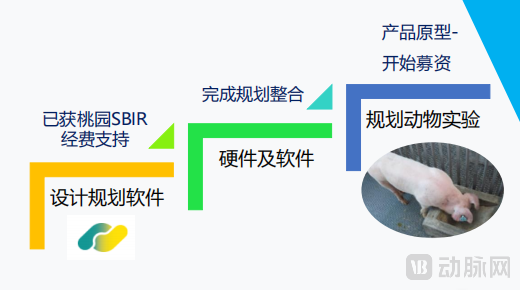
R&D Phase Source: Quanhong Technology
In the R&D process, the team is key.Fang Yuanting, founder of QuanHong Technology, is responsible for formulating and executing the company’s development strategy. He has over 10 years of experience in electronic product R&D, having collaborated with Denso on the design and development of Toyota’s in-vehicle entertainment systems, and with Mitsubishi Heavy Industries on the Singapore government’s OBU tender project. Chief Financial Officer Xiao Minghuang brings nearly 10 years of experience in financial management and electronics production, and is well-versed in medical regulations.
In software R&D, the team is led by Wang Yucheng, a graduate of Chung Yuan Christian University’s Department of Electrical and Electronic Engineering, who specializes in AI algorithms and software development. Additionally, Dr. Liao Shaogang, Dean of the College of Electrical Engineering and Computer Science at Chung Yuan Christian University, serves as the Technical Director.
In the development of medical devices, a professor from Taipei Medical University serves as the medical advisor, while Dr. Li Huang-De from the Institute of Applied Mechanics at National Taiwan University provides consultation on medical device technology. The Director of Medical Device Development is the former Chief Technology Officer who participated in the development of the first-generation Israeli capsule endoscope and the magnetically controlled capsule endoscope.
In terms of specific business operations, QuanHong Technology has two major directions:First, it licenses its patented technology to overseas manufacturers to develop the U.S. and European markets; second, for the Chinese and Southeast Asian markets, it conducts product marketing and sales by distributing products to hospitals through distributors and partnering with health checkup centers to reach consumers directly.
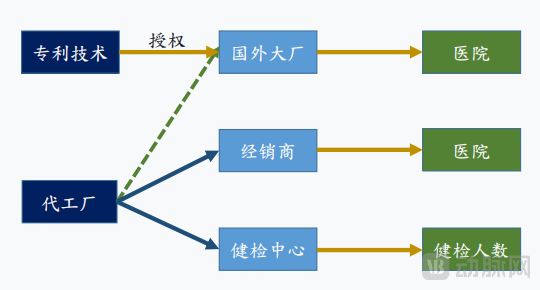
Corporate Operating Model Source: Quanhong Technology
With the widespread adoption of minimally invasive surgeries, the global endoscopy market is experiencing rapid growth. According to data analysis by Guoyuan Securities, the growth rate of China’s endoscopy market exceeds the global average, with its market size surpassing RMB 20 billion in 2018. Looking ahead, driven by heightened public health awareness, advancements in endoscopy-related technologies, and supportive national policies, the endoscopy market is poised to reach new heights, offering broad prospects for future development.
Fang Yuanting, CEO of Quanhong Technology, stated that endoscopy plays a significant role in promoting the health of people across China and around the world. Improving the early detection rate of cancer could save millions of patients. This is particularly important in China, where endoscopy screening rates are relatively low; technologies that simplify the procedure and increase screening uptake are urgently needed.
In his view, China’s healthcare industry is currently undergoing rapid development, presenting a prime market entry opportunity for Quanhong Technology. Adhering to the principles of precision medicine, Quanhong Technology’s endoscopic assistance systems contribute to healthier lives for individuals.
Currently, Quanhong Technology is raising angel-round funding to conduct subsequent animal trials and apply for medical regulatory certifications.
About the 2021 Maker Guangdong · Biomedical Special Competition
The 2021 “Maker Guangdong” Biopharmaceutical SME Innovation and Entrepreneurship Competition was guided by the Department of Industry and Information Technology of Guangdong Province, the Department of Finance of Guangdong Province, and the People’s Government of Dongguan City, and hosted by Guangdong Medical Valley. Since undertaking the competition, it has focused on the biopharmaceutical sector, identifying high-quality projects related to COVID-19 prevention and control as well as health protection. To date, nearly 200 projects have been identified, with many recommended projects winning major awards in the provincial finals. Guangdong Medical Valley was honored as the “Best Organizing Unit of 2020.”
Guangdong Medical Valley, established in 2014, is a new healthcare industry cluster service provider under the Zhongchuang Group. It focuses on investment and incubation platforms for the biopharmaceutical and medical device industries. Currently, it has laid out its presence in Guangzhou, Zhuhai, and other regions, with a total area of approximately 530,000 square meters of completed and under-construction parks. It is a national-level technology enterprise incubator, a key construction project in Guangdong Province, and a demonstration park in Guangzhou City. Guangdong Medical Valley has always adhered to the concept that "industrial clusters are the most important lever for innovative development in the healthcare industry." It insists on an integrated development model combining healthcare industry incubators, equity investments in healthcare projects, and comprehensive supporting services for the healthcare industry. Deeply rooted in the Greater Bay Area, it is committed to building a world-class international healthcare industry innovation center.