

How Nestlé Dominates China's $8 Billion Medical Nutrition Market
Foods for Special Medical Purposes: A concept entirely unfamiliar to many, it is, in layman’s terms, simply “meals” for patients, classified as food rather than pharmaceuticals.
Professionally speaking, the full name of "special medical food" is "Food for Special Medical Purposes (FSMP)." It is neither a health supplement nor a pharmaceutical drug, but rather a specially processed and formulated food product designed to meet the specific nutritional and dietary needs of individuals with limited food intake, digestive or absorptive impairments, metabolic disorders, or those in specific disease states.
In 2016, the Administrative Measures for the Registration of Foods for Special Medical Purposes were officially promulgated and implemented, providing a legal basis for the production and market access of FSMPs in China. Since then, relevant policies for China’s FSMP industry have been gradually introduced, steering the sector toward standardized development and unlocking its substantial market potential.
According to statistics, the global annual consumption of foods for special medical purposes (FSMP) totals RMB 56 billion to RMB 64 billion, with the market size growing at an annual rate of 6%. In the United States, 65% of patients with malnutrition use FSMP, compared with 27% in the United Kingdom, while mainland China accounts for only 1.6%, or approximately RMB 600 million, representing just 1% of the global market.
The field of foods for special medical purposes (FSMP) represents China’s third emerging blue-ocean market, following pharmaceuticals and medical devices. For Nestlé, one of the world’s leading food companies, this sector also offers substantial profit potential.
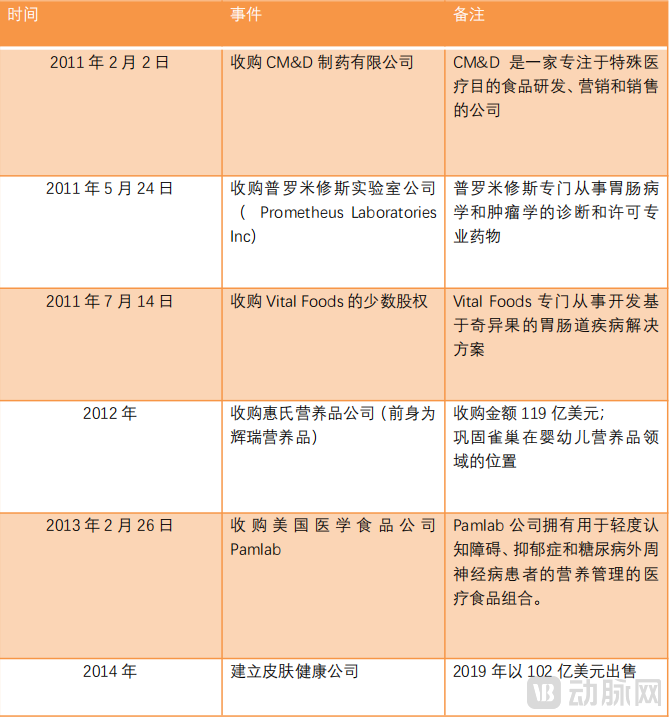
Since 2004, Nestlé has been strategically positioning itself in the health science sector. In 2011, Nestlé established Nestlé Health Science, focusing primarily on two core business areas: consumer health (including nutritional supplements, vitamins, and over-the-counter medications) and medical nutrition (including foods for special medical purposes). Since then, Nestlé has continued to make significant investments in the health science field. In 2020, Nestlé Health Science achieved sales of CHF 3.3 billion, with organic growth accelerating to 12.2%.
Since entering the Chinese market in 2012, Nestlé has gradually penetrated the FSMP (Foods for Special Medical Purposes) sector, starting with infant formula, and has become an industry leader.
In 2016, China’s FSMP industry began to move toward standardization, with market and consumer awareness of FSMPs becoming increasingly clear, well-defined, and widely accepted. The vast market for FSMPs gradually opened up.
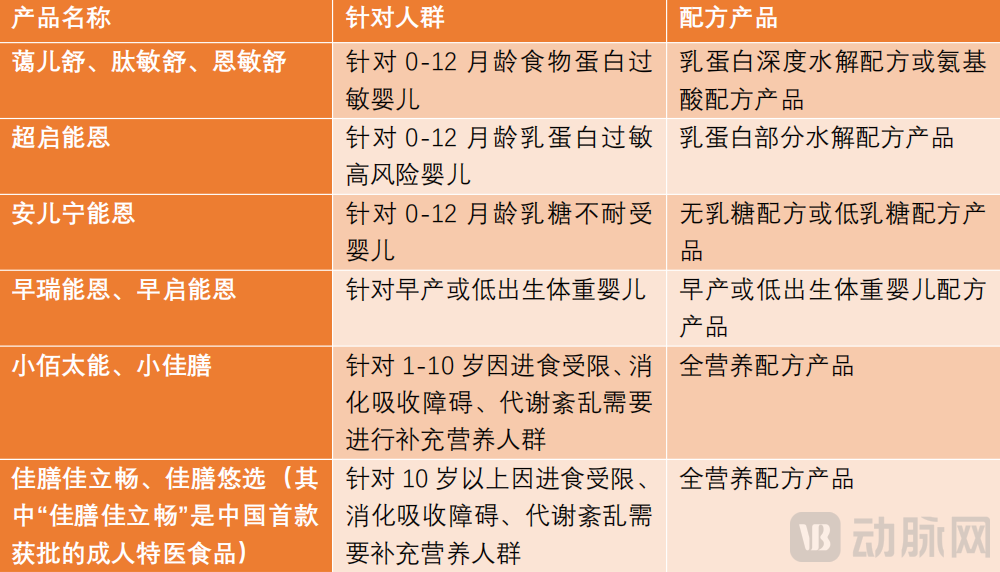
According to data from the China Food and Drug Administration, as of July 9, 2021, a total of 72 formula foods had been approved through registration for special medical purposes. Among them, Nestlé had 11 products granted “Special Medical Purpose Food Registration Certificates,” making it the company with the largest number of approved products.
Nestlé’s product portfolio spans pediatric and geriatric populations, addressing conditions such as pediatric growth disorders, pediatric allergies, elderly malnutrition, adult digestive disorders, metabolic health, and brain health. While its offerings essentially cover all age groups, the company’s primary focus is on infant foods for special medical purposes.
As the Chinese government has placed greater emphasis on foods for special medical purposes (FSMPs), approvals in China have increasingly focused on non-infant products. In 2019, Nestlé Health Science’s Nutren Optimum complete nutritional formula became the first FSMP approved for adults in China, as well as the country’s first liquid, whole-protein, complete nutritional formula.
Let’s go back to 2004.
This marked the seventh year of Peter Brabeck-Letmathe’s tenure as Nestlé’s CEO, during which the Nestlé Nutrition division was established as a standalone business unit. This move aligned with the strategy he articulated upon assuming the CEO role: to position Nestlé as a leader in “nutrition, health, and wellness.” Through this dedicated business unit, Nestlé embarked on a large-scale expansion into the field of health science.
Subsequently, Nestlé’s Nutrition Division continued to expand through a series of acquisitions, such as the 2007 acquisition of Novartis Medical Nutrition and the well-known U.S. infant food brand Gerber.
In 2008, Nestlé established its Health Nutrition business under the framework of the Nestlé Nutrition Department.
By 2009, the annual sales of Nestlé Nutrition approached CHF 10 billion, accounting for approximately 8% of Nestlé’s total global sales that year (CHF 128 billion). Sales from the medical nutrition segment represented 17% of Nestlé Nutrition’s revenue.
In 2010, Nestlé announced a plan to invest CHF 500 million over the next decade to support the establishment of an independent health science business, pioneering a new industry straddling food and pharmaceuticals to address obesity and chronic diseases.
In 2011, Nestlé Health Science and the Nestlé Institute of Health Sciences were established. The company’s business primarily focuses on two major segments: consumer health (including nutritional supplements, vitamins, and over-the-counter medications) and medical nutrition (including foods for special medical purposes), further expanding Nestlé’s footprint in the pharmaceutical industry.
Subsequently, Nestlé accelerated its expansion in the healthcare sector. Since 2011, it has undertaken a series of major initiatives, including large-scale acquisitions and investments.
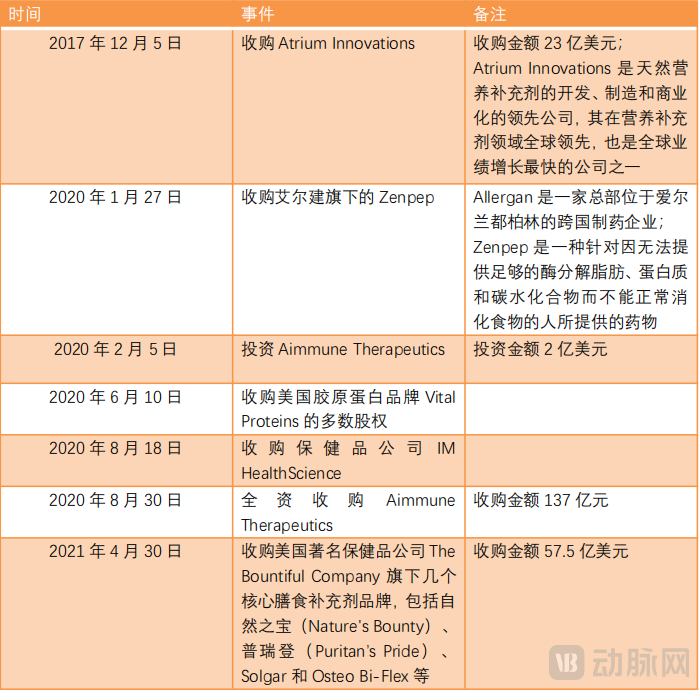
In 2017, current CEO Schneider joined Nestlé from outside the company. The executive, who previously served as CEO of Fresenius, the German healthcare giant, has further accelerated Nestlé’s expansion in the pharmaceutical industry, undertaking several major initiatives in 2020 alone.
The acquisition of Zenpep in early 2020 expanded Nestlé’s Medical Nutrition business and complemented its therapeutic product portfolio; on June 10, 2020, the acquisition of the U.S. collagen brand Vital Proteins enabled Nestlé to enter an entirely new business sector. The full acquisition of Aimmune at a premium valuation was regarded by analysts as “another milestone” for Nestlé Health Science following its 2017 acquisition of Atrium. The earlier acquisition of Atrium was described by foreign media as the “boldest” move undertaken since Schneider assumed office.
Schneider’s significant investment in the medical and health sector also underscores the market’s promising potential. Foods for Special Medical Purpose (FSMP), a business segment that bridges pharmaceuticals and nutrition, are experiencing faster growth and offering broader market opportunities compared to traditional mainstream food products.
Nestlé’s series of developments, mergers and acquisitions, and investments in the fields of medical nutrition and nutritional health products also corroborate the approach large corporations take to build a business segment: first, enriching the product portfolio by leveraging existing brands; second, expanding business lines through mergers and acquisitions.
Through continuous development, Nestlé is poised to grow its Health Science division into a “mini-Nestlé” within the health science sector, characterized by substantial business scale and strong brand power.
Since Schneider assumed the role of CEO, Nestlé has taken continuous action, steadfastly pursuing a path of specialization by divesting non-core businesses and focusing its operations on “nutrition, health, and well-being.”
Nestlé’s significant investments in the health science sector have also yielded strong results. According to its 2020 financial report, Nestlé Health Science achieved double-digit sales growth, with annual sales reaching CHF 3.3 billion (approximately USD 3.63 billion) and an organic growth rate of 12.2%, compared to the Group’s overall organic growth rate of 3.6%.
In its financial report, Nestlé also highlighted that Health Science is one of the fastest-growing business divisions within the Group. The Group’s overall growth in 2020 was driven by its pet health and Health Science businesses. Furthermore, starting from 2021, Nestlé Health Science will be reported as an independent operating segment in Nestlé’s financial statements.
Currently, the global market size for foods for special medical purposes (FSMP) is approximately RMB 56–64 billion, growing at an annual rate of 6%. Among these, the market sizes and growth rates in North America, Europe, and Japan are RMB 27–30 billion and 3%, RMB 13–15 billion and 5%, and RMB 10–12 billion and 7%, respectively.
Data show that Abbott, Nestlé, and Danone are the top three competitors in the global market for foods for special medical purposes (FSMP), with their combined sales accounting for 70% of the entire market in 2019. Among them, Abbott holds a distinct advantage by leveraging its global presence in the infant formula market, maintaining a share of approximately 30% in the overall FSMP market from 2015 to 2019. Nestlé surpassed Danone in 2018 to become the second-largest player in the industry. Looking ahead, Nestlé’s further development in the global FSMP sector is worth anticipating.
There is a huge market gap for FSMP in China.
Data show that among the 140 million hospitalized patients in China, less than 1% receive clinical nutrition diagnosis and management. Clinical nutrition therapy for hundreds of millions of outpatients with chronic non-communicable diseases remains largely unmanaged, while the prevalence of malnutrition among patients with major diseases, such as cancer, reaches 70%–80%. According to Zhiyan data, in 2017, China’s supply capacity for foods for special medical purposes (FSMP) reached 24,700 metric tons, yet a shortfall of 11,900 metric tons persisted.
It is estimated that, based on overseas market models, the total size of China’s special medical purpose formula (FSMP) market will reach RMB 20–30 billion. However, the current domestic FSMP market remains limited in scale. According to incomplete statistics, the market for products intended for infants under one year of age is approximately RMB 3 billion, while the adult FSMP market is around RMB 5 billion. This is primarily due to the long-standing practice of selling FSMPs as pharmaceutical products through hospital channels, coupled with low consumer awareness. With clearer product positioning and gradually improving laws and regulations, the FSMP industry is poised for significant growth.
Data show that China’s market for foods for special medical purposes (FSMP) has expanded rapidly in recent years, with the market size growing from RMB 2.01 billion in 2015 to RMB 4.52 billion in 2018, representing a compound annual growth rate (CAGR) of 31.01%. In 2019, the scale of China’s FSMP industry reached RMB 5.84 billion, a year-on-year increase of 29.2%.
Nestlé has also recognized the immense potential of the Chinese market. In 2012, Nestlé Health Science entered the Chinese market and gradually established a comprehensive product portfolio in China.
On April 24, 2018, Nestlé Group announced the completion of its new factory in Taizhou, Jiangsu Province, with an investment of RMB 1 billion. This is Nestlé’s first facility in China dedicated to the production of foods for special medical purposes (FSMP), and it is regarded as a strategic move by Nestlé to capture the Chinese FSMP market. The factory has established China’s first fully enclosed sterile filling production line, filling a domestic gap in both industry and technology.
In 2019, Nestlé successfully inaugurated its R&D center based at the Taizhou factory. As part of Nestlé’s global R&D network, this center stands alongside three other R&D centers located in New York and Switzerland, sharing advanced global production processes and formulations.
On the sales front, Nestlé has been continuously expanding its distribution channels. On June 13, 2018, Nestlé Health Science partnered with Renhe Pharmacy Network to make its Nestlé Health Science Optimum Nutrition products available for purchase across Renhe Pharmacy Network’s official online platform and at 50 authorized offline DTC (Direct-to-Consumer) stores nationwide, thereby introducing these products into hospital-based retail channels.
In addition, Nestlé Health Science leverages channels such as cross-border e-commerce and community-based nutrition clinics to understand and meet consumer demand for foods for special medical purposes (FSMPs). The company has established overseas flagship stores on JD.com and Tmall, respectively, to expand the out-of-hospital coverage of Nestlé products.
According to statistics from Abbott’s China R&D Center (prior to 2017), the top four players in the medical food industry accounted for approximately 80% of the domestic market share. Among them, Abbott held 32%, Danone 21%, Nestlé 16%, and Fresenius 14%, with others accounting for 17%.
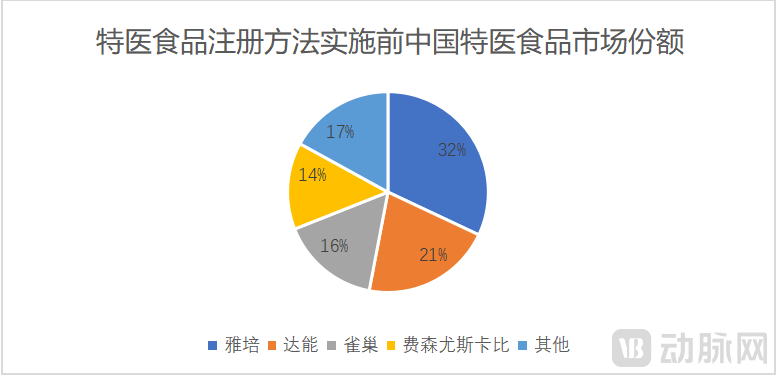
Data Source: Abbott R&D Center
Domestic demand for foods for special medical purposes (FSMP) is accelerating, with companies showing strong intentions to secure early market positions, while foreign giantsIts market share in the domestic market has become relatively stable.widening the gap among various partiesKey elements have already been transformed into a company’s brand power and R&D capability.For Nestlé, after making large-scale investments and acquisitions to expand its business and product lines, the next stepThe Key May Lie in the Formulation and Technology of Foods for Special Medical PurposesofR&D.