

Arvinas: The Second Company Founded by PROTAC Pioneer Craig Crews Nears Clinical Validation with Lead Candidates in Phase II

Arvinas
Developer of drugs in the fields of oncology and neurodegenerative diseases
PROTAC (Proteolysis-Targeting Chimera), a hot technology that has developed vigorously in recent years, originated from the 2004 Nobel Prize in Chemistry (awarded to Israeli scientists Aaron Ciechanover and Avram Hershko, and American scientist Irwin Rose for their discovery of ubiquitin-mediated protein degradation).
Currently, companies with a presence in this field abroad include C4 Therapeutics, Cullgen, Kymera Therapeutics, and Nurix Therapeutics, while domestic enterprises involved in this area include Linkage Pharmaceuticals, Fendi Technology, Suzhou Kintor Pharmaceuticals, and Wuyuan Biopharma. In addition, several major pharmaceutical companies have entered this field through collaborations, such as Roche, Merck & Co., Eli Lilly, AstraZeneca, Novartis, GSK, Genentech, Bayer, and Pfizer.
So, who was the first to discover this technology, which has been recognized by both academia and industry? We must mentionCraig Martin Crews, a pioneer in this field, is a professor at Yale University and the originator of the PROTAC concept.
Crews has founded two companies.Proteolix was founded in 2003 and acquired by Onyx Pharmaceuticals in 2009. In 2013, Crews embarked on a new venture by establishing Arvinas, the world’s first company dedicated to the PROTAC field. Arvinas went public in September 2018 with an initial offering price of just $16 per share. Within less than three years, its stock price surged to $77.55, reaching a market capitalization of $3.799 billion—nearly five times its value at IPO. Notably, the stock once peaked at $92.77, pushing its market capitalization above $4 billion.
What stories lie between such a figure, who is both a scientist and an entrepreneur, and PROTAC? Let’s take a look at Crews and his journey in translating PROTAC research into applications.

As early as 2001, Professor Crews’ team and Professor Raymond J. Deshaies of the California Institute of Technology first proposed the concept of PROTACs and successfully designed and synthesized the first batch of bifunctional PROTAC molecules for the degradation of methionine aminopeptidase 2 (MetAP-2). The first publication describing PROTAC technology was also published by Professor Crews’ team in July 2001.
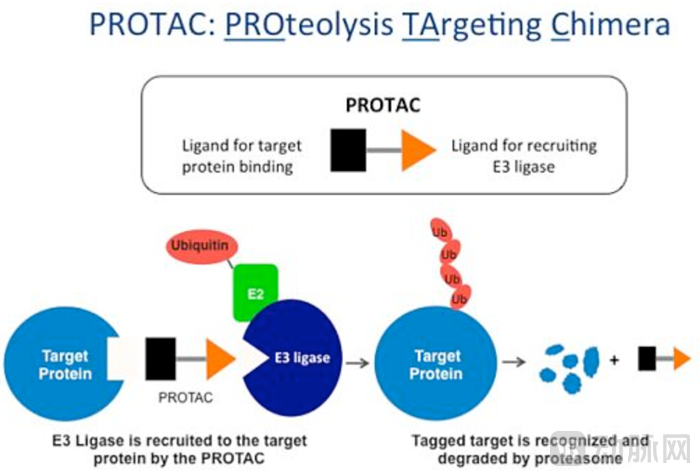
Schematic of Targeted Protein Degradation. Image source: Yale University official website
PROTAC technology leverages the intracellular ubiquitin-proteasome system to degrade target proteins to a certain extent. A PROTAC molecule consists of a ligand for the protein of interest (POI) at one end and a ligand for an E3 ubiquitin ligase at the other, connected by a linker of appropriate length (whose composition and length can significantly influence PROTAC activity). Upon binding, a ternary complex is formed, leading to the ubiquitination of the target protein, which is then recognized and degraded by the proteasome.
Its discovery has also propelled the development of the targeted protein degradation (TPD) field, ushering in a new era for novel therapeutics and innovative chemical knockout tools. This technology offers several advantages, including overcoming cancer drug resistance, eliminating both enzymatic and non-enzymatic functions of kinases, and degrading “undruggable” protein targets.Especially for "undruggable" targets: traditional small-molecule inhibitors require strong binding to the target protein, typically at its active site; whereas PROTAC protein degraders only need weak binding to the target protein to specifically "tag" it.PROTAC technology is expected to address 80% of “undruggable” protein targets.
Subsequently, in 2003, Crews co-founded Proteolix, whose proteasome inhibitor Kyprolis™ received FDA approval for the treatment of multiple myeloma. During this period, through continuous research, Professor Crews’ team synthesized the first small-molecule PROTAC containing nutlins in 2008, successfully recruiting the androgen receptor (AR) to mouse double minute 2 (MDM2) and triggering its ubiquitination and proteasomal degradation by serving as an E3 ubiquitin ligase. In 2009, Proteolix was acquired by Onyx Pharmaceuticals, while Crews continued his research and development efforts in the field of PROTACs.
Based on this intellectual property,In 2013, Crews founded Arvinas, the first pharmaceutical company focused on PROTACs.In 2018, Arvinas successfully went public on the Nasdaq (NASDAQ: ARVN). Beyond what has been mentioned above, Craig Crews is not only a scientist and entrepreneur but also serves on multiple editorial boards and has acted as an editor for chemical biology. He has achieved notable success in these fields. Of particular interest is how Crews translated his scientific research into commercial enterprise development, and Arvinas may well provide the answer.
Arvinas is a clinical-stage biopharmaceutical company dedicated to the discovery, development, and commercialization of therapies that degrade disease-causing proteins. In addition to Cerws mentioned above, the company boasts a team of leaders, directors, and scientific officers with extensive experience in the biopharmaceutical industry, including President and CEO John G. Houston (formerly Senior Vice President of Drug Discovery at Bristol-Myers Squibb), CSO Ian Taylor (formerly Head of Early Development in Oncology at Pfizer and Vice President of Cancer Biology at Bayer), and Tomasz M. Beer, M.D., F.A.C.P., a member of the Scientific Advisory Board (an internationally renowned researcher and clinician specializing in prostate cancer), among others.
Under the leadership of a highly experienced team,Arvinas was established based on Professor Cerws’ PROTAC technology.PROTAC Discovery Engine and PROTAC-Targeted Protein Degradation Technology Platform.
Since its establishment in 2013, Arvinas’ PROTAC discovery engine has achieved breakthroughs in oral bioavailability, blood-brain barrier-penetrant degraders in preclinical studies, first-in-human safety data, human pharmacokinetic and pharmacodynamic data, and first-in-human efficacy data.
The drug discovery process of the PROTAC Discovery Engine is primarily divided into three steps:
First, the selection of ligases and the identification of ligands.The human body possesses over 600 E3 ligases. Leveraging advanced high-throughput screening and DNA-encoded library (DEL) technologies, Arvinas matches the appropriate E3 ligase from its knowledge base to the correct target. This includes identifying novel target-binding “warheads,” addressing “undruggable” targets, and discovering new E3 ligase binders. Furthermore, Arvinas discovers PROTAC protein degraders that target E3 ligases with specific expression patterns—such as those localized in tumors or the central nervous system—to advance the development of targeted cancer therapies and neurological treatments.
Next is the rapid design of PROTACs.The formation of a ternary complex among the PROTAC degrader, the target protein, and the E3 ligase is a fundamental prerequisite. However, the scientific team’s profound understanding of “ubiquitination regions” has led them to recognize that improving design efficiency requires leveraging structural and biochemical data to accurately predict which lysine residues on the target protein can be “tagged” by ubiquitin. Arvinas has approached this challenge from three angles—evolutionary linkers, budget-constrained computational models, and proteomics—to rapidly and precisely characterize drug properties and iterate quickly, thereby optimizing the selectivity of degraders for their drug targets.
Finally, the degradants are converted into drugs.Unlike the “Rule of Five” for small-molecule drug discovery, which has been proposed and applied for over two decades, Arvinas has developed its own proprietary “Arvinas Rules” to guide the development of PROTAC degraders. Arvinas has also engineered PROTAC degraders with favorable drug-like properties and potency by studying the relationships between pharmacokinetics/pharmacodynamics (PK/PD) and efficacy.
By integrating the PROTAC discovery engine with the PROTAC targeted protein degradation technology platform, we systematically select, identify, design, and translate targeted protein therapeutics using PROTAC technology, thereby achieving high-efficiency drug design and effective therapeutic outcomes.
Arvinas has built a broad pipeline of protein degradation product candidates by leveraging its PROTAC discovery engine,Pipeline products cover therapeutic areas including targeted oncology (including immuno-oncology) and neurology.Diseases in other therapeutic areas,There are currently 13 projects under development.。
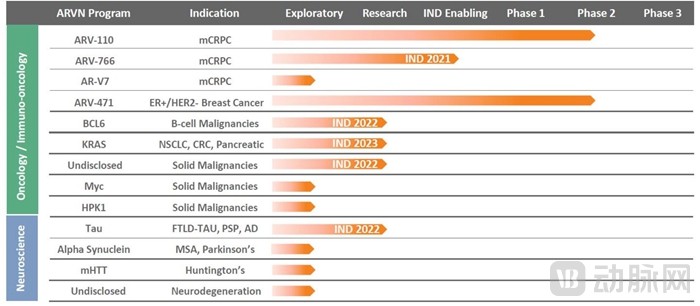
Pipeline under development, image source: Arvinas 2020 Annual Report
Arvinas’ lead candidates are ARV-110 and ARV-471.
In March 2019, Arvinas initiated clinical studies of ARV-110, a targeted protein degrader, marking the first PROTAC drug worldwide to enter clinical trials for the treatment of metastatic castration-resistant prostate cancer (mCRPC).
In the United States, prostate cancer is the second most common cancer and the second leading cause of cancer-related deaths. Currently, the standard-of-care drugs for metastatic castration-resistant prostate cancer (mCRPC), enzalutamide and abiraterone, benefit some patients. However, up to 25% of patients do not respond to these therapies due to factors such as increased androgen production, enhanced expression of the androgen receptor (AR) gene, and AR point mutations. Furthermore, the vast majority of patients who initially respond eventually develop drug resistance, leading to a poor prognosis.
ARV-110 is a PROTAC protein degrader targeting the androgen receptor (AR), and its ability to modulate AR signaling is a critical factor in controlling disease progression. ARV-110 exerts its therapeutic effect by leveraging the body’s natural mechanisms to degrade AR protein, thereby overcoming resistance caused by increased target protein expression and mutations.
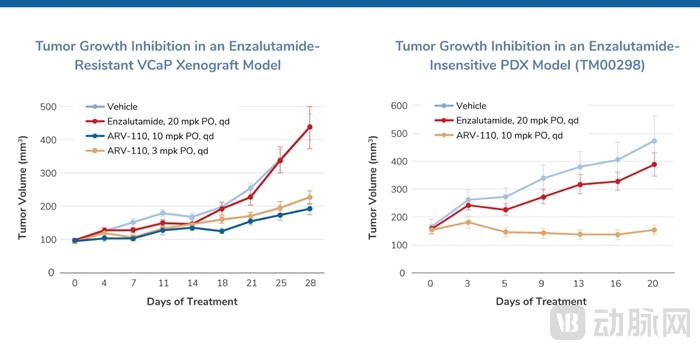
Comparison of ARV-110 Development Data, Image Source: Arvinas Official Website
In preclinical studies, ARV-110 demonstrated robust activity as an androgen receptor (AR)-targeted degrader. In enzalutamide-sensitive models, ARV-110 achieved prostate-specific antigen (PSA) reductions comparable to those of enzalutamide at lower doses. In in vivo models with acquired and intrinsic resistance to enzalutamide, ARV-110 was shown to inhibit tumor growth by 70% and 100%, respectively.
In August 2019, Arvinas announced that another lead candidate, ARV-471, had entered clinical development. ARV-471 is an oral PROTAC protein degrader targeting the estrogen receptor (ER) for the treatment of patients with locally advanced or metastatic ER-positive/HER2-negative breast cancer.
Approximately 80% of newly diagnosed breast cancer cases are estrogen receptor-positive (ER+). Although approved therapies demonstrate certain efficacy in patients, many ER+ breast cancers gradually develop resistance during treatment. For instance, fulvestrant (Faslodex), the standard-of-care agent for ER+ metastatic breast cancer following anti-estrogen therapy, has validated that ER degradation is a critical factor in therapeutic intervention; however, up to 50% of ERs remain preserved compared to baseline levels after six months of fulvestrant treatment.
Unlike fulvestrant, which is administered via intramuscular injection, Arvinas’ ER-targeted PROTAC protein degrader ARV-471 is an oral therapy under development. Preclinical studies have demonstrated that ARV-471 exhibits potent activity as an ER degrader, showing superior tumor growth inhibition compared to fulvestrant. Interim data from Phase I clinical trials indicate robust efficacy signals in patients with ER-positive/HER2-negative advanced or metastatic breast cancer who have received multiple prior therapies, highlighting its potential as a “best-in-class” estrogen receptor degrader.
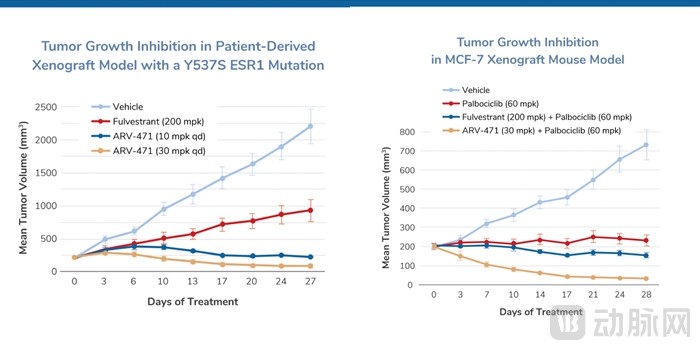
Comparison of ARV-471 R&D Data, Source: Arvinas Official Website
Currently, the ARV-110 and ARV-471 programs are both in Phase II clinical trials and are wholly owned by Arvinas.
In addition, Arvinas has also made strategic moves in the field of central nervous system (CNS) diseases. PROTAC protein degraders can cross the blood-brain barrier and enter CNS cells, enabling the intracellular degradation of pathogenic proteins such as Tau.This approach prevents intracellular dysfunction and the "prion-like" spread of pathological tau protein into the extracellular space and to healthy neurons, holding promise as an effective therapy for diseases associated with pathogenic tau and α-synuclein.
Although Arvinas boasts a rich pipeline, with the exception of ARV-110 and ARV-471, which are both in Phase II clinical trials, its other drug candidates remain in the preclinical development stage. Currently, Arvinas is still in the early stages of product development and has not yet commercialized any candidate products.
However, is PROTAC technology truly flawless?
Its development still faces many challenges awaiting breakthroughs. Because PROTACs function via a catalytic mechanism, traditional methods struggle to accurately assess their pharmacokinetic (PK) and pharmacodynamic (PD) properties; therefore, there is an urgent need for further research to establish robust PK/PD evaluation frameworks for PROTACs. Although the human genome encodes more than 600 E3 ubiquitin ligases, only a limited subset—such as VHL, CRBN, cIAP, and MDM2—are currently employed in PROTAC design. Expanding the repertoire of usable E3 ubiquitin ligases represents another major challenge facing the field.Furthermore, PROTAC technology also faces challenges such as the selection of linker length, off-target effects, and difficulties in ternary complex formation.
In the future, the key to determining whether PROTAC technology can become a breakthrough in drug development lies in how to address these challenges while leveraging its advantages.