

Miao Health Partners with Peking University Shenzhen Hospital to Advance National Strategy for Chronic Disease Prevention and Control
On July 26, the “Launch Ceremony for the Regional Pilot Program on Joint Management of ‘Three Highs’ Using Appropriate 5G+AI Health Management Technologies and the Co-establishment of Lifestyle Health Management Centers,” jointly organized by the China Health Promotion Foundation, Peking University Shenzhen Hospital, and Miao Health, was successfully held. Distinguished attendees included Professor Guo Qing, Chairman of the Health Management Branch of the Chinese Medical Association; Professor Chen Yun, President of Peking University Shenzhen Hospital; Professor Cai Yongjiang, Director of the Health Management Center at Peking University Shenzhen Hospital; Mr. Gu Shufeng, Senior Vice President and Chief Operating Officer of Miao Health; and Mr. Luo Xiaobin, Senior Vice President and Chief Medical Officer of Miao Health.
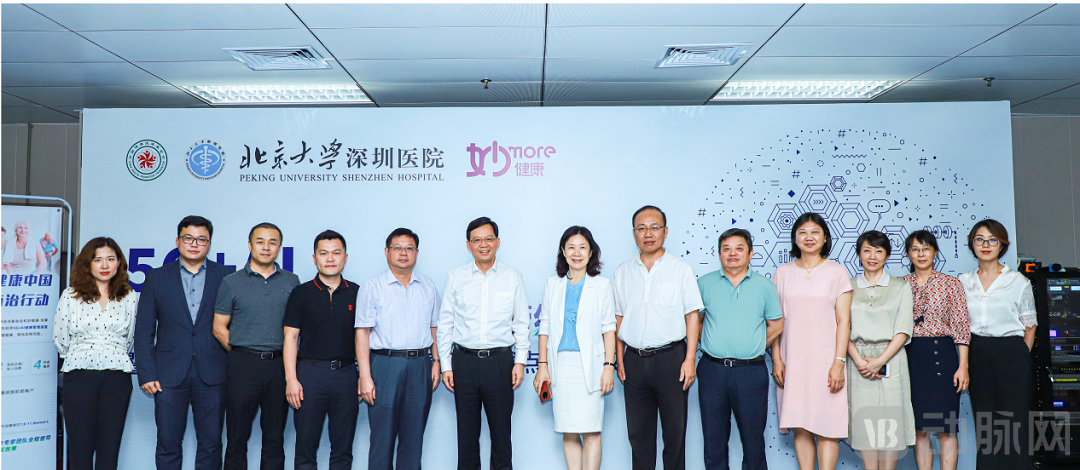
At the meeting, both parties reached a consensus on the collaboration framework for the project titled “Integrated Application of Appropriate Technologies for Co-management of the ‘Three Highs’ Leveraging 5G+AI in Health Management.” By co-establishing offline lifestyle health management centers and integrating online 5G+AI technologies, the initiative aims to deliver high-quality, efficient health intervention and management services covering all aspects of daily life for individuals with the “Three Highs” (hypertension, hyperglycemia, and hyperlipidemia) as well as residents within the region, thereby fundamentally improving their health outcomes and quality of life.
In his opening remarks, Professor Guo Qing, Chairman of the Health Management Branch of the Chinese Medical Association, stated, “The launch of the research project on the application of appropriate 5G+AI health management technologies here represents a valuable exploration of post-examination health management service pathways in public hospitals. By leveraging 5G technology to build an intelligent, interconnected world, and relying on Miao Health’s independently developed health technology ecosystem, the project integrates online AI-driven interventions with the co-development of offline lifestyle health management centers. This approach aims to create a closed-loop system for lifelong health management and establish a national model for a ‘three-early’ health management system characterized by ‘early screening, early assessment, and early intervention.’”
The “novel health management model linking hospitals, communities, and households” explored by the project, if successfully implemented, will facilitate collaborative management of risk factors for incidence and mortality associated with the “three highs” (hypertension, hyperglycemia, and hyperlipidemia) across regions, thereby helping localities better establish a high-quality, efficient, coordinated, and integrated new healthcare service system.
Currently, approximately 300 million people in China are affected by chronic diseases, such as hypertension, hyperlipidemia, diabetes, and heart disease. These conditions are characterized by low cure rates, prolonged treatment courses, and high medical costs, necessitating long-term and continuous therapeutic management to ensure patients’ quality of life.
Therefore, it is extremely urgent to establish a novel management model for the “three highs” (hypertension, hyperglycemia, and hyperlipidemia) to help affected individuals manage their health, provide early warning and prediction of high-risk and high-incidence conditions, and promptly address the health needs associated with the onset, progression, and deterioration of these diseases.
The “5G+AI Appropriate Technologies for Integrated Management of the ‘Three Highs’ in Health Management” project, jointly developed by Miao Health and Peking University Shenzhen Hospital, has effectively addressed this issue.
Leveraging 5G, AI technology, and intervention management by professional medical teams, the chronic disease management chain has been fully integrated across online and offline settings as well as within and outside hospitals: patients undergo physical examinations and consultations at the hospital, and after discharge, they record health data and receive personalized health interventions through Miao Health’s “Miao+,” “H Platform,” and “M Platform” to foster healthy behaviors. During this period, physicians and health service providers deliver real-time, professional health guidance via remote monitoring and activity recognition, ensuring the timeliness and effectiveness of management.
Dr. Luo Xiaobin, Chief Medical Officer of Miao Health, stated that as a digital platform for precision health management, Miao Health not only possesses R&D capabilities in AI, the Internet of Things (IoT), and big data, but also demonstrates professional expertise in health management and the ability to integrate multi-channel resources. The company has accumulated extensive practical experience in delivering precise services to user groups and improving health outcomes for individuals with chronic diseases. By introducing the internationally advanced Canadian Health Management Center—a pioneer in lifestyle medicine with over 20 years of globally renowned offline clinical experience—Miao Health has optimized its technical support and service capabilities upon entering the Chinese market. Building on the original Lifestyle Health Management Center, Miao Health has provided comprehensive online-to-offline (O2O) management services to 6.92 million visits by patients with chronic diseases, helping them regain their health.
“In the future, we hope to leverage Miao Health’s core capabilities in artificial intelligence and digital health management, collaborate with the public healthcare system, fully utilize the linking role of big data platforms, boost industry efficiency, provide more precise and efficient services for doctors, hospitals, and patients, and contribute to the realization of Healthy China,” said Dr. Luo Xiaobin.
Since the 18th National Congress of the Communist Party of China, “Healthy China” has been elevated to a national strategy, with an explicit mandate to “reduce premature mortality from cancers, cardiovascular and cerebrovascular diseases, diabetes, and other conditions, and to control the burden of chronic diseases.”
The “5G+AI Appropriate Health Management Technology for Co-management of the ‘Three Highs’ Project” represents a significant practice by Miao Health and Peking University Shenzhen Hospital in the field of chronic disease management, guided by the “Healthy China 2030” initiative. The success of this project will further enhance primary-level chronic disease management, optimize regional early warning systems for chronic diseases, and improve tiered intervention and management mechanisms. It aims to explore a health management model that is more cost-effective, aligned with current social development and productivity levels, and affordable for the majority of the population.
In practice, this model will undergo iterative testing, evaluation, refinement, and improvement, ultimately evolving into a replicable and scalable framework. It will be comprehensively promoted and applied across the National Center for Discipline Construction and Technological Innovation in Health Management, thereby supporting the implementation of the national strategy for comprehensive prevention and control of chronic diseases.