

ATLATL: Five-Dimensional Accelerated Incubation – How This R&D-Oriented Innovation Complex Drives High-Speed Biotech Growth
On July 13, 2021, the National Health Commission released the Statistical Bulletin on the Development of China’s Health Undertakings in 2020 (hereinafter referred to as the “Bulletin”). The Bulletin showed that the total national health expenditure in 2020 was estimated at RMB 7,230.64 billion, accounting for 7.12% of GDP.
While total per capita health expenditure in developed countries typically accounts for more than 12% of GDP, China still has significant room for growth, which will further fuel the vigorous development of its healthcare industry. However, the rapidly expanding biotech sector also faces common industry pain points. Classic challenges such as the “80/20 rule” and the “double ten” costs associated with new drug development are key reasons why many startup pharmaceutical companies fail to survive in the long run.
How can these pain points be addressed to help scientists achieve twice the results with half the effort in translating scientific research into practical applications? Some insights may be gleaned from the ATLATL Innovation R&D Center (hereinafter referred to as the ATLATL Dart Accelerator or ATLATL).
Located in Shanghai’s Zhangjiang Science City, ATLATL was founded by Zhu Pengcheng in early 2017. Covering an area of 26,000 square meters, it is a world-class Class A shared laboratory facility. ATLATL features core laboratories and multiple research centers, equipped with comprehensive R&D resources and professional solutions to provide operational management and technical support for research teams. But did ATLATL start out with such high standards from the very beginning? Not at all. These cutting-edge designs and concepts stem from Zhu Pengcheng’s previous entrepreneurial journey.
In 2008, Zhu Pengcheng completed his postdoctoral research at Harvard University and planned to launch a startup in Boston to enter the biopharmaceutical industry.In the early stages of his entrepreneurial journey, Zhu Pengcheng identified that the biopharmaceutical industry is generally characterized by high barriers to entry, including substantial upfront capital requirements, complex operational and management challenges, and low resource utilization efficiency. Most critically, despite consuming significant time and energy from founders, these efforts often yield suboptimal results.Zhu Pengcheng pondered whether there could be a service system akin to Amazon Web Services (AWS) that could be applied in the biotech sector, enabling comprehensive planning and management of biomedical initiatives to accelerate the development of the biopharmaceutical industry.
Biotech startups were in urgent need of fully equipped, flexible, and comprehensive shared laboratory facilities. However, the shared laboratories available at the time were often surrounded by unfinished shell spaces and plagued by issues such as inadequate management and inflexible leasing terms, creating a pressing need for a robust service system to address these challenges. To tackle this pain point, Zhu Pengcheng established the first shared laboratory, NEO Innovator (Version 1.0), in Boston in 2011. Yet, after launching the facility, he gradually identified additional shortcomings, including limited scale and a non-profit operational model.
This is also a problem that currently exists in many shared laboratories, incubators, and other institutions. Many of them are financially dependent on certain companies, investment funds, universities, governments, etc., which is not a path suitable for market-oriented operations.
Addressing the two major pain points of time and quality that rapidly growing unicorn companies care about, Zhu Pengcheng improved and upgraded NEO Innovator, which evolved into a second shared laboratory, SmartLabs, three years later.(Version 2.0).SmartLabs established its laboratories and implemented professionalized management in alignment with multinational corporate standards. In its first year of operation, the tenant companies secured over $4 billion in investment and financing, with six of them ranked among the top 15 unicorns of that year. The hub has been the birthplace of numerous global industry benchmarks and, to date, has spawned seven publicly listed companies, including gene-editing firms Editas Medicine and CRISPR Therapeutics, as well as C4 Therapeutics, TCR2 Therapeutics, and Gritstone Oncology.
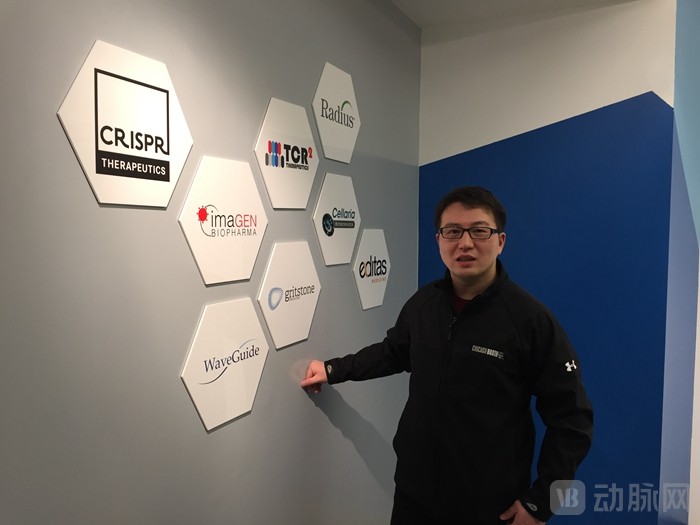
Dr. Zhu, Who Established Incubator 2.0 in Boston
However, Zhu Pengcheng did not stop there. He believed that the previous Version 1.0 and 2.0 shared laboratories were essentially based on a partitioned leasing model. Once proven successful, this model would inevitably be imitated by numerous companies. Only by establishing an innovation and commercialization complex with greater breadth and higher added value could one create unique value, open up new market tracks, and lead the industry.
In 2017, Zhu Pengcheng began establishing the ATLATL Dart Accelerator (Version 3.0) in Shanghai, leveraging the unique advantages of the Yangtze River Delta to create an innovation complex with R&D capabilities. In 2020, building on prior experience, ATLATL launched its 4.0 model—an ecological cluster that aggregates and serves as a source for innovation.
Headquartered in Shanghai Zhangjiang Core Science City, which also serves as the global hub for the biomedical R&D service supply chain, ATLATL leverages its strategic position in the Yangtze River Delta to empower its development. Unlike traditional shared laboratories, ATLATL is an innovative complex featuring a comprehensive R&D system, drawing on Zhu Pengcheng’s years of entrepreneurial experience in Boston. Currently, ATLATL has gradually evolved into a leading life and health technology innovation complex that integrates R&D centers, accelerated translation, and early-stage incubation, primarily comprising the following five sectors.
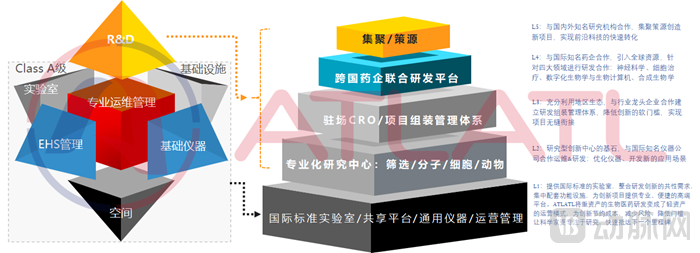
Functional Modules
1Shared Laboratories: Transforming Asset-Heavy Biotech R&D into an Asset-Light Operating Model
As the cornerstone of the entire R&D ecosystem, the ATLATL Shared Laboratory module upholds the laboratory standards established by Zhu Pengcheng in Boston. It features turnkey labs and public R&D platforms built to international standards, specialized operations and EHS management, laboratory infrastructure and services, shared instrumentation and related scientific research services, as well as intelligent management through LIMS and IoT. Currently, ATLATL Shared Laboratories serve over 85 R&D teams, including multinational corporations such as AstraZeneca and WuXi AppTec; publicly listed companies like Junshi Biosciences and Blue Sail Medical; rapidly growing enterprises such as Imabio and Longxin; and innovative, technology-leading startups like Grit Bio, Eccogene, and Lingke.
By optimizing previous R&D innovation models, this module transforms asset-heavy biopharmaceutical R&D into an asset-light operational model, saving costs for innovation, reducing risks, lowering barriers, and enabling scientists to focus more on R&D work where they excel and which holds greater value, thereby rapidly reaching the next milestone.
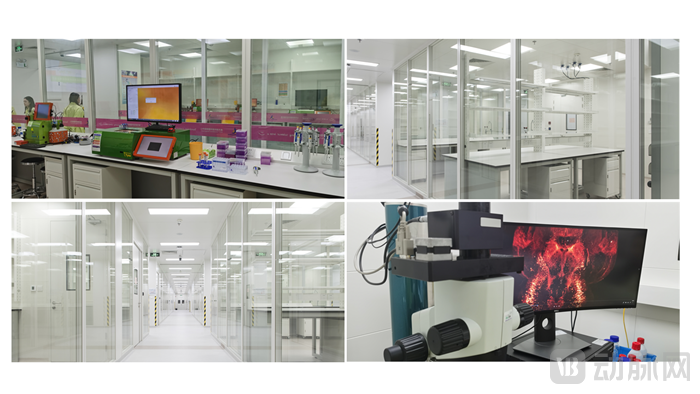
ATLATL Lab Images
2Specialized Central Laboratories: Dual Advancement in the Timeliness of Scientific Research and the Compatibility of Equipment R&D and Utilization
By partnering with internationally renowned instrument manufacturers to establish specialized research centers, ATLATL leverages a collaborative model wherein the manufacturers provide instrumentation and operations and maintenance management, while ATLATL engages in instrument utilization and R&D services. Based on feedback from scientists, this partnership facilitates instrument optimization and the development of new application scenarios. To date, ATLATL has co-established multiple research centers, including those focused on gene and cell therapy, proteomics, and drug screening, securing instrumental support valued at over RMB 140 million.
Specialized central laboratories can be regarded as the cornerstone of research-oriented innovation centers. Scientists are also involved in the research and development (R&D) of instruments, fostering the most direct and timely collaboration with instrument manufacturers. As R&D efforts advance, the instruments are continuously optimized, thereby achieving dual progress: enhancing the timeliness of scientists’ R&D work and improving the adaptability of equipment from instrument companies.
3R&D and Assembly System: On-site CRO, Personalized R&D, Lowering the Soft Barriers to Innovation, and Achieving Seamless Project Integration
The development of instruments and technologies has spurred the growth of related industries, such as Contract Research Organizations (CROs). ATLATL leverages the ecosystem in the Zhangjiang area by partnering with renowned CRO companies to establish on-site CRO services and a R&D assembly management system. For instance, in collaboration with Charles River Laboratories, it has jointly created a drug acceleration platform focused on animal services, enabling efficient project transfer and seamless integration.
In collaborative projects, ATLATL mobilized on-site partners and neighboring companies to work together, providing integrated R&D and assembly services for a company spun out of a renowned research institute in Boston. ATLATL also invited major multinational pharmaceutical companies and investment firms to attend a summit on IT+BT (Information Technology + Biotechnology), where it proposed the AVIC+Lab model, and subsequently conducted experimental validation for an AI-driven drug design company. Furthermore, ATLATL has provided integrated R&D and assembly solutions for a UK-based company and offered CRO/FTE services to on-site enterprises.
In terms of collaboration, the ATLATL team focuses on personalized R&D—where traditional CROs lack competitive advantages—CRO services with high demands for logistics and communication, as well as project assembly and implementation management. This approach lowers the soft barriers to innovation and ensures seamless project integration.
4R&D Collaboration: Focusing on Four Key Areas—Neuroscience, Cell Therapy, Computational Biology and Biocomputing, and Synthetic Biology
ATLATL collaborates with multiple internationally renowned pharmaceutical companies to introduce global resources,For the four major fields of neuroscience, cell therapy, digital biology and biocomputing, and synthetic biologyEngage in R&D collaboration. Currently, ATLATL has jointly established the BI-ATLATL Joint Laboratory with Boehringer Ingelheim to conduct R&D collaboration in synthetic biology, incubating multiple companies within six months; by establishing joint laboratories with industry leaders, it carries out early-stage R&D and investment collaboration.
In collaborating with external innovation platforms of multinational corporations, ATLATL has the opportunity to amplify its ecosystem value and gain broader access to top-tier global research institutions and scientists. Furthermore, ATLATL can leverage ecosystem integration to drive industry-specific innovation sourcing.
5Pioneering Innovation: Direct collaboration with universities, institutions, and government strategic innovation initiatives to accelerate the translation of scientific research achievements.
ATLATL collaborates directly with renowned domestic and international research institutions, universities, high-tech parks, and government agencies to aggregate resources for originating new projects. It plans, participates in, and implements the development, construction, and operation of innovative integrated platforms, thereby accelerating the translation of cutting-edge technologies.Currently, ATLATL has established collaborations with institutions and enterprises such as Fudan University, the Lingang New Area, and several renowned research institutes and hospitals.
The field of scientific research translation is still in its infancy in China. Compared with the efficient and well-supported translation processes at foreign universities and research institutions, China currently lacks a comprehensive system for screening research outcomes and guiding scientists from the laboratory to industrialization.This sector is worth exploring and developing for ATLATL, as well as for domestic biotech companies and major universities and institutions.
The layered integration across these five dimensions gradually outlines ATLATL’s robust system architecture, creating greater value-added advantages that distinguish ATLATL from other experimental platforms. This establishes ATLATL’s uniqueness, professionalism, leadership, and comprehensiveness, addressing the pain points of startup biotech companies in terms of cost and time.
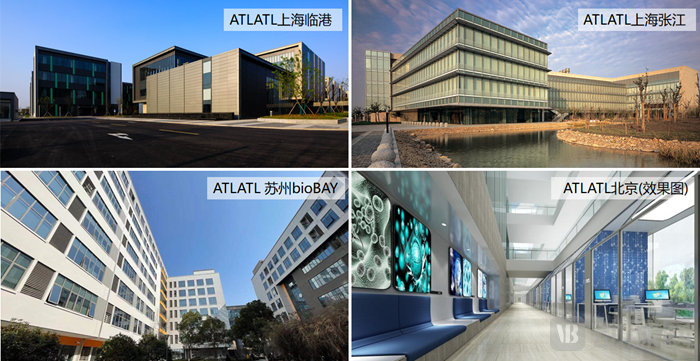
ATLATL's Current Layout
Looking ahead, ATLATL will continue to anchor itself in the Yangtze River Delta, a global hub for the biopharmaceutical R&D supply chain. By establishing a presence in core biotech clusters such as Beijing, Suzhou, Zhangjiang, and Lingang, ATLATL will develop distinctive innovation bases tailored to local strengths. Through synergistic collaboration across these regions, the company will deepen and broaden its integrated R&D innovation ecosystem, thereby fueling the robust growth of the biotech industry.