

Unicorn YunzhiSheng's Medical Journey: From Voice-Enabled EMR to AI-Powered Clinical Decision Support
In Paul Levinson’s view, there is a humanizing trajectory in the development of media technology—one that evolves to better align with the physiological characteristics of human senses. This media theorist recognizes the positive aspects of media technology and firmly believes that by following this path, media technology can liberate humanity from the oppressions of nature and biological constraints, thereby further advancing human civilization and social progress.
Levinson’s perspective is also evident in the healthcare sector. In 2014, leveraging artificial intelligence technologies such as intelligent speech recognition, natural language understanding, and clinical knowledge graphs, Unisound AI Technology Co., Ltd. developed a voice-enabled electronic medical record (EMR) system. This system replaces the traditional keyboard-and-mouse data entry method with voice input—a form of natural human speech—thereby freeing physicians from the burdensome tasks of medical record collection and documentation.
Driven by policy support, demand pull, and corporate exploration, the development of smart hospitals has entered the 2.0 phase. The construction of smart hospitals based on new technologies such as artificial intelligence, the Internet, and the Internet of Things has become an inevitable path for the future development of hospitals.This wave of medical transformation, driven by technological advancements, has swept across China.
However,Enterprises still face numerous unresolved challenges in their pursuit of building smart hospitals, such as how to plan product roadmaps and how to seize first-mover advantages in the market.VCBeat conducted an exclusive interview with Xie Guanchao, President of Unisound’s Healthcare Business Unit, to seek answers.
In 2012, Unisound launched its Voice Cloud and deep learning applications, marking the beginning of its exploration in the technology sector. Despite its early entry, the company did not maintain a consistent pace of rapid growth. Instead, amidst the hype surrounding the artificial intelligence market, Unisound chose to focus quietly on technological development.
According to its prospectus from last year, the ratios of R&D expenses to operating revenue for Unisound AI Technology Co., Ltd. from 2017 to 2020 were 109.13%, 117.78%, 77.61%, and 163.55%, respectively, far exceeding the 15% threshold required by regulations.
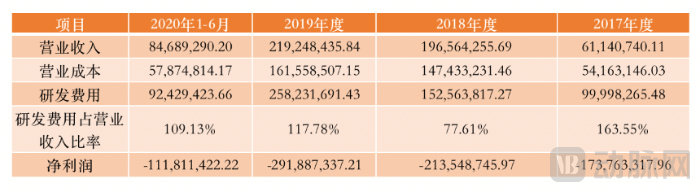
Excerpt of Financial Indicators
Meanwhile, Unisound AI Technology Co., Ltd. is attempting to list on the STAR Market under the second set of listing criteria. These criteria require that a company’s “estimated market capitalization be no less than RMB 1.5 billion, its operating revenue for the most recent year be no less than RMB 200 million, and its cumulative R&D expenditure over the past three years account for no less than 15% of its cumulative operating revenue over the same period.” This clearly demonstrates Unisound’s strong commitment to technological research and development.
Judging from the development path of Unisound AI Technology Co., Ltd., the time and energy invested in refining its core technologies during the early stages have continuously fueled its subsequent growth, enabling the company to achieve sustained upward momentum.
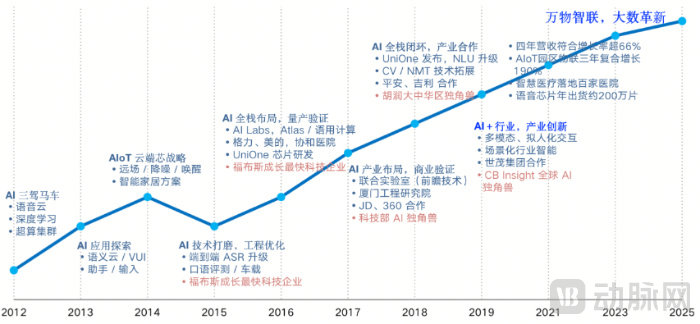
Corporate Development Path
But for Unisound, building a solid technical foundation is merely the first step in its product research and development.Product capabilities and the scenario-based value derived from their application are more critical.
In the interview, Xie Guanchao told VCBeat:“In the healthcare sector, Unisound aims to drive product innovation through technological advancement; however, beyond technology itself, it places greater emphasis on delivering tangible value in hospitals and other application scenarios.”
In 2014, Unisound AI Technology Co., Ltd. made a decisive entry into the healthcare sector, developing an intelligent speech-based electronic medical record system to address the industry’s three major pain points: efficiency, safety, and data management.By automatically converting speech to text and entering electronic medical record (EMR) data in a structured format, the efficiency of medical record documentation is improved. Meanwhile, to ensure precise recognition, Unisound has implemented deep customization for hospitals by extracting key phrases and corpus from complete medical records across different departments and disease types. This provides scenario-specific support for more than 40 clinical and medical technology departments, adapting to the actual usage needs of various hospital departments.
The system’s speech recognition accuracy exceeds 95%, with certain departments achieving over 98%. Unisound told VCBeat,The system’s high accuracy is underpinned by its self-developed speech recognition engine, the first of its kind in China’s medical field. This engine has undergone extensive model optimization tailored to medical databases, which encompass millions of specialized medical terms, tens of thousands of hours of accumulated corpus data, highly complex Chinese-English code-switching patterns, and unique medical symbols.
Unisound’s early commitment to deep technological development has become the cornerstone of its sustained upward growth, while the data accumulated through its intelligent medical voice systems and its profound understanding of healthcare scenarios have provided stronger support for subsequent product development, thereby establishing its own competitive moat.
As Xie Guanchao has stated:“Different scenarios will give rise to distinct technical capabilities and create varying value. Therefore, on the foundation of robust technology, a deep understanding of application scenarios and the accumulation of data are particularly crucial.”
Unisound’s deep understanding of its products has enabled it to launch, over the past two to three years, a series of clinical decision support solutions derived from its proprietary clinical knowledge graph and related technologies, with its product framework no longer confined solely to the realm of speech recognition.
Based on millions of data points, Unisound has taken its next step by building a knowledge graph.This knowledge graph covers seven major categories of entities, including symptoms, signs, diseases, surgeries, examinations and tests, and medications, totaling 1.32 million entities corresponding to 3.34 million medical terms. It includes ten major categories of entity relationships, amounting to 7.57 million relationships. Its application capability was validated by achieving a score exceeding 500 on the National Medical Licensing Examination. Since 2017, the knowledge graph has undergone three iterations and has been put into practical use.
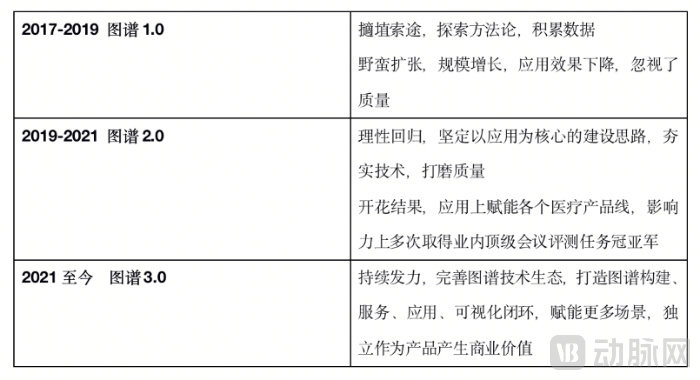
Knowledge Graph Iteration Path
Currently, Unisound has won championships in multiple competitions by leveraging this knowledge graph.
Empowered by technology, knowledge graphs, as one of the core drivers propelling the development of the internet and artificial intelligence, can help industries break free from repetitive cognitive tasks to a certain extent through their construction.Unisound’s in-depth development of knowledge graphs has also gradually enhanced the intelligence level of its products. Unisound aims to achieve a balance between knowledge and capabilities by expanding the breadth of knowledge, thereby building a comprehensive knowledge graph-based decision support system.
In Xie Guanchao’s view, informatization is the prerequisite for intelligent technologies. Once informatization reaches a relatively mature stage, intelligence will become an essential pathway for building smart hospitals. Leveraging its knowledge graph, Unisound AI Technology Co., Ltd. plans to develop auxiliary decision-making products to address common challenges at the current stage. Furthermore, the company intends to continuously advance clinical decision-making through AI technologies, achieving a transition from efficiency tools to decision-support products.
Regarding product planning, Xie Guanchao further explained: “At present, we primarily position this product as an assistant, but we aspire for it to truly evolve into a colleague and even a mentor to physicians. Although it remains uncertain how long this journey will take, I am convinced that this is the definitive trend for future development.”
Going forward, Unisound will continue to refine its clinical knowledge graph and enhance its technical capabilities. It will deploy its products in healthcare scenarios to effectively align its technologies and capabilities with industry demands, thereby deepening product development.
As a technology-driven enterprise, Unisound appears to possess the ability to grasp the underlying logical chains of things and identify the industry’s intrinsic pain points from just a few lines of code.
In January this year, the release of the “Quality Control Indicators for Medical Record Management (2021 Edition)” and its accompanying interpretation by the National Health Commission once again elevated medical record issues to a key management priority.
Unisound, which has built its medical product ecosystem around issues related to electronic medical records (EMRs), is precisely positioned at this critical juncture. As an early entrant, Unisound has developed a portfolio of solutions including an intelligent EMR quality control system, a medical quality management platform, a single-disease quality control platform, and an intelligent health insurance audit system.
Xie Guanchao told VCBeat“Initially, our understanding of medical quality control was relatively simplistic; we viewed medical records merely as documentation and focused on identifying inconsistencies within them. However, as our operations advanced, we realized that the scope extends beyond medical record documentation to encompass issues across the entire healthcare delivery process. Consequently, the solution we currently provide in hospitals is no longer limited to a medical record quality control product, but rather a comprehensive medical quality control platform.”
Unisound’s Intelligent Medical Record Quality Control System not only performs formal screening of medical records but also accurately interprets their clinical content to identify deficiencies, thereby reengineering workflows and enhancing the efficiency of quality control operations. It provides auxiliary tools for quality control personnel, enables the Medical Affairs Department to automate quality management processes, and delivers multi-dimensional statistical analytics.
It is evident that Unisound has completed the iterative upgrade from perceptual intelligence to cognitive intelligence, and has established a tripartite business framework encompassing clinical care, hospital administration, and medical insurance.
Currently, Unisound targets top-tier (Grade 3A) hospitals as its benchmark clients, having established partnerships with institutions such as Peking Union Medical College Hospital and Zhongshan Hospital affiliated to Fudan University. By collaborating with industry technology providers, it has deployed solutions in over 100 representative large general Grade 3A hospitals, with more than 500 additional hospitals currently in the testing phase.
Regarding revenue, Xie Guanchao stated to VCBeat, “In the first half of this year, Unisound’s revenue from its medical business more than doubled compared to the same period last year.”
It is reported that Unisound’s entire medical team comprises fewer than 100 employees, yet these individuals have underpinned the company’s healthcare business segment, driving its revenue to double annually. How has Unisound achieved this? The answer lies in the company’s strategic approach—productization.
In the eyes of Unisound,Productization is an unavoidable path for AI companies. Without developing standardized products, companies risk having their R&D rhythms disrupted by customized client demands, thereby hitting a growth ceiling.
Therefore, in product development, Unisound adheres to the creation of standardized products. By ensuring that strategy precedes technology, technology precedes business operations, and business operations precede customer engagement, we meet over 90% of the needs of different customers within the same scenario.
Productization enhances labor efficiency, further driving revenue growth.
Over the past nine years, Unisound has secured a total of 10 funding rounds from Series A to Series D (according to Qichacha data), raising at least RMB 2 billion. The company has also obtained 51 software copyrights and 533 patents, firmly establishing itself as one of the leading unicorns in the artificial intelligence and Internet of Things (AI/IoT) sectors.
From Unisound AI Technology Co., Ltd.’s two-year preparation for its STAR Market listing and its experience through the quiet period, to its withdrawal of the IPO application materials this year amid claims of continuing to build core technologies and product systems to maintain competitiveness, this technology-focused company appears to be rising and falling with the industry.
As Unisound returns to the primary market, securing nearly $100 million in its D1 financing round, it is evident that the company’s efforts have been far from futile amidst its ups and downs.