

Huiying Medical Addresses Hospital Imaging Informatics Challenges with AI at CHIMA 2021

HY Medical
Provider of Medical Imaging and Oncology Radiotherapy Platforms
Medical imaging data is a common type of data. It is roughly estimated that 90% of disease diagnosis processes involve the acquisition and analysis of imaging data. However, unlike intuitive textual information, imaging information is embedded within collections of pixels. Computers must learn to apply appropriate logical operations within defined regions to effectively interpret imaging information. Therefore, for a long period, the term "imaging informatization" referred merely to the standardization of imaging data acquisition, rather than the standardization of imaging data storage.
From July 29 to 31, the 2021 China Hospital Information Network Conference (CHIMA) was grandly held in Qingdao, Shandong Province. Nearly 10,000 attendees participated, including representatives from the National Health Commission, academicians from the Chinese Academy of Sciences and the Chinese Academy of Engineering, as well as renowned experts, scholars, and industry leaders in the field of healthcare informatization both domestically and internationally. At the conference, Dr. Chai Xiangfei, founder of HY Medical, and Director Chen Min from the Second Hospital of Shandong University were invited to deliver keynote speeches, providing solutions to the aforementioned issue of imaging data standardization. Meanwhile, HY Medical presented its integrated AI-based medical imaging solution and engaged with participating hospitals in exploring various applications of AI technology to facilitate digital and intelligent transformation in hospitals, thereby promoting high-quality hospital development.
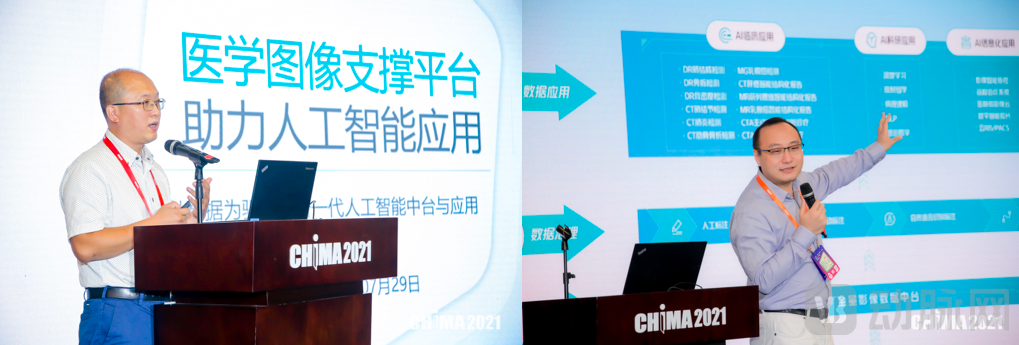
Dr. Chai Xiangfei, Founder of HY Medical; Director Chen Min, The Second Hospital of Shandong University
Currently, cost reduction and efficiency improvement have become operational goals for institutions across various industries. Since the release of the "Opinions on Promoting High-Quality Development of Public Hospitals" on June 4, 2021, public hospitals have adopted the "New Four Modernizations" as their development objectives: premium-quality development, refined management and operations, precise disease diagnosis and treatment, and intelligent information technologies.
The “Notice on Accelerating the Mutual Recognition of Inspection and Test Results,” issued on July 16, further clarifies the overarching operational guideline for medical institutions: to enhance efficiency, reduce the financial burden on the public, improve patients’ healthcare experience, and boost the utilization efficiency of medical resources through mutual recognition and sharing of inspection and test results. The intelligent application of information technology undoubtedly serves as a catalyst for cost reduction, efficiency improvement, and high-quality development in public hospitals, while also acting as an enabler for refined operations and precision diagnosis and treatment.
As a global leader in smart imaging, HY Medical is committed to providing hospitals at all levels with intelligent, integrated, hospital-wide solutions centered on medical imaging, thereby supporting hospitals in achieving high-quality development. At this CHIMA conference, Dr. Chai Xiangfei, founder of HY Medical, delivered a keynote speech titled “Next-Generation Data Middle Platform Empowering High-Quality Development of Public Hospitals.” Focusing on the informatization, digitalization, and intelligent transformation of hospital imaging, he analyzed challenges in medical workflows and clinical diagnosis and treatment, and proposed building a new generation of AI-driven data middle platforms while ensuring information security.
“The New” Generation emphasizes three key aspects: “full-cycle,” “end-to-end process,” and “organization-wide participation,” enabling imaging informatics to permeate both in-hospital and out-of-hospital settings and bridge clinical practice with scientific research.
Full-Cycle Empowerment: HY Medical is the only vendor in China with integrated capabilities for building imaging clouds, AI, and cloud-based film solutions. With the release of the "Notice on Accelerating the Mutual Recognition of Examination and Test Results," HY Medical’s advantages in integrated construction have become even more prominent. Spanning from imaging clouds to digital films, and from image quality control to training and education, HY Medical’s data middle platform breaks down the physical barriers between central hospitals and primary care institutions. It facilitates the decentralization of high-quality medical resources to primary care facilities. Centered on medical imaging, it supports remote diagnostics, audio-video consultations, image quality control, and training programs. This approach not only meets national standards for the mutual recognition of test results but also comprehensively supports hospitals in achieving higher levels of informatization ratings.
End-to-End Empowerment: At the forum, Chai Xiangfei described the end-to-end value of the data middle platform as follows: “After a patient completes imaging in the radiology department, radiologists can perform diagnoses within seconds using an all-in-one AI-assisted diagnostic system. Patients can view their imaging reports on their mobile devices after a short wait and retain long-term access for future reference. The patient’s personal information and imaging report data are stored in the AI-powered data middle platform, where data governance capabilities enable research access, algorithmic analysis, and inpatient comparison. Interdepartmental connectivity is achieved without the need for integrating multiple systems; a single middle platform supports the entire patient journey from admission to discharge, as well as physicians’ clinical workflows and research activities.”
Empowering All Stakeholders: As the volume of hospital data continues to grow, its value is increasingly being recognized. Artificial intelligence (AI) technology currently represents the most effective approach for data mining and utilization. The HY Medical Data Middle Platform incorporates AI algorithms such as deep learning and machine learning, while integrating thousands of feature values. This platform assists physicians in conducting fund-sponsored projects and scientific research initiatives. Meanwhile, it also enables hospital administrators to monitor in real time the work performance and research activities of radiologists at all levels.
Chai Xiangfei stated that healthcare is an industry characterized by a strong sense of social responsibility and public welfare attributes. Since its inception, HY Medical has adhered to the original aspiration of “Tech for Good,” aiming to leverage technology to address the imbalance in medical resource distribution. As one of the earliest pioneers in the medical AI sector, Guo Na has witnessed the state’s encouragement for artificial intelligence to achieve “leapfrog development” as well as its determination to drive healthcare reform. HY Medical is also committed to unlocking the value of medical data, providing hospitals with integrated, comprehensive intelligent solutions.
The Second Hospital of Shandong University (hereinafter referred to as “Shanda Eryuan”) is a Grade A tertiary general hospital, one of the first member units of the National Regional Medical Centers jointly established by the National Health Commission and provincial governments, and a teaching hospital of Shandong University. At the China Health Information Technology and Health & Medical Big Data Application Exchange Conference and Software, Hardware, and Health & Medical Products Expo, the Statistical Information Center of the National Health Commission announced the list of institutions that passed the 2020 National Medical Health Information Interconnectivity Standardization Maturity Test during the opening ceremony. Shanda Eryuan successfully passed the Level 4 Class A assessment for national medical information interconnectivity standardization maturity.
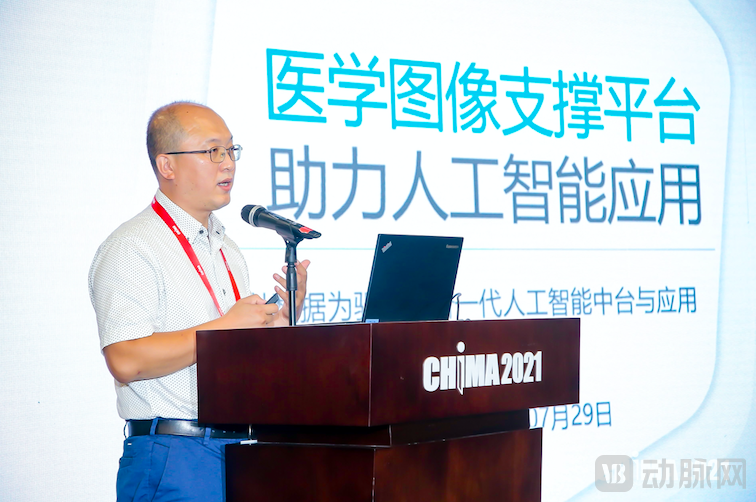
Chen Min, Director of the Information Center, The Second Hospital of Shandong University
At the CHIMA Medical Big Data Sub-forum, Mr. Chen Min, Director of the Information Center at The Second Hospital of Shandong University, shared with attendees the hospital’s “AI Data Middle Platform” construction project. Designed and implemented by HY Medical, this project covers the entire workflow of data aggregation, data analysis, data governance, and data utilization.
Director Chen stated at the meeting that the traditional “siloed” approach to IT construction had kept the Information Department preoccupied with “maintaining stability.” Today, the Information Department should assume the roles of data steward and value creator. In response to the challenges posed by multiple distributed and integrated systems, the Second Hospital of Shandong University selected HY Medical’s integrated smart imaging solution. With the goal of enabling continuous data utilization, HY Medical leverages the tools, methodologies, and operational mechanisms provided by its data middle platform to transform data into services that can be continuously utilized, explored, and opened up. This makes data more accessible for business operations, achieving digitization of scenarios, servitization of data, and intelligentization of data services. Empowered by the data middle platform, hospital business systems gain “full-dimensional” and “intelligent” capabilities, evolving from mere informatization to intelligent business systems.
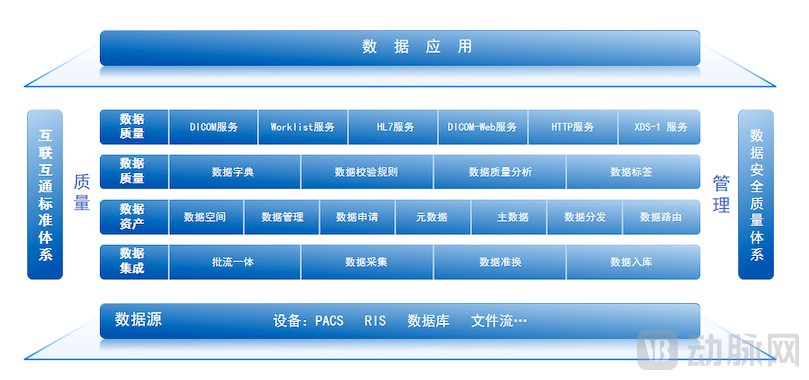
Application System Architecture of the Second Hospital of Shandong University
It is understood that HY Medical’s integrated smart imaging solution has been fully implemented at the Second Hospital of Shandong University, covering medical technology departments, clinical departments, and research centers, thereby truly achieving end-to-end data management and data mining. With intelligent support through information technology, the Second Hospital of Shandong University is emerging as a comprehensive research and teaching hospital with strong overall capabilities.
Concurrent with the CHIMA Conference, a Medical Information Technology and Product Exhibition was held. HY Medical presented its hospital-wide integrated smart imaging solution and launched products addressing four key areas: an integrated AI-assisted diagnosis solution, an artificial intelligence research platform construction plan, an in-hospital imaging data middle-end construction plan, and an integrated regional imaging cloud/cloud film construction plan. These newly released products align with the initiatives for smart hospital development, interoperability certification, and the establishment of research-oriented hospitals.
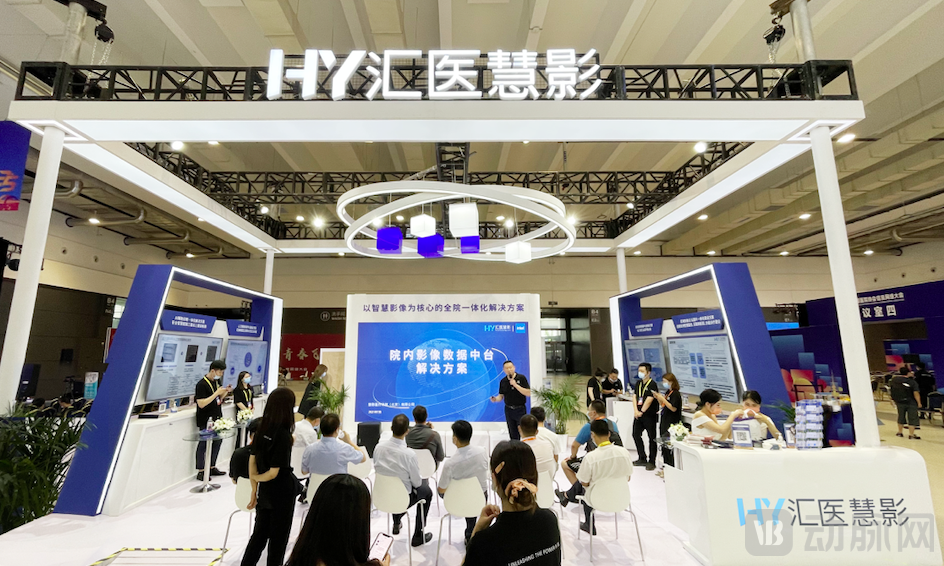
HY Medical Exhibition Area
AI is the future of healthcare IT and an inevitable path toward high-quality development for hospitals. Building on informatization, achieving hospital intelligence through AI, and leveraging artificial intelligence to unlock the value of medical data are essential choices for every hospital committed to high-quality development, as well as key drivers in realizing the goal of universal healthcare.
As Chen Weiguang, Managing Partner at BlueRun Ventures, stated at a forum: “Without new data platforms, there can be no meaningful discussion of big data and AI. New infrastructure is giving rise to new data platforms that integrate computing power and technological resources. This integration will attract more talent and capital, driving further reform and upgrading of technology.” HY Medical is firmly on the path to unlocking the extraordinary value of medical data and leveraging AI to support healthcare reform and advancement.