

CHIMA 2021: Six Key Directions in Healthcare Informatics — Data, Security, and Regional Medical Integration
The recent passage of a typhoon, coupled with the ongoing impact of the pandemic, lent the China Hospital Information Network Conference (CHIMA 2021), held this year in Qingdao, a somewhat quiet atmosphere.
The exhibition area at the Hongdao International Conference and Exhibition Center was slightly smaller compared to the year before last. In terms of IT infrastructure, industry leaders such as Neusoft Group, Winning Health and Chuangye Huikang (which have been embroiled in disputes over their merger), and Thinkive Medical, which has been developing quietly, were absent from this industry-level informatization conference. Only three listed IT companies—Yilianzhong, Donghua Medical Information, and Shanda Diwei—participated to support the event.
In contrast, companies specializing in regional healthcare IT infrastructure, information security, and next-generation IT solutions focused on healthcare big data have emerged as standout participants at the exhibition. Each of these sectors featured double-digit exhibitor participation, making them a highlight of this year’s CHIMA exhibition area.
In addition, tech and healthcare giants such as Tencent, Alibaba, GE, Philips, Huawei, Yidu Cloud, LinkDoc, United Imaging, and Beifang Big Data have all established a presence in Hongdao. Under the theme “Digital-Intelligence Symbiosis: Co-Creating the Future,” each industry leader is striving to identify its unique role within the infrastructure of healthcare informatization.

Since the launch of China’s new healthcare reforms, more than ten guiding policies have been successively issued to promote the development of hospital informatization. To date, a large number of tertiary hospitals and some secondary hospitals have achieved highly effective informatization, significantly improving operational efficiency. However, reforms in the upper-level structure of the healthcare system have not fundamentally resolved long-standing issues such as the misallocation of medical resources and uneven regional development. To truly drive system-wide coordination among medical care, health insurance, and pharmaceuticals (the “Three-Medical Linkage”) and implement tiered diagnosis and treatment at the regional level, restructuring the quality of primary healthcare is the ultimate solution.
At this CHIMA conference, companies such as Yilianzhong and Alibaba Cloud conducted in-depth discussions on the solution of county-level medical consortia. Yilianzhong has gradually established a closely integrated medical consortium health management organization centered on health, aligned with the Healthy China strategy, facilitating a shift from “treating existing diseases” to “preventing diseases.” This effort has built a “trinity” health service system encompassing disease prevention, medical treatment, and health management.
Shaxian General Hospital, featured in the exhibition area, serves as a prime example of a closely integrated medical consortium. Yilianzhong first established a regional information platform and data center for Shaxian General Hospital in accordance with national standards for regional interconnectivity. By unifying data standards and service specifications, the company achieved seamless information exchange and data aggregation within the region. Leveraging big data mining and analytics technologies, it provides intelligent analysis and assessment of the hospital’s operational management, offering smart decision-support services to facilitate scientific management decisions.
Secondly, Yilianzhong has introduced a “full closed-loop” design concept, leveraging “Internet+ technology” to integrate pre-consultation, intra-consultation, and post-consultation services, thereby achieving a seamless online-offline closed loop. Meanwhile, physicians can maintain necessary communication with patients and conduct post-consultation follow-ups through patient management tools on the hospital’s internet portal, continuously monitoring patients’ recovery progress. This ensures that patients enjoy a consistent healthcare experience both at home and in the hospital, realizing a full-process closed loop.
Upon completion of the construction, residents’ healthcare experience will undergo a significant transformation. In short, when residents visit hospitals, physicians will be able to access their medical records, healthcare information, and health management data from various medical and health institutions, providing sufficient evidence-based support for accurate diagnosis. Additionally, an intelligent assistant will provide reminders, interventions, and guidance regarding residents’ diet, daily routines, exercise, and medication adherence at home. Overall, future healthcare will extend beyond mere treatment of illnesses to encompass comprehensive health management.
Nevertheless, the development of medical consortia has not been without challenges. At the Sub-forum on Regional Smart Healthcare Construction, part of the Smart Health Digital Development Forum hosted by Alibaba Cloud, Xi Biao, Executive Director and Chief Expert of the Hebei Think Tank (Health), stated that, at present, the advancement of tightly integrated county-level medical consortia remains relatively slow, as does the enhancement of foundational capabilities. This is largely due to the insufficient information technology infrastructure at the primary care level. Building more effective county-level medical consortia requires support from big data and smart healthcare technologies; however, leveraging these technologies effectively necessitates accelerated development of IT infrastructure in primary healthcare institutions.
Currently, the construction cost of a medical community ranges from approximately RMB 5 million to RMB 20 million. In accordance with China’s overall plan to designate 567 counties as pilot sites for county-level medical community development, the market size to be absorbed over the next few years will exceed RMB 10 billion.
Trend 2, Trend 3: Big Data-Driven Informationization Remains a Hotspot
There are two trends in big data infrastructure development: one is the construction of a data middle platform centered on textual information, and the other is the establishment of an imaging data middle platform focused on medical imaging data. Based on these two platforms, enterprises further develop data applications.
Data Middle Platform
In the realm of data middle platforms, companies such as Yidu Cloud, Tencent, Huimei Technology, and Senyi Intelligence have all presented their solutions. While there are certain differences in architectural layering and functionality among these enterprises, their overall approaches are largely convergent. The general strategy involves establishing a data center that operates independently of the Hospital Information System (HIS) yet enables seamless integration with it, thereby performing functions such as data processing, management, and application. This aims to help hospitals improve managerial efficiency, ensure quality and safety, and enhance the translation of scientific research into practical applications.
Taking Tencent Smart Healthcare’s Data Middle Platform as an example, it has built a one-stop, integrated, and visualized healthcare data workstation. Starting from the three dimensions of “governance,” “integration,” and “utilization,” it covers the full spectrum of medical data service capabilities—from data integration and data governance to data application. Furthermore, by opening its platform and introducing an ecosystem, it helps healthcare institutions and administrative departments at all levels achieve comprehensive, professional, and automated management of healthcare data.
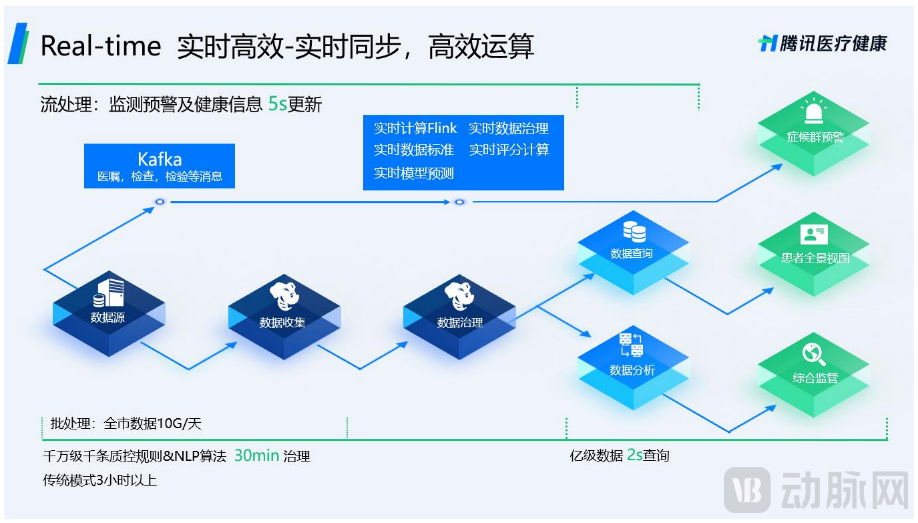
Tencent’s data middle platform provides data producers with streamlined data service configuration capabilities, including encapsulated data ingestion, custom service queries, and external publishing authorization. Meanwhile, through its service marketplace, the platform offers data consumers demand search and permission management services, thereby better matching data supply with demand. Furthermore, the middle platform has established standardized interface specifications in accordance with national standards and usage requirements, unifying external interfaces to enable integrated stream and batch processing for real-time data access by specific business applications. This effectively facilitates the aggregation of cross-system data services across diverse scenarios.
Big data applications are typically characterized by rapid innovation. At the CHIMA conference, Yidu Cloud, a listed company specializing in medical AI and big data, launched two new products: a Multi-Center Clinical Research Solution and a Scientific Research Collaboration Platform.
Yidu Cloud’s Multi-Center Medical Research Platform establishes a network for multi-center medical research, leveraging secure multi-party computation to redefine research value, foster collaborative innovation in clinical studies, and accelerate the translation of high-quality scientific achievements. Meanwhile, Yidu Cloud’s Research Collaboration Platform, supported by the hospital cooperation network underpinned by the Yidu Cloud Medical Data Intelligence Platform, provides medical researchers with professional, efficient, convenient, and secure intelligent services covering the entire online medical research workflow. On this platform, anyone can initiate projects, with no rigid distinction between “lead” and “participating” centers, thereby significantly enhancing the efficiency of research collaboration.
Senyi Intelligence continues to adopt the “12306” solution introduced at CHINC 2021, addressing issues such as insufficient data governance, limited intelligence capabilities, unclear value orientation, lack of closed-loop resolution mechanisms, and incomplete business scenarios. This approach supports hospitals in achieving certifications and standards for Smart Hospitals, Interconnectivity, and Electronic Medical Record (EMR) system grading, thereby facilitating their high-quality development.
Imaging Data Middle Platform
Compared with previous conferences, the medical imaging data middle platform and big data-based intelligent applications have garnered greater attention. Huiyi Huiying, Kayi, Fujifilm, LinkDoc, GE, and Philips all showcased their proprietary solutions. Most of these solutions employ computer vision technology to interpret pixel-based imaging data, aiming to achieve standardization of such data.
Taking Huiyi Huiying’s Imaging Middle Platform as an example, this platform comprises three major modules: data quality, data assets, and data integration. With the goal of sustaining data utilization, it leverages the tools, methodologies, and operational mechanisms provided by the data middle platform to transform data into service capabilities that can be continuously utilized, explored, and opened up. This makes data more accessible for business use, achieving scenario-based datafication, data-as-a-service, and intelligent data services. Empowered by the data middle platform, hospital business systems gain “full-dimensional” and “intelligent” capabilities, evolving from merely informatized systems into intelligent business systems.
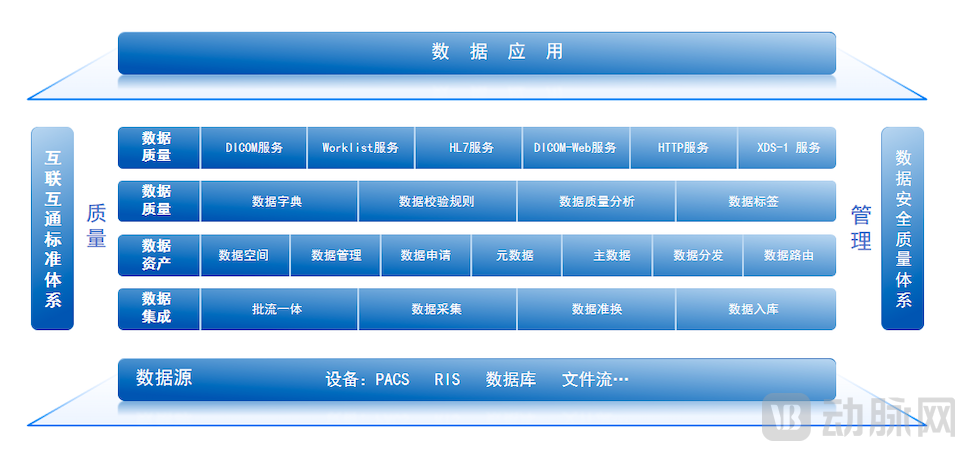 Imaging Middle-Platform Application System Architecture Developed by Huiyi Huiying for the Second Hospital of Shandong University
ZeroCrunch’s latest offerings are more focused on the application of “AI + Medical Big Data.” The Hubble Integrated Lung Cancer Solution, designed for physicians, leverages AI to automatically detect, guide, and extract key clinical diagnosis and treatment tasks, serving as an “intelligent brain” for clinicians. This helps mitigate the risk of medical errors, reduce missed and misdiagnoses, and improve the efficiency of lung cancer diagnosis and treatment. The second new product, the AI Intelligent Consultation Platform, enables standardized management across the entire workflow, providing services such as cloud storage, real-time AI-assisted diagnosis, intra-hospital and inter-hospital imaging data sharing, and imaging consultations. Additionally, solutions including 3D lung reconstruction, AI-assisted decision-making, and CT imaging-assisted diagnosis were also showcased.
Notably, although companies are actively strategizing around big data in medical imaging, their AI efforts are not confined to the radiology department. Whether it is LinkDoc’s 3D lung reconstruction, Fujifilm’s multifunctional 3D analysis, or GE Healthcare’s Edison Cube, AI enterprises are striving to extend their applications into clinical practice, shifting from “diagnosis” to “diagnosis and treatment.”
As a traditional PACS system vendor, Kayi also unveiled innovations at this CHIMA conference, launching a distributed high-concurrency cloud imaging solution. This solution achieves decentralization and supports simultaneous computation across massive numbers of devices. In terms of application, Kayi is also attempting to independently develop AI-assisted diagnostic software to realize the application of big data in medical imaging.
The surge in interest in imaging middle platforms is not unfounded. VCBeat speculates that electronic medical record (EMR) grading has, to some extent, driven the establishment of imaging middle platforms. Imaging data accounts for more than 80% of a hospital’s total data volume. To achieve Level 5 EMR certification, hospitals must implement unified management of imaging data, which requires building an imaging data middle platform. Currently, a large number of hospitals have already achieved Level 4 EMR certification, and these institutions generally place significant emphasis on digitalization. From this perspective, imaging data middle platforms may well become the next wave of enthusiasm in healthcare informatization construction.
The release of the Cybersecurity Law in 2017 sounded the first alarm regarding cybersecurity issues for hospital IT departments. The Multi-Level Protection Scheme (MLPS) 2.0, released in May 2019, further emphasized the importance of this issue and put forward substantive construction requirements for the work of hospital IT departments. Cybersecurity and information security construction have become tasks as critical as electronic medical record (EMR) system grading. In June 2021, the Data Security Law of the People’s Republic of China directly addressed data security in hospitals, with the law scheduled to take effect in September. With the support of these policies, it is not surprising that major providers of cybersecurity and data security solutions gathered at CHIMA; this may well become the next policy-driven new market for healthcare informatization construction.
Meichuang Technology told VCBeat, “The advancement of policies is merely a catalyst for hospitals to adopt information security measures. In reality, as fragmented medical data has gradually coalesced into the big data landscape we see today, its value has gained significant recognition. Structurally, while data and risks were previously dispersed, the centralization of data has led to a corresponding concentration of risks. These factors have collectively driven hospitals to prioritize the protection of their data.” Consequently, hospital information security represents a substantial blue-ocean market.
Meanwhile, the gradual implementation of concepts such as cloud hospitals, cloud desktops, and cloud-based medical consortia has imposed new requirements on cybersecurity. To ensure the security and order of cloud services, hospitals must simultaneously seek more robust network protection while migrating their data to the cloud.
According to VCBeat’s analysis, the state’s formulation of information security regulations for the healthcare industry is not merely a precautionary measure; in fact, many hospitals frequently exhibit the following six major issues:
1. The division between the internal and external networks is unclear, and isolation measures between them are lacking;
2. The operation of the hospital’s core Hospital Information System (HIS) lacks effective security safeguards and audit mechanisms;
3. The hospital's information system is not an isolated system and faces the risk of hacker intrusion and cyberattacks;
4. In the absence of redundancy in equipment and network links, a hospital faces the risk of business interruption in the event of a failure;
5. The hospital's portal website lacks necessary security measures, posing risks of SQL injection attacks and malware implantation;
6. Most hospitals have not deployed endpoint security management and auditing systems, allowing non-compliant endpoints to access the internal network at any time and making it impossible to trace the source in the event of an endpoint security incident.
In response to these issues, companies on the CHIMA platform—including Meichuang Technology, UCloud, VenusTech, Ankye Technology, H3C, Hillstone Networks, Qi-An-Xin, and Sangfor—have all provided corresponding solutions.
Taking Meichuang Technology, a company with a strong focus on data security, as an example, it has developed four major product lines—data security, data management, disaster recovery and backup, and intelligent operations and maintenance—along with comprehensive information security solutions. These offerings address the healthcare industry’s specific needs for data security, disaster recovery, and data management, delivering the following capabilities.
1. Defend against SQL injection attacks and vulnerability-based database attacks from external and internal access vectors, strengthen security defenses at the database layer, and mitigate both external and internal threats;
2. Address the management deficiencies of traditional methods, prevent unauthorized access, theft, alteration, or destruction of data by illegal users, strengthen database access control, and comprehensively ensure account security;
3. Provide comprehensive support for database operations and maintenance (O&M) security management across application change and deployment, hazardous operation control, sensitive data classification and grading, prevention of accidental operations, recovery from accidental operations, O&M auditing, and operational reporting, thereby meeting the requirements of internal controls for O&M security and various laws and regulations (such as Classified Protection of Cybersecurity, SOX, PCI, and enterprise internal control regulations).
4. Implement protection of sensitive and private data;
5. Assist users in generating compliance reports and conducting root-cause analysis of incidents after the fact, while strengthening the logging of internal and external database network activities to enhance data asset security.
Currently, the bidding prices for comprehensive hospital information security solutions typically depend on the scale of the hospital, ranging from RMB 5 million to RMB 20 million. With increasingly stringent policy requirements for data and the advancement of various cloud services, the number of hospitals requiring data security and cybersecurity services will continue to grow, creating a market worth tens of millions of yuan.
As a comprehensive exhibition, in addition to the large-scale solutions mentioned above, CHIMA also showcases innovative applications launched by health IT enterprises, striving to embed “smart” capabilities into every corner of hospitals.
Amid the impact of the COVID-19 pandemic and the need for public safety, enclosed spaces and secondary contact in medical settings have become critical pain points within the healthcare system. Leveraging Dongchao Technology’s “Interactive Aerial Imaging” technology, Dongchao Health has developed four major system products and solutions: the Contactless Smart Outpatient Clinic System, the Contactless Smart Ward System, the Contactless Smart Operating Room System, and the Contactless Public Service System.
Kejin Software has focused its efforts on building a warning platform for medical safety adverse events. By leveraging NLP-based algorithms, Kejin Software can promptly identify errors within medical text information and report them to the adverse event warning platform for centralized handling by the quality management department. Through its partnership with DingTalk, physicians can also easily access the system via DingTalk to proactively report issues not detected by AI. This approach enables hospitals to monitor adverse events across the entire institution, promptly identify high-risk issues, and take preventive measures before they occur.
The applications described above represent only a glimpse of the exhibition. Overall, the absence of leading enterprises did not diminish the overall impression of CHIMA; stripped of the halo surrounding mainstream tracks, we found it easier to spot some previously hidden sectors.
As the information infrastructure of tertiary hospitals is gradually completed, we will see more resources shifting toward information security and big data applications. Meanwhile, primary healthcare represents a market that cannot be overlooked and deserves in-depth exploration by smart health technology vendors.
As stated in the theme of this year’s CHIMA conference, “Digital-Intelligence Symbiosis, Co-Creating the Future,” there remains significant potential for smart hospitals when we delve deeper into their operations.