

Aidite Founder Li Hongwen: Core Technology Development Is Key for Oral Healthcare Enterprises in the Digital Era
Recently, the dental healthcare industry has once again surged into the spotlight.
In mid-June, Angelalign, the leading domestic player in clear aligner therapy, successfully listed on the Hong Kong Stock Exchange, becoming the “first stock of orthodontics in China.” On its first day of trading, the stock closed at HK$401, representing a surge of 131.79%, with a market capitalization reaching HK$66.49 billion, further underscoring the immense growth potential of China’s dental medical industry.
According to relevant data from the "2020 White Paper on Dental Healthcare" released by VCBeat Research Institute,In 2018, the scale of China's dental medical service industry was approximately RMB 139.8 billion, representing a year-on-year growth of about 24%. Meanwhile, Chinese residents' awareness of oral preventive healthcare has gradually increased, driving an over 50% rise in demand for dental medical services.
However,Accompanying the market boom, the industry faces challenges such as the continued dominance of foreign brands in certain sectors, imbalances in industrial supply, and a shortage of talent, making sustainable development a long and arduous journey. Therefore, how to enhance the influence of domestic brands and effectively promote the practical implementation of digital applications in dental healthcare have become critical issues requiring deep reflection within the industry.
In light of this, VCBeat conducted an exclusive interview with Mr. Li Hongwen, founder of Aidite, aiming to find answers to the aforementioned questions by analyzing Aidite’s digital strategy.
“R&D is undoubtedly the future of corporate development,”Li Hongwen stated that enterprises need to conduct technological development and reserves based on the future development trends of the industry. "If we develop a product in the future that is both technologically leading and truly desired by customers, then we not only follow a trend but also 'create' a trend."
“There is a common saying in China: ‘A toothache isn’t a disease, but it hurts like hell.’ In reality, however, a toothache is not life-threatening. As a result, people have traditionally perceived oral health as being distant from overall life and health. Consequently, compared with developed countries such as those in Europe and the United States and Japan, Chinese residents have relatively weak awareness of oral healthcare,” said Li Hongwen. He added that with China’s rapid economic development and a significant improvement in living standards, demand for dental medical services will continue to rise, representing an overarching trend and opportunity.
Li Hongwen’s views were corroborated in the relevant report.
According to relevant data from the "2019 China Health and Family Planning Statistical Yearbook," the aforementioned report estimates that the market size of China's oral medical services in 2018 was approximately RMB 139.8 billion, representing a year-on-year growth of about 24%. With the growth of the population base, the number of people requiring oral medical care in China has increased to 694 million, and 50% of residents suffer from various oral diseases. Consequently, the demand for oral medical services will remain at a high level in the long term.
Meanwhile, Chinese residents’ awareness of oral preventive healthcare is gradually awakening.Public concern is also shifting from traditional oral health issues, such as “wisdom tooth pain, dental caries, cavities, and tooth decay,” to aesthetic concerns like “insufficiently white teeth, misaligned teeth, and smile impairment.” Consequently, scenarios in oral healthcare will become more refined and comprehensive.
However, although driven by the "appearance economy," China's dental healthcare market has been booming, butFrom the supply side, clinics account for over 90% of the total number of institutions but provide only 53% of dental care services, while hospital-based medical institutions, comprising less than 10%, deliver 47% of such services. Furthermore, using the United States as a benchmark, China faces a substantial shortage of dentists, with only one-sixth the number of dentists per 100,000 people compared to the U.S., indicating a severe imbalance on the supply side.
“Although China is currently making rapid breakthroughs and advancements in some cutting-edge technologies, many challenges remain,” Li Hongwen told VCBeat. “Compared with foreign countries, we still lag slightly behind in foundational technologies and academic research, and there remains a certain gap in the practical implementation of dental education.”
Furthermore, Li Hongwen emphasized,“In terms of materials, although we have made significant achievements in the research and development of specific materials—such as Aidite’s zirconia, which has performed well in the global market—there remains a phenomenon among consumers where brand recognition outweighs quality awareness. Changing this mindset will require a long and arduous journey for domestic brands to establish themselves.”
In recent years, the digitalization process has been advancing vigorously within China’s dental healthcare industry. “Digital” transformation has become a key strategic initiative for many companies to respond to market changes and has also served as a powerful tool for securing financing.
According to earlier reports by VCBeat, the primary market for dental healthcare saw 33 financing deals in the first half of this year, with total funding exceeding RMB 5 billion, setting a new historical record. Moreover, among upstream companies that secured financing, 90% were related to digitalization.
“In recent years, digitalization has gained significant momentum. It not only provides patients with a more comfortable clinical experience but also substantially improves physicians’ work efficiency, as digital workflows are inherently standardized. Furthermore, digitalization breaks down technical barriers and integrates the upstream, midstream, and downstream segments of the industry,” said Li Hongwen. He emphasized that the digital transformation of dental care delivery is an inevitable trend and represents the most critical opportunity for the rise of China’s dental sector. “Currently, Aidite’s core business is centered around digital solutions.”
Founded in 2007, Aidite has undergone 14 years of development. Its business scope has gradually expanded from the initial R&D of zirconia materials to the R&D, production, sales, and comprehensive supply of dental materials such as glass ceramics and resins, as well as CAD/CAM equipment and digital solutions. In recent years, it has also successively expanded into fields including oral care, oral prevention, and clear aligner orthodontics.
Specifically, in the clinical scenarios of denture restoration and dental implants, Aidite has launched the CEMO Chairside System, adhering to the principles of comfort, precision, and immediacy. This system reduces clinical risks for dentists and improves patient visit efficiency. In the realm of oral healthcare, Aidite has established two development goals: aligning its products and end-to-end solutions as closely as possible with patient needs, and making oral healthcare resources as accessible as possible to children and the elderly. To achieve these objectives, Aidite is heavily investing technology and resources in both patient care and oral healthcare services.
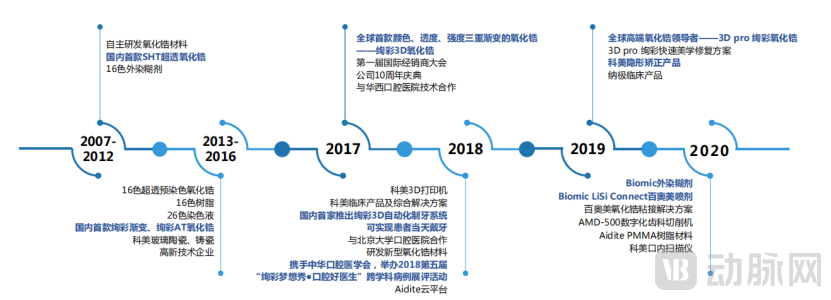
Aidite’s Development History (Image provided by Aidite)
However, when Aidite is mentioned, the first term that comes to mind for many industry professionals is still zirconia materials, which constitute the foundation of Aidite’s presence and success in the industry.
From 2007 to 2012, Aidite launched China's first SHT ultra-translucent zirconia material;
From 2013 to 2016, a series of products were launched, including 16-color ultra-translucent pre-shaded zirconia, the first vibrant color-mimicking gradient zirconia, and vibrant AT biomimetic anterior zirconia materials;
In 2017, Aidite launched the world’s first multi-layered 3D zirconia featuring triple gradients in color, translucency, and strength. In 2018, it successfully introduced China’s first multi-layered 3D automated tooth fabrication system, enabling same-day delivery of dentures to patients. The market launch of Aidite’s biomimetic multi-layered zirconia and its automated tooth fabrication solutions holds significant importance for the dental prosthetics manufacturing industry.
In 2019, Aidite once again launched a flagship product: the Xuancai 3D Pro zirconia material.
It is understood that Xuancai 3D Pro zirconia is a novel gradient zirconia material co-developed by Aidite and Peking University School of Stomatology. With a cervical strength of up to 1050 MPa, it employs infiltration technology to achieve a natural, layer-free triple gradient transition in strength, translucency, and color, thereby meeting the requirements of restorative materials for a wide range of indications.
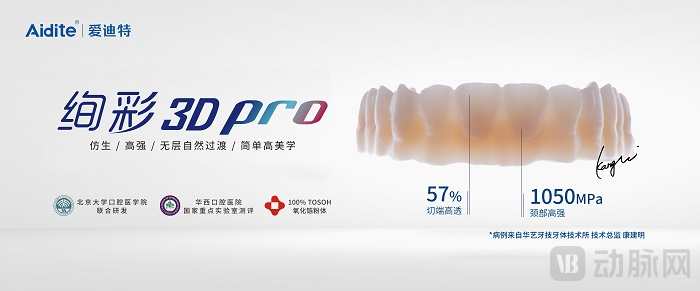
Aidite Colorful 3D Pro Zirconia Material (Image courtesy of Aidite)
But it is not just a zirconia material.
It is understood that Xuancolor 3Dpro zirconia features a proprietary shade guide, which eliminates the need to adjust the value and saturation of zirconia restorations after shading with traditional resin shade guides. This effectively shortens clinical fabrication time. Furthermore, when used in conjunction with Biomic external staining paste, it enables technicians to complete external staining in the simplest and fastest manner.
“What is certain is that Aidite is no longer synonymous with a simple zirconia material company; we have transformed into a digital enterprise,” said Li Hongwen.
It is worth noting that Aidite’s annual revenue growth rate and annual operating cash flow growth rate have both reached 50% in recent years, which may be attributed to its digital transformation.
It is understood that AIDITE’s current digitalization strategy is primarily reflected in two major business segments: one being laboratory products and solutions, and the other being clinical products and solutions.
Dental laboratory product solutions encompass digital materials—including zirconia, glass ceramics, and resin—CAD/CAM equipment, as well as comprehensive solutions such as the 3Dpro Vibrant Color Rapid Aesthetic Restoration Solution and the Digital Aesthetic Solution for Glass Ceramics.
Among these, the most noteworthy is the 3Dpro Vibrant Rapid Aesthetic Restoration Solution. Built on a foundation of high aesthetics, this solution utilizes the latest generation of 3D biomimetic vibrant zirconia materials combined with fully automated CAD/CAM equipment to streamline the fabrication process, enabling dental laboratories to achieve 24-hour rapid delivery of dentures.
Clinical products and solutions primarily include the NAGY Zero-Caries Program and the CAMEO Chairside Immediate Restoration System.
Among them, Aidite’s Kemei Chairside Immediate Restoration System is the most distinctive, leveraging computer-aided design (CAD) and computer numerical control (CNC) milling technologies to establish a digital dental clinic.Within this ecosystem, dentists can acquire digital intraoral impressions of patients using intraoral scanners. Following restorative design with visualization of the anticipated outcome, precise milling of tooth morphology, personalized staining, and sintering, they can obtain biomimetic, highly aesthetic all-ceramic restorations.
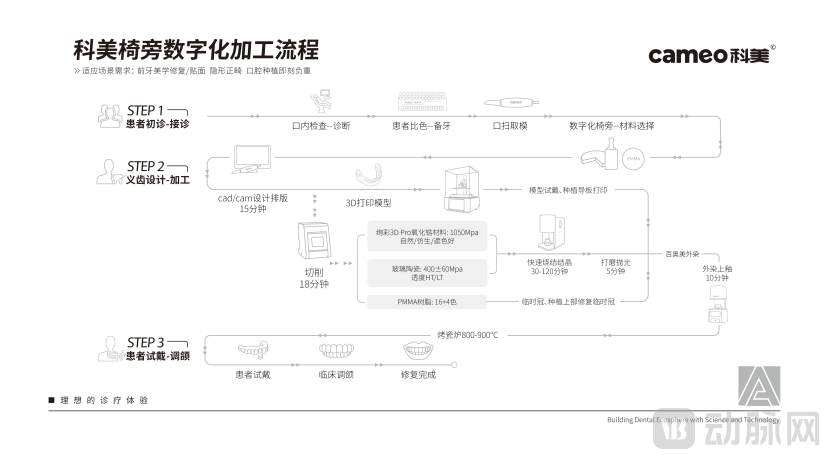
Schematic Diagram of Kemei’s Chairside Digital Processing Workflow (Image courtesy of Aidite)
Specifically,The chairside digital solutions built upon Kemei’s chairside equipment are mainly applied in two scenarios:
First, immediate restoration with Kemei technology: Through chairside CAD/CAM milling using Kemei systems, ultra-thin veneers as thin as 0.3 mm can be fabricated more rapidly and precisely. The Kemei all-ceramic restoration protocol requires minimal tooth preparation, offering excellent biocompatibility and favorable long-term outcomes. Furthermore, optical 3D true-color scanning for impression-taking simplifies the cumbersome steps of traditional impressions, helps avoid misdiagnosis, and enhances both clinical efficiency for dentists and the patient experience.
Second, dental implants and clear aligner orthodontics. The chairside fabrication of surgical guides for implants launched by Kemei features rapid production and low cost. Meanwhile, temporary crown and bridge restorations utilize Kemei’s gradient PMMA resin, enabling the rapid milling of precise temporary restorations with excellent aesthetic outcomes.
Overall, the CAMEO Chairside Immediate Restoration System encompasses a comprehensive suite of digital equipment and materials, complemented by premium clinical training programs. It maintains precision at the micron level throughout the entire workflow and leverages the high aesthetic advantages of CAMEO’s biomimetic, gradient digital materials to create a complete product-service closed loop. This system empowers dentists to overcome chairside operational bottlenecks, significantly enhancing patient visit efficiency and overall experience.
“At the dental laboratory level, Aidite’s current mission is to help small-scale processing facilities transition into digitalized processing centers. On the materials front, Aidite will leverage its material expertise to assist partners in pursuing digital transformation.”Li Hongwen concluded,“Similarly, Aidite has also implemented a digital strategy at the clinic level, leveraging its advantages in materials, technology, and equipment to empower clinics.”
“Although some products of certain companies have achieved good performance at present, this may not necessarily indicate that the company itself is particularly strong; it may simply be because it has positioned itself in a favorable market trend,” said Li Hongwen.The R&D of core technologies and materials is always the future of a company's development. Although focusing on R&D does not necessarily guarantee a future, failing to engage in R&D certainly means there is no future.
The primary reason lies in the vast market potential for dental materials.According to data from DENTSPLY, the global dental materials market reached $10 billion in 2012, when China’s denture production was approximately 86.5 million units, accounting for 60% of global output. However, the domestic market demand in China was RMB 4.35 billion.The Chinese dental materials market, dominated by dentures, is projected to reach RMB 12 billion by 2030.
Secondly, according to relevant research reports from Shenwan Hongyuan, the gross profit margin of dental equipment and instruments has long remained above 20%, and the market application scale of 3D printing in dentistry is growing rapidly, expected to increase from $353 million in 2013 to $3.571 billion in 2022.
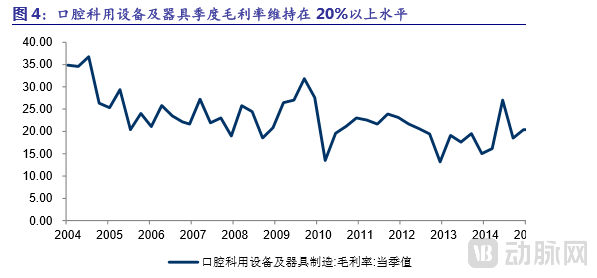
Historical Trend Chart of Gross Profit Margin for Dental Equipment and Instruments. Source: Shenwan Hongyuan’s Report on “Dental Aesthetics” in the Medical Aesthetics Series
Finally, in certain segments of the dental healthcare sector—including materials, technologies, and equipment—foreign brands continue to dominate, underscoring the urgent need for the rise of domestic brands.
“Although domestic brands have already achieved substitution for foreign brands on the laboratory technician side, a certain gap still exists between domestic and foreign brands on the clinical side due to higher requirements for quality, aesthetics, and workflow experience. Moreover, domestic brands indeed need to make further efforts in terms of integration and all-in-one solutions,” said Li Hongwen. “We hope that in the future, domestically developed products can fully replace foreign brands on the laboratory technician side, and that some high-end domestic products will emerge for clinical use.”
Since its inception, Aidite has remained dedicated to the research and development of zirconia materials, continuously developing related consumables, intelligent equipment, and new technologies centered on novel dental materials. To date, the company has secured numerous patents and undertaken multiple scientific and technological program projects over the past three years, establishing itself as a cornerstone of the industry in material and technological R&D.
ButThe development of new materials and technologies does not mean “working behind closed doors”; assessing future development trends is equally important.
In other words, only by making accurate judgments on development trends can we proceed with technological reserves and development.Developing industry-leading products that truly meet consumer needs is the path to sustainable development.
“For Aidite, only by crafting materials to the highest possible standard—achieving a level of excellence that physicians consider rare and highly sought-after—can such materials sustain their growth. This represents both an opportunity and a challenge,” stated Li Hongwen. He noted that Aidite continues to benchmark itself against international manufacturers, actively seeking partnerships to strive for a transition from catching up to surpassing its competitors.